In-Depth Guide to Comparing Payroll Services for Small Business
Why Payroll Services for Small Business Matter More Than You Think
Payroll services for small business handle employee compensation, tax calculations, and compliance so you can focus on running your company instead of wrestling with spreadsheets and government forms.
Quick comparison of payroll service options:
| Service Type | Best For | Starting Price | Key Features |
|---|---|---|---|
| Full-Service Payroll | Businesses with W-2 employees | Typically a monthly base fee plus a per-employee fee | Tax filings and payments, W-2s, benefits support, compliance tools |
| Contractor-Only Payroll | Freelancers and independent contractors | Typically a per-contractor monthly fee | 1099-NEC preparation and filing support, simplified payments |
| Dedicated Payroll Support | Growing businesses needing hands-on guidance | Typically higher monthly fees plus per-employee fees | Specialist support, compliance help, HR tools depending on plan |
Payroll is more than cutting checks. It means calculating wages correctly, withholding the right taxes, filing forms with multiple government agencies, and keeping detailed records for every pay period.
For creative entrepreneurs managing film productions or media projects, these administrative tasks pull you away from your actual work.
The stakes are high. Miss a tax deadline and you can face penalties. Miscalculate overtime and you can violate wage and hour laws. Lose employee records and you're unprepared for audits.
Modern payroll services automate these processes. They calculate overtime using state and federal rules, submit tax payments on your behalf, and generate year-end forms automatically. The best providers also offer employee self-service portals where your team can access pay stubs and update their information without bothering you.
For official guidance on federal payroll tax responsibilities, reference the IRS overview of employer payroll tax topics: IRS Employer's Tax Guide overview.
This guide compares payroll service approaches to help you choose the right solution for your business size, budget, and specific needs.
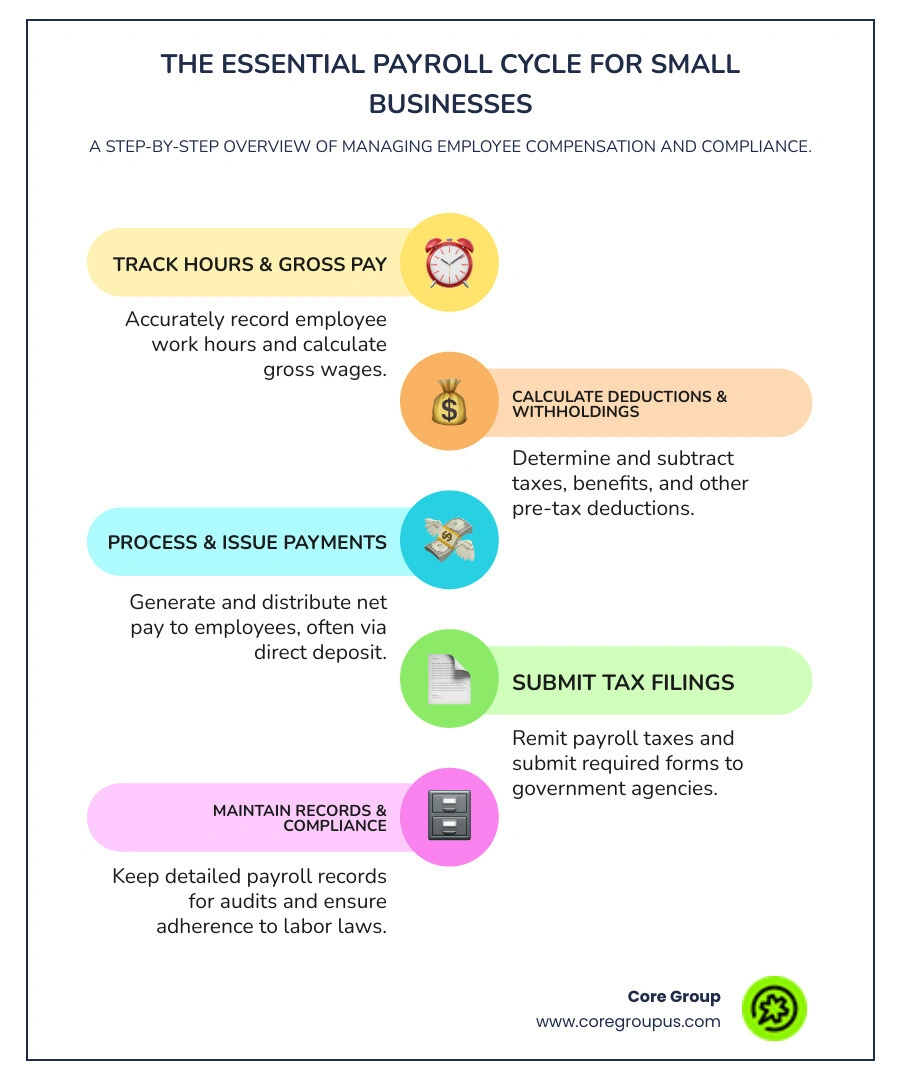
Payroll services for small business word roundup:
What Makes Up Payroll Services for Small Business
At its core, payroll is the process of compensating your employees for their hard work. But for a small business owner, it's far more intricate than just writing a check. It involves a series of critical steps to ensure your team is paid accurately and on time, while also keeping your business compliant with a myriad of regulations.
The fundamental components of a robust payroll service include:
Wage calculations: This is where it all begins. A payroll service accurately calculates gross wages for each employee, whether they're hourly, salaried, or paid by commission. This means tracking work hours, applying different pay rates, and factoring in overtime, bonuses, or tips.
Tax withholdings and deductions: This is often the most complex part. Payroll services help calculate and apply federal, state, and local income tax withholdings, as well as Social Security and Medicare contributions (FICA), based on the information you provide and current rules. Beyond taxes, they also manage other deductions like health insurance premiums, retirement plan contributions, garnishments, and more.
Issuing payments: Once wages and deductions are calculated, the service issues payments. This typically involves direct deposit, which is convenient for both you and your employees.
Maintaining detailed records: Every pay period generates data that must be carefully recorded and stored. This includes pay stubs, time worked, tax deductions, and other payroll-related information for each employee. These records are vital for internal accounting, tax filings, and potential audits.
Filing required tax forms: Payroll isn't complete until required returns are prepared and filed. Services can help with the preparation and submission of necessary tax forms, both quarterly and annually. This commonly includes federal forms like 940 and 941, state unemployment tax forms, and year-end forms like W-2s for employees and 1099-NECs for contractors.
Beyond these core functions, modern payroll services for small businesses can extend to managing benefits, supporting compliance with wage and hour rules (like minimum wage and overtime requirements), and producing accurate reports for your books.
To learn more about how we can simplify these processes for your business, explore our Payroll Services Made Simple or find our comprehensive Payroll Solutions for Small Business.
How Professional Payroll Services Support Compliance and Save Time
Running a small business is a juggling act, and payroll can feel like an entire circus act on its own. This is precisely where professional payroll services for small business shine, offering invaluable support in maintaining compliance and reclaiming your precious time.
Saving Time and Reducing Errors:Imagine automating the tedious tasks that eat up your week. Payroll services do just that. They calculate pay, handle tax deductions, and file payroll taxes for you, so you spend less time on admin and more time running your business. This automation drastically reduces the chances of human error, which can be costly in terms of penalties and employee dissatisfaction.
Consider these time-saving benefits:
- Automated Calculations: No more manual calculations for wages, overtime, or deductions. Systems are pre-set to handle these complexities, including specific state rules for overtime.
- Streamlined Processes: From time tracking to direct deposit, the entire payroll workflow is streamlined. You can run payroll in a matter of minutes, not hours, through user-friendly dashboards or mobile apps.
- Employee Self-Service: Many services offer built-in employee self-service portals. This means your team can easily access pay information, update personal details, or view their W-2s, saving you from answering repetitive questions and reducing administrative burden.
Ensuring Compliance:Compliance is arguably the most critical aspect of payroll. Federal, state, and local labor laws and tax regulations are constantly changing, and staying on top of them can feel like a full-time job. A professional payroll service acts as your compliance co-pilot.
Key compliance aspects payroll services handle:
- Up-to-Date Tax Laws: Services stay updated on changing tax laws and regulations across all US states, ensuring your deductions and filings are always correct. This prevents costly mistakes before they happen.
- Wage and Hour Laws: They ensure you adhere to federal and state minimum wage laws, overtime rules, and other wage-related regulations. For example, auto overtime calculations are a standard feature, ensuring you're always on the right side of the law.
- Remittance Submission: Accurate and timely submission of tax remittances to government agencies is crucial. Payroll services manage this process, ensuring your business avoids penalties.
- Compliance and Audit Support: Many services include compliance and audit support, giving you peace of mind that your operations adhere to all federal, state, and local regulations. If an audit comes knocking, you’ll have expert help and carefully maintained records.
- Year-End Filings: The burden of preparing and filing W-2s and 1099-NECs at year-end is lifted, as services automate these crucial tasks.
By offloading these responsibilities to a dedicated payroll service, you gain not just time, but also the confidence that your payroll is accurate and fully compliant. It frees up your schedule, allowing you to focus on growing your business and pursuing your passion as a creative entrepreneur.
For a deeper dive into how these services can transform your business operations, check out our insights on Learn more about payroll and HR services and our detailed guide on Payroll Tax Information.
Key Features to Look for When Choosing a Payroll Provider
Choosing the right payroll services for small business can feel overwhelming, but focusing on key features custom to your needs will simplify the decision. For creative entrepreneurs, a service that integrates seamlessly with your existing workflow, ensures compliance, and offers flexibility is paramount.
Here are the essential features we recommend looking for:
- Direct Deposit: This is a non-negotiable convenience. Direct deposit ensures your employees receive their paychecks quickly and securely, often within one to two business days. Some providers even offer instant payments, using funds from your business balance for even faster turnaround.
- Support for Multiple States: If your team is remote or your business operates across state lines (e.g., you have employees in Texas and California), multi-state payroll capabilities are crucial. Look for services that can handle tax calculations for various states and localities, and correctly pay unemployment tax to employees’ home states.
- Benefits Administration: Modern payroll services go beyond just paychecks. Many offer integrated benefits solutions, allowing you to easily manage and enroll your team in medical, dental, and vision plans. Some even provide options for modern retirement plans with transparent pricing, supporting your team's long-term financial well-being.
- Employee Self-Service: Empowering your employees to access their pay information, update personal details, and manage their own data through a secure portal saves you significant administrative time and reduces errors.
- Time Tracking Integration: For hourly employees, seamless integration with time tracking systems (like a POS system) is a huge time-saver. This allows for automatic import of timecards, tips, and commission rates directly into payroll, making pay runs faster and more accurate.
- Unlimited Pay Runs and Off-Cycle Payments: Flexibility is key. Ensure your chosen service allows for unlimited pay runs per month and the ability to process off-cycle payments (for bonuses or corrections) without incurring extra costs.
- Dedicated Support: While automation is great, sometimes you need to talk to a human. Look for providers that offer live support from payroll specialists or even provide a dedicated accountant or payroll manager who understands your unique business needs. This personalized support can be invaluable.
- No Long-Term Contracts: As a small business, flexibility is vital. Opt for services that offer month-to-month plans with no long-term commitments, allowing you to cancel anytime.
Automated Tax Filings with Payroll Services for Small Business
One of the biggest headaches for small business owners is navigating the labyrinth of tax filings and government remittances. This is where professional payroll services for small business truly earn their keep, automating these complex and time-sensitive tasks.
Services ensure your business remains compliant by handling:
- Federal and State Remittances: They automatically calculate and submit your federal and state payroll taxes (including income tax, Social Security, and Medicare) on your behalf. This includes ongoing state and federal tax filings, both quarterly and annually.
- Tax Registration Guidance: For new businesses or those expanding into new states, many providers offer guidance with state tax registration, ensuring you're set up correctly from the start.
- Year-End W-2 and 1099-NEC Forms: The dreaded year-end paperwork becomes a breeze. Payroll services automatically generate, prepare, and file W-2 forms for your employees and 1099-NEC forms for your contractors, ensuring accuracy and timely submission.
- Compliance and Audit Support: With accuracy guarantees for payroll tax forms and included compliance and audit support, you can rest assured that your operations adhere to all federal, state, and local regulations. If you're ever out of compliance, they can even help you get back on track.
Navigating these tax requirements can be daunting, but with a dedicated service, you don't have to tackle this task alone. We have resources available, such as our Hiring Employees Guide, to help you understand the tax steps when you decide it's time to start hiring.
Security Features in Payroll Services for Small Business
In today's digital landscape, protecting sensitive financial and personal data is paramount. When evaluating payroll services for small business, the security measures offered should be a top priority. After all, payroll involves highly confidential information for both your business and your employees.
Reputable payroll providers implement robust security protocols to safeguard this data:
- Data Encryption: All sensitive information, from employee bank details to tax identification numbers, should be encrypted both in transit and at rest. This means that if data were ever intercepted, it would be unreadable.
- Fraud Prevention: Providers employ sophisticated systems to detect and prevent fraudulent activities, protecting your business from unauthorized transactions or data breaches. This often includes multiple layers of verification and monitoring.
- Identity Verification: To prevent unauthorized access, strong identity verification measures are in place for both business owners and employees. This ensures that only authorized individuals can access payroll accounts or sensitive information.
- Secure Employee Portals: Employee self-service portals are designed with security in mind, offering secure logins and encrypted access to personal pay information and documents. This allows employees to manage their details confidentially.
- Dedicated Security Teams: Leading payroll services often have dedicated security organizations that continuously monitor and update their systems to combat evolving cyber threats. They help ensure that your and your employees’ data is safe and secure.
- Compliance with Data Protection Regulations: Providers adhere to strict data protection regulations, ensuring that sensitive information is handled in accordance with legal requirements.
By entrusting your payroll to a service with comprehensive security features, you protect your business from potential fraud, data breaches, and the legal ramifications that can follow. It's about securing peace of mind for you and your team.
For more insights into managing your team and their data securely, explore our resources on More about HR and payroll for small business.
Understanding Pricing and Software Integration
When considering payroll services for small business, understanding the pricing models and how they integrate with your existing business tools is crucial for both your budget and operational efficiency. We believe in a profit-first approach, and that starts with clear financial planning.
Typical pricing models:Payroll service pricing usually follows a combination of a base monthly fee and a per-employee charge.
- Base monthly fee: This is a fixed fee that covers the core service, regardless of the number of employees.
- Per-employee charges: In addition to the base fee, you'll typically pay an extra amount per employee (often monthly or per pay run, depending on the provider).
- Contractor-only pricing: If you primarily work with contractors, some services offer a more streamlined, lower-cost option focused on contractor payments and year-end 1099-NEC reporting.
- Setup fees: Some providers charge a one-time fee to get started.
- Tiered plans: Many providers offer different service tiers (Basic, Plus, Premium) with varying features and corresponding price points.
- Flexible contracts: Look for services that offer month-to-month plans with no long-term commitment, allowing you to cancel anytime.
Software integration:The true power of modern payroll services lies in their ability to integrate with your other business tools. This connectivity saves time, reduces data entry, and helps ensure accuracy across your financial ecosystem.
- Accounting software: Syncing with your accounting software can automatically transfer payroll totals, making bookkeeping easier and keeping your financial records up to date.
- Time tracking tools: For hourly employees, integration with time tracking can reduce manual entry and make payroll runs faster and more accurate.
- HR and benefits platforms: Many payroll services offer integrated HR tools and benefits administration, creating a more unified workflow for hiring, onboarding, and ongoing team management.
By carefully considering both the pricing structure and the integration capabilities, you can select a payroll services for small business solution that fits your budget and improves your operational efficiency. For more insights into optimizing your financial systems, especially for creative ventures, check out our Bookkeeping for Agencies: The Ultimate Guide.
Frequently Asked Questions about Payroll Management
We understand that navigating payroll can bring up a lot of questions. Here, we address some of the most common concerns small businesses have about payroll services, offering clear and concise answers.
What is the difference between full service and contractor only payroll?
The main difference lies in who you're paying and the associated legal and tax requirements.
Full-service payroll: This option is designed for businesses with W-2 employees. It supports payroll processing, including calculating gross wages, managing withholdings and deductions, and helping with required filings such as quarterly payroll tax returns and annual W-2s. It also helps you stay aligned with wage and hour rules that apply to employees.
Contractor-only payroll: This option is for businesses that primarily work with 1099 contractors. Contractors are generally responsible for their own income tax payments, so you typically do not withhold income tax or FICA from contractor payments. Contractor-focused payroll tools simplify payments and support year-end Form 1099-NEC reporting.
Many providers offer both, with contractor-only options typically being more affordable due to fewer ongoing payroll tax and compliance requirements.
How do payroll services handle multi state tax requirements?
Managing payroll for employees across different states can be complex due to varying tax laws, unemployment insurance rules, and local regulations. Professional payroll services for small business are built to help handle these requirements.
Here's how they commonly address multi-state tax requirements:
- Automated tax calculations: Services calculate the correct federal, state, and local taxes based on each employee's work location and residency settings.
- State-specific compliance support: They stay updated on filing requirements for each state where your employees work.
- Location tracking: You can set up locations spanning multiple states and localities within the payroll system so filings and payments route properly.
- Streamlined filings: The service can prepare and file necessary payroll tax forms with the correct agencies on the right schedule.
This functionality is important for businesses with remote teams or multiple locations across the US.
Is a payroll service worth the cost for a single employee?
Yes, it often can be. Even with one employee, you still have tax deadlines, withholding requirements, and filing obligations at the federal and (usually) state levels.
Here are a few reasons a payroll service may be worth it even for a single employee:
- Compliance support: Payroll services can help you stay on track with payroll tax filings and reduce the risk of costly penalties.
- Time savings: Outsourcing payroll frees you from manual calculations, payments, and paperwork.
- Cleaner bookkeeping: Payroll entries and reports make it easier to keep your books accurate.
- Audit readiness: Organized payroll records help if you ever need to respond to a notice or audit.
For many small business owners, the peace of mind and time saved justifies the monthly cost.
Conclusion
Navigating the complexities of payroll can be one of the most demanding aspects of running a small business, especially for creative entrepreneurs who are passionate about their craft, not paperwork. We hope this guide has illuminated the profound benefits that professional payroll services for small business can offer, from ensuring compliance and automating tedious tasks to freeing up your valuable time.
By choosing the right payroll partner, you're not just outsourcing a task; you're investing in accuracy, efficiency, and peace of mind. Imagine a world where you don't have to worry about tax deadlines, changing state regulations, or calculating overtime. Instead, you can channel your energy into developing new projects, nurturing client relationships, and growing your creative vision.

At Core Group, we understand the unique needs of creative entrepreneurs. Our "no-fluff, profit-first playbook" is designed to simplify your financial management, guaranteeing peace of mind and saving you time. We believe in providing solutions that allow you to focus on what you do best, backed by our commitment to your success. With us, you get the expert support you need, so you can stop wrestling with spreadsheets and start producing your next masterpiece.
Ready to reclaim your time and ensure your payroll is handled with precision and care?Get started with expert payroll resources