Payroll Direct Deposit: Everything Employers and Employees Need to Know
Understanding How Direct Deposit Functions
The payroll direct deposit system relies on the Automated Clearing House network, a secure electronic payment infrastructure that coordinates transactions between US financial institutions. Instead of printing physical paper paychecks, folding them into envelopes, and physically handing them to your staff, your business sends an electronic file containing payment instructions to your business bank account. Your bank acts as the originating financial institution and routes those instructions through the clearinghouse to the employee receiving bank.
When an employer processes payroll, funds move quietly behind the scenes. On payday, net wages appear directly in employee checking or savings accounts, while detailed digital pay stubs remain accessible through employee self service portals or secure email. Modern banking networks batch these transfers in organized groups, ensuring rapid processing while maintaining bank-grade security protocols across every step of the transaction chain. Using modern tools detailed in our payroll guide for small business owners, managing this transition is surprisingly straightforward.

Benefits of Payroll Direct Deposit for Business Owners and Staff
Eliminating paper paychecks yields massive operational advantages for growing businesses. Physical checks represent a huge fraud risk because they display your corporate routing and account numbers clearly on the bottom of every slip of paper. Transitioning to direct deposit drastically reduces check tampering and identity theft risks by keeping sensitive financial credentials within encrypted banking channels.
For staff members, direct deposit delivers instant access to hard-earned pay without taking lunch breaks to line up at bank teller windows or paying expensive check-cashing fees. Employees also gain the flexibility to split single paychecks across multiple accounts, making personal budgeting and automatic savings allocation seamless. For business owners, direct deposit stabilizes cash flow. Paper checks create unpredictable financial drag when staff wait days or weeks to deposit them. Electronic transfers process on a predictable schedule, giving you absolute clarity over cash balance updates and payroll reconciliation.
How to Set Up Payroll Direct Deposit Step by Step
Setting up payroll direct deposit requires setting clear administrative foundation steps. First, choose an administrative platform or partner with a financial advisor to handle electronic clearing. Once your business banking credentials connect to your software stack, you can gather setup documentation during standard onboarding workflows. Establishing these routines early prevents administrative bottlenecks down the road. You can explore complete setup protocols in our detailed breakdown of small business direct deposit.
Essential Information Needed for Payroll Direct Deposit Setup
To initialize electronic deposits for team members safely, keep a standardized list of required employee details in your onboarding workflow
- Nine-digit ABA bank routing transit number
- Individual checking or savings account number
- Explicit account type designation (checking vs. savings)
- Legal account holder full name matching bank records
- Signed employee direct deposit authorization form
- Voided physical check or formal bank verification letter
Requesting a voided check or official bank verification letter is a critical fraud prevention step. Deposit slips are notoriously unreliable for setup because they occasionally display internal routing numbers intended for direct deposits at specific branch counters rather than general ACH clearing networks. Having employees double-check these details during onboarding keeps the entire payment ecosystem running smoothly.
Common Direct Deposit Errors and How to Prevent Them
Clerical typos are the primary cause of failed electronic transfers. Transposing two numbers in an account field causes bank transfers to bounce back, delaying employee pay and creating extra work for payroll managers.
When a direct deposit fails due to incorrect account details, the receiving bank rejects the transaction and sends an automated return notification. In compliance with national network policies, employers can issue a formal ACH reversal request within five business days of the initial transaction date if an overpayment or clerical error occurs. To eliminate manual errors, implement strong internal controls such as double-checking numbers against voided checks, requiring self-service employee entry, or establishing two-step administrative approval before finalizing payroll files.
NACHA Files Prenotification and Processing Timelines
Electronic transactions move according to standardized banking clearing calendars. Federal guidelines require payroll transmittal files to be submitted at least two business days prior to the effective payroll settlement date. Planning ahead for holidays and weekends is vital to ensure funds arrive right on schedule.

If your payday is Friday, your payroll transmittal file must be generated, reviewed, and transmitted no later than Wednesday morning. Standard clearing times range from one to three business days, though funds typically show up as fully settled in employee accounts by 9:00 a.m. on the designated payday. Off-cycle payments or urgent corrections made outside standard lead times may require separate processing steps or wire transfers.
Generating NACHA Files for Automated Payroll Transfers
A NACHA file is a standardized text file formatted to meet strict banking network parameters governed by the National Automated Clearing House Association. These files package payment instructions into standard lines containing Prearranged Payment and Deposit (PPD) entry codes along with detail records for each recipient.
Most enterprise systems follow structured data rules, like those detailed in Oracle Direct Deposit Technical Documentation. When your system exports a NACHA file, it formats company identifiers, individual bank routing coordinates, payment amounts, and transaction codes into unified blocks that your bank treasury system can read seamlessly and process automatically.
Purpose of Prenotification and Test Transactions
Before sending an employee full net paycheck across banking networks, running a test transaction is best practice. This verification step is known as prenotification (or a prenote).
A prenotification is a zero-dollar transaction submitted through the ACH network to test whether the provided routing and account numbers are active and valid.
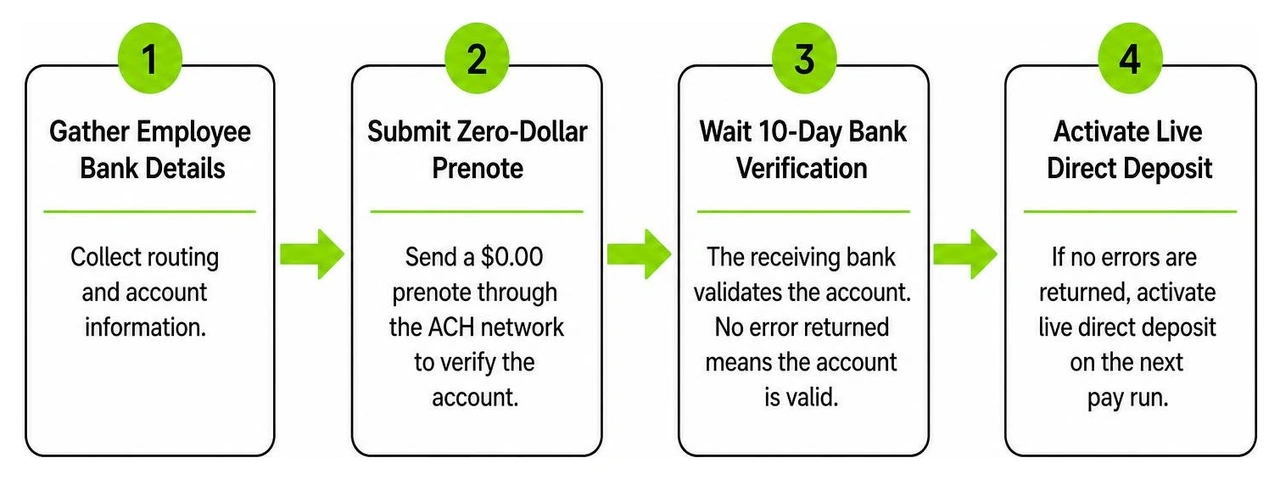
As described in the Oracle System Setup Guide, the prenote process generally incorporates a waiting period of about ten business days. During this window, the receiving financial institution verifies account status. If no error alerts return, live direct deposit starts safely on the subsequent pay run. During the prenote testing phase, employees typically receive a standard paper check to ensure they are paid on time without delay.
Compliance Rules Costs and Mandatory Direct Deposit Requirements
Running electronic payroll requires sticking strictly to federal rules and state labor regulations. Beyond system setup, business leaders must handle data privacy, wage payment compliance, and banking cost management smoothly. Maintaining organized record-keeping practices protects your company during audits. For deeper compliance strategies, check out our guide on payroll tax compliance.
Cost Breakdown Comparing Electronic Transfers and Paper Checks
The financial case for choosing ACH electronic transfers over printed paper paychecks is overwhelmingly clear.
| Payment Method | Transaction Fee Range | Printing & Supplies Cost | Estimated Admin Cost | Total Average Cost Per Item |
|---|---|---|---|---|
| Paper Paycheck | $0.50 to $1.00 | $0.25 to $0.50 | $0.26 to $0.80 | $1.01 to $2.30 |
| ACH Direct Deposit | $0.26 to $0.50 | $0.00 | $0.05 to $0.15 | $0.31 to $0.65 |
Moving from paper checks to electronic direct deposit slashes your administrative overhead while eliminating check stock expenses, printer toner, postage, and manual reconciliation time.
Legal Compliance and State Mandate Standards
Federal standards allow employers to make direct deposit mandatory for staff, provided workers can choose which financial institution receives their pay. However, state labor regulations vary widely across the US and must be reviewed carefully.
Certain state labor laws prohibit employers from compelling workers to use direct deposit. In these jurisdictions, employers must offer easy opt-out choices, such as traditional paper checks or electronic payroll cards (pay cards), without charging employees service fees to access their wages. Always store signed written or digital authorization records in secure employee files to ensure complete audit compliance and maintain trust across your team.
Frequently Asked Questions
How long does it take for direct deposit funds to become available?
Standard ACH direct deposit processing takes one to three business days to clear completely. As long as payroll transmittal files are submitted before your bank daily processing cutoff time (typically two business days prior to payday), funds are generally available in employee accounts by 9:00 a.m. local time on payday morning.
Can an employer require staff members to use direct deposit?
Yes, under federal law, employers can mandate direct deposit as long as employees can choose their own bank. However, individual state wage payment laws dictate whether you can enforce mandatory electronic payments. In many states, you must offer employees an alternative payment option, such as a paper check or a pay card.
What happens when payday falls on a weekend or bank holiday?
Because the ACH network does not process transactions on weekends or federal banking holidays, scheduled paydays landing on non-business days must be adjusted. Employers generally adjust their submission timelines to process payroll one business day early, ensuring staff receive their funds on the business day immediately preceding the weekend or holiday.
Conclusion
Mastering payroll direct deposit simplifies operations, strengthens payment security, and guarantees your team gets paid reliably every time. Transitioning from manual paper checks to streamlined electronic transfers saves time, lowers operating costs, and eliminates administrative headaches.
At Core Group, we help creative entrepreneurs streamline their finances, optimize cash flow, and build stable, profitable businesses. Our no-fluff profit playbook gives you total peace of mind, freeing you up to focus on the creative work you love. Reach out to our team today or explore our complete payroll services small business guide to elevate your business operations.