Top Payroll HR Services for Small Business
Why Managing Payroll and HR Doesn't Have to Consume Your Creative Energy

Payroll hr services small business solutions handle the complex tasks of paying your team, managing taxes, and staying compliant—so you can focus on your creative work instead of drowning in paperwork.
Quick Answer: What You Need to Know
Payroll and HR services for small businesses typically include:
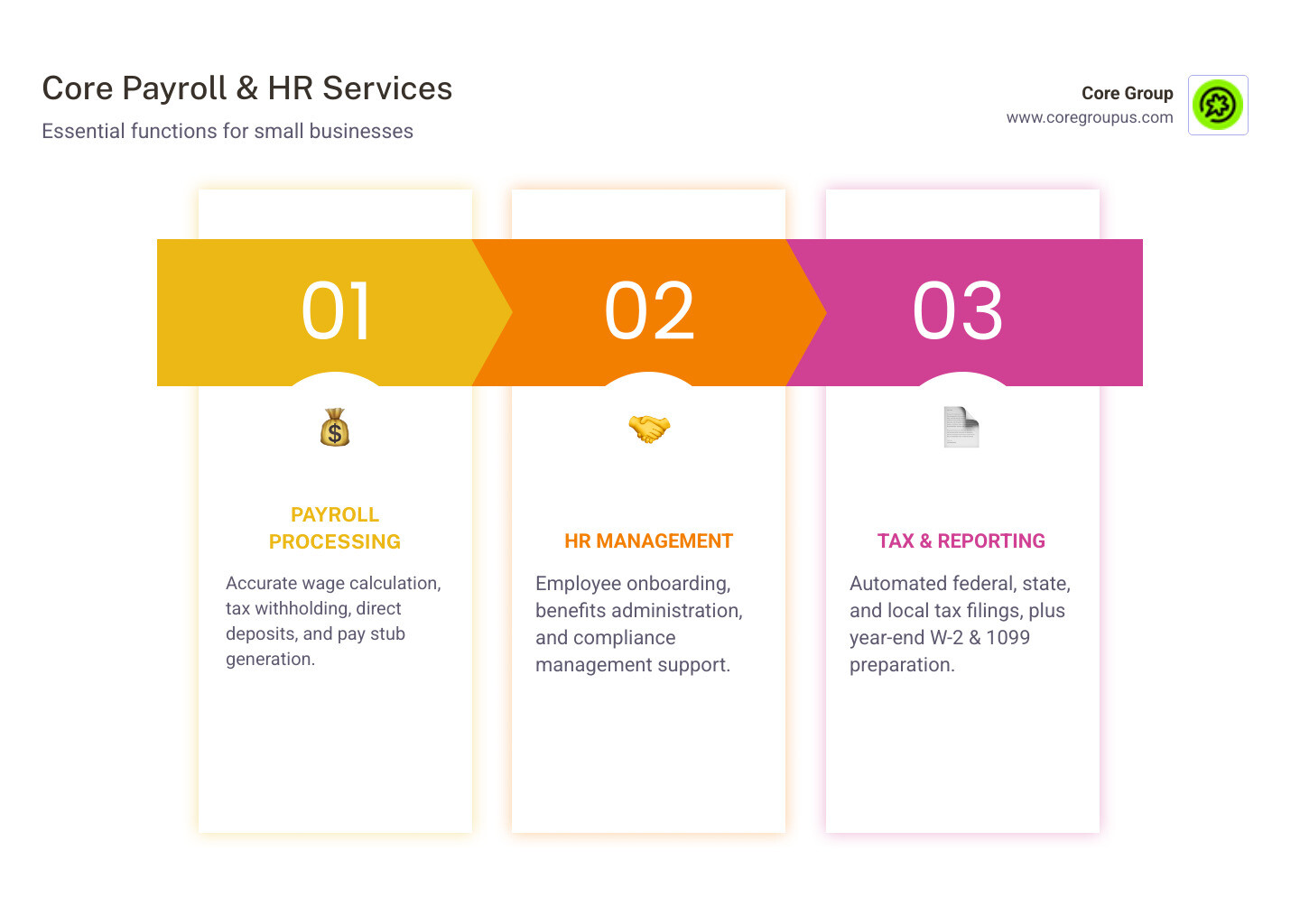
- Payroll Processing: Wage calculations, tax withholdings, direct deposit, and pay stubs
- Tax Compliance: Automated federal, state, and local tax filings and payments
- Year-End Reporting: W-2 and 1099 form creation and IRS e-filing
- HR Support: Employee onboarding, benefits administration, and compliance management
- Self-Service Tools: Employee portals for accessing pay stubs and updating information
- Typical Cost: Starting around $39-$79 per month plus $5-$10 per employee
As a creative entrepreneur, you didn't start your business to become an expert in payroll tax codes or employment law. Yet here you are, spending hours tracking employee hours, calculating wages, and worrying about compliance penalties.
You're not alone. Many small business owners initially try to manage payroll themselves, only to find it becomes unfeasible as their business grows. The stakes are high—tax penalties from payroll errors can be expensive, and mistakes can damage employee trust.
The good news? Modern payroll and HR services have evolved specifically for businesses like yours. They automate the tedious work, guarantee tax accuracy, and give you back the time you need to focus on what you do best.
Saving time is one of the primary reasons small businesses use payroll software. It also provides peace of mind that employees will be paid quickly and accurately via their preferred method of payment.
Whether you're paying your first employee or managing a growing team, the right payroll and HR solution can transform one of your biggest administrative headaches into a streamlined, automated process that just works.
Why Your Small Business Needs Integrated Payroll and HR Services
As creative entrepreneurs, your passion is your craft, not wading through tax forms or deciphering complex labor laws. Yet, managing a team, even a small one, comes with significant administrative responsibilities. This is where integrated payroll hr services small business solutions become invaluable. They're not just about cutting checks; they're about safeguarding your business, saving you precious time, and fostering a happy, compliant workforce.

One of the most compelling reasons small businesses turn to specialized services is the sheer amount of time saved. Imagine reclaiming those hours spent tracking employee attendance, calculating wages, and ensuring correct deductions. This time isn't just "free" time; it's time you can reinvest into revenue-generating activities, perfecting your product, or connecting with your clients. As one source highlighted, "Saving time is one of the primary reasons small businesses use payroll software." It provides the peace of mind that your employees will be paid accurately and on time, every time.
Beyond time savings, these services act as a crucial shield against costly errors and penalties. Tax penalties and fines resulting from payroll errors can be incredibly expensive for small businesses. By automating calculations, payments, and filings, payroll software significantly minimizes or even eliminates these mistakes, potentially saving you a substantial amount of money. We understand that navigating federal, state, and local payroll tax compliance can feel like a minefield, especially with regulations constantly changing. Dedicated services ensure your business remains compliant, taking that burden off your shoulders.
Moreover, a well-managed payroll and HR system contributes directly to employee satisfaction. When employees are paid accurately and on schedule, and have easy access to their pay stubs and HR information, it builds trust and demonstrates your commitment to their well-being. This, in turn, allows you to focus on nurturing your team and growing your business, rather than getting bogged down in administrative minutiae. For more insights on this synergy, explore our thoughts on HR and Payroll for Small Business.
Core Components of Payroll & HR Services for Small Business
Understanding what constitutes comprehensive payroll hr services small business is key to choosing the right partner. These services go far beyond simply processing payments, encompassing a wide array of features designed to streamline your operations and ensure compliance.
Essential Payroll Functions
At its heart, payroll is about ensuring your team is paid correctly and on time. The core functions provided by modern payroll services are robust:
- Wage Calculation: This involves accurately calculating gross wages based on hours worked, salary, and any commissions or bonuses. This can be complex, especially with varying pay rates or overtime.
- Tax Withholding: A critical component, this ensures the correct amounts for federal, state, and local income taxes, Social Security, and Medicare are withheld from each paycheck. Errors here can lead to significant penalties.
- Direct Deposit: Most services offer direct deposit, allowing employees to receive their pay directly into their bank accounts, eliminating the need for paper checks and trips to the bank. Some even offer payroll debit cards as an alternative.
- Pay Stubs: Services generate detailed pay stubs, accessible electronically through employee portals or as printed statements, which clearly outline earnings, deductions, and net pay.
- Payroll Reporting: Comprehensive services provide customizable payroll reports that offer valuable insights. These reports can cover multiple worksites, payroll deductions and contributions, payroll tax liability, time activities, vacation and sick leave, and workers’ compensation. They are essential for financial planning and for sharing with your accountant. For a deeper dive into managing your finances, check out our Accounting resources.
- Year-End W-2 & 1099 Preparation: Come tax season, services automatically generate, deliver, and e-file W-2 forms for employees and 1099 forms for contractors with the IRS on your behalf, ensuring compliance and saving you the headache of manual preparation.
Key HR Service Integrations
The "HR" in payroll hr services small business isn't just an add-on; it's a vital integration that helps you manage your most valuable asset: your people.
- Employee Onboarding: Streamlining the process of bringing new hires into your company, from paperwork to setting up payroll and benefits.
- Benefits Administration: Managing health insurance, retirement plans (like 401(k)s), and other employee benefits. This can include tracking and ensuring compliance with regulations like the Affordable Care Act (ACA).
- Workers' Compensation: Many payroll services offer assistance with workers' compensation, sometimes even integrating payment services directly with payroll, which can simplify managing this crucial insurance aspect.
- Time Tracking: Integrated timekeeping solutions allow employees to clock in and out easily, feeding directly into payroll calculations and ensuring accurate wage payments.
- Employee Self-Service Portals: These portals empower employees to access their pay statements, update contact information, and manage their withholdings independently, reducing administrative requests for you.
When considering a full-service HR solution, you might encounter Professional Employer Organization (PEO) services. A PEO acts as a co-employer, handling a wide range of HR tasks, including benefits, payroll, and compliance, often providing access to better benefits packages due to their larger employee pool. To learn more about comprehensive HR solutions, including PEOs, visit our Professional Employer Organization services page.
Managing Taxes and Compliance with payroll hr services small business
For small businesses, tax and compliance management can be one of the most daunting aspects of payroll. The risk of error and the associated penalties are significant. This is where dedicated services truly shine.
- Automated Tax Filing: Services automate the calculation, payment, and filing of all federal, state, and local payroll taxes. This includes managing tax deposits and ensuring they are made accurately and on time.
- Federal Tax Compliance: Navigating IRS regulations, such as those related to income tax, FICA (Social Security and Medicare), and unemployment taxes, is complex. Payroll services ensure your business adheres to these federal mandates.
- State & Local Tax Rules: Beyond federal requirements, each state and many local jurisdictions have their own payroll tax laws, unemployment insurance rates, and reporting requirements. A good service will manage these specific regional nuances for your business, no matter which of the 50 states you operate in.
- Regulation Changes: Payroll and HR regulations are constantly changing. Services stay up-to-date with the latest laws, ensuring your business remains compliant without you having to be a legal scholar.
- Reporting Agent Authorization (Form 8655): When you partner with a payroll service, they often require you to complete Form 8655, Reporting Agent Authorization. This form notifies the IRS that the service provider is authorized to act on your behalf for payroll tax matters, further simplifying your responsibilities.
By entrusting these complex tasks to experts, you gain peace of mind knowing that your tax obligations are being met accurately and on time. This proactive approach to compliance is a cornerstone of smart financial planning. Explore more about strategic financial guidance on our Tax Planning page.
Choosing the Right Solution: In-House vs. Outsourcing
Deciding how to manage your payroll and HR functions is a pivotal choice for any small business. It boils down to two main approaches: keeping it in-house or outsourcing to a dedicated service provider. Each has its own set of advantages and disadvantages.
| Feature | In-House Payroll | Outsourced Service |
|---|---|---|
| Control | High (direct oversight) | Moderate (provider manages, you oversee) |
| Cost | Lower direct software/service fees, higher labor | Higher direct service fees, lower labor |
| Time Commitment | High (manual processing, research, learning) | Low (provider handles tasks) |
| Compliance Risk | High (reliance on internal knowledge, prone to error) | Low (provider ensures compliance, often guaranteed) |
| Scalability | Difficult (requires more staff/training as you grow) | Easy (provider scales with your business) |
The DIY Approach: In-House Payroll
For many creative entrepreneurs, especially those just starting out or with a single employee, the idea of managing payroll themselves might seem appealing. It offers full control over the process, and initially, the direct costs for basic payroll software might appear lower than a full-service provider.
However, the "DIY" approach comes with significant caveats. It demands a high time investment. As one source noted, "Initially, the owner might manage it, but this becomes unfeasible" as the business grows. You're responsible for tracking hours, calculating wages, deducting taxes, depositing funds, filing returns, and issuing year-end forms like W-2s. This manual process is prone to errors, which can lead to costly tax penalties and fines. For a small business with limited resources, the risk associated with these errors can be substantial.
While it might work for a solo entrepreneur or a very small team with simple payroll needs, the complexity quickly escalates with more employees, varying pay structures, or benefits. It's often best suited for businesses where the owner has a strong financial background and ample time to dedicate to administrative tasks. At Core Group, we understand the unique challenges faced by creative entrepreneurs. To see if the DIY approach aligns with your business stage, consider Who We Help.
The Expert Approach: Outsourcing payroll hr services small business
Outsourcing your payroll hr services small business is akin to hiring a team of experts without the overhead. This approach offers significant benefits, particularly as your business grows and its needs become more complex.
- Expert Support and Guaranteed Compliance: Outsourced providers specialize in payroll and HR. They stay abreast of ever-changing federal, state, and local regulations. Many even offer 100% accuracy guarantees on tax forms, effectively transferring the compliance risk from your shoulders to theirs. This includes managing intricate aspects like state tax registration guidance and ensuring proper handling of contractor payouts and deductions.
- Scalability: As your business expands, an outsourced service can easily accommodate more employees or more complex pay structures without you needing to invest in additional software, training, or staff.
- PEO vs. ASO Models: Outsourcing isn't a one-size-fits-all solution. You have options like:
- Payroll Service Providers: Focus primarily on payroll processing, tax filing, and basic HR administrative tasks.
- Administrative Services Organizations (ASOs): Offer broader HR support, including benefits administration, but you retain full employer liability.
- Professional Employer Organizations (PEOs): A full-service solution where the PEO becomes a co-employer, handling payroll, benefits, HR administration, and compliance. This model can give small businesses access to better benefits packages and robust HR support that they might not otherwise be able to afford. A full-service PEO, for example, covers HR administration, benefits, payroll & tax, compliance, and talent management.
By choosing to outsource, you free yourself from administrative burdens, minimize compliance risks, and gain access to specialized expertise. This allows you to truly embody our "profit-first playbook," focusing your energy on growth and creative endeavors. Find how our approach integrates seamlessly with your business needs on How We Do It.
How to Select the Perfect Payroll & HR Service Provider
Choosing the right payroll hr services small business provider is a critical decision that can significantly impact your operational efficiency and peace of mind. It’s not just about finding the cheapest option; it’s about finding the best fit for your unique creative business.

Key Features to Look For
When evaluating potential providers, consider the following essential features that will make your life easier:
- Single Database Architecture: Look for providers that operate on a "truly single database." As one expert insight highlights, "You can’t truly automate without a truly single database." This means all your payroll, HR, and employee data resides in one place, ensuring a seamless flow of information, reducing redundancies, and minimizing errors.
- Automation: Automated tax calculations, payments, and filings are non-negotiable. Automation reduces manual effort, ensures accuracy, and helps you avoid penalties.
- Mobile Access: In today's world, being able to manage payroll and HR tasks from any device, anywhere, is a huge advantage. This flexibility is essential for creative entrepreneurs on the go.
- Employee Self-Service: Empowering your employees with self-service portals to view pay stubs, update personal information, and manage withholdings reduces administrative burden on your team and fosters transparency.
- Robust Reporting: The ability to generate customized reports is vital for financial analysis, tax preparation, and understanding your labor costs. Look for services that offer detailed reports on payroll deductions, tax liability, time activities, and more.
- Integration Capabilities: Ensure the service can integrate with other essential business software you use, such as accounting platforms or time-tracking systems, for a holistic view of your operations.
When considering software solutions, it's about finding tools that simplify your processes. For a comprehensive look at optimizing your business tools, explore our Resources page.
Understanding the Cost Structure
The cost of payroll hr services small business can vary significantly, and understanding the pricing model is crucial to avoid surprises.
- Base Monthly Fee: Most providers charge a flat monthly fee for their core services. This can range from around $39 to $140 per month for basic to premium plans.
- Per-Employee Fee: In addition to the base fee, many services charge a per-employee fee, typically ranging from $5 to $10 per employee per month or per pay run. This fee often scales with your team size.
- Per-Payroll Run Fee: Some providers might charge an additional fee each time you process payroll, especially if you run payroll more frequently than a standard bi-weekly or semi-monthly schedule.
- Setup Fees: Be aware of one-time setup fees. For example, some providers charge a $50 one-time setup fee for their payroll plans.
- Tiered Plans: Many providers offer tiered plans (e.g., Basic, Plus, Premium) with increasing features and corresponding costs. A Basic plan might cover payroll and tax filing, while a Premium plan could include HR tools, workers' compensation, and more advanced reporting.
While there's a direct cost, the value often outweighs it. As noted, "Tax penalties and fines resulting from payroll errors can be expensive. By helping minimize or eliminate these mistakes, payroll software may save you money." The peace of mind, time savings, and compliance assurance are significant returns on investment.
Questions to Ask Potential Providers
Before making a commitment, engage with providers and ask these key questions to ensure they align with your business needs:
- What are your exact pricing models, including all potential fees (base, per-employee, per-run, setup, hidden costs)? Get a clear, all-inclusive quote.
- How do you handle federal, state, and local tax compliance, especially in multiple states if we expand? Ensure they cover all the states where your business operates.
- What level of customer support do you offer (phone, email, chat, dedicated representative), and what are the response times?
- Can you support complex pay structures, such as commissions, bonuses, or different pay rates for various roles?
- What are your data security measures to protect sensitive employee and business information?
- How easily can your service scale with our business growth, from a few employees to a larger team?
- What reporting capabilities do you offer, and can reports be customized and exported?
- Do you offer employee self-service portals, and what features are included?
- How do you assist with year-end tax form preparation (W-2s, 1099s)?
- What integrations do you have with other software (e.g., accounting, time tracking)?
- What are your onboarding and setup processes, and what support do you provide during this phase?
- Are there any long-term contracts, or can we cancel anytime?
By asking these questions, you’ll gain a clearer picture of each provider's capabilities and how they can best serve your creative entrepreneurial journey.
Frequently Asked Questions about Payroll HR Services
We often encounter common questions from small business owners about payroll hr services small business. Let's address some of the most pressing concerns.
How much should I expect to pay for small business payroll?
The cost of small business payroll services is not a one-size-fits-all figure; it depends on several factors, including your payroll frequency, the total number of employees, and the specific services you need. Most commonly, providers use a model with a base monthly fee plus a per-employee charge.
For example, basic payroll solutions can start as low as $39 per month, plus an additional $5 per employee. More comprehensive plans, which might include advanced HR features, benefits administration, or improved reporting, could range from $59 per month for basic services to $140 per month for premium offerings, often with a per-employee fee of around $10 per pay run. Some providers may also charge a one-time setup fee, such as $50.
While these costs might seem like an added expense, it's crucial to consider the value proposition. Saving time is a significant benefit, allowing you to focus on growing your business. More importantly, "Tax penalties and fines resulting from payroll errors can be expensive. By helping minimize or eliminate these mistakes, payroll software may save you money." The cost of avoiding a single penalty can often outweigh months of service fees, making it a wise investment for peace of mind and compliance.
What's the difference between a PEO and a standard payroll service?
This is a great question that often causes confusion! While both help with payroll, their scope and relationship with your business are quite different.
- Standard Payroll Service Scope: A standard payroll service focuses primarily on processing payroll, calculating and filing taxes, handling direct deposits, and generating pay stubs and year-end forms (W-2s, 1099s). They act as a vendor, handling these specific tasks for you. You remain the sole employer of record, retaining all employer liabilities and responsibilities for HR functions beyond basic payroll administration.
- PEO (Professional Employer Organization) Co-Employment Model: A PEO operates under a co-employment model. This means your business (the "worksite employer") and the PEO (the "administrative employer") share employer responsibilities. The PEO handles a much broader range of HR functions, including:
- HR Responsibilities: Full HR administration, employee onboarding, benefits administration (often providing access to better, more affordable health insurance and retirement plans due to their larger pool of employees), and talent management.
- Liability Differences: The PEO takes on significant employer-related liabilities, including compliance with complex labor laws, workers' compensation management, and unemployment claims. This significantly reduces your administrative burden and compliance risk.
A standard payroll service is like hiring a specialized accountant for your payroll. A PEO is like outsourcing your entire HR department, gaining expert support and access to big-company benefits and compliance assurance. For businesses looking to offload substantial HR and payroll responsibilities, a PEO can be a transformative partnership.
How do services handle year-end tax forms like W-2s and 1099s?
Year-end tax forms are a critical responsibility for any employer, and this is an area where payroll hr services small business truly shine, taking a significant burden off your shoulders.
- Automated Generation: Modern payroll services automatically generate W-2 forms for your employees and 1099 forms for your independent contractors. This process pulls all the necessary data—wages, withholdings, benefits—directly from the payroll records maintained throughout the year.
- Employee Delivery: Services typically manage the delivery of these forms to your employees and contractors. This can be done electronically through secure employee self-service portals, allowing individuals to access and download their forms conveniently. Some providers also offer options for mailing printed forms.
- E-filing with IRS: Crucially, these services also handle the e-filing of W-2s and 1099s directly with the IRS and relevant state agencies. This ensures timely and accurate submission, helping you avoid penalties for late or incorrect filings. Many providers offer "100% accuracy guaranteed" for these tax forms, providing immense peace of mind.
By automating this complex and time-sensitive process, payroll services ensure that you meet your year-end tax obligations efficiently and accurately, allowing you to wrap up the year confidently and focus on planning for the next.
Conclusion
Navigating the complexities of payroll hr services small business doesn't have to be a drain on your creative energy or your bottom line. As we've explored, the right service provider can be a game-changer, offering invaluable benefits from saving time and ensuring compliance to boosting employee satisfaction.
By outsourcing or utilizing robust software, you can delegate the tedious tasks of wage calculation, tax withholding, year-end reporting, and HR administration to experts. This strategic move not only protects your business from costly penalties and errors but also frees you to focus on what you do best: your creative work. It's about changing a potential administrative headache into a streamlined, automated process that just works.
At Core Group, we believe in a no-fluff, profit-first playbook that guarantees peace of mind and saves you time. We understand the unique needs of creative entrepreneurs, and our expertise in financial management, bookkeeping, and tax services is designed to support your vision.
Ready to find your perfect service match and truly focus on your creative business? Let's chat about how we can help you streamline your financial strategy and reclaim your valuable time.
Book a Call with us today to discuss your specific needs, or explore our resources for Get expert payroll guidance custom for creative entrepreneurs.