Don't Let Uncle Sam Take Your Overtime with This Handy Calculator
What a Qualified Overtime Calculator Actually Does for Your Paycheck
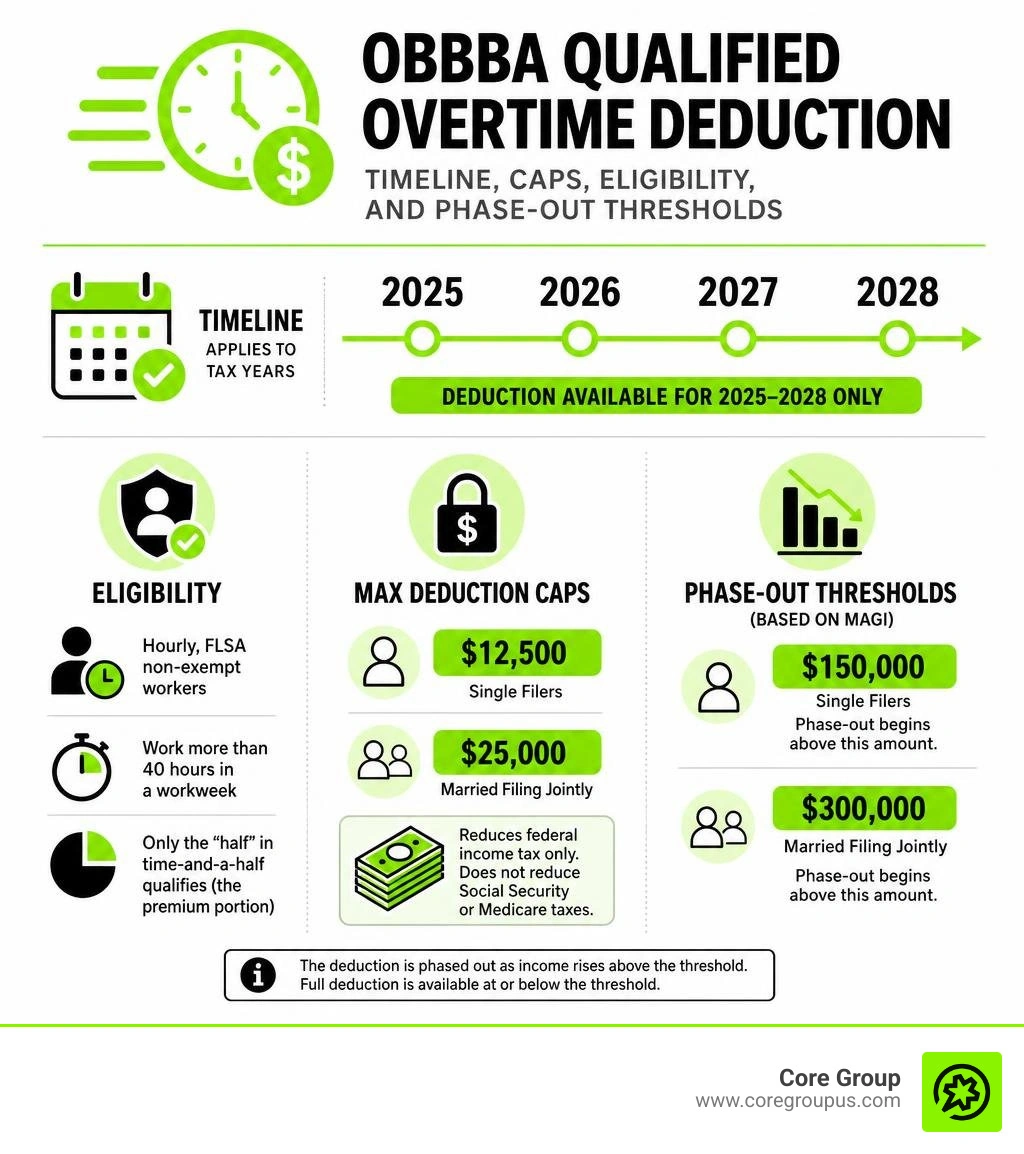
A qualified overtime calculator is not the same as a basic paycheck tool. It specifically figures out the premium portion of your overtime pay that qualifies for a federal tax deduction under the One Big Beautiful Bill Act (OBBBA), signed into law on July 4, 2025.
Here is a quick breakdown of how it works
| What You Need to Know | The Short Answer |
|---|---|
| What qualifies | Only the "half" in time-and-a-half, not your full overtime wages |
| Who qualifies | Hourly, FLSA non-exempt workers putting in more than 40 hours per week |
| Max deduction | $12,500 for single filers / $25,000 for married filing jointly |
| Income phase-out starts | $150,000 MAGI (single) / $300,000 MAGI (joint) |
| Years it applies | Tax years 2025 through 2028 only |
| What it reduces | Federal income tax only, not Social Security or Medicare |
If you work overtime regularly, this deduction could mean real money back in your pocket. For example, a worker earning $20 an hour who puts in consistent overtime could save hundreds to thousands of dollars per year on their federal tax bill.
But here is the catch most people miss. The deduction is not based on all your overtime pay. It is based only on the extra 50% you earn above your regular rate. That distinction matters a lot when you are trying to figure out exactly what to report.
This guide walks you through how to use a qualified overtime calculator correctly, who qualifies, what the limits are, and how to make sure you are not leaving money on the table at tax time.
Qualified overtime calculator definitions
Understanding the OBBBA and the qualified overtime calculator
The tax landscape went through a massive shift when the One Big Beautiful Bill Act, or OBBBA, was signed into law in July 2025. This temporary legislation running from 2025 through 2028 introduced a federal income tax deduction specifically for qualified overtime compensation. The goal was simple, let hard-working people keep more of their hard-earned money when they put in extra hours.
However, calculating this deduction is not as simple as taking your total overtime earnings and writing them off. If you use a standard overtime pay calculator, you will only see your total gross pay. To estimate your actual federal tax savings, you need a specialized tool like the No Tax on Overtime Calculator 2026 to Estimate Federal Overtime Tax Savings.
A standard calculator multiplies your overtime hours by your overtime rate, which is usually 1.5 times your regular hourly wage. A qualified overtime calculator takes that math a step further. It separates your regular hourly base rate from the premium portion of your pay. The OBBBA deduction applies only to the federal income tax on that premium portion.
By understanding this difference, you can utilize tools to estimate your annual tax-free amount. If you want to dive deeper into the core mechanics, you can read our guide on how to calculate qualified overtime to see how these numbers break down on paper.
What Counts as Qualified Overtime Compensation
How to Use a qualified overtime calculator for Premium Pay
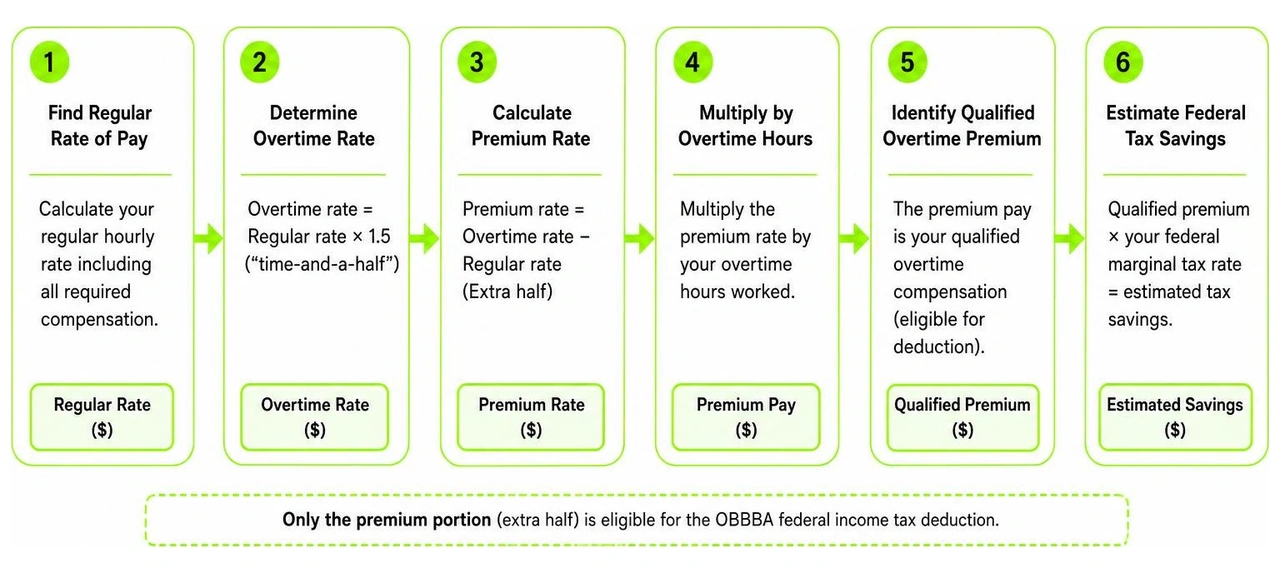
To get the most out of a qualified overtime calculator, you must understand the concept of premium pay. Under the Fair Labor Standards Act, specifically FLSA Section 7, covered non-exempt employees must receive overtime pay at a rate of not less than one and one-half times their regular rate of pay for all hours worked over 40 in a workweek.
The regular rate is not always just your base hourly wage. It must include other forms of compensation like non-discretionary bonuses and shift differentials. Once you have the regular rate, the overtime rate is split into two parts, the straight-time portion and the premium portion.
The premium portion is the extra half in time-and-a-half. This is the only part that qualifies for the OBBBA tax deduction.
Let us look at a quick example. If your regular rate of pay is $20 per hour, your overtime rate is $30 per hour. When you work an overtime hour, you earn $30.
- $20 of that is your regular rate, which is fully taxable.
- $10 of that is the overtime premium, which is the qualified overtime compensation eligible for the federal tax deduction.
If you work 10 hours of overtime in a week, you earn $300 in total overtime pay. Your qualified overtime premium is $100. This $100 is the amount you would enter into a tax calculator to estimate your savings. You can learn more about how these calculations affect your overall tax liability by reading about overtime pay taxes.
For official government guidelines on how the regular rate is determined under federal law, you can consult the elaws FLSA Overtime Calculator Advisor for Nonexempt Employees.
Eligible Employees and Excluded Workers
Not everyone who works long hours can claim this deduction. The OBBBA relies heavily on FLSA definitions to determine eligibility.
To qualify for the deduction, you must be a covered, non-exempt employee who is legally entitled to overtime pay under the FLSA. This group primarily consists of hourly workers and salaried non-exempt employees who earn below the federal salary threshold. In 2026, the federal salary threshold for overtime exemption is $35,568 per year, though some states have much higher limits.
The following workers are excluded from claiming the qualified overtime deduction
- Exempt salaried employees, such as managers, executives, and professionals who do not receive FLSA overtime pay.
- Independent contractors and 1099 workers, as they are self-employed and not covered by FLSA overtime requirements.
- Employees whose overtime pay does not meet the strict federal definition of overtime, even if their employer pays them extra for working holidays or weekends.
If you are unsure whether your overtime pay is treated differently than your normal wages, you might ask, does overtime get taxed at a higher rate? While payroll systems might withhold more tax from a large overtime check, your actual tax rate at the end of the year is the same as your regular income. The OBBBA deduction helps lower this burden even further for eligible workers.
Deduction Caps and State Law Interactions
Federal Deduction Limits and Phase-Out Thresholds
While the OBBBA provides a fantastic opportunity to save on taxes, the federal government placed limits on how much you can deduct. These limits prevent high earners from receiving disproportionate benefits and cap the total tax-free amount you can claim each year.
The maximum annual deduction for qualified overtime compensation is
- $12,500 per return for single filers and heads of household.
- $25,000 per return for married couples filing jointly.
Additionally, the deduction features a phase-out based on your Modified Adjusted Gross Income, or MAGI. The phase-out begins when your MAGI reaches
- $150,000 for single filers.
- $300,000 for married couples filing jointly.
For every $1,000 your income exceeds these thresholds, your maximum allowable deduction is reduced by $100. This means the deduction completely phases out for single filers with a MAGI of $275,000 and joint filers with a MAGI of $550,000.
To see how these limits and phase-outs apply to your specific financial situation, you can use the No Tax on Overtime Calculator 2026 TCJA from CalcSpring. Understanding these thresholds is essential for accurate tax planning, and you can read more about the general tax rates by checking out what is the federal tax rate on overtime.
How State Overtime Rules Affect Your Federal Deduction
One of the most complex aspects of using a qualified overtime calculator is navigating the interaction between state and federal laws. Several states, including California and Alaska, have daily overtime rules that are more generous than the federal weekly standard.
For example, California requires employers to pay overtime after 8 hours of work in a single day, even if the employee does not exceed 40 hours in the workweek. Alaska has similar rules under its own state statutes.
However, the federal OBBBA deduction is strictly tied to overtime required under Section 7 of the FLSA, which only mandates overtime for hours worked beyond 40 in a workweek.
Consider this scenario. A worker in California works four 10-hour days in a single week.
- Under California state law, they are entitled to 8 hours of daily overtime.
- Under federal FLSA rules, they worked exactly 40 hours, so no weekly overtime is required.
- In this case, none of the overtime premium qualifies for the federal OBBBA deduction because the weekly hours did not exceed 40.
If you are working in a state with daily overtime standards, you must use a California Overtime Wage Calculator to determine your gross pay, but you must only count hours exceeding 40 per week for your federal tax deduction. For more information on how West Coast tax rules apply, read about whether is overtime taxed at a higher rate in california.
For workers in the far north, you can review the official state guidelines on the Minimum Wage Standard and Overtime Hours page to see how Alaska defines its daily and weekly work limits.
Employer Reporting and Employee Recordkeeping
W-2 Reporting for 2025 and 2026
The IRS has rolled out specific guidelines for how employers must report qualified overtime compensation. Because the OBBBA was enacted mid-year in 2025, the reporting requirements for the 2025 tax year were relatively relaxed.
For tax year 2025, employers were not required to separately report qualified overtime on Form W-2. Instead, the IRS allowed any reasonable method for employees to determine their qualified overtime, such as using employer payroll portals or obtaining a separate statement from their payroll department under Notice 2025-69.
However, for tax year 2026 and later years, separate reporting is mandatory. Employers must track and report qualified overtime compensation directly on Form W-2. This is typically reported in Box 14 with a description like "OT" or "QualOT", or in Box 12 using Code TT.
This change requires employers to update their payroll systems to ensure they are isolating the premium portion of overtime pay accurately. If you want to understand how these payroll reporting methods impact your tax return, you can read our detailed article on tax on overtime pay.
Tracking Your Savings with a qualified overtime calculator
As an employee, the burden of proof ultimately rests on you if the IRS decides to audit your tax return. To claim the qualified overtime deduction safely and accurately, you must maintain excellent records.
We recommend saving all of your pay stubs throughout the year. Your pay stubs should clearly show your regular hours, overtime hours, regular rate of pay, and overtime rate of pay. If your employer does not separately list the qualified overtime premium on your W-2, you can use these pay stubs to calculate the amount yourself.
Using a tool like the Overtime Calculator for All 50 US States can help you keep track of your hours and verify that your employer is calculating your overtime pay correctly. Keeping these records organized will give you peace of mind and make tax preparation much smoother.
Frequently Asked Questions about Overtime Taxes
Does the OBBBA deduction reduce Social Security and Medicare taxes
No, the OBBBA deduction only applies to federal income tax. It does not reduce your Federal Insurance Contributions Act, or FICA, taxes. You and your employer must still pay the standard Social Security tax of 6.2% and Medicare tax of 1.45% on your entire gross wage, including all overtime pay.
Can I claim both the overtime and tips deductions
Yes, if you work in an industry where you receive both overtime pay and tips, you can claim both deductions. The OBBBA contains separate provisions for qualified overtime compensation and qualified tip income. Each deduction has its own set of rules and limits, but they can both be claimed on the same tax return to maximize your savings.
What happens to the overtime tax deduction after 2028
The qualified overtime deduction is a temporary tax relief measure. It is currently scheduled to sunset after December 31, 2028. Unless Congress passes future legislation to extend the OBBBA provisions or make them permanent, overtime pay will return to being fully taxable at federal income tax rates starting in tax year 2029.
Conclusion
Navigating taxes can feel overwhelming, especially with temporary laws like the OBBBA changing how your overtime is treated. But you do not have to figure it out alone.
At Core Group, we offer financial management, bookkeeping, and tax services specifically tailored for creative entrepreneurs. Our financial services are designed to take the stress out of numbers. We use a no-fluff, profit-first playbook that guarantees peace of mind and saves you time, allowing you to focus entirely on growing your business.
We stand behind our services with our unique MacBook Pro guarantee. If you want to make sure you are maximizing your tax savings and keeping your business on the right track, let us handle the math. To learn more about how different pay structures impact your bottom line, check out our insights on the overtime tax rate and let us help you keep more of what you earn.