How to Set Up S Corp Payroll in 7 Simple Steps
Set Up S Corp Payroll Without Guessing at Your Pay
To set up S corp payroll, pay yourself a defensible salary through payroll before taking profit distributions. Start with these seven steps.
- Set a salary based on your work and market pay.
- Register for federal and state payroll tax accounts.
- Choose payroll software and a regular pay schedule.
- Add any qualifying owner health insurance to payroll.
- Run payroll and deposit withheld taxes on time.
- File quarterly and annual payroll tax forms.
- Track stock basis before taking distributions.
Your salary is subject to payroll taxes. Distributions generally are not, but they cannot replace a reasonable salary for the work you do. I’m Christian Brim, and I’ll walk you through each step so you can spend less time worrying about payroll and more time on your creative work.

Key s corp payroll setup vocabulary includes s-corp business taxes, s-corp tax planning, and s-corp health insurance.
Understanding Owner Compensation, Salary vs. Distributions
Running an S corporation gives creative entrepreneurs a meaningful tax advantage, but it also creates dual roles. You are an owner holding equity in the company, and you are an employee providing valuable services.
Understanding the difference between earned wages and equity withdrawals is vital. W-2 salary represents compensation for your everyday labor, while shareholder distributions represent your share of residual profits. Familiarity with fundamental S Corp payroll rules ensures that you do not accidentally blur these lines.
| Compensation Component | Tax Treatment | Subject to FICA Taxes | Frequency |
|---|---|---|---|
| W-2 Salary | Subject to income tax withholding and payroll taxes | Yes, 15.3% split between employer and employee | Regular schedule, such as monthly, bi-weekly, or semi-monthly |
| Shareholder Distributions | Pass-through ordinary income on Schedule K-1 | No, exempt from Social Security and Medicare | As profits allow, after payroll is met |
W-2 wages incur Federal Insurance Contributions Act (FICA) taxes, which fund Social Security and Medicare. Distributions avoid FICA taxes completely, passing through to your personal tax return without that extra 15.3% burden. That tax distinction is why the IRS monitors S corp owner wages so closely.
Determining Reasonable Compensation for Shareholder-Employees
The IRS requires shareholder-employees to draw reasonable compensation before taking any distributions. A reasonable salary is the amount an independent business would pay an unrelated employee for performing the exact same duties.
Reviewing your initial S Corp formation checklist helps you define your operational roles clearly. To establish a defensible figure, consider the following factors.
- Training, professional credentials, and practical experience
- Time allocated to executive duties versus direct client work
- Local market rates using Bureau of Labor Statistics (BLS) data or industry salary surveys
- Complexity and operational revenue of the business
Many owners rely on the old rule of thumb splitting income sixty percent to salary and forty percent to distributions. The IRS does not recognize arbitrary percentage formulas. They evaluate market rates and job functions, meaning your compensation must be grounded in real-world compensation benchmarks.
Balancing Wages with the Qualified Business Income (QBI) Deduction
Section 199A provides a potential twenty percent deduction on qualified business income for pass-through entities. Your W-2 wages directly influence this calculation.
W-2 salary reduces net business profit, which in turn reduces eligible QBI. For owners above statutory income phase-out thresholds, having sufficient W-2 wages is actually required to claim the deduction. Striking the right balance between payroll tax savings and QBI deduction optimization requires careful planning, but the FICA tax savings from a reasonable salary generally provide the larger net benefit for growing businesses.
Complete S Corp Payroll Setup, The 7-Step Guide
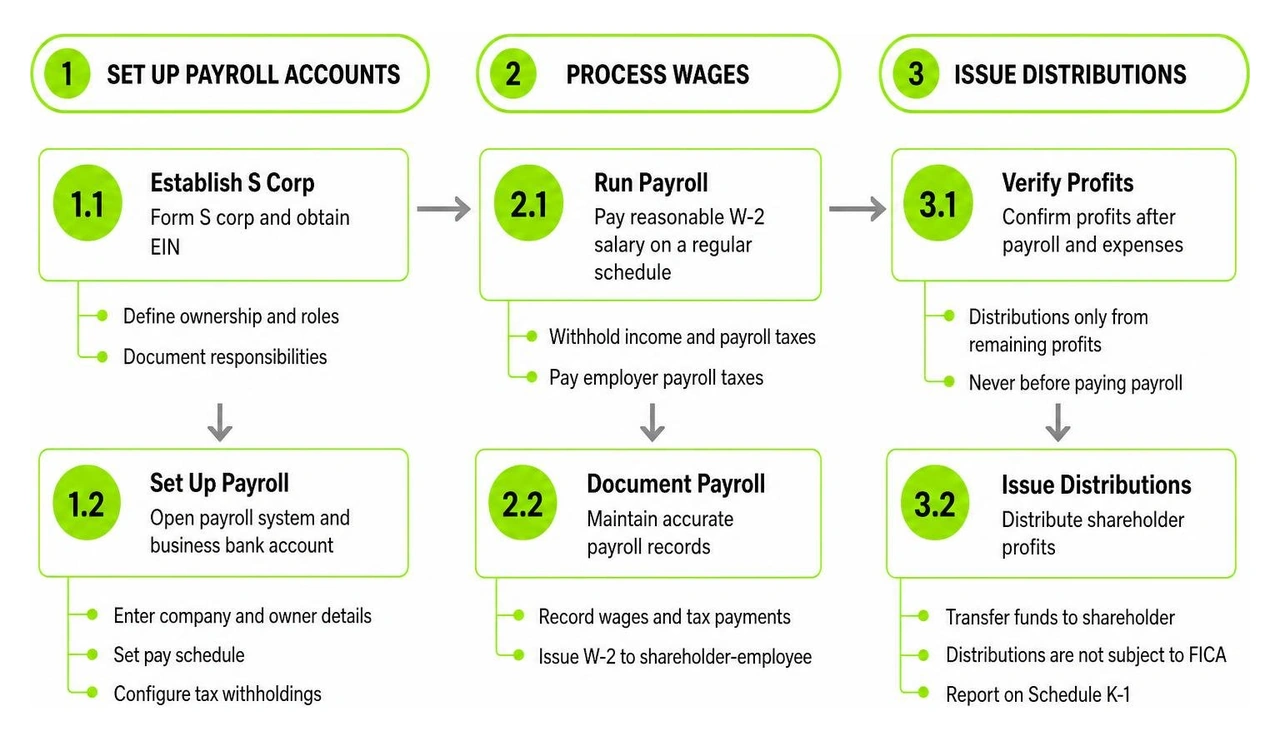
Transitioning from simple owner draws to automated corporate compensation is straightforward when you follow an organized plan. Our small business payroll guide for 2026 outlines how modern systems automate these administrative tasks so you stay fully compliant without wasting creative energy.
Step 1, Establish and Document Your Defensible Salary
Begin by documenting what you do every day. Write a formal job description covering your management tasks, marketing efforts, and client deliverables. Benchmark these responsibilities against published compensation data for your geographic market.
Record your agreed-upon wage in formal corporate minutes or a written resolution. Keeping this paper trail in your corporate records ensures you can easily defend your compensation structure if tax authorities ever ask.
Step 2, Register for Federal, State, and Local Tax Accounts
Your corporation needs active employer tax accounts before you process your first paycheck.
- Ensure you have a valid Federal Employer Identification Number (EIN).
- Enroll in the Electronic Federal Tax Payment System (EFTPS) to remit federal tax withholdings.
- Register with your state department of revenue for state income tax withholding.
- Open an account with your state labor department for State Unemployment Insurance (SUI).
Step 3, Configure Software for Your S Corp Payroll Setup
Choose a dedicated payroll platform that automates tax filings, direct deposits, and quarterly forms. Manual payroll calculations introduce unnecessary compliance risks, while software costs around thirty to fifty dollars per month and handles tax calculations automatically.
Enter your corporate details, bank accounts, and federal and state tax IDs. Complete your own Form W-4, establish your direct deposit instructions, and select a sustainable pay schedule such as semi-monthly or monthly.
Step 4, Add 2% Shareholder Health Insurance to Payroll
If your corporation pays or reimburses medical coverage for an owner who holds more than two percent of corporate stock, specific reporting rules apply under IRS Notice 2008-1. Correctly deducting S Corp health insurance requires running these premiums through your payroll system.
These premiums are added to your federal and state taxable wages in Box 1 of Form W-2, but they are excluded from Social Security and Medicare wages in Boxes 3 and 5. This structure lets the corporation deduct the expense while allowing you to take the self-employed health insurance deduction on your personal Form 1040. If you need software-specific walkthroughs, Intuit provides helpful guidance on setting up corporate officer medical payroll items.
Step 5, Process Scheduled Payroll and Remit Tax Withholdings
Process your payroll on your established schedule. Your system will withhold federal income tax, state income tax, and employee FICA taxes, which include 6.2% for Social Security and 1.45% for Medicare. The corporation matches the 7.65% FICA portion.
The Social Security wage base caps at $176,100, which sets maximum annual Social Security tax at $10,918.20 per employee. Once an employee earns above that wage threshold, only the 1.45% Medicare tax applies. Most modern platforms automatically withdraw and remit these tax payments to tax authorities on your assigned schedule.
Step 6, Submit Quarterly and Annual Payroll Tax Filings
Your payroll filings run on statutory quarterly and annual deadlines.
- Form 941 is filed quarterly, with due dates of April 30, July 31, October 31, and January 31, to report wages and withheld federal taxes.
- Form 940 is filed annually by January 31 to report Federal Unemployment Tax Act (FUTA) liabilities.
- Form W-2 and W-3 are issued to employees and submitted to the Social Security Administration by January 31 following the tax year.
- State filings include quarterly state wage reports and unemployment tax returns submitted according to local deadlines.
Step 7, Distribute Remaining Profits Against Stock Basis
Once payroll is processed and necessary operating reserves are set aside, you can take profit distributions. Understanding how S Corp profit distributions work protects your tax-free status.
Distributions must be drawn from your business checking account to your personal account, documented as equity distributions rather than payroll. You can only take tax-free distributions up to your available stock basis. Maintain accurate basis tracking on IRS Form 7203 every year, because distributions that exceed your stock basis are treated as taxable capital gains.
Special Payroll Processing, Health Benefits, Fringe Checks, and Tax Loans

Shareholder-employees often have unique compensation elements that regular staff do not, such as company-paid health plans or year-end benefit reconciliations. Knowing how to handle these non-cash fringe benefits keeps your year-end reporting smooth.
Running Fringe Benefit and Zero Net Paychecks
When your company pays health insurance premiums directly to an insurer throughout the year, you may need to record that benefit without sending extra cash to your personal bank account.
You can accomplish this by generating a fringe benefit or zero net paycheck. In payroll software, you add a non-cash earning item for the total health insurance premium value alongside an equal offset deduction. This increases your reported taxable wages for income tax purposes and places the right amount in Box 14 of your W-2 without generating an unneeded cash payment.
Managing Employee Tax Loans for Insufficient Wages
When non-cash benefits are added to a payroll run that has little or no cash wages, the resulting income tax withholding can exceed the cash payout.
In these situations, some systems create an employee tax loan. The business covers the required tax withholding on the owner's behalf, recording the outlay as a short-term receivable on corporate books. The shareholder must repay this loan back to the corporation by April 15 of the following year to keep corporate books clean and prevent the balance from being reclassified as a taxable distribution.
Avoiding Costly Mistakes During S Corp Payroll Setup

Small setup mistakes can lead to unexpected tax assessments or administrative headaches. Reviewing our essential guide to S corporations helps you avoid these common traps.
- Taking zero salary while drawing distributions is the fastest way to invite an IRS audit.
- Inconsistent payroll schedules make compensation look like distributions rather than regular employment.
- Missing federal tax deposit deadlines triggers immediate penalties ranging from 2% to 15% depending on how late the payment is, while late quarterly filings add 5% per month up to 25%.
- Failing to document your wage rationale leaves you without written justification showing how you determined your salary level.
- Neglecting to track stock basis on Form 7203 can lead to surprise capital gains taxes.
Frequently Asked Questions About S Corp Payroll
How much can I save on self-employment taxes with an S corp?
Tax savings depend on your overall profit and your reasonable salary level. Sole proprietors pay self-employment tax (15.3%) on their entire net business profit up to statutory caps.
For example, an owner with $120,000 in net business income who pays a reasonable salary of $75,000 and takes $45,000 in distributions saves approximately $6,885 per year in payroll taxes. An owner earning $200,000 who takes a $95,000 salary and $105,000 in distributions can save over $16,000 annually. Even after paying modest payroll software fees, the net savings remain substantial.
What happens if an S corp owner takes distributions without running payroll?
If an S corporation owner takes distributions while providing services but pays no salary, the IRS can reclassify those distributions as W-2 wages during an audit.
When reclassification occurs, the IRS assesses back payroll taxes on the entire reclassified amount, adds failure-to-file and failure-to-pay penalties, and charges statutory interest. You also lose the ability to deduct health insurance premiums properly, turning what should have been a tax-saving strategy into an expensive headache.
Can an S corp owner pay themselves a salary once a year?
While running a single annual payroll in December is technically possible, it creates cash flow and compliance challenges.
Tax authorities expect taxes to be withheld and remitted throughout the year as income is earned. Waiting until the final weeks of December can trigger underpayment penalties or complicate your quarterly Form 941 filings. Running consistent monthly or semi-monthly payroll aligns with standard business practices and keeps your tax liabilities predictable.
Conclusion
Setting up payroll for your S corporation does not have to pull you away from your creative work. By establishing a defensible salary, setting up an automated payroll tool, handling shareholder health insurance properly, and taking profit distributions against verified stock basis, you protect your business and maximize your tax savings.
At Core Group, we provide financial management, bookkeeping, and tax services specifically tailored for creative entrepreneurs. Our no-fluff, profit-first playbook delivers peace of mind, backed by our MacBook Pro guarantee. If you are ready to structure your business properly from the start, check out our step-by-step guide on how to form an S corp or reach out to our team today.