The Safest Bets: Low-Risk 401(k) Investments for Peace of Mind
Understanding the best safe 401k options for long term stability
When we talk about long-term stability in your retirement account, we aren't just talking about avoiding a "zero" balance. We are talking about building a foundation that can withstand the storms of the stock market. For many of our clients at Core Group, the goal isn't to beat Wall Street; it’s to ensure that the money they’ve worked so hard for is actually there when they decide to hang up their hats.

The search for safe 401k options usually leads investors toward two primary goals: principal protection and low volatility. Principal protection means that even if the market takes a nosedive, the actual dollar amount you contributed remains intact. Low volatility means the value of your account doesn't swing wildly from day to day, which is a huge win for your mental health.
One of the most effective ways to ensure your plan is set up for success is to understand the structure of the plan itself. For business owners, implementing a Safe Harbor 401k can be a game-changer. These plans are designed to pass IRS non-discrimination testing automatically, allowing owners and highly compensated employees to maximize their contributions while providing a guaranteed match or contribution to employees. It’s a win-win that creates a stable environment for everyone involved.
Stable value funds as safe 401k options
If you are looking for the "Holy Grail" of 401(k) safety, you might find it in stable value funds. These are unique to retirement plans and aren't typically found in standard brokerage accounts.
Stable value funds are essentially portfolios of high-quality, short-to-intermediate-term bonds that are "wrapped" in insurance contracts. These contracts guarantee that the fund's value won't drop, even if interest rates rise or bond prices fall. Historically, these funds offer returns ranging from 1.5% to 3.5%. While that might not sound like a lot compared to a tech stock boom, consider this: during the Great Recession of 2008, while the S&P 500 was losing over 50% of its value, stable value funds remained... well, stable. They provided a positive return and protected every cent of the investor's principal.
Target date funds as automated safe 401k options
For those of us who would rather spend our time creating than rebalancing a portfolio, target-date funds (TDFs) are a fantastic "set-it-and-forget-it" option. A TDF is a diversified mix of stocks and bonds that automatically adjusts based on the year you plan to retire.
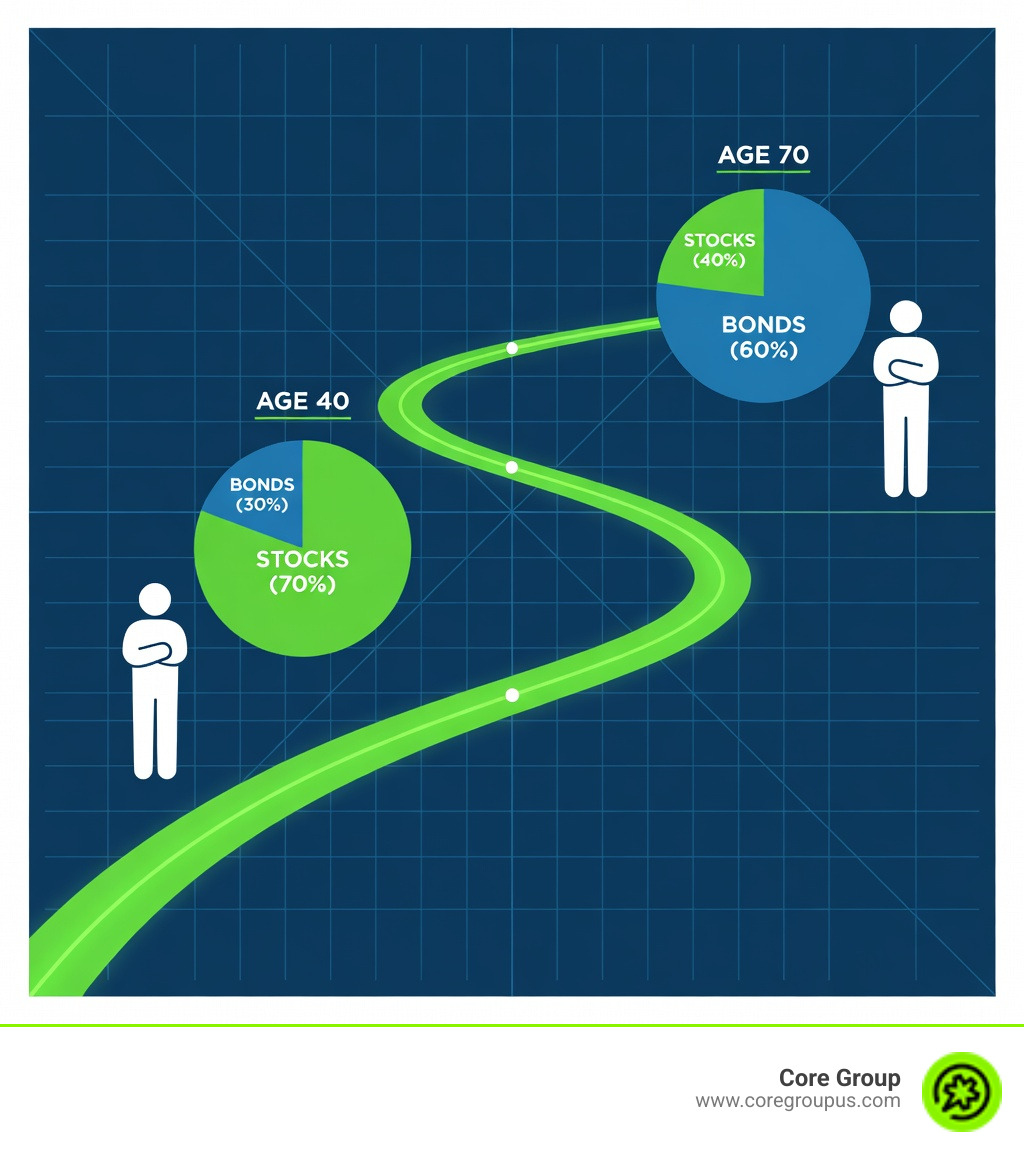
These funds follow what is known as a "glide path." When you are young, the glide path is aggressive, focusing heavily on stocks for growth. As you get closer to your target retirement year, the fund automatically shifts its allocation toward more conservative assets like bonds and cash. This research on 401k asset allocation highlights how TDFs help investors avoid the common mistake of being "too aggressive" right before they need to start withdrawing their money.
Top low risk investment vehicles for retirement stability
Not all "safe" investments are created equal. Depending on your plan, you likely have access to a few different types of low-risk vehicles. Understanding the nuances between them can help you fine-tune your strategy.
| Feature | Money Market Funds | Bond Funds | Stable Value Funds |
|---|---|---|---|
| Primary Goal | Liquidity/Preservation | Income/Stability | Principal Protection |
| Risk Level | Extremely Low | Low to Moderate | Very Low |
| Typical Return | 0.01% - 4% (Variable) | 2% - 5% (Variable) | 1.5% - 3.5% (Fixed/Stable) |
| Protection | Underlying Assets | None (Market Value) | Insurance Wrapped |
High quality corporate bond funds
When you buy a corporate bond, you are essentially acting as the bank and lending money to a company. In return, they pay you interest. To keep things safe, you want to look for "investment-grade" bond funds. These funds only lend to companies with high credit ratings—think of the blue-chip giants that have been around for decades.
High-quality corporate bond funds usually focus on intermediate terms (3 to 10 years). While they carry slightly more risk than government bonds, they often offer a higher yield. The key is to look for funds with low expense ratios. Every dollar you pay in fees is a dollar that isn't compounding in your account.
Government backed securities and TIPS
If you want the ultimate level of security, look no further than the U.S. government. Treasury bonds are backed by the "full faith and credit" of the United States.

One specific type of government security that is excellent for safe 401k options is Treasury Inflation-Protected Securities (TIPS). Inflation is the "silent killer" of retirement savings; it erodes your purchasing power over time. TIPS are designed to combat this. The principal value of a TIPS bond increases with inflation (measured by the Consumer Price Index). When the bond matures, you are paid either the adjusted principal or the original principal, whichever is greater. This ensures that your "safe" money doesn't lose its value to rising prices. For more on how these fit into a broader strategy, US News Money provides excellent ongoing analysis of federal security trends.
Strategic ways to protect your retirement savings from market volatility
Safety isn't just about what you buy; it's about how you manage your total portfolio. Even the safest fund can't protect you if you have all your eggs in one basket.
Diversification across asset classes
Diversification is the only "free lunch" in investing. By spreading your money across different asset classes—large-cap stocks, international equities, emerging markets, and various types of bonds—you ensure that a crash in one sector doesn't take down your entire 401(k).
For example, while technology funds like the Vanguard Information Technology Index Fund (VITAX) have seen incredible 10-year returns of over 20%, they are also highly volatile. Balancing those high-growth "satellite" positions with "core" safe holdings like money market funds or short-term Treasuries creates a portfolio that can grow during the good times and survive the bad ones.
Shifting to conservative assets as retirement nears
As you approach your "retirement red zone"—the five to ten years before you stop working—your priority should shift from wealth accumulation to wealth preservation. This is because of "sequence of returns risk." If the market crashes right as you start taking withdrawals, it can have a devastating permanent impact on how long your money lasts.
We recommend maintaining a cash reserve or a significant allocation to low-risk assets like Treasury bonds as you get closer to your date. T. Rowe Price analysis suggests that by age 45, you should have three times your current income saved, rising to seven times by age 55. If you are hitting these benchmarks, you can afford to take less risk and move into safe 401k options to lock in your gains.
Common mistakes to avoid during economic downturns
When the market starts to look like a roller coaster, human instinct is to scream and jump off. In 401(k) investing, that is usually the worst thing you can do.
The biggest mistake investors make during a crash is stopping their contributions. When prices are low, your 401(k) contribution actually buys more shares. This is called dollar-cost averaging. If you stop contributing when the market is down, you miss out on the "sale" prices that lead to the biggest gains during the recovery.
Another critical error is taking early withdrawals. Unless you qualify under the "Rule of 55" or have a dire emergency, withdrawing money before age 59½ usually triggers a 10% penalty plus immediate income taxes. You are essentially giving away a huge chunk of your savings to the IRS just because you were nervous about a temporary market dip.
The impact of fees and expense ratios
Fees are the termites of a retirement account—they are small, often invisible, and they slowly eat away at the structure of your savings. A difference of just 0.40% in an expense ratio might seem tiny, but over 30 years on a $100,000 balance, it can cost you over $70,000 in lost growth.
When looking for safe 401k options, always check the expense ratio. Passive index funds often cost less than 0.10%, while some actively managed "safe" funds might charge 0.70% or more. Unless that active manager is consistently outperforming the market (and fewer than 10% of them do over a decade), you are better off with the lower-cost index option.
Special considerations for international professionals
For expats or those of us who work with international clients, retirement planning adds a layer of complexity. Currency risk is a real factor; if your 401(k) is in USD but you plan to retire in Europe, a weakening dollar could effectively "shrink" your savings.
Furthermore, cross-border taxation can be a minefield. It’s vital to understand how your 401(k) withdrawals will be taxed in your country of residence. Some countries have Double Taxation Agreements (DTAs) with the U.S. that protect your distributions, while others do not. Protecting your 401(k) in this context means more than just picking safe funds; it means having a tax-efficient withdrawal strategy.
Frequently Asked Questions about safe 401k options
What is the safest investment in a 401k plan?
The absolute safest investments are typically Money Market Funds and Stable Value Funds. Money market funds invest in very short-term, high-quality debt and aim to keep a net asset value of $1.00 per share. Stable value funds offer a similar level of principal protection but usually provide a slightly higher interest rate because they are backed by insurance contracts.
Can I lose money in a safe 401k investment?
Technically, yes, though the risks are different than with stocks. The main risks for "safe" investments are inflation risk (where your money grows slower than the cost of living) and interest rate risk (where rising rates cause the value of existing bonds to fall). Management fees can also reduce your balance if the fund's returns are lower than the expense ratio.
When should I shift to lower risk investments?
A common rule of thumb is to begin shifting more of your portfolio into safe 401k options about 10 years before your planned retirement date. You can use the "110 minus your age" rule to determine your equity percentage. For example, if you are 60, you might keep 50% in stocks (110 - 60) and 50% in safer bonds and cash.
Conclusion
At Core Group, we understand that for creative entrepreneurs, your business is your primary passion—but your 401(k) is your future freedom. You shouldn't have to spend your weekends analyzing bond yields or worrying about market crashes. By choosing safe 401k options that align with your age and risk tolerance, you can build a "profit-first" retirement strategy that guarantees peace of mind.
Whether you are looking for the principal protection of a stable value fund or the automated ease of a target-date fund, the key is to stay disciplined, keep your fees low, and focus on the long term. If you’re ready to take the stress out of your financial future and focus on what you do best, it’s time to start your tax planning strategy with a team that speaks your language. Let's make sure your retirement is as bright as your creative vision.