Everything you need to know about tax brackets 2026 married jointly
What the tax brackets 2026 married jointly mean for your business
If you are looking at the tax brackets 2024 married jointly, you are seeing the end of an era. As we move into the 2026 tax year, the expiration of the Tax Cuts and Jobs Act means that tax planning is more critical than ever for creative entrepreneurs.
| Projected 2026 Tax Rate | Taxable Income (Married Jointly) |
|---|---|
| 10% | $0 – $23,200 |
| 15% | $23,201 – $94,300 |
| 25% | $94,301 – $190,000 |
| 28% | $190,001 – $290,000 |
| 33% | $290,001 – $518,000 |
| 35% | $518,001 – $625,000 |
| 39.6% | Over $625,000 |
Note: These are projected figures based on the sunsetting of current laws and inflation adjustments.
The standard deduction for married couples filing jointly in 2026 is expected to drop to approximately $15,000 to $16,000, a significant change from the $29,200 seen in 2024. This shift means that more of your income may be subject to tax unless you have significant itemized deductions.
Understanding these layers is the first step toward smarter tax planning. For creative entrepreneurs, knowing where you land in these brackets helps you manage irregular cash flow and avoid a massive surprise when it is time to file.
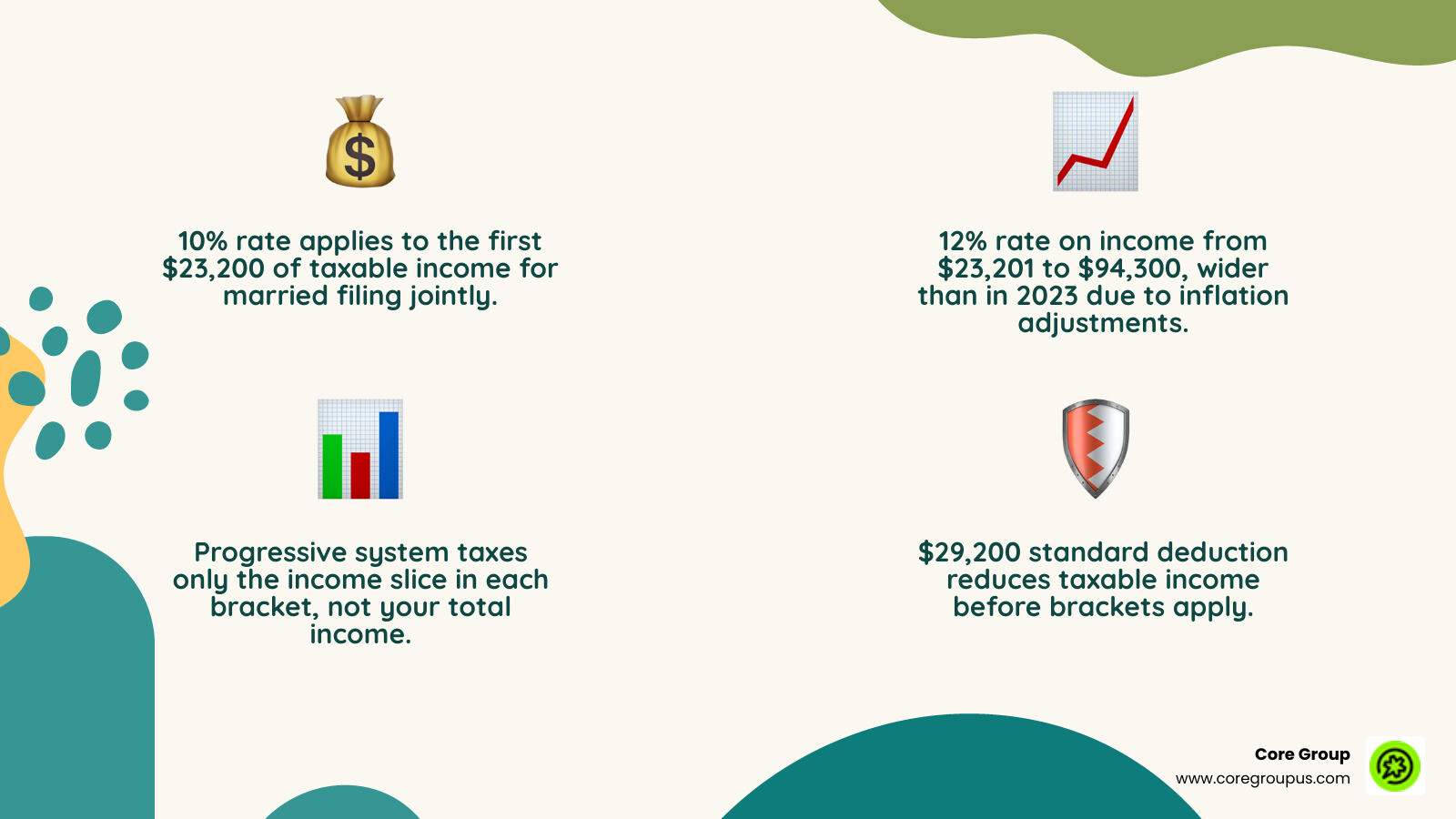
Understanding the federal tax brackets for 2026
When we look at the federal tax landscape for 2026, we are seeing a return to the pre-2018 structure. While the tax brackets 2024 married jointly offered lower rates and a higher standard deduction, the sunsetting of the Tax Cuts and Jobs Act (TCJA) changes the math for every household. This adjustment is a major shift for those who have only operated their businesses under the recent tax rules.
The 2026 brackets are built on seven rates: 10%, 15%, 25%, 28%, 33%, 35%, and 39.6%. Because the top rate is increasing from 37% back to 39.6%, high-earning creative couples need to be particularly diligent with their year-end strategies.
To help you plan, it is useful to compare the 2026 outlook with the Official 2024 tax parameters and inflation adjustments that many are still using as a baseline.
How marginal rates impact your 2026 tax planning
One of the most common questions we hear is whether moving into a higher bracket means all your money is taxed at that rate. The answer remains no. Even with the changes in 2026, the U.S. uses a progressive system. Your "marginal" rate is only applied to the income within that specific bucket.
For example, if a married couple has $100,000 in taxable income in 2026, they will pay 10% on the first portion and 15% on the next, with only the final slice hitting the 25% bracket. This is why your "effective" tax rate is usually much lower than your top bracket. You can explore Detailed federal income tax data and statistics to see how these averages have shifted over time as laws change.
The impact of the TCJA sunset on inflation indexing
The IRS continues to adjust brackets for inflation to prevent "bracket creep," but the structural change in 2026 is much larger than a simple inflation adjustment. While the tax brackets 2024 married jointly were indexed using the Chained Consumer Price Index (C-CPI), the underlying law itself is reverting to older percentages. This means that even if your income stays the same, your tax liability could increase simply because the rates themselves have moved upward.
Calculating taxable income for married couples in 2026
Finding your taxable income in 2026 requires a different approach than in previous years. Taxable income is what remains after subtracting your deductions from your gross income, but the "floor" has changed.
For a creative entrepreneur, the process still follows these steps:
- Gross Income: Total earnings from all sources.
- Adjusted Gross Income (AGI): Gross income minus "above-the-line" deductions like HSA contributions or self-employment tax portions.
- Taxable Income: AGI minus either the standard deduction or itemized deductions.
Because the standard deduction is decreasing from the levels seen in the tax brackets 2024 married jointly, many couples will find that itemizing becomes beneficial again. If you are wondering As a freelancer how do I plan for taxes in this new environment, the focus should shift toward documenting every possible business expense and personal deduction.
Standard deduction and the return of personal exemptions
In 2026, the standard deduction for married filing jointly is expected to be roughly half of the 2024 amount of $29,200. However, the trade-off is the return of personal exemptions. Previously suspended by the TCJA, these exemptions allow you to subtract a set amount for yourself, your spouse, and each dependent.
This shift makes the calculation more complex than it was for the tax brackets 2024 married jointly. You will also still see additional deductions for taxpayers who are 65 or older or legally blind. Choosing the right filing status is more important than ever, and for many, checking S corp eligibility requirements is a vital step in managing how much of your business income is actually subject to these new rates.
The end of the TCJA era
The suspension of personal exemptions is set to end after 2025. This means that for your 2026 filings, you will likely see the return of those per-person deductions on your tax forms. While the standard deduction is smaller, these exemptions can help offset the difference for larger families. This is a major reversal from the rules that governed the tax brackets 2024 married jointly, and it requires a fresh look at your withholding and estimated payments.
Advanced tax considerations for high income earners in 2026
As your business grows, the 2026 tax landscape introduces new hurdles. High-income earners must navigate not only higher base rates but also the expiration of key deductions that were available during the era of the tax brackets 2024 married jointly.
The Net Investment Income Tax (NIIT) of 3.8% remains in effect for married couples with a Modified Adjusted Gross Income (MAGI) over $250,000. This tax applies to investment income like dividends and capital gains. To manage this, many entrepreneurs ask, Do 401k contributions reduce MAGI? Lowering your AGI through retirement contributions remains one of the most effective ways to stay under this threshold.
Alternative Minimum Tax and the QBI deduction sunset
The Alternative Minimum Tax (AMT) is expected to affect more families in 2026 as the high exemption levels from the TCJA expire. If you have significant business expenses or specific types of income, you may need to calculate your taxes under both systems and pay the higher amount.
Perhaps the biggest change for business owners is the scheduled expiration of the Section 199A deduction. This allowed many to deduct 20% of their qualified business income. While this was a staple of the tax brackets 2024 married jointly, its absence in 2026 means your effective tax rate on business profits could rise significantly. This is why we frequently analyze Should creative entrepreneurs become an S corp to find other ways to optimize tax efficiency.
Common mistakes when applying 2026 tax rates
Navigating the transition from the tax brackets 2024 married jointly to the 2026 rules can lead to several common errors:
- Assuming the Standard Deduction is Enough: With the standard deduction dropping, many couples who didn't itemize in 2024 should start tracking mortgage interest and charitable gifts again for 2026.
- Overlooking Personal Exemptions: Don't forget to claim the per-person exemptions that return in 2026, as these were not available in recent years.
- Underestimating the Top Rate: If your household income is high, the top rate has moved from 37% to 39.6%. This can create a significant gap if you are still basing your estimated payments on 2024 or 2025 figures.
- Ignoring the QBI Sunset: If you are a pass-through entity, the loss of the 20% deduction means you need to set aside more for taxes than you did previously.
Frequently Asked Questions about 2026 tax rates
What is the standard deduction for married filing jointly in 2026?
The standard deduction is projected to decrease to approximately $15,000 to $16,000 for 2026, down from the $29,200 level seen in the tax brackets 2024 married jointly. However, personal exemptions are expected to return to help offset this change.
How do I know if I should itemize or take the standard deduction in 2026?
Because the standard deduction is lower in 2026, you should itemize if your total deductions—including mortgage interest, state and local taxes, and charitable gifts—exceed the new, lower threshold. This is a major change from the 2024 tax year.
When do the 2026 tax brackets actually apply to my filings?
The 2026 tax brackets apply to income earned between January 1, 2026, and December 31, 2026. You will use these rates when you file your tax return in early 2027.
Conclusion
Understanding the tax brackets 2024 married jointly was a great starting point, but the shift to 2026 requires a more proactive strategy. With rates rising and the standard deduction changing, creative entrepreneurs need a clear plan to protect their profits.
At Core Group, we help you navigate these transitions with a profit-first mindset. You shouldn't have to spend your time decoding IRS updates when you could be focused on your creative work. Whether you need help with S corp elections, managing the loss of the QBI deduction, or simply want the peace of mind that comes with expert bookkeeping, we are here to support you.
Our goal is to provide a solid financial foundation so you can grow your business with confidence. If you are ready to move past the guesswork and secure your financial future, Start your strategic tax planning today and let us help you keep more of what you earn.