Tick-Tock: When Do 1099s Need to Be Issued to Contractors?
The 1099 Deadlines Every Business Needs to Know
Knowing when are 1099s due can save your business from costly IRS penalties. Here are the key deadlines at a glance.
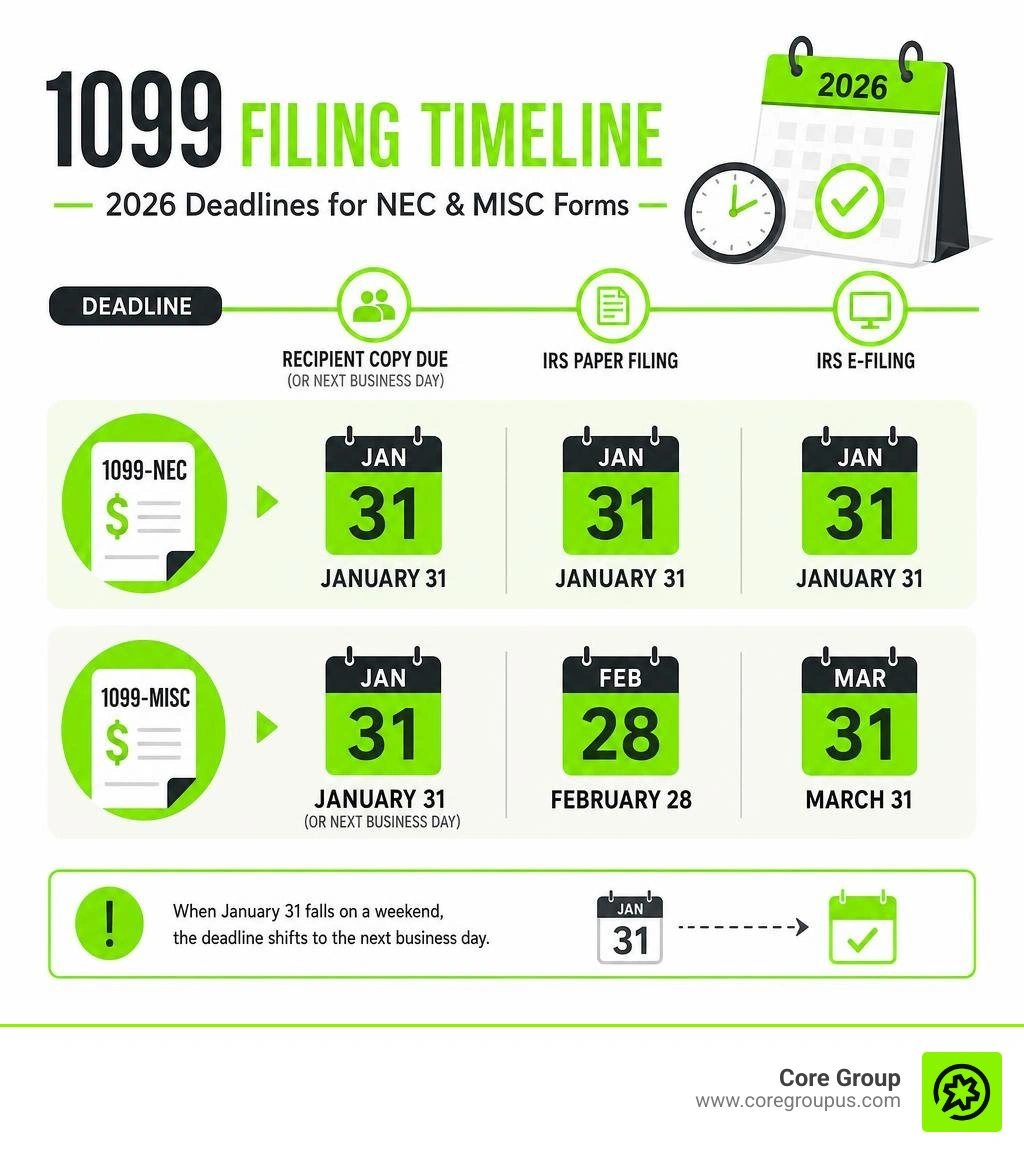
| Form | Recipient Copy Due | IRS Paper Filing | IRS E-Filing |
|---|---|---|---|
| 1099-NEC | January 31 (or next business day) | January 31 | January 31 |
| 1099-MISC | January 31 (or next business day) | February 28 | March 31 |
Note that when January 31 falls on a weekend, the deadline shifts to the next business day. For 2025 payments (filed in 2026), this date was February 2, 2026.
If you pay independent contractors, freelancers, or vendors, 1099 forms are not optional. The IRS requires businesses to file them every year, and the deadlines come up fast.
For many creative entrepreneurs running production companies, agencies, or media businesses, tax season sneaks up between shoots and client deliverables. One missed deadline can mean penalties starting at $60 per form and climbing to $330 or more, depending on how late you file.
The good news is that the deadlines are predictable. Once you know the rules, staying compliant is mostly a matter of preparation.
Similar topics to when are 1099s due
Understanding When Are 1099s Due for Businesses
Staying on top of your tax calendar is one of the most important administrative tasks for any business owner. In the financial world, we look at deadlines through two lenses, which are the year the income was earned and the year the forms are actually prepared and sent to the IRS. For example, the payments you made to contractors throughout the 2025 tax year had to be reported and filed during the early months of the 2026 tax year.
As we navigate through 2026, it is already time to start organizing your accounting files for the current 2026 tax year. This proactive approach ensures you are not scrambling when the next filing season arrives in early 2027. To keep your business running smoothly, you can refer to official schedules like Publication 509 (2026), Tax Calendars | Internal Revenue Service to track every critical deposit and filing date throughout the year.
Deadlines for Form 1099 NEC and Form 1099 MISC
The IRS treats Form 1099-NEC and Form 1099-MISC differently when it comes to filing schedules.
For Form 1099-NEC, which reports nonemployee compensation, the deadline is always January 31 of the following year. This date applies to both the copy you give to your contractor and the copy you send to the IRS. It does not matter if you file on paper or use electronic filing software. The IRS wants all nonemployee compensation records submitted by this early date to help prevent identity theft and tax fraud.
For Form 1099-MISC, the timeline is slightly more generous. You must furnish the recipient copy to your contractor or vendor by January 31. However, your deadline to file with the IRS depends on your filing method. If you are paper filing, the physical forms must be submitted by February 28. If you are e-filing, you have until March 31 to submit the forms electronically.
Weekend and Holiday Adjustments for Tax Deadlines
The IRS follows a taxpayer-friendly rule when a major deadline lands on a Saturday, a Sunday, or a legal holiday. In these situations, the deadline automatically moves to the very next business day.
This adjustment explains why the filing deadline for 2025 forms shifted to Monday, February 2, 2026. Because January 31, 2026 fell on a Saturday, business owners were given until the following Monday to hand out recipient copies and file their 1099-NEC forms without facing any late fees. These holiday rules also apply to local state holidays in the District of Columbia, which can occasionally push federal deadlines forward by a day or two.
Who Must Receive a 1099 Form
If your business hires independent contractors, freelancers, or other service providers, you will likely need to issue 1099 forms. These forms act as information returns that tell the IRS how much money you paid to self-employed individuals and unincorporated businesses.

Determining who gets a form requires looking at the total amount paid to each vendor over the course of the calendar year. Keeping clean bookkeeping records throughout the year makes this process simple, as you can quickly run a vendor ledger report to see who crossed the reporting thresholds.
When Are 1099s Due for Nonemployee Compensation
Form 1099-NEC is specifically designed to report nonemployee compensation. You must issue this form to any service provider who is not your employee if you paid them $600 or more during the tax year. This rule applies to freelance designers, copywriters, independent videographers, web developers, and even the clean-up crew you hired to tidy up your studio.
If you are wondering about the exact definitions of these payments, you can read our guide on Nonemployee Compensation to understand how the IRS classifies these workers. For a deeper dive into the form itself, you can also check out 1099-NEC Explained.
As a quick note for future planning, tax legislation introduces an increase in this reporting threshold from $600 to $2,000 for tax years beginning after 2025. This means that for the payments you make in 2026, you will only need to file a 1099-NEC if the total payment to a single contractor reaches or exceeds $2,000.
When Are 1099s Due for Miscellaneous Payments
Form 1099-MISC is reserved for miscellaneous payments that do not fall under nonemployee compensation. The most common payments reported on this form include rent for office spaces, royalties, prizes, awards, and medical payments.
The threshold for Form 1099-MISC is also $600 for most categories, including rent and medical payments. However, if you pay royalties to someone, the threshold is much lower, requiring a form for any amount of $10 or more.
Another important category is attorney fees. If you pay an attorney for legal services in the course of your business, you must report these payments. If the attorney is an individual or partnership, their fees are reported on Form 1099-NEC. However, if you pay gross proceeds to an attorney in connection with a legal settlement, those gross proceeds must be reported in Box 10 of Form 1099-MISC, even if the law firm is incorporated.
Exceptions to the 1099 Filing Rules
Not every business payment requires a 1099 form. The most common exception is payments made to corporations. Generally, you do not need to issue a 1099-NEC or 1099-MISC to any vendor that is registered as a C corporation or an S corporation.
However, there are major exceptions to this corporate exemption rule. You must always issue a 1099 for medical and health care payments, as well as any payments made to attorneys for legal services, regardless of whether the provider is incorporated.
It is also vital to understand how single-member limited liability companies fit into this picture. If you hire a single-member LLC that is treated as a disregarded entity for tax purposes, you must still issue them a 1099. To learn more about how to handle these specific vendors, you can read our guide on Single Member LLC 1099 Reporting to make sure you do not miss any required filings.
Reporting 1099 Income on Tax Returns
If you are on the receiving end of a 1099 form as a freelancer or sole proprietor, this income must be reported on your personal tax return. Typically, you will use Schedule C, Profit or Loss From Business, which is attached to your Form 1040.
This schedule allows you to list your total gross receipts and deduct your ordinary and necessary business expenses. The net profit calculated on Schedule C is then used to determine your self-employment tax, which covers your Social Security and Medicare contributions.
What to Do If You Do Not Receive a 1099 Form
A common misconception among freelancers is that if they do not receive a 1099 form, they do not have to report the income. This is incorrect. The IRS requires you to report all business income, regardless of whether a client sends you a form.
The IRS receives copy of every 1099 filed by businesses. They use automated matching systems to compare the 1099s reported under your Social Security Number or Employer Identification Number with the income listed on your tax return. If there is a mismatch, the IRS will send an underreporting notice, which can lead to accuracy-related penalties and interest charges. If you did not receive a form, you should rely on your own accounting records, invoices, and bank deposits to report your exact earnings.
Penalties and Extensions for Late 1099 Filings
Failing to meet the deadlines for 1099 forms can quickly become an expensive mistake. The IRS takes information reporting very seriously, and the penalties are designed to encourage businesses to file on time, even if they are slightly late.

To understand the full scope of these regulations, businesses should refer to Publication 1099 (2026), General Instructions for Certain Information Returns | Internal Revenue Service . This document outlines the official procedural rules for managing information returns.
Late Filing Penalties for Businesses
If you miss the filing deadline, the penalty amount per form is determined by how late the forms are actually submitted. For the 2025 tax year forms filed in 2026, the basic penalty tiers are structured in the following manner.
- If you file within 30 days of the due date, the penalty is $60 per return.
- If you file more than 30 days late but by August 1, the penalty rises to $130 per return.
- If you file after August 1 or do not file at all, the penalty increases to $340 per return.
If the IRS determines that a business intentionally disregarded the filing requirements, the penalties skyrocket. In cases of intentional disregard, the minimum penalty is $680 per form, or 10 percent of the total income that should have been reported on the form, with no maximum limit. For a business that works with dozens of contractors, these fines can easily threaten the financial health of the company.
Requesting Extensions with Form 8809 and Form 15397
If your business is struggling to gather the necessary financial data to file on time, you can request an extension. To get more time to file your forms with the IRS, you can submit Form 8809, Application for Extension of Time To File Information Returns.
For most 1099 forms, submitting Form 8809 before the deadline grants an automatic 30-day extension. However, this automatic extension does not apply to Form 1099-NEC. Because of the strict rules surrounding nonemployee compensation, the IRS only grants extensions for Form 1099-NEC under very specific hardship conditions, such as natural disasters or severe operational disruptions.
If you need extra time to distribute the recipient copies to your contractors, you cannot use Form 8809. Instead, you must use Form 15397 to request an extension of time to furnish recipient statements. This application must be sent to the IRS by fax and must explain the detailed reasons why you cannot meet the January 31 deadline.
Frequently Asked Questions About 1099 Deadlines
Navigating tax rules can be confusing, especially with changing thresholds and multiple forms. Here are some of the most common questions we hear from business owners.
What is the difference between Form 1099 NEC and Form 1099 MISC
The main difference lies in the type of payment you are reporting. Form 1099-NEC is used exclusively for nonemployee compensation, which means payments made to independent contractors for services performed for your business.
Form 1099-MISC is used for other miscellaneous business payments, such as rent, royalties, prizes, and medical payments. While both forms generally share a $600 threshold, they have different IRS filing deadlines and require separate reporting workflows.
Who is required to efile 1099 forms
The IRS has significantly expanded its electronic filing mandates. Under rules that went into effect for returns required to be filed on or after January 1, 2024, any business that files 10 or more information returns in aggregate must file electronically.
This 10-return threshold is calculated by adding together all of your information returns, including W-2s, 1099-NECs, and 1099-MISCs. If the combined total of all these forms is 10 or more, you are legally required to e-file. To make this process easier, the IRS offers a free e-filing portal called the Information Reporting Intake System, or IRIS, which is designed to help small businesses submit their forms without needing expensive software. For detailed technical instructions on these filing systems, you can consult the General Instructions for Certain Information Returns (2025) | Internal Revenue Service .
What happens if a business misses the 1099 deadline
If you miss the deadline, the best course of action is to file the forms as soon as possible. Filing quickly minimizes the penalty tier you fall into, saving your business money.
Once you realize a deadline was missed, you should prepare the forms, furnish the recipient copies, and e-file the returns with the IRS. If you receive an IRS penalty notice, you may be able to request penalty abatement if you can document reasonable cause, such as showing that you acted responsibly and that the delay was due to circumstances beyond your control.
Conclusion
Managing contractor payments and staying compliant with IRS deadlines does not have to be a source of constant stress. By understanding when are 1099s due and setting up a clean, year-round system for collecting W-9 forms and tracking vendor expenses, you can make tax season a non-event for your business.
At Core Group, we specialize in helping creative entrepreneurs take control of their finances. Our no-fluff, profit-first playbook is designed to give you complete peace of mind and save you valuable time, allowing you to focus on creating your best work. We are so confident in our ability to streamline your financial management that we back our services with our unique MacBook Pro guarantee.
If you are ready to stop worrying about tax deadlines and start building a more profitable business, we are here to help. You can learn more about how we can support your business by visiting our page on how to Get peace of mind with professional tax planning.