A Freelancer's Guide to Nonemployee Compensation and the 1099-NEC
Defining nonemployee compensation and its role in the gig economy
When we talk about nonemployee compensation, we are describing the money paid to people who provide services but are not technically employees of a company. In the creative world, this is the bread and butter of our industry. If you are a freelance cinematographer hired for a three day shoot, a graphic designer creating a logo for a startup, or a consultant providing marketing strategy, the money you receive is classified as nonemployee compensation.
The gig economy has transformed how we work, with millions of Americans choosing the flexibility of being their own boss. However, this flexibility comes with a specific set of rules. Unlike a standard paycheck where your boss takes out taxes before the money hits your bank account, nonemployee compensation arrives in full. There is no federal income tax withholding, no Social Security or Medicare deductions, and certainly no employer sponsored health insurance or 404(k) matching.
This type of income covers a wide range of payments. It includes professional fees paid to attorneys or accountants, commissions paid to independent sales agents, and even prizes or awards given for services rendered. If you want to dive deeper into the technical definitions, you can read more about What Is Nonemployee Compensation? to see how the IRS views these payments. The core takeaway is that as a nonemployee, you are essentially a business of one. You are responsible for your own tools, your own workspace, and most importantly, your own tax bill.
Understanding Form 1099-NEC and the 2026 reporting thresholds
If you have been freelancing for a while, you are likely familiar with the $600 rule. Traditionally, if a business paid you $600 or more for services during the calendar year, they were required to send you a Form 1099-NEC. This form is the official way the IRS keeps track of nonemployee compensation. It tells the government exactly how much you were paid so they can make sure you report it on your tax return.
However, we are currently in April 2026, and things have changed significantly this year. Thanks to the One Big Beautiful Bill Act, the reporting threshold has seen its first major update in decades. Starting with the 2026 tax year, businesses only need to issue a Form 1099-NEC if they pay a nonemployee $2,000 or more.
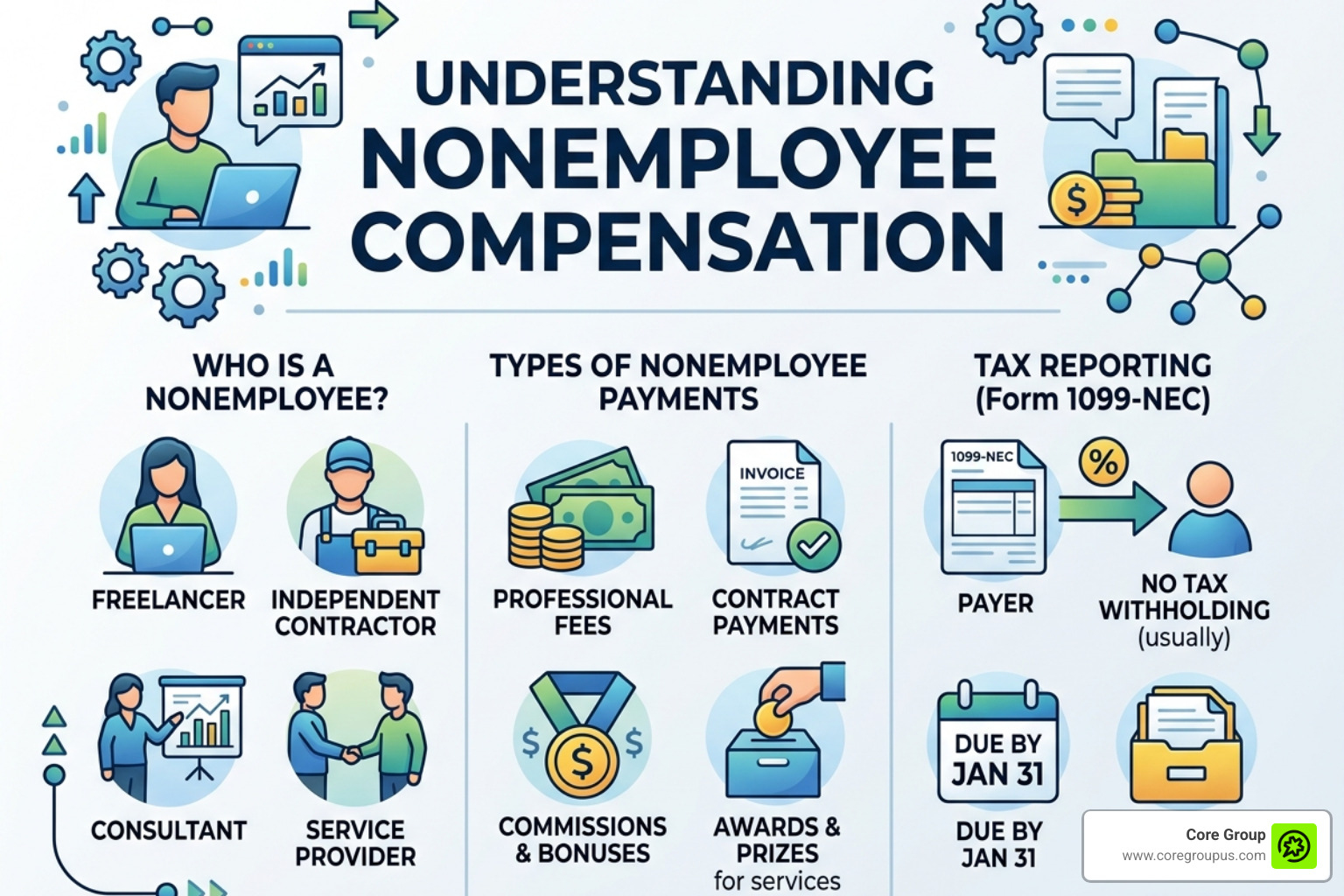
This is a massive jump from the old $600 limit. The goal was to reduce the paperwork burden on small businesses and freelancers alike. Even better, this $2,000 threshold is now indexed for inflation, meaning it will likely creep up every few years to keep pace with the economy.
Despite the higher threshold, the filing deadline remains the same. Businesses must get these forms to you and the IRS by January 31 of the following year. If you are curious about the history of this form or why it was reintroduced a few years back, check out this resource on how 1099 Nec Explained covers the transition from the old 1099-MISC system.
It is vital to remember that even if you earn $1,500 from a client and they do not send you a form because it is under the new $2,000 limit, that money is still taxable. The IRS expects you to report every dollar of nonemployee compensation you receive, regardless of whether a form was generated.
How the IRS determines worker classification
One of the biggest headaches for both businesses and freelancers is the concept of worker classification. Are you truly an independent contractor, or should you be an employee? This is not just a matter of what you call yourself in a contract. The IRS and the Department of Labor have very specific ways of looking at the relationship.
Misclassification is a serious issue. Recent data suggests that up to 30% of employers have misclassified workers at some point. This usually happens when a business treats someone like an employee by controlling when and how they work, but pays them as a contractor to save money on taxes and benefits.
The following table highlights the general differences between the two roles.
| Feature | Independent Contractor (Nonemployee) | Employee (W-2) |
|---|---|---|
| Tax Withholding | None; worker pays all taxes | Employer withholds income and FICA taxes |
| Work Schedule | Sets own hours and deadlines | Employer sets specific work hours |
| Tools and Equipment | Uses own gear and software | Employer provides necessary tools |
| Method of Work | Focuses on the final deliverable | Employer directs the step by step process |
| Benefits | No health insurance or PTO | Often eligible for company benefits |
| Expenses | Worker pays for business costs | Employer typically reimburses expenses |
If you want to see the official stance, the IRS provides a wealth of information About Form 1099-NEC that helps clarify these distinctions.
Key differences between employee and nonemployee compensation
The most painful difference between these two worlds is the tax structure. When you are an employee, your employer pays half of your FICA taxes (Social Security and Medicare). When you receive nonemployee compensation, you are both the employer and the employee. This means you are responsible for the full 15.3% self-employment tax.
Furthermore, employees are covered by unemployment insurance and workers' compensation. If a project ends or you get hurt on the job, there is a safety net. As a nonemployee, you generally do not have access to these protections unless you live in a state with very specific gig worker laws. You also miss out on the employer's contribution to your future Social Security benefits unless you are diligent about paying your self-employment taxes today.
IRS and DOL tests for worker status
To figure out where you fall, the IRS uses three main categories of evidence.
- Behavioral Control - Does the company control or have the right to control what the worker does and how the worker does the job? If they provide extensive training and a detailed manual on how to perform every task, you might be an employee.
- Financial Control - Are the business aspects of the worker’s job controlled by the payer? This includes things like how the worker is paid, whether expenses are reimbursed, and who provides tools or supplies. Independent contractors usually have a significant investment in their own equipment and have the opportunity for both profit and loss.
- Relationship Type - Are there written contracts or employee type benefits like insurance, a pension plan, or vacation pay? Will the relationship continue and is the work performed a key aspect of the business?
The Department of Labor (DOL) also uses an Economic Reality Test, which looks at whether the worker is economically dependent on the employer or is truly in business for themselves. If you are ever in a situation where the classification is unclear, you or the business can file Form SS-8 to ask the IRS for a formal determination.
Tax obligations and filing requirements for independent contractors
As a recipient of nonemployee compensation, you need to get comfortable with the IRS Form 1040 and its various schedules. Since no taxes were taken out of your pay during the year, you will likely owe a chunk of change when tax season rolls around.
The primary tax you need to worry about is the self-employment tax. This is currently 15.3%, which consists of 12.4% for Social Security and 2.9% for Medicare. You calculate this on Schedule SE. You also have to pay standard federal and state income taxes on your net profit.
Speaking of profit, one of the few perks of being a nonemployee is the ability to deduct business expenses. You report your income and expenses on Schedule C. This is where you list your camera gear, your home office space, your software subscriptions, and any other "ordinary and necessary" costs of doing business. If you operate as a Single Member Llc 1099 Reporting guidelines can help you understand how to flow that income through to your personal return.
Because the IRS wants its money throughout the year, you are generally required to make quarterly estimated tax payments if you expect to owe $1,000 or more. These payments are due in April, June, September, and January. If you wait until the end of the year to pay everything, you might get hit with underpayment penalties.
Strategies for managing nonemployee compensation documentation
The best way to protect yourself from a stressful tax season or a potential audit is to keep impeccable records. You should treat your freelance work like the professional business it is.

- Collect W-9s early - Before you even start working for a client, provide them with a completed Form W-9. This gives them your Taxpayer Identification Number so they can issue your 1099-NEC correctly.
- Track every expense - Use accounting software or even a simple spreadsheet to log every business purchase. Save your receipts digitally.
- Separate your finances - We highly recommend opening a separate bank account for your business. This makes it much easier to see exactly how much nonemployee compensation you have received without it getting mixed up with your grocery money.
- Use written contracts - Always have a contract that clearly states you are an independent contractor, defines the scope of work, and outlines the payment terms. This helps prove your status if the IRS ever asks.
Reporting income without a physical form
It happens every year. A client moves offices, forgets to file, or simply ignores the January 31 deadline. If you do not receive a 1099-NEC, do not panic. You do not need the physical form to file your taxes.
Your own records are your best friend here. If you have been tracking your invoices and bank deposits, you should know exactly how much you earned from that client. Simply report the total amount as business income on your Schedule C. The IRS is much happier when you report income without a form than when you omit income that they eventually find out about.
Frequently Asked Questions about 1099 forms
What should I do if I do not receive a 1099-NEC
If it is mid February and you are missing a form, first check your email and any portals you use for that client. Many businesses have moved to digital delivery. If you still cannot find it, reach out to the client's accounting department and ask for a copy. If they still do not provide one, just use your own records to report the income. You do not need to attach the 1099-NEC to your tax return anyway; you just need the numbers from it.
Can I receive both a W-2 and a 1099-NEC in the same year
Absolutely. This is very common for creative professionals who might have a part time staff job but also take on freelance projects on the side. You will report your W-2 wages on the standard "Wages and Salaries" line of your 1040, and your nonemployee compensation on Schedule C. Just keep in mind that your W-2 job only covers the taxes for that specific income. You still need to set aside money for the taxes on your freelance work.
What are the penalties for misclassifying a worker
For businesses, the penalties can be steep. They may be required to pay back taxes for both the employer and employee portions of FICA, unpaid overtime, workers' compensation premiums, and unpaid unemployment taxes. There can also be significant fines for failing to file the correct information returns. For the worker, misclassification usually means you have been overpaying on your self-employment taxes and missing out on benefits you were legally entitled to.
Conclusion
Navigating nonemployee compensation is part of the journey for any successful creative entrepreneur. While the tax forms and classification rules might seem like a distraction from your real work, getting them right is what allows your business to thrive and stay out of trouble with the IRS.
At Core Group, we specialize in helping creative entrepreneurs make sense of these complex financial requirements. Our "no-fluff, profit-first playbook" is designed to give you peace of mind and save you time, so you can get back to doing what you love. We understand the unique challenges of the gig economy and are here to ensure your financial foundation is as solid as your creative vision.
If you are looking for a partner to help manage your bookkeeping, tax strategy, or 1099 reporting, we are here to help. You can find More info about tax planning services on our website to see how we can support your business growth. Being your own boss is a lot more fun when you aren't worried about the tax man.