One Big Beautiful Bill: When Does the No Tax on Overtime Actually Start?
The New Overtime Tax Break Every Worker Needs to Know About
When does the no tax on overtime start? Here is the quick answer.
| Detail | Information |
|---|---|
| Effective start date | January 1, 2025 (retroactive) |
| Law signed | July 4, 2025 (Public Law 119-21) |
| Expiration date | December 31, 2028 |
| Max deduction (single) | $12,500 per year |
| Max deduction (joint) | $25,000 per year |
| Applies to | Federal income tax only |
Millions of American workers put in extra hours every week. Until recently, every dollar of that overtime got taxed the same as regular wages. That changed on July 4, 2025, when President Trump signed the One Big Beautiful Bill Act into law.
The new law created a federal tax deduction for qualifying overtime pay. It covers the 2025 through 2028 tax years. And because the start date was made retroactive, overtime you worked all the way back to January 1, 2025 is already covered.
By early March 2026, more than 15.5 million Americans had already claimed this deduction. Average tax refunds climbed more than 10% compared to the year before.
But there is an important catch most people miss. The deduction does not make all your overtime tax-free. It only applies to the premium portion of time-and-a-half pay, and it does not touch Social Security or Medicare taxes. Understanding exactly what qualifies is the difference between getting your full benefit and leaving money on the table.
I'm Christian Brim, and in this guide I'll walk you through everything you need to know to claim this deduction correctly.

When does the no tax on overtime start terms simplified.
When Does the No Tax on Overtime Start for American Workers
For millions of hourly employees, the wait is over. The federal overtime tax break is officially active. When we look at the timeline, the most important detail is that the start date is retroactive. This means you do not have to wait for future paychecks to see the benefits.

The policy officially went into effect on January 1, 2025. Even though the implementing legislation was not signed until the middle of that year, Congress wrote the law to cover the entire 2025 tax year. This retroactive structure means that any qualified overtime hours you logged starting on New Year's Day in 2025 are eligible for the deduction.
This major tax relief window is temporary. Under the current law, the deduction remains available through December 31, 2028. Unless Congress acts to extend the legislation, the policy will sunset at the end of 2028, and overtime pay will return to being taxed as ordinary income.
To help you understand the full scope of this timeline and how it impacts your tax filings, you can read more in this guide on When Does No Tax on Overtime Start? Everything Workers Need to Know. Keeping track of these dates ensures you do not miss out on years of potential savings, especially if you have been regularly working more than forty hours a week.
Knowing when these rules apply is the first step in planning your household budget. For a deeper look at the historical context of these rates, you can also explore our guide on the tax on overtime pay.
Key Dates and When Does the No Tax on Overtime Start
The journey of this tax cut is tied to several critical dates. President Trump signed the One Big Beautiful Bill Act, officially designated as Public Law 119-21, on July 4, 2025. Because the law was signed halfway through the year, the IRS designated the 2025 tax year as a transition period.
During this transition period, employers were not required to change their payroll systems immediately to report overtime separately on W-2 forms. This meant that workers filing their taxes in early 2026 had to rely on their own pay stubs or transitionary employer statements to calculate their qualified overtime premium.
Understanding these historical milestones helps clarify why your tax forms might look different depending on the year you are filing. For more details on the evolution of these withholding rules, check out our resource on overtime pay taxes.
State Tax Conformity and When Does the No Tax on Overtime Start
While the federal government has embraced this tax break, state governments are a completely different story. The No Tax on Overtime policy is a federal income tax deduction. It does not automatically apply to state income taxes.
Most states determine their tax rules based on federal Adjusted Gross Income. Because this new overtime policy is a below-the-line deduction, it reduces your taxable income but does not lower your Adjusted Gross Income. Consequently, many states do not recognize this deduction on state tax returns.
For example, if you work in California, you will still owe state income taxes on your full overtime earnings. California has not conformed to this federal rule, meaning your state tax bracket remains unaffected. You can read more about how local rules differ in our analysis of is overtime taxed at a higher rate in california.
To see a broader perspective on how state-level decoupling impacts workers across the country, refer to the national breakdown on How no tax on overtime works and when you'll still pay taxes.
Understanding the Qualified Overtime Deduction Rules
To claim this deduction successfully, you must understand what counts as qualified overtime compensation. The law relies strictly on the guidelines established by the Fair Labor Standards Act.

Under the Fair Labor Standards Act, standard overtime is defined as hours worked beyond forty in a single workweek. The biggest area of confusion for most taxpayers is the difference between total overtime pay and the overtime premium. The deduction only applies to the premium portion of your time-and-a-half pay.
The premium portion is the extra half rate paid on top of your regular hourly rate. For example, if your regular rate is $20 per hour, your time-and-a-half overtime rate is $30 per hour. The regular $20 base rate is still fully taxable. Only the additional $10 per hour premium is eligible for the federal income tax deduction.
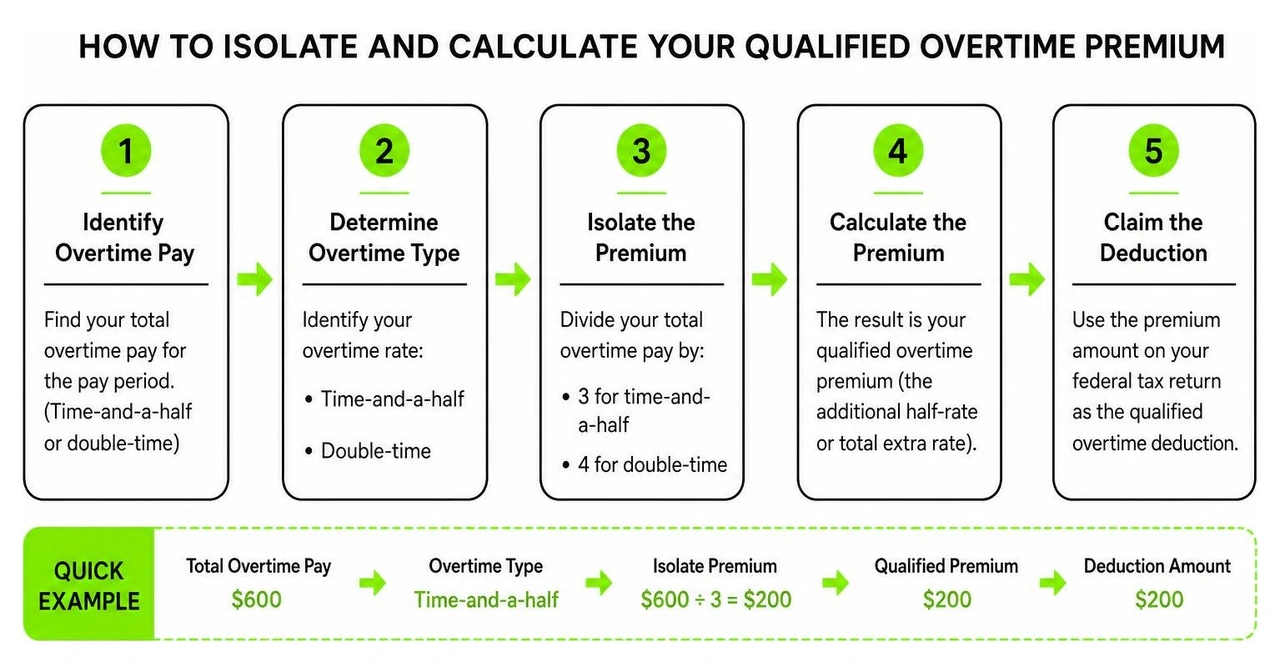
If you are paid a standard time-and-a-half rate, a simple trick to find your deductible premium is to take your total overtime pay and divide it by three. If you receive double-time, you would divide the overtime portion by four to isolate the standard premium. For a step-by-step breakdown of this math, we have put together a guide on how to calculate qualified overtime.
For official regulatory definitions of what constitutes standard overtime under federal employment law, you can visit the Federal Overtime Tax Rules and Guidelines.
Who Qualifies for the Overtime Tax Break
The deduction is designed for non-exempt W-2 employees who are legally entitled to overtime pay under federal labor standards. This includes hourly workers in manufacturing, healthcare, retail, and public safety.
However, high-income earners face restrictions. The deduction begins to phase out once your Modified Adjusted Gross Income exceeds certain limits. For single filers, the phase-out starts at $150,000. For married couples filing jointly, the phase-out starts at $300,000.
If your income exceeds these limits, your maximum deduction is reduced. To learn more about how these thresholds interact with standard federal brackets, read our article on what is the federal tax rate on overtime.
What Taxes Are Still Owed on Overtime Pay
It is important to remember that this new law is not a complete tax exemption. You will still pay several types of taxes on your overtime earnings.
First, FICA payroll taxes still apply to every dollar of your overtime pay. You and your employer must still pay the standard 6.2% Social Security tax and the 1.45% Medicare tax on all overtime wages. The federal deduction only reduces your income tax liability, not your payroll tax liability.
To understand why payroll taxes are still withheld and how this impacts your net take-home pay, you can read our explainer on does overtime get taxed at a higher rate.
For a complete policy analysis of how these remaining taxes affect the federal budget and working families, take a look at the commentary on No Tax On Overtime Explained.
How to Claim the Overtime Deduction on Your Tax Return
When tax season arrives, claiming your savings requires completing specific forms. You do not need to itemize your deductions to claim this benefit. It is available to both itemizers and those taking the standard deduction.
To claim the deduction, you must fill out Schedule 1-A and attach it to your Form 1040. On Schedule 1-A, you will calculate your total qualified overtime premium and apply any necessary income phase-outs. The final deduction amount is then transferred to Form 1040, Line 13b.
Because this is a below-the-line deduction, it reduces your taxable income directly. However, it does not lower your Adjusted Gross Income, which means it will not affect your eligibility for other tax credits that rely on Adjusted Gross Income limits.
For a detailed walkthrough of how this below-the-line deduction changes your final tax bill, see our guide on how to calculate overtime tax rate.
To find the official instructions for filling out these tax schedules, you can consult the Government Guide on Overtime Tax Rules.
Employer Reporting Requirements and W-2 Forms
As we move past the initial transition period, employer reporting requirements have become more structured. For the 2025 tax year, employers were allowed to report qualified overtime premium in Box 14 of the W-2 using the label "FLSA OT Prem" or provide a separate statement.
Starting with the 2026 tax year, reporting is mandatory and standardized. Employers must report qualified overtime compensation in Box 12 of Form W-2 using Code "TT".
If you want to estimate how these W-2 changes will impact your monthly take-home pay, you can use our interactive paycheck calculator with overtime.
Income Limits and Phase-Out Calculations
The deduction is reduced gradually for workers earning above the phase-out thresholds. For every $1,000 of Modified Adjusted Gross Income above the starting limit, your maximum deduction is reduced by $100.
| Filing Status | Phase-Out Starts (MAGI) | Complete Phase-Out (No Deduction) |
|---|---|---|
| Single Filers | $150,000 | $275,000 |
| Married Filing Jointly | $300,000 | $550,000 |
If you are married, you must file a joint return to claim the deduction. Married couples filing separately are completely ineligible for this tax break.
To review the exact IRS worksheets used to calculate these phase-outs, visit the Official Overtime Tax Deduction Guide.
Frequently Asked Questions About the Overtime Tax Break
Is my entire overtime paycheck tax-free
No. Only the qualified overtime premium, which is the extra half portion of your time-and-a-half rate, is eligible for the federal income tax deduction. Your base hourly wages earned during those overtime hours remain fully taxable under ordinary federal income tax rates. Additionally, all overtime hours are still subject to state income taxes in non-conforming states and federal payroll taxes.
Does the overtime deduction lower my AGI
No. The overtime deduction is classified as a below-the-line deduction. It reduces your federal taxable income, but it does not lower your Adjusted Gross Income. This is an important distinction because your Adjusted Gross Income is used to determine your eligibility for other tax benefits, student loan payment calculations, and health insurance subsidies.
Can self-employed individuals claim the overtime deduction
No. The deduction is strictly limited to non-exempt W-2 employees who are covered by the Fair Labor Standards Act. Independent contractors, 1099 gig workers, and self-employed business owners do not earn overtime wages under standard federal labor definitions, meaning they cannot claim this deduction.
Conclusion
The No Tax on Overtime deduction represents a major opportunity for hourly workers to keep more of their hard-earned money. By understanding the retroactive start date, the phase-out rules, and the specific calculation of the overtime premium, you can make sure you claim every dollar you deserve.
At Core Group, we focus on helping creative entrepreneurs and non-exempt teams navigate complex tax changes. We offer financial management, bookkeeping, and tax services designed to save you time and provide complete peace of mind. Our unique, no-fluff, profit-first playbook is built to protect your business and maximize your deductions, all backed by our MacBook Pro guarantee.
If you are a business owner trying to structure your payroll for these new rules, or a professional looking to plan your taxes, we are here to help. For specialized strategies tailored to creative service providers, read our guide on marketing consultant overtime tax planning.
To stay ahead of future changes and ensure your payroll systems are fully compliant, keep an eye on our updated analysis of the overtime tax rate. Let us handle the numbers so you can focus on growing your business.