Tax on Overtime Pay: Is Your Extra Work Finally Tax-Free?
Your Extra Hours Finally Pay Off a Little More
The rules around tax on overtime pay changed significantly in 2025, and if you work extra hours, you may owe less to the IRS than before.
Here is the quick version:
- What changed: The One Big Beautiful Bill Act, signed July 4, 2025, created a new federal deduction for qualified overtime pay
- Who qualifies: Non-exempt (FLSA-covered) employees who earn overtime pay and have a modified AGI under $275,000 (single) or $550,000 (joint)
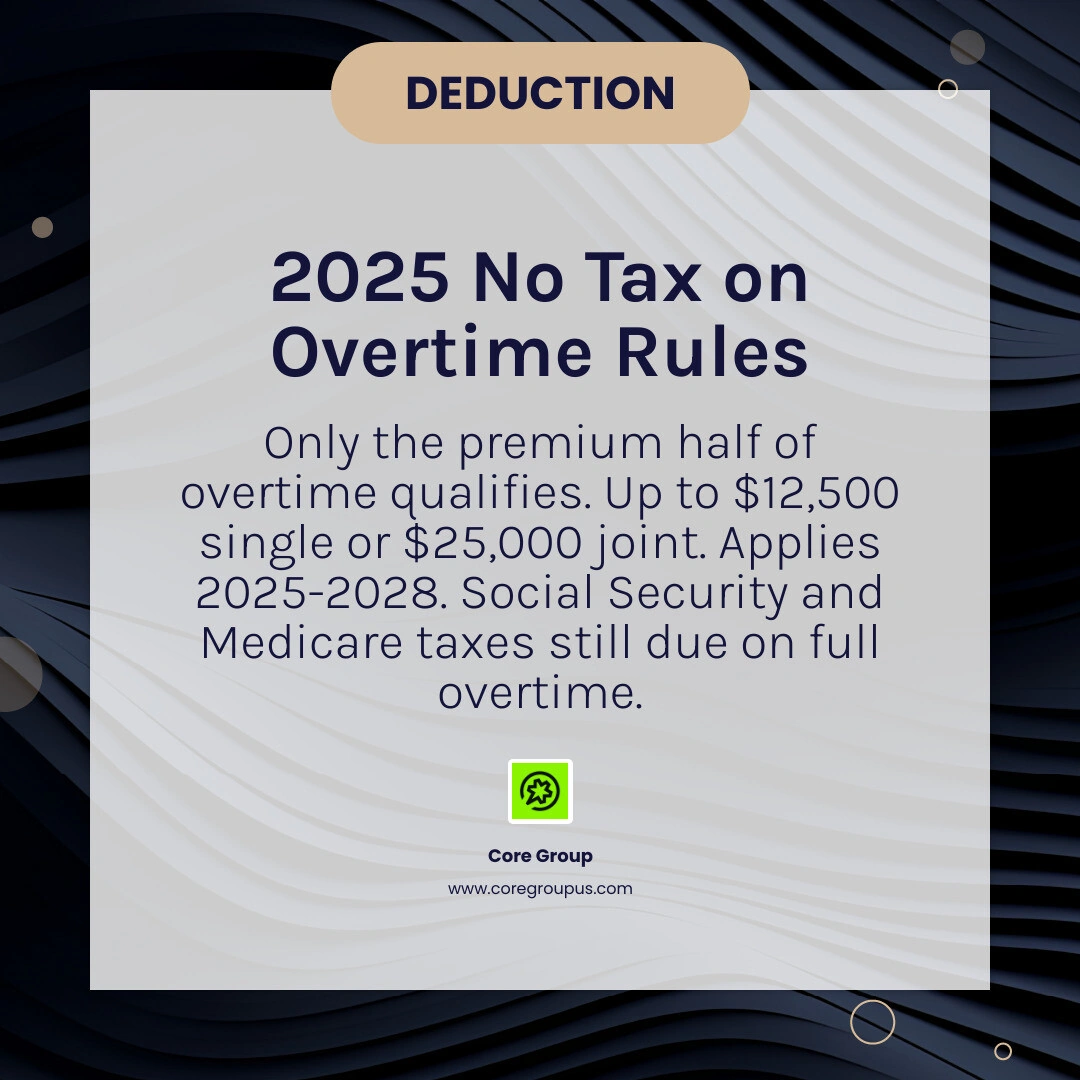
- What you can deduct: Only the premium portion of overtime, meaning the "half" in time-and-a-half, not your full overtime amount
- How much: Up to $12,500 per year for single filers, or $25,000 for married couples filing jointly
- When it applies: Tax years 2025 through 2028 only
- Payroll taxes: Social Security and Medicare taxes still apply to all overtime pay
This is not a blanket exemption. Most overtime pay is still taxable. But for millions of workers, the deduction is already making a real difference. By early March 2026, more than 15.5 million returns had claimed the deduction, and average refunds were running more than 10% higher than the year before.
If you are a creative professional or freelancer who picks up extra hours on productions, shoots, or projects, understanding exactly how this deduction works, and what it does not cover, can help you avoid a costly surprise at tax time.
Tax on overtime pay terms to learn:
Understanding the new federal tax on overtime pay deduction

When the One Big Beautiful Bill Act became law on Independence Day in 2025, it introduced a major shift in how the federal government looks at your extra hours. For the first time in modern tax history, we have a specific provision designed to lower the tax on overtime pay for the American workforce. However, it is important to understand that this is a deduction, not a total tax exemption.
In tax forms, this is what we call a below the line deduction. This means it reduces your taxable income but does not actually lower your Adjusted Gross Income (AGI). While that might sound like technical jargon, the practical result is simple. You pay income tax on a smaller portion of your earnings.
This deduction applies to the 2025 tax year and is currently scheduled to stay in place through 2028. Because the law was passed halfway through 2025, it applies retroactively to all qualified overtime earned since January 1 of that year. Many workers were surprised to find their refunds were larger this spring because they could suddenly deduct a portion of the extra work they did months before the bill even existed.
To learn more about maximizing your return, you can check out our guide on how to save on taxes. Understanding how no tax on overtime in big, beautiful bill works is the first step toward keeping more of your hard earned money.
Eligibility and income limits for the deduction
Not every worker who puts in extra hours will see a benefit from this new law. The IRS has set specific boundaries based on your job type and how much you earn. To qualify, you must be a non-exempt employee under the Fair Labor Standards Act (FLSA). This generally means workers who are entitled to time and a half pay for hours worked over 40 in a single week.
If you are a salaried professional, a teacher, or a business owner, you might be considered exempt from FLSA overtime rules, which means you typically won't qualify for this specific deduction. For our creative entrepreneurs, this distinction is vital. If you are operating as an independent contractor, early guidance suggests you are not eligible for this deduction because it is designed for W-2 employees.
There are also strict income limits. The deduction begins to phase out once your Modified Adjusted Gross Income (MAGI) hits a certain level. If you earn more than the upper limit, the deduction disappears entirely.

The phase-out works by reducing your deduction by $100 for every $1,000 you earn above the initial threshold. For example, a single filer earning $200,000 would see a smaller deduction than someone earning $140,000. Once a single filer hits $275,000 or a married couple filing jointly hits $550,000, the benefit is gone.
Knowing what overtime pay really qualifies for a tax break in 2025 is essential because things like holiday pay or shift differentials don't automatically count as deductible overtime unless they actually exceed the 40 hour workweek threshold.
Calculating the premium portion of your overtime

One of the biggest points of confusion regarding the tax on overtime pay is exactly how much you get to deduct. Many people hear No Tax on Overtime and assume their entire overtime check is tax free. That is not the case.
The law only allows you to deduct the premium portion of your overtime pay. If you earn $20 per hour as your regular rate and $30 per hour for overtime, your premium is $10. That $10 is the only part that qualifies for the deduction. The base $20 you earned for that hour is still taxed at your normal income tax rate.
Think of it as the half in time and a half. If you are lucky enough to earn double time through a union contract or special agreement, the rules are even stricter. You can still only deduct the amount that would have been the time and a half premium.
The IRS has placed a cap on how much you can deduct each year regardless of how many hours you work:
- Single filers can deduct a maximum of $12,500 in premium pay.
- Married couples filing jointly can deduct up to $25,000.
It is a common mistake to think the whole amount is covered. As the experts at CNN Politics point out, you should think all your overtime pay will be tax free? Think again. You can find more details on how these rates are applied in our post on the overtime tax rate.
Filing Schedule 1A and reporting requirements
To actually get this money back, you have to tell the IRS about it. This is not an automatic adjustment. You must file Schedule 1-A with your tax return and enter the total deduction amount on Form 1040, line 13b.
For the 2025 tax year, reporting is a bit like the Wild West. Because the law was passed mid-year, employers were not required to track this separately on W-2 forms. You might see information in Box 14 of your W-2, but many workers have to rely on their own pay stubs and year-end summaries to calculate their premium pay manually.
Starting in 2026, the process gets more organized. Employers will be required to report qualified overtime compensation in Box 12 of the W-2 using code TT.
If you get this calculation wrong, it can lead to what some call $5,000 mistakes. Underpaying your taxes due to a miscalculated deduction can result in a 20% negligence penalty plus interest. This is why record keeping is so important. You should save every pay stub that shows overtime hours and rates.
For those in the gig economy, tax planning for freelancers is already complex, and this new law adds another layer of documentation if you are balancing W-2 work with your creative projects. You can read more about avoiding these pitfalls in this article on understanding the IRS's 'No Tax on Overtime' law.
Frequently Asked Questions about overtime taxes
What is the current tax on overtime pay rate
Even with this new deduction, you are still paying some tax on overtime pay. The No Tax on Overtime rule only applies to federal income tax. It does not touch payroll taxes, which are often called FICA taxes.
You and your employer must still pay:
- 6.2% for Social Security (up to the annual wage base)
- 1.45% for Medicare
These taxes are withheld from every dollar you earn, including the overtime premium. So, while your income tax bill might go down, your paycheck will still show these deductions. If you are wondering about specific states, you might ask is overtime taxed at a higher rate in california. Generally, the answer is no, but the way withholding is calculated on a large check can sometimes make it feel that way.
Does the tax on overtime pay apply to state returns
This is where it gets tricky. Just because the federal government gives you a break doesn't mean your state will. Every state has to decide whether to follow the federal lead.
For example, the Alabama Department of Revenue has its own specific rules for overtime exemptions. In contrast, states like Colorado have indicated that state income tax will still be owed on overtime pay for 2026. If you live in a state with no income tax, like Florida or Texas, this isn't a concern. But if you are in a state with local or state income taxes, you need to check if they have conformed to the new federal law.
When does the new law expire
The No Tax on Overtime provision is not a permanent change to the tax code. It was designed as a temporary relief measure. Currently, the law is set to expire after the 2028 tax year.
Unless Congress acts to extend it, the deduction will vanish in 2029, and the tax on overtime pay will return to its previous levels. For many, especially those who are self-employed or running a business, this temporary nature makes long-term planning difficult. If you are wondering as a freelancer how do I plan for taxes, it is always best to assume these types of breaks are short lived and keep your savings strategies flexible.
Conclusion
The new federal deduction for overtime is a welcome change for millions of workers, but it is far from simple. Between premium pay calculations, income phase-outs, and varying state rules, there are plenty of ways to get tripped up.
At Core Group, we specialize in helping creative entrepreneurs navigate these types of complex financial shifts. We know that you would rather be focusing on your next big project than squinting at Schedule 1-A. Our profit-first playbook is designed to give you peace of mind and save you time, ensuring your business stays healthy while you stay creative. We even back our service with a MacBook Pro guarantee.
If you want to make sure you are capturing every deduction available to you, get expert help with your tax planning from our team today. We are here to help you turn those extra hours into real savings.