A Practical Guide to 401(k) Deduction Limits
How a 401(k) Deduction Works
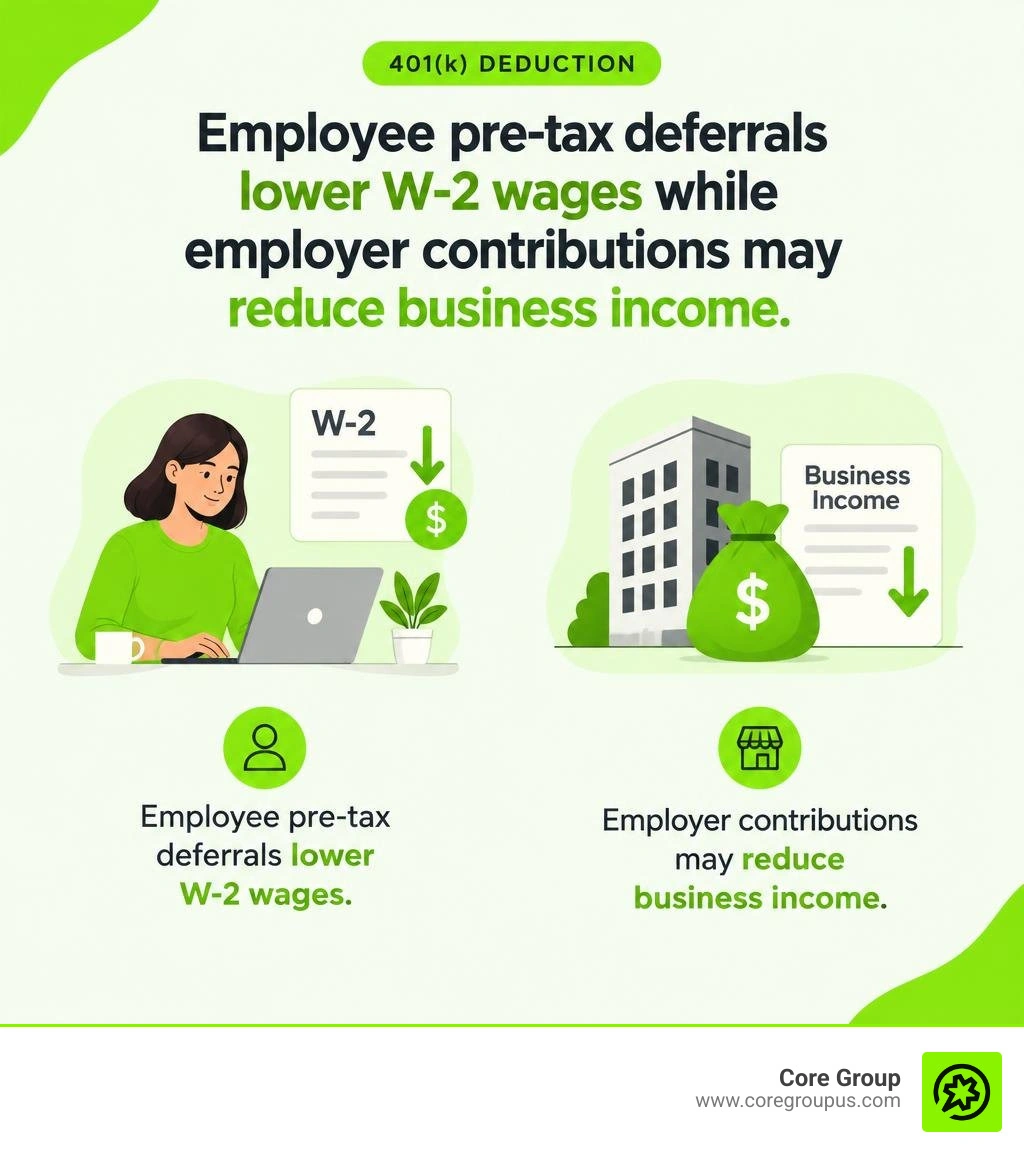
To get the tax benefit often called a 401 k deduction, choose traditional pre-tax contributions through payroll. They lower your federal taxable wages, so do not deduct them again on your tax return. Roth 401(k) contributions do not lower your taxable income now.
If you run a creative business, your employer matching and profit-sharing contributions may also be deductible on the business return, subject to plan rules and limits. Keep those contributions separate from your own paycheck deferrals.
I’m Christian Brim, and I’ll help you sort out which limits and deadlines apply to each.
Key terms for 401 k deduction include 401k contribution limits 2025, 401k employer contribution rules, and 401k after tax contribution.
How the 401 k Deduction Works for Employees and Employers
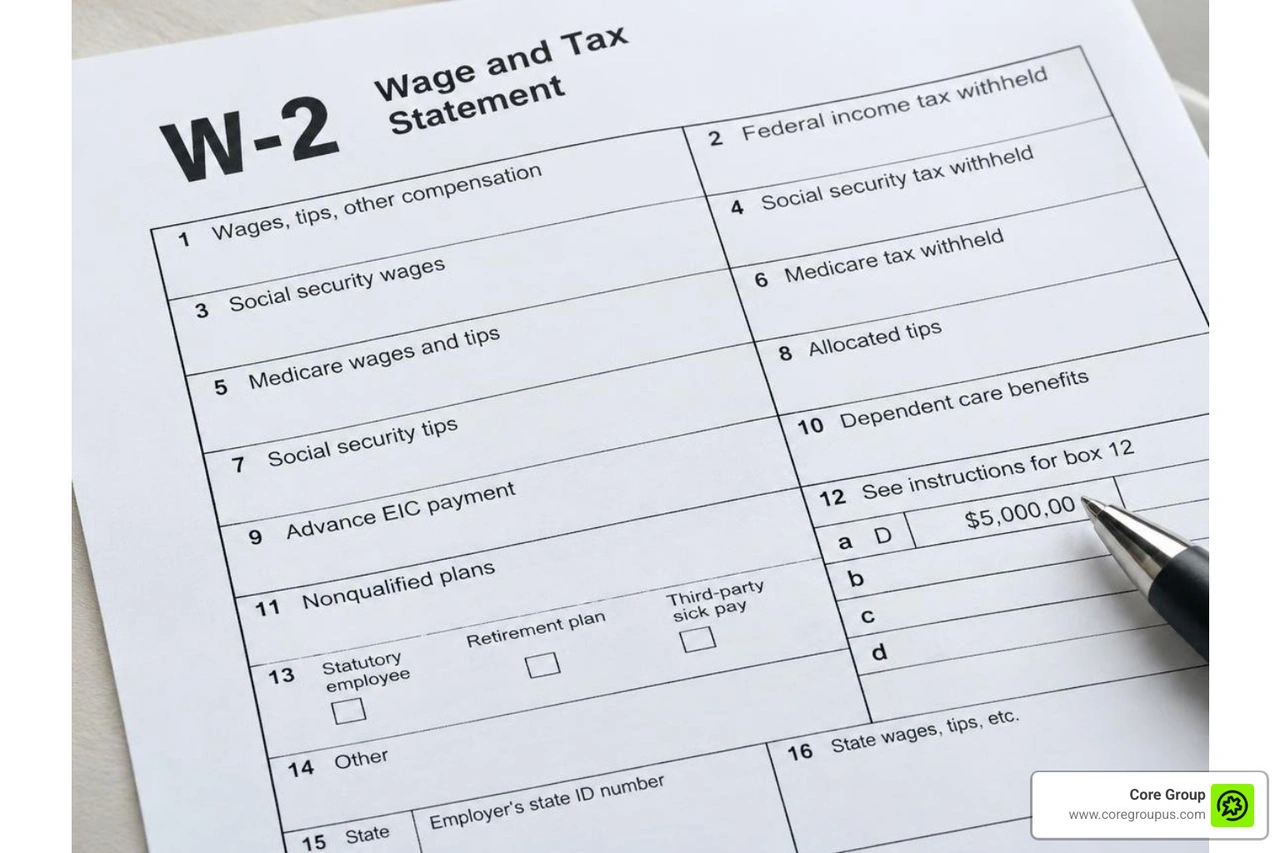
Understanding retirement tax rules starts with distinguishing between employee elective deferrals and company-funded contributions. When employees participate in a workplace plan, their contributions flow directly through payroll deductions. For pre-tax elective deferrals, payroll systems subtract the contribution amount from gross earnings before calculating federal and most state income tax withholdings.
This exclusion means that employee contributions never appear as taxable income in Box 1 of Form W-2. Taxpayers often search their tax software for a specific line to claim a deduction for their workplace retirement savings, but standard workplace plan deferrals are already reflected as an income reduction. Attempting to write off that amount again on your tax return constitutes double counting and invites unwanted IRS scrutiny.
For business owners and corporate entities, company-paid contributions operate as ordinary and necessary business expenses. S corporations, C corporations, partnerships, and sole proprietorships can write off qualified matching and nonelective contributions on their respective business tax forms. You can explore standard tax reporting guidelines on Form 1040 alongside the comprehensive 401k plan overview from the Internal Revenue Service to verify how business deductions differ from individual payroll exclusions.
Pre-Tax Versus Roth 401(k) Deduction Mechanics
Choosing between traditional pre-tax and Roth designations changes when you receive your tax benefits. A traditional 401(k) provides upfront tax relief by lowering current-year adjusted gross income. In exchange for this immediate reduction, every dollar withdrawn during retirement, including investment growth, is taxed as ordinary income.
A designated Roth 401(k) operates on after-tax dollars. Your payroll department withholds income taxes on the entire contribution amount in the year you earn it, meaning you get no upfront tax deduction. The advantage arrives later, because qualified distributions taken after age 59½ and after meeting the five-year holding rule are completely tax-free.
| Feature | Traditional 401(k) | Roth 401(k) | Voluntary After-Tax 401(k) |
|---|---|---|---|
| Upfront Tax Relief | Yes, reduces Box 1 wages | No, funded with after-tax pay | No, funded with after-tax pay |
| Taxation on Earnings | Tax-deferred until withdrawal | Tax-free upon qualified distribution | Tax-deferred until distribution or conversion |
| Taxation on Withdrawals | Taxed as ordinary income | 100% tax-free if qualified | Contributions tax-free, earnings taxed as income |
| Annual Limit Category | Elective deferral limit | Elective deferral limit | Section 415(c) overall limit |
Reporting Contributions on Form W-2 and Form 1040
When tax season arrives, your Form W-2 tells the full story of your retirement contributions. Box 1 reports your federal taxable wages, which has already been reduced by any traditional pre-tax 401(k) deferrals. Box 3 for Social Security wages and Box 5 for Medicare wages will still show your full gross compensation, because retirement deferrals remain subject to FICA payroll taxes.
Box 12 uses informational codes to track specific deferral types. Code D designates traditional pre-tax elective deferrals, while Code AA indicates Roth contributions. When filing Form 1040, you simply transfer the Box 1 amount directly to Line 1a. Understanding whether and how do 401(k) contributions reduce MAGI helps determine eligibility for other tax credits and deduction phase-outs throughout your return.
2026 Contribution and Catch-Up Limits
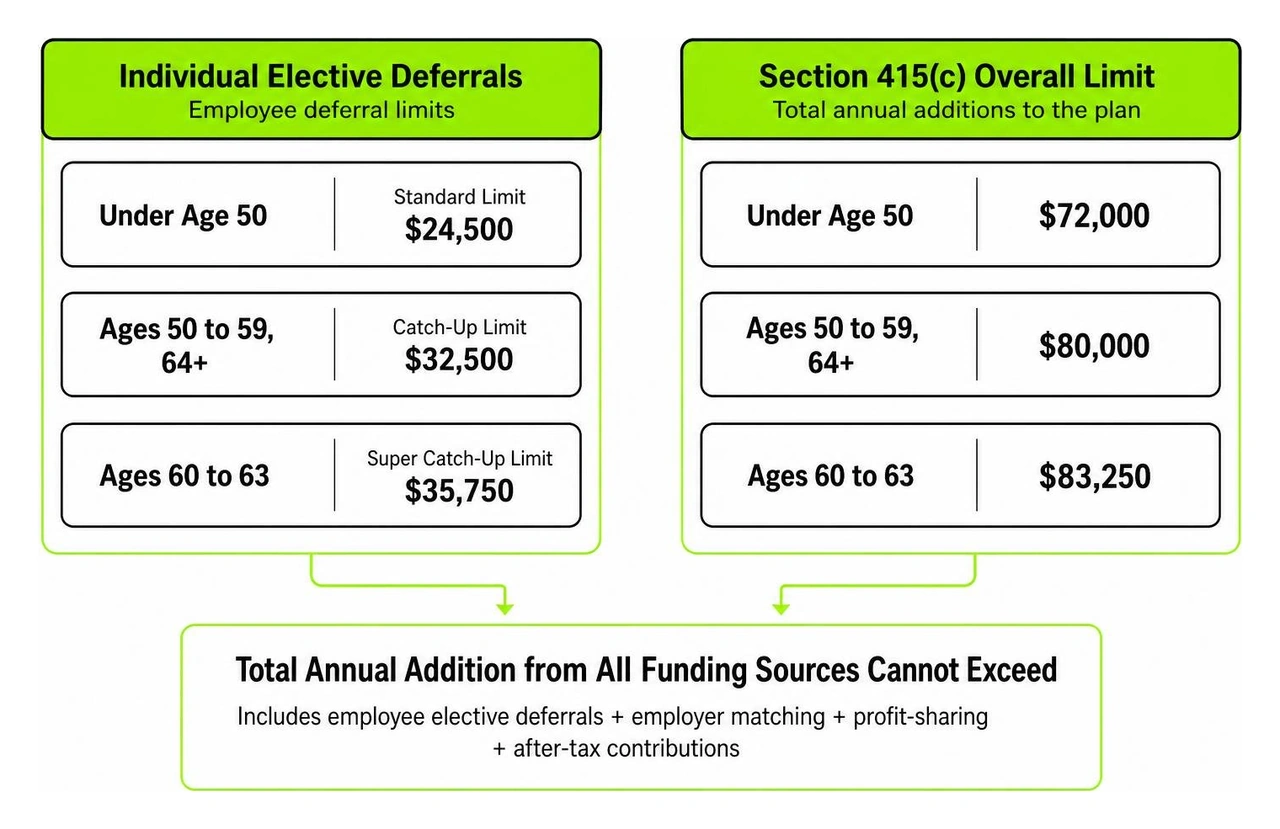
The IRS updates retirement plan limitations periodically to account for cost-of-living adjustments. Staying within these thresholds prevents costly administrative corrections and unexpected tax penalties. Plan participants must monitor both individual employee deferral caps and aggregate plan contribution limits under Internal Revenue Code Section 415(c).
Our 2026 contribution limit guide highlights how annual cost-of-living adjustments expand savings potential for creative business owners and high earners alike.
| Contribution Category | Standard Limit (Under Age 50) | Catch-Up Limit (Ages 50 to 59, 64+) | Super Catch-Up Limit (Ages 60 to 63) |
|---|---|---|---|
| Employee Elective Deferral | $24,500 | $32,500 | $35,750 |
| Catch-Up Allowance Only | None | $8,000 | $11,250 |
| Section 415(c) Overall Limit | $72,000 | $80,000 | $83,250 |
Elective Deferrals and SECURE 2.0 Catch-Up Rules
For the 2026 tax year, the standard employee elective deferral cap is $24,500 across traditional and Roth accounts combined. Participants aged 50 and older can take advantage of an $8,000 standard catch-up contribution, bringing their personal deferral ceiling to $32,500.
Under the SECURE 2.0 Act, individuals who attain age 60, 61, 62, or 63 during the tax year qualify for an enhanced super catch-up contribution of $11,250 instead of the standard $8,000 amount, provided their employer plan supports the provision. Business owners and employees evaluating 401(k) over 50 catch-up options must also note that high-income earners with prior-year FICA wages exceeding $145,000 are required to make all catch-up contributions into a Roth account rather than a pre-tax account.
Mega Backdoor Roth and Section 415 Limits
The total annual addition from all funding sources cannot exceed $72,000 in 2026 before factoring in age-based catch-up amounts. This aggregate cap encompasses your employee elective deferrals, employer matching dollars, discretionary profit-sharing allocations, and any voluntary after-tax contributions.
High-earning professionals whose plans allow after-tax deposits can utilize the mega backdoor Roth strategy. After maxing out the standard $24,500 elective deferral and receiving company matching funds, participants can allocate non-deductible after-tax contributions up to the $72,000 cap. Converting these after-tax funds immediately into a designated Roth account allows high earners to shelter substantial sums of future investment growth from taxation. Learn more about navigating after-tax 401(k) contribution rules to avoid unexpected taxable distributions.
Rules and Limits for Employer 401(k) Contributions
Company-sponsored matching and profit-sharing contributions provide a powerful lever for business tax planning. When structured properly, these contributions reduce business taxable income under IRC Section 404 while building wealth for company owners and their teams.
Establishing clear plan rules ensures that business allocations remain fully compliant with federal nondiscrimination and vesting standards. Following clear employer contribution rules lets businesses optimize corporate deductions while rewarding key personnel.
The Twenty-Five Percent Payroll Deduction Limit and Timing Rules
The IRS limits total employer deductions to 25 percent of the aggregate eligible compensation paid to all eligible plan participants during the tax year. For 2026, the maximum compensation that can be considered for any individual employee is $350,000.
To claim an employer deduction for a given tax year, business contributions must be deposited into the plan trust by the company's federal tax return filing deadline, including official extensions. This rule allows accrual-basis and cash-basis businesses to calculate their final year-end profits, determine an optimal profit-sharing contribution, and deduct that expense on their prior-year return even when the physical deposit occurs in the subsequent calendar year.
Safe Harbor Match Structures and SECURE 2.0 Tax Credits
Traditional plans require annual nondiscrimination testing to verify that contributions do not disproportionately favor business owners or highly compensated employees. Adopting a safe harbor structure waives these testing requirements in exchange for mandatory, fully vested company contributions. Employers generally satisfy safe harbor rules through either a basic match of 100 percent on the first 3 percent of compensation plus 50 percent on the next 2 percent, or a 3 percent nonelective contribution to all eligible staff.
Small business owners establishing new plans can also leverage lucrative SECURE 2.0 tax credits. Qualifying employers with up to 50 employees can claim a tax credit covering 100 percent of plan startup costs up to $5,000 annually for three years. Additionally, eligible employers can claim a direct tax credit for employer contributions made on behalf of non-highly compensated employees, starting at 100 percent in years one and two before gradually phasing down over five years. Our safe harbor 401(k) guide breaks down how these options streamline administration for growing firms.
Self-Employed Solo 401 k Deduction Strategies

Solo business owners, independent consultants, and single-member LLCs with no full-time employees other than a spouse can establish an individual Solo 401(k). This structure allows the business owner to wear two distinct hats, employee and employer.
As an employee, you can defer up to $24,500 in 2026, plus any applicable catch-up amounts. As the employer, your business can contribute an additional 25 percent of net adjusted self-employment earnings for sole proprietors or 25 percent of W-2 wages for S corporation owner-employees, up to the overall $72,000 ceiling.
Calculating Earned Income on Schedule 1
For unincorporated sole proprietors reporting on Schedule C, calculating deductible profit-sharing contributions involves an adjustment. Net earnings from self-employment must first be reduced by one-half of the self-employment tax deduction before determining the allowable percentage.
This calculation adjusts your base earned income downward, which results in an effective maximum employer contribution rate of 20 percent of net earnings after the self-employment tax adjustment, rather than a flat 25 percent. The resulting employer contribution is reported on Schedule 1 Line 16 of Form 1040, providing an above-the-line deduction that lowers adjusted gross income without requiring you to itemize deductions.
Retroactive Plan Adoption and Last-Minute Tax Relief
Recent legislative updates provide flexibility for business owners seeking last-minute tax deductions. Under current federal rules, an employer can establish and adopt a qualified retirement plan retroactively up until the due date of the business tax return, including extensions.
While employee elective deferrals must generally be elected prospectively during the operating tax year, retroactive plan adoption allows sole proprietors and corporate entities to fund deductible employer profit-sharing contributions for the prior tax year. This allows business owners to analyze their final financial performance with their tax advisor before committing specific capital to deductible contributions.
Managing Contribution Oversights and Additional Tax Credits
Maintaining retirement accounts requires monitoring contributions across all jobs and checking state-specific tax variations. Over-contributing or failing to claim applicable credits can result in unnecessary tax burdens.
State laws also impact how retirement deductions are handled. While most states follow federal guidelines by excluding pre-tax contributions from taxable income, certain states apply unique rules. Taxpayers can review individual state guidelines, such as the state tax treatment of retirement income, to confirm local compliance.
Correcting Excess Deferrals Before April 15
Exceeding the annual elective deferral limit often happens when an employee changes employers mid-year and both companies withhold contributions up to the individual cap. When this occurs, the excess amount must be reported to the plan administrator and distributed back to the participant by April 15 of the following year.
If you correct the excess by April 15, the returned deferral is taxed as ordinary income in the year it was contributed, while any associated investment earnings are taxed in the year distributed. If you miss the April 15 deadline, you face double taxation. The excess amount is taxed in the year of contribution and taxed again when eventually withdrawn from the plan, without the benefit of basis adjustments.
Claiming the Savers Credit on Form 8880
Low- and moderate-income taxpayers who contribute to an employer plan or individual retirement account may qualify for the Retirement Savings Contributions Credit, commonly known as the Saver's Credit. This non-refundable credit directly reduces your tax liability dollar-for-dollar on top of the upfront exclusion provided by pre-tax contributions.
The Saver's Credit applies to the first $2,000 of retirement contributions for single filers and up to $4,000 for married couples filing jointly. Depending on adjusted gross income, the credit rate is 50 percent, 20 percent, or 10 percent of contributions, yielding a maximum credit of $1,000 for individuals and $2,000 for joint filers. Taxpayers calculate the credit on Form 8880 and report the final amount on Schedule 3 Line 4 of Form 1040.
Frequently Asked Questions About 401(k) Deductions
Can you claim a 401(k) deduction without itemizing?
Yes, traditional pre-tax contributions do not require you to itemize deductions on Schedule A. For W-2 employees, the tax benefit occurs automatically because your employer reduces your taxable wages in Box 1 of Form W-2 before you file. You receive the full standard deduction on Form 1040 while still benefiting from your payroll exclusion. Self-employed individuals deduct their employer contributions as an above-the-line deduction on Schedule 1, which reduces adjusted gross income regardless of whether they itemize.
Do employer matching contributions show up on Form W-2?
Employer matching and nonelective contributions do not appear anywhere on your Form W-2. These contributions grow tax-deferred within your account and are excluded from your gross income for both income tax and payroll tax purposes in the year they are made. You only report these funds when you take distributions from the plan during retirement, at which point the withdrawals are taxed as ordinary income.
Does participating in a 401(k) reduce traditional IRA deduction limits?
Active participation in an employer-sponsored retirement plan can limit or eliminate your ability to deduct contributions made to a traditional IRA. If you or your spouse are covered by a workplace plan, the deductibility of your traditional IRA contribution phases out across specific modified adjusted gross income ranges set annually by the IRS. However, workplace plan participation does not restrict your ability to make standard contributions to a Roth IRA, provided your income remains under the separate Roth IRA income eligibility caps.
Conclusion
Maximizing the tax advantages of your retirement plan requires balancing payroll deferrals, business deductions, and annual IRS limits. Whether you are an employee optimizing your take-home pay or a creative business owner designing a high-impact profit-sharing formula, proactive planning ensures you capture every allowable dollar of tax relief while maintaining total regulatory compliance.
At Core Group, we provide comprehensive financial management, bookkeeping, and tax services designed specifically for creative entrepreneurs. Our team implements a straightforward, profit-first playbook that eliminates financial clutter, protects your business, and gives you back valuable time to focus on growth. Explore our guide on maximizing 401(k) and MAGI tax planning strategies to align your retirement contributions with your long-term business goals.