Beyond the Limit: How After-Tax 401(k) Contributions Can Boost Your Retirement
What Is a 401(k) After-Tax Contribution and Why It Matters
A 401k after tax contribution is one of the most powerful and most overlooked tools in retirement planning. Most people know about the standard pre-tax 401(k) and the Roth 401(k). But there is a third option that can dramatically increase how much you save for retirement each year.
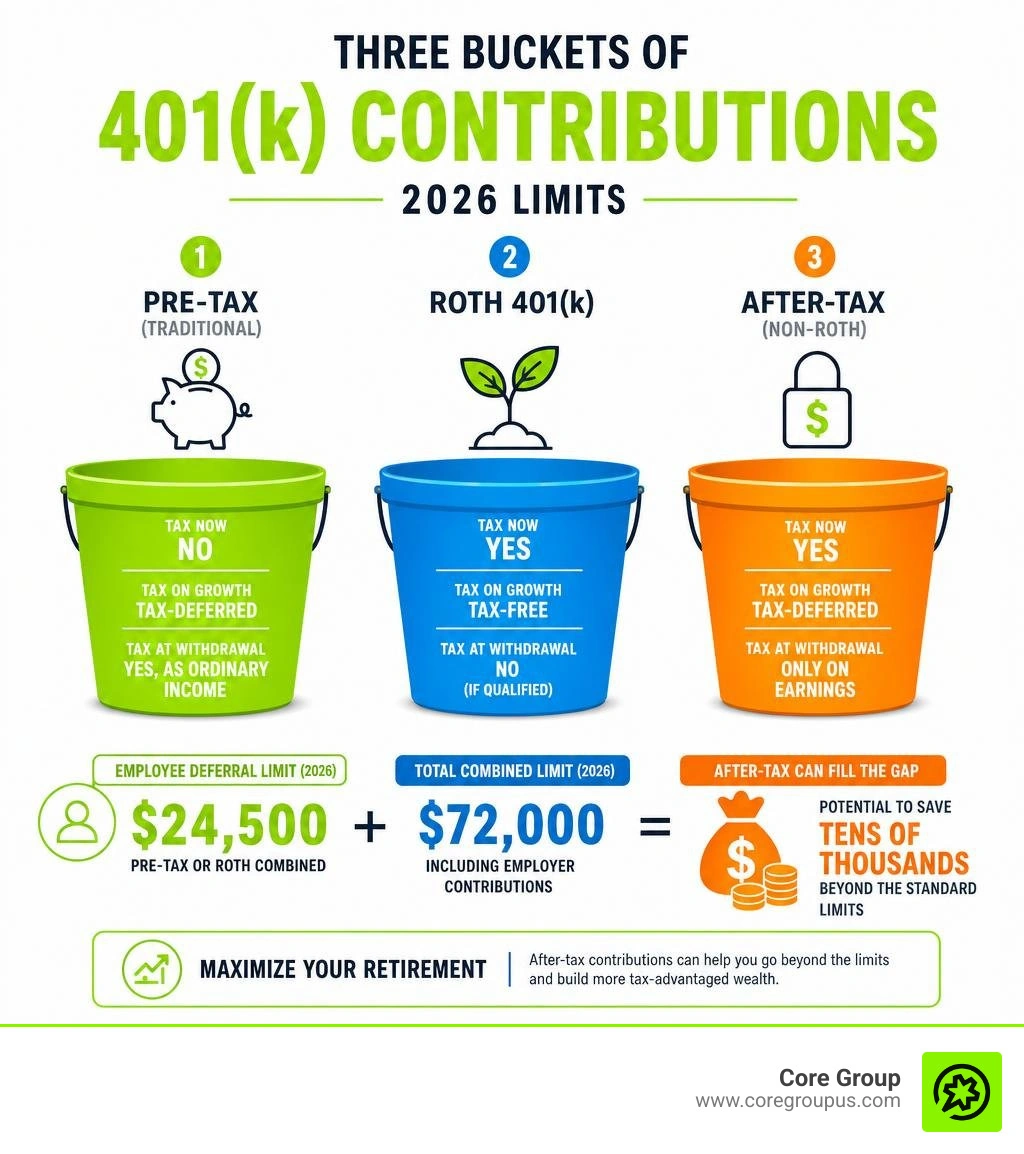
Here is a quick breakdown of how the three contribution types compare.
| Contribution Type | Tax Now | Tax on Growth | Tax at Withdrawal |
|---|---|---|---|
| Pre-Tax (Traditional) | No (deducted) | Tax-deferred | Yes, as ordinary income |
| Roth 401(k) | Yes | Tax-free | No (if qualified) |
| After-Tax (non-Roth) | Yes | Tax-deferred | Only on earnings |
The key numbers for 2026
- The standard employee deferral limit is $24,500 (pre-tax or Roth combined)
- The total combined limit including employer contributions is $72,000
- After-tax contributions can fill the gap between those two numbers
So if you have maxed out your $24,500 employee deferral and your employer adds a match, you may still have room to contribute tens of thousands more in after-tax dollars. When those funds are converted to a Roth account, that is the strategy known as the Mega Backdoor Roth.
This guide is for creative entrepreneurs, freelancers, and high earners who want to go beyond the standard limits and build serious tax-free wealth in retirement.
401k after tax contribution further reading
Understanding After-Tax Savings and How They Work
To understand how after-tax savings work, we must first look at the three distinct buckets inside a 401k plan. Most savers are familiar with the traditional pre-tax bucket and the Roth bucket. The after-tax bucket is a separate sub-account that functions differently from both.
When you make a standard pre-tax contribution, your savings reduce your taxable income today. Your investments grow tax-deferred, and you pay ordinary income tax on both your contributions and your earnings when you withdraw the money in retirement. This is a great option if you want to lower your current tax liability, but it does not help you avoid taxes later.
A Roth 401k contribution uses money you have already paid taxes on today. The benefit is that your money grows tax-free, and your future withdrawals are completely tax-free as long as you meet the qualification rules.
An after-tax contribution is the third bucket. Like a Roth contribution, you make after-tax contributions with money that has already been taxed. However, the growth on these contributions is only tax-deferred, not tax-free. This means that if you leave the money in the after-tax bucket, you will owe ordinary income tax on the earnings when you withdraw them.
Understanding these differences is crucial for tax planning. For a deeper look at how retirement accounts interact with your adjusted gross income, you can read our guide on Do 401k Contributions Reduce MAGI.
Pre-Tax versus Roth versus After-Tax Deferrals
The main differences between these options come down to contribution limits and tax brackets. While pre-tax and Roth contributions share the same annual employee elective deferral limit of $24,500 in 2026, after-tax contributions are subject to a much higher ceiling.
Choosing the right bucket depends on your current tax bracket and your expected tax bracket in retirement. High earners often prefer pre-tax contributions to secure immediate tax relief. However, once you hit the elective deferral limit, the after-tax bucket becomes an incredibly valuable way to save more.
Tax Treatment of Contributions and Earnings
The tax treatment of after-tax contributions is unique because it creates a clear distinction between your principal and your earnings. The money you contribute directly is known as your tax basis. Since you already paid taxes on this money before contributing it, you can withdraw your principal tax-free at any time.
The earnings generated by those contributions are treated as pre-tax. They grow tax-deferred under IRS rules, meaning you will not pay taxes on them until you take a distribution. When you do take a withdrawal, the IRS applies the pro-rata rule. This rule states that any partial withdrawal must consist of a proportional mix of tax-free principal and taxable earnings. You cannot simply withdraw your tax-free contributions and leave the taxable earnings behind.
This pro-rata treatment is defined under IRS Notice 87-13. Because of these rules, leaving your money in an after-tax account for a long time without converting it can actually be less tax-efficient than using a standard taxable brokerage account, where long-term capital gains rates are often lower than ordinary income tax rates.
Contribution Limits for 2026 and the Section 415 Limit
The IRS sets strict limits on how much money can go into a 401k plan each year. These rules are governed by Section 415 of the Internal Revenue Code, which defines the total annual additions allowed in a single participant's account.
For 2026, the overall Section 415 limit is $72,000. This is a combined limit that includes your employee elective deferrals, any employer matching contributions, employer profit-sharing contributions, and your voluntary after-tax contributions.
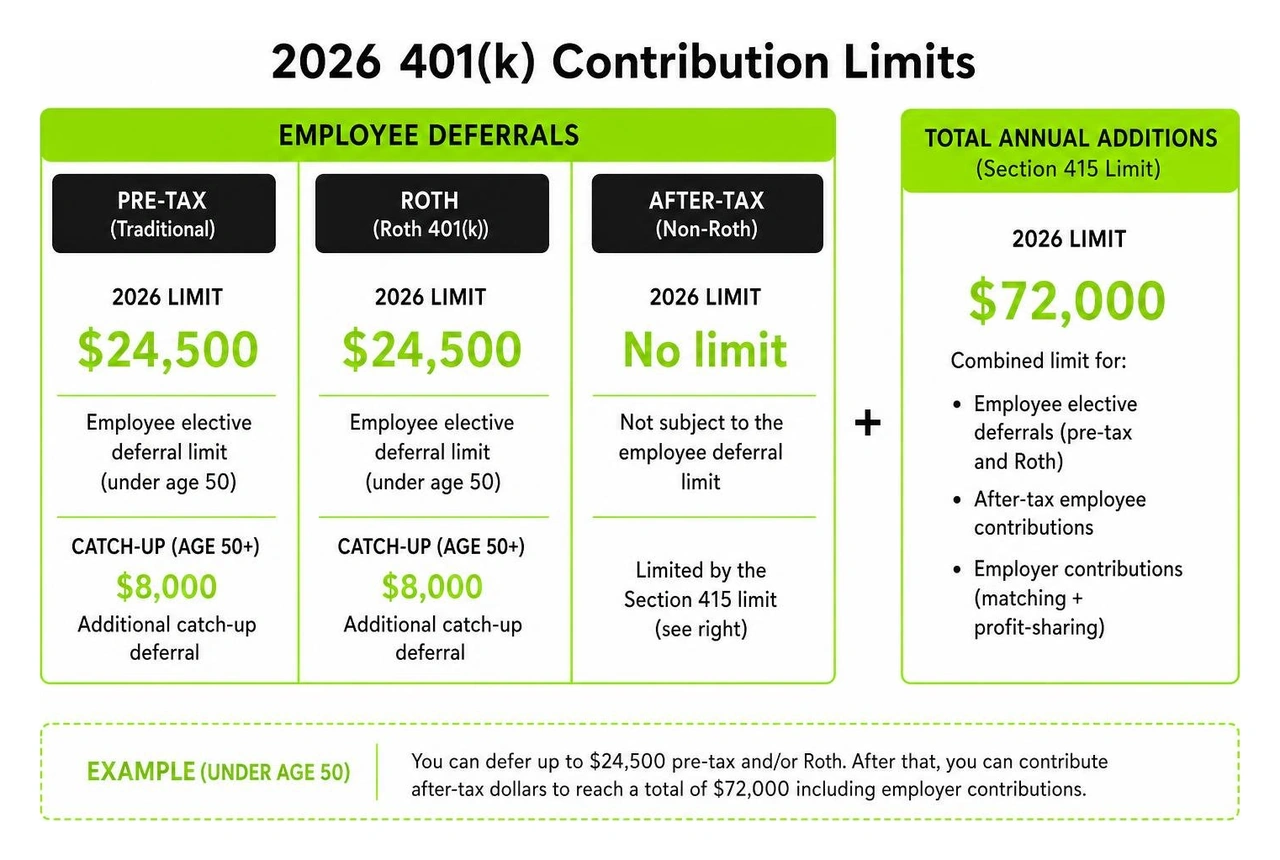
This means that if you are under age 50, you and your employer can save a combined total of $72,000 in your 401k plan. If your employer does not offer a massive matching or profit-sharing contribution, you can use a 401k after tax contribution to fill the remaining gap all the way up to that $72,000 limit.
For more details on navigating these limits, check out our article on 401k Maximum Contribution 2026.
Standard Deferrals and Catch-Up Contributions
Older savers have access to even higher limits. If you are aged 50 to 59, or age 64 and older, the standard catch-up contribution limit for 2026 is $8,000. This brings your total employee deferral limit to $32,500 and your overall Section 415 limit to $80,000.
Under the SECURE 2.0 Act, there is also a special super catch-up contribution limit for individuals aged 60 to 63. In 2026, this super catch-up limit is $11,250. This raises the employee elective deferral limit to $35,750 and the overall Section 415 limit to $83,250 for this specific age bracket.
To learn more about how these rules apply to older savers, read our breakdown of the 2026 Maximum 401k Contribution Over 50.
Calculating Your Remaining 401k After Tax Contribution Room
To find out how much you can contribute to an after-tax account, you need to use a simple calculation.
Your after-tax contribution room equals the Section 415 limit ($72,000 in 2026) minus your personal pre-tax and Roth elective deferrals ($24,500 in 2026) minus any employer matching or profit-sharing contributions.
For example, if you are 35 years old and you contribute the maximum $24,500 in elective deferrals, and your employer provides a $5,500 matching contribution, your remaining space is calculated in this manner.
$72,000 minus $24,500 minus $5,500 equals $42,000.
In this scenario, you can make up to $42,000 in after-tax contributions.
For job switchers, there is an interesting planning opportunity. While the $24,500 employee elective deferral limit is a per-person limit across all jobs, the Section 415 limit of $72,000 is calculated per unrelated employer. If you switch to an unrelated employer mid-year, your Section 415 limit resets, allowing you to potentially make additional after-tax contributions at your new company.
The Mega Backdoor Roth Strategy Explained
The true power of making a 401k after tax contribution is realized when you combine it with a Mega Backdoor Roth strategy. By itself, saving money in an after-tax account is only moderately beneficial because the earnings are eventually taxed as ordinary income. But if you convert those after-tax dollars into a Roth account, you unlock tax-free growth and tax-free withdrawals for life.
For detailed strategies on how these accounts function, you can explore the Bogleheads Wiki on After-tax 401(k) and resources like Fidelity's guide on after-tax contributions.
In-Plan Roth Conversions versus Roth IRA Rollovers
There are two primary ways to move your after-tax contributions into a Roth account.
The first option is an in-plan Roth conversion. If your employer's plan supports this feature, you can convert your after-tax contributions directly into a Roth 401k account within the same workplace plan.
The second option is an in-service distribution to a Roth IRA. This allows you to roll your after-tax contributions out of your company plan and into your own personal Roth IRA while you are still employed.
Under IRS Notice 2014-54, you can split your distribution to optimize your taxes. You can roll your after-tax contributions (your tax basis) directly into a Roth IRA, and roll any pre-tax earnings into a Traditional IRA. This allows you to avoid paying any immediate taxes on the conversion.
For more strategic analysis, check out Carry's explanation of after-tax 401ks and the SDO CPA breakdown of the Mega Backdoor Roth.
Step-by-Step Execution of the Mega Backdoor Roth
Executing this strategy requires careful coordination.
First, you must confirm that your plan allows after-tax contributions and either in-plan Roth conversions or in-service distributions.
Second, you make your after-tax contributions through payroll deductions.
Third, you convert those funds to Roth as quickly as possible. Many modern plans offer an automatic conversion feature that instantly moves your after-tax contributions into the Roth bucket every pay period. This is the gold standard because it prevents any earnings from accumulating, meaning you convert the money before any taxable growth occurs.
At the end of the year, your plan administrator will issue a Form 1099-R showing the distribution and any taxable earnings. That Roth accounts are subject to the five-year aging rule, which requires the account to be open for five years before you can make tax-free withdrawals of earnings.
Plan Eligibility and Nondiscrimination Testing Hurdles
Before you get too excited about the Mega Backdoor Roth, you must check your plan's eligibility rules. Most standard, off-the-shelf 401k plans do not allow after-tax contributions. You will need to review your plan's Summary Plan Description or talk to your HR department to see if this feature is supported.
For business owners, offering after-tax contributions requires careful plan design. To understand how to set up a compliant plan, you can read our Safe Harbor 401k Complete Guide.
The Average Contribution Percentage Test and Highly Compensated Employees
The biggest hurdle for businesses with employees is nondiscrimination testing. The IRS uses the Average Contribution Percentage (ACP) test to ensure that highly compensated employees (HCEs) do not benefit disproportionately from the plan compared to non-highly compensated employees (NHCEs).
Because after-tax contributions are typically only utilized by high-income earners who can afford to save beyond the standard $24,500 limit, plans that allow after-tax contributions often fail the ACP test. If a plan fails this testing, the excess contributions must be returned to the highly compensated employees, which negates the strategy.
Even if you have a Safe Harbor plan, which normally exempts you from standard nondiscrimination testing, adding an after-tax contribution feature can void that exemption and trigger mandatory testing. For a deeper look at compliance, read Maner CPA's guide on after-tax contributions.
How to Set Up a 401k After Tax Contribution in Your Plan
For creative entrepreneurs and small business owners, the easiest way to utilize this strategy is through a custom Solo 401k. Because a Solo 401k has no common-law employees, it is completely exempt from ACP testing and top-heavy testing.
To set this up, you must work with a third-party administrator or a custom plan provider to adopt a plan document that specifically permits voluntary after-tax contributions and in-service Roth conversions. Standard brokerage platforms usually do not offer this level of customization, so a custom plan is often required to unlock the Mega Backdoor Roth.
Common Mistakes to Avoid with Your 401k After Tax Contribution
While this strategy is highly lucrative, it is easy to make mistakes that can result in unexpected tax bills.
The most common mistake is delaying your Roth conversions. If you let your after-tax contributions sit in the plan for months or years before converting them, they will generate earnings. Those earnings will be subject to ordinary income tax upon conversion, which reduces the overall tax efficiency of the strategy.
Another mistake is exceeding the Section 415 limit. You must track your contributions, especially if you receive variable employer matching or profit-sharing contributions throughout the year, to ensure your total additions do not exceed $72,000 in 2026.
Finally, do not ignore state tax implications. While federal tax rules are highly structured, state tax treatment of after-tax contributions and conversions can vary, so it is always wise to consult a professional.
Frequently Asked Questions About After-Tax Savings
Can I withdraw after-tax contributions without paying taxes?
Yes, you can withdraw your original after-tax contributions tax-free because you have already paid income taxes on that money. However, any associated earnings are subject to the pro-rata rule and will be taxed unless they are rolled over or converted to a Roth account.
What is the SECURE 2.0 high earner catch-up rule?
Under the SECURE 2.0 Act, if your FICA wages exceeded $150,000 in the previous tax year, any catch-up contributions you make in 2026 must be designated as Roth contributions. If your employer's plan does not offer a Roth option, you will not be allowed to make catch-up contributions at all.
How does switching jobs affect my contribution limits?
While your personal elective deferral limit of $24,500 is a combined limit across all employers for the calendar year, the Section 415 limit of $72,000 is calculated per unrelated employer. This means that if you change jobs mid-year, you may be able to make additional after-tax contributions up to the Section 415 limit with your new employer.
Conclusion
Maximizing your retirement savings requires a strategic approach to tax planning. For creative entrepreneurs and high earners, utilizing a 401k after tax contribution is one of the best ways to build a massive tax-free nest egg.
At Core Group, we help creative entrepreneurs navigate these complex rules with our no-fluff, profit-first playbook. We handle your bookkeeping, financial management, and tax planning so you can focus on growing your business, all backed by our MacBook Pro guarantee.
To learn more about how retirement contributions impact your overall tax strategy, read our guide on 401k and MAGI.