A – Z Guide to 2026 401k Catch-Up Contribution Limits
Calculate Your 2026 401k Catch-Up Contribution Limit
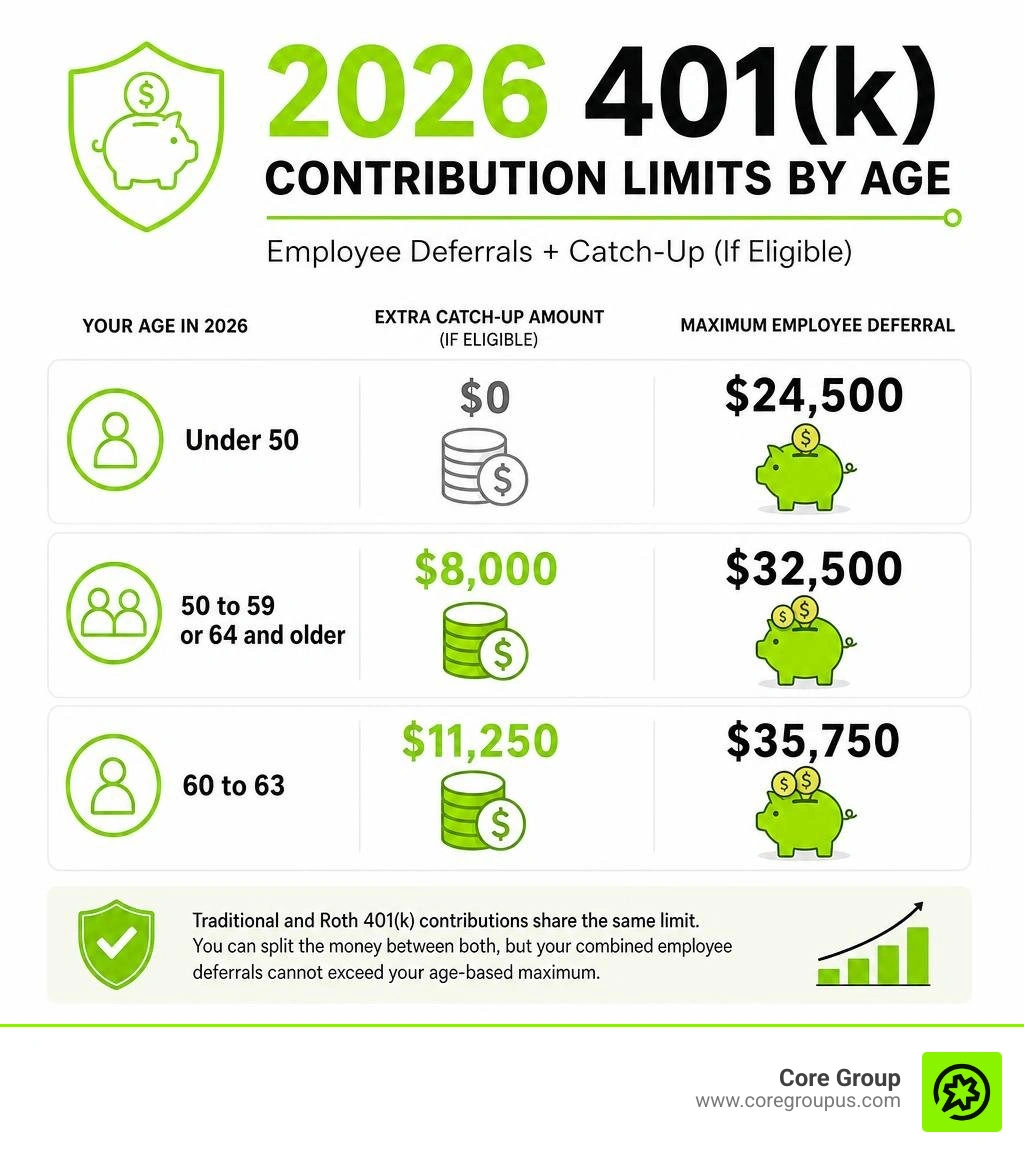
For the 401k 2026 contribution limit IRS catch up rules, start with the $24,500 employee deferral limit. Then add the catch-up amount that matches your age in 2026, if your plan permits catch-up contributions.
| Your age in 2026 | Extra catch-up amount | Maximum employee deferral |
|---|---|---|
| Under 50 | $0 | $24,500 |
| 50 to 59 or 64 and older | $8,000 | $32,500 |
| 60 to 63 | $11,250 | $35,750 |
Traditional and Roth 401(k) contributions share the same limit. You can split the money between both, but your combined employee deferrals cannot exceed your age-based maximum.
One important change applies to some higher earners. If you are 50 or older and had $150,000 or more in 2025 FICA wages from the employer sponsoring your plan, your 2026 catch-up contributions generally must go into a Roth 401(k). Your regular $24,500 deferrals can still be traditional, Roth, or a mix.
For creative business owners and employees, these numbers matter because a strong retirement plan can lower tax stress, support cash flow planning, and turn a high-income year into lasting savings. I am Christian Brim, and this guide will help you apply the 2026 limits without getting lost in IRS language.
Explore more about 401k 2026 contribution limit irs catch up
Understanding the 401k 2026 Contribution Limit IRS Catch Up Rules
Planning for retirement as an entrepreneur or creative professional requires keeping up with shifting regulations. As of August 2026, the retirement landscape has seen significant updates designed to help older workers boost their nest eggs while adjusting for ongoing inflation trends.

Understanding these rules ensures you do not leave free money on the table. Knowing the exact limits helps you optimize tax planning and maintain personal peace of mind. To review specific rules for workers crossing the mid-career milestone, check out our breakdown of the 2026 Maximum 401k Contribution Over 50.
Here is how the contribution numbers compare between the 2025 and 2026 tax years.
| Limit Category | 2025 Tax Year | 2026 Tax Year | Change |
|---|---|---|---|
| Base Elective Deferral (Under 50) | $23,500 | $24,500 | +$1,000 |
| Standard Catch-Up (Ages 50 to 59, 64+) | $7,500 | $8,000 | +$500 |
| Super Catch-Up (Ages 60 to 63) | $11,250 | $11,250 | $0 |
| Total Maximum Deferral (Ages 50 to 59, 64+) | $31,000 | $32,500 | +$1,500 |
| Total Maximum Deferral (Ages 60 to 63) | $34,750 | $35,750 | +$1,000 |
| Section 415(c) Annual Additions Cap | $70,000 | $72,000 | +$2,000 |
| Annual Compensation Limit | $350,000 | $360,000 | +$10,000 |
Standard Deferrals vs 401k 2026 Contribution Limit IRS Catch Up Rules
The base elective deferral under Internal Revenue Code Section 402(g) represents the maximum amount an employee can set aside from their salary into a qualified plan. For 2026, this base cap stands at $24,500. This is up $1,000 from the prior year.
For participants turning 50 or older by the close of the calendar year, the IRS allows an additional standard catch-up contribution. For 2026, the standard catch-up allowance has increased to $8,000. This allows qualifying participants in age brackets 50 to 59 and 64 and older to stash away up to $32,500 in total elective deferrals. These cost-of-living adjustments were published in WASHINGTON The Internal Revenue Service today announced cost of living adjustments applicable to dollar limitations for pen.
Special Age 60 to 63 Super Catch Up Calculations
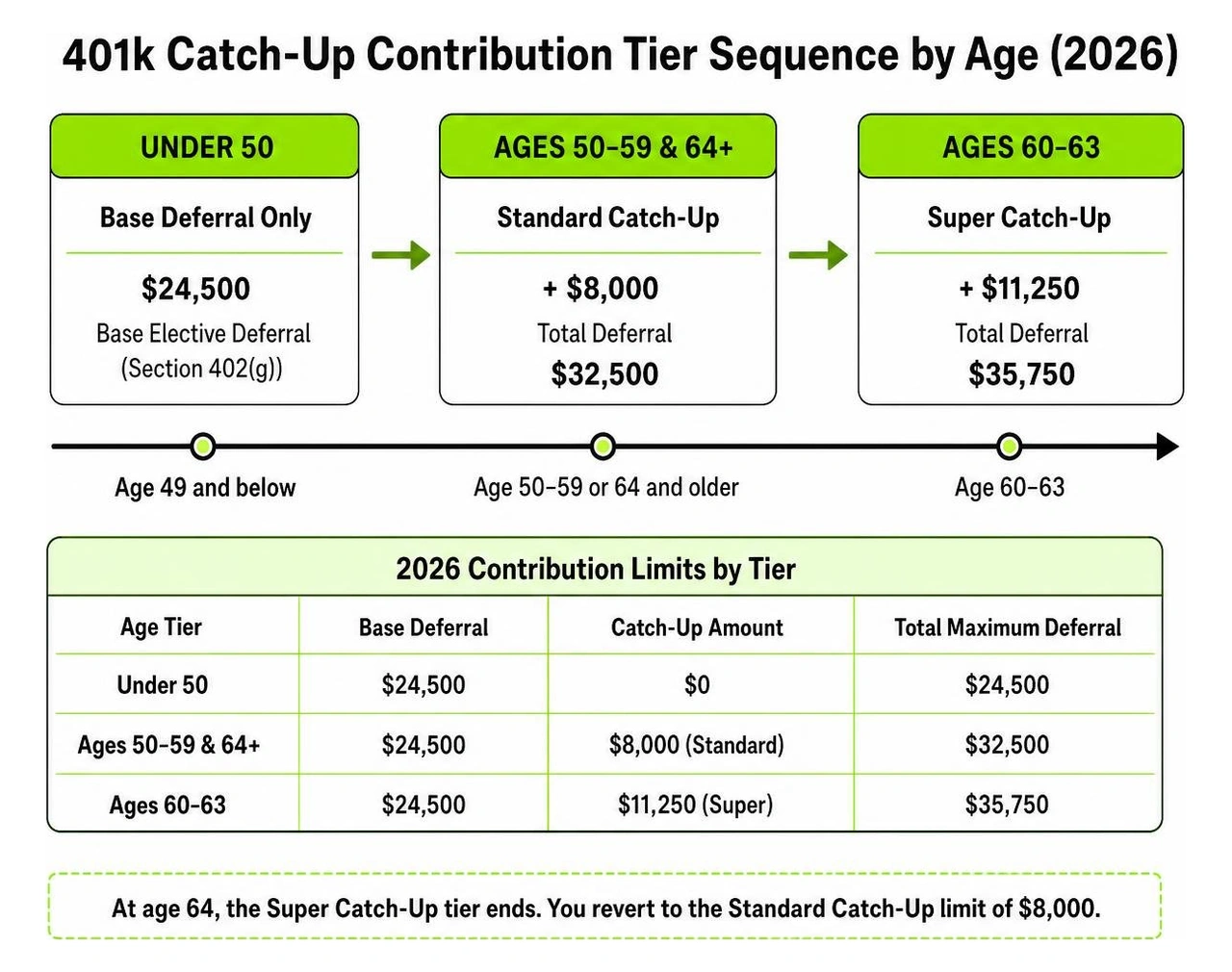
Under Section 109 of the SECURE 2.0 Act, retirement savers in their peak pre-retirement years gain access to an enhanced catch-up tier. If you attain age 60, 61, 62, or 63 during the 2026 calendar year, your catch-up ceiling increases to $11,250 instead of the standard $8,000.
Combining the base elective deferral of $24,500 with this enhanced allowance yields a personal deferral cap of $35,750.
That when a participant reaches age 64, this special tier ends. The participant reverts back to the standard catch-up limit of $8,000 for that tax year. For more on these statutory timeline shifts, review our guide on 401k Changes 2026.
SECURE 2.0 Mandatory Roth Catch Up Rules for High Earners
A fundamental operational shift enacted under Section 603 of SECURE 2.0 has taken effect. High-earning workers who make catch-up contributions can no longer allocate those specific catch-up dollars on a pre-tax basis.

Instead, affected participants must direct their catch-up deferrals into a designated Roth account using after-tax dollars. While standard base deferrals up to $24,500 can remain 100% pre-tax, catch-up contributions must be designated as Roth if your earnings cross statutory limits. This structural change impacts current take-home pay because the catch-up amount no longer reduces your current taxable income.
How FICA Wages Impact Your 401k 2026 Contribution Limit IRS Catch Up
The requirement to make catch-up contributions as Roth deferrals is governed by a specific wage threshold. For 2026, that threshold is set at $150,000 based on prior-year earnings.
The IRS uses a one-year lookback rule. If your Box 3 Social Security wages on your 2025 Form W-2 from the employer sponsoring your plan exceeded $150,000, all 2026 catch-up contributions made under that employer plan must be Roth.
If an employer does not offer a designated Roth 401(k) program within its plan document, high earners subject to this mandate will be barred from making catch-up contributions entirely until the plan is updated.
Exceptions for Partners and Sole Proprietors
Because the statutory language in Section 603 ties the $150,000 threshold strictly to W-2 Box 3 FICA wages, self-employed business owners receive unique treatment.
Partners reporting earnings on Schedule K-1 and sole proprietors reporting business profits on Schedule C do not receive W-2 FICA wages from their businesses. As a result, they are exempt from the mandatory Roth catch-up requirement. They can continue making both standard and catch-up deferrals entirely on a pre-tax basis into their Solo 401(k) plans. To see how small business retirement setups are built, read our Safe Harbor 401k Complete Guide.
Total Annual Additions and Contribution Limits for 2026
Elective employee deferrals are only one part of the total retirement funding picture. The IRS also enforces an overall limit on total annual additions under Internal Revenue Code Section 415(c).
The Section 415(c) limit caps the combined total of employee deferrals, employer matching contributions, nonelective profit-sharing contributions, and forfeiture allocations. For 2026, this total annual additions ceiling increases to $72,000 or 100% of participant compensation, whichever is less. For more information on business match structures, see our article on the 401k Company Match Limit.
Section 415c Additions and Employer Match Limits
When calculating total additions, catch-up contributions are treated separately. They sit on top of the Section 415(c) base cap.
- For participants under age 50, the absolute maximum addition is $72,000.
- For participants age 50 to 59 or 64 and older, the total addition limit reaches $80,000 ($72,000 plus the $8,000 standard catch-up).
- For participants age 60 to 63, the total addition limit reaches $83,250 ($72,000 plus the $11,250 super catch-up).
The annual compensation limit under Section 401(a)(17) rises to $360,000 for 2026. Employers calculating percentage-based matching or profit-sharing formulas cannot account for any compensation beyond this $360,000 threshold.
The additions cap applies per unrelated employer. If you own a side business with a Solo 401(k) and also work for an unrelated corporate employer, you can receive employer profit-sharing contributions in your Solo plan up to the $72,000 limit independently of your employer plan additions. For official guidelines on these caps, visit the Retirement topics - 401(k) and profit-sharing plan contribution limits | Internal Revenue Service reference page.
Strategies for After Tax Contributions and Mega Backdoor Roth
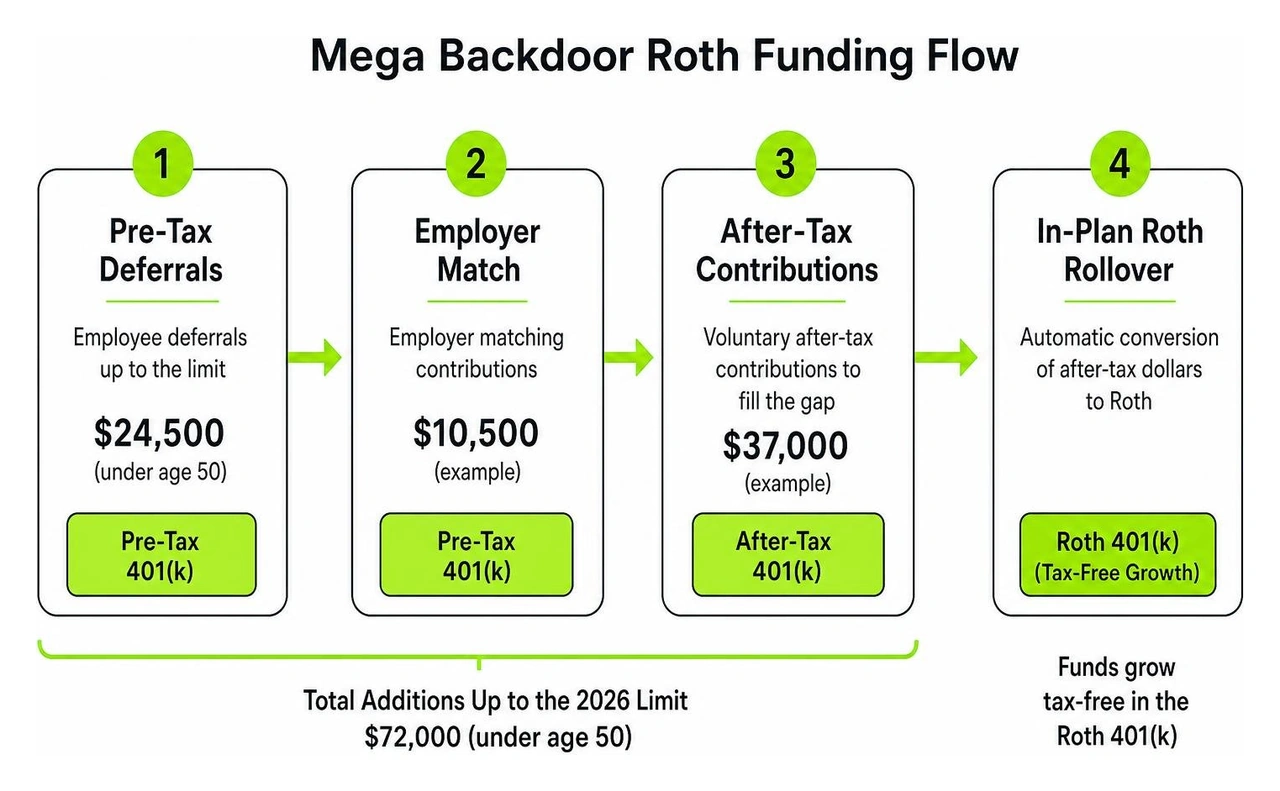
Creative entrepreneurs and high earners looking to maximize their savings can take advantage of voluntary after-tax contributions. This strategy helps fill the gap between their salary deferrals plus employer match and the total $72,000 additions cap.
For example, if an employee under age 50 contributes the maximum $24,500 base deferral and receives an employer match of $10,500, their total additions equal $35,000. If the plan allows voluntary after-tax contributions, the employee can contribute an additional $37,000 in after-tax funds to reach the $72,000 limit.
Pairing these voluntary after-tax dollars with automated in-plan Roth rollovers executes what is commonly known as a Mega Backdoor Roth. This shifts substantial savings into tax-free growth territory. You can learn the complete mechanics of this process in our deep dive on 401k After Tax Contribution strategies.
Excess 401k Deferrals and Remediation Steps
Exceeding IRS elective deferral limits is an easy mistake to make, especially when changing jobs mid-year or managing multiple retirement accounts.
The $24,500 elective deferral limit applies to you as an individual taxpayer across all employers combined. If you contribute $15,000 to Employer A and $12,000 to Employer B in 2026, your total deferrals equal $27,000. This creates an excess deferral of $2,500.
When an excess deferral happens, take the following remediation steps immediately
- Notify the plan administrator in writing as soon as the excess is discovered.
- Request a corrective distribution of the excess deferral plus any net attributable earnings before April 15 of the following tax year.
- Obtain Form 1099-R from the recordkeeper documenting the distribution.
Failing to remove the excess deferral prior to the April 15 deadline leads to harsh double taxation. The excess amount is taxed as ordinary income in the year it was contributed and is taxed a second time when distributed from the plan in retirement, without receiving any cost basis recognition.
Frequently Asked Questions About 2026 401k Limits
What happens if I turn 50 mid year in 2026?
The IRS uses a calendar-year rule for catch-up eligibility. As long as you celebrate your 50th birthday on or before December 31, 2026, you are considered eligible for the full $8,000 catch-up contribution beginning on January 1, 2026.
Can I contribute to both a 401k and an IRA in 2026?
Yes. 401(k) limits and Individual Retirement Account (IRA) limits are completely separate. For 2026, you can contribute up to $24,500 to a 401(k) and up to $7,500 to an IRA (plus a $1,100 catch-up if age 50 or older). However, your ability to deduct traditional IRA contributions or make direct Roth IRA contributions is subject to IRS income phaseout ranges.
How do catch up limits apply across multiple employers?
Elective deferrals and catch-up limits apply per taxpayer across all plans. If you are 52 years old, your total elective contributions across all 401(k) and 403(b) accounts cannot exceed $32,500 for the year, regardless of how many different employers you work for.
Conclusion
Maximizing your retirement plan is one of the most effective ways to lower your taxable income, protect your business profits, and build long-term personal wealth. Between standard deferral increases, enhanced super catch-up tiers for savers aged 60 to 63, and the new mandatory Roth catch-up rules for high earners, managing retirement plans requires proactive coordination.
At Core Group, we help creative entrepreneurs streamline their finances with our no-fluff, profit-first playbook. Our bookkeeping and tax strategies provide complete peace of mind, freeing you up to focus on growing your business while we handle complex IRS compliance.
To ensure your contributions align with your broader tax goals and manage adjusted income brackets, explore our guide on 401k and MAGI.