How Much Can You Save? The Ultimate Guide to 2026 401k Limits
What You Can Save in Your 401k in 2026
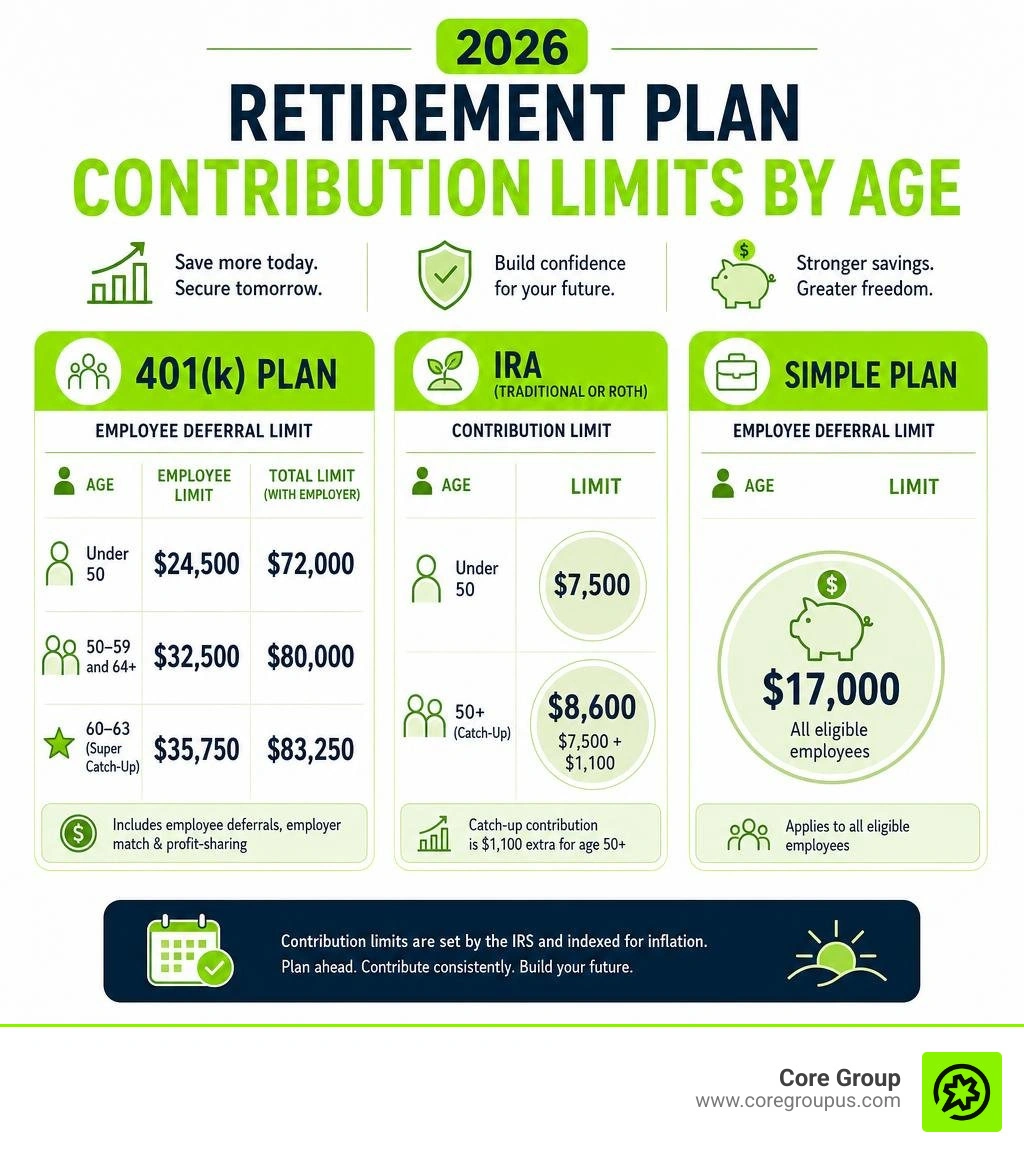
The 401k maximum contribution for 2026 increased, giving savers more room to build retirement wealth. Here are the key numbers at a glance.
| Saver Type | Employee Limit | Total Limit (with Employer) |
|---|---|---|
| Under age 50 | $24,500 | $72,000 |
| Age 50 to 59 and 64+ | $32,500 | $80,000 |
| Age 60 to 63 (super catch-up) | $35,750 | $83,250 |
A few other important 2026 limits are useful to know right away.
- IRA limit (traditional or Roth) is $7,500 (up from $7,000 in 2025)
- IRA catch-up (age 50+) is $1,100 extra, for a total of $8,600
- SIMPLE plan limit is $17,000
For creative entrepreneurs and freelancers in film, media, and the arts, retirement savings often fall to the bottom of the priority list. There are projects to finish, clients to invoice, and payroll to sort out. But the IRS adjusts retirement limits every year based on inflation, and 2026 brought some of the most significant increases in recent memory.
The standard employee deferral jumped from $23,500 to $24,500. Catch-up rules expanded under the SECURE 2.0 Act. And a brand-new rule now requires high earners to route catch-up contributions into Roth accounts.
Understanding these numbers now means fewer surprises at tax time, and more money working for your future.
Understanding the 401k Maximum Contribution 2026 Limits
Every autumn, the Internal Revenue Service reviews the cost of living index to determine adjustments for the upcoming tax year. For 2026, high inflation rates triggered solid bumps across almost all retirement savings vehicles. These changes are designed to help your savings keep pace with the real-world costs of goods and services.
When we talk about the 401k maximum contribution 2026 limits, we are looking at a dual system. The IRS regulates both what you can personally put in from your salary and the absolute total amount that can enter your account from all sources combined. This includes company matches and profit-sharing allocations.
To help you visualize how these changes impact your planning, let us look at how the 2026 numbers stack up against the previous year. You can read the official government announcement at the IRS 401k Newsroom.
| Contribution Type | 2025 Limit | 2026 Limit | Change |
|---|---|---|---|
| Employee Elective Deferral | $23,500 | $24,500 | +$1,000 |
| Standard Catch-Up (Age 50+) | $7,500 | $8,000 | +$500 |
| Super Catch-Up (Ages 60-63) | $11,250 | $11,250 | No Change |
| Section 415(c) Combined Limit | $70,000 | $72,000 | +$2,000 |
Employee Elective Deferrals for Traditional and Roth Accounts
Your personal contribution is technically called an elective deferral because you choose to defer a portion of your compensation into the retirement plan. In 2026, you can defer up to $24,500 of your hard-earned money.
This limit is a combined cap. If your company offers both a traditional pre-tax 401k and a Roth 401k, you do not get a separate $24,500 limit for each. You can split your contributions between the two buckets in any ratio you like, but the sum of both cannot exceed $24,500.
Pre-tax contributions lower your taxable income today, which is fantastic for creatives currently in a high tax bracket. On the flip side, Roth deferrals are made with after-tax dollars. While you do not get a tax break today, your money grows tax-free, and your qualified withdrawals in retirement are completely tax-free.
Combined Employee and Employer Limits under Section 415
The second boundary is the Section 415(c) limit, which dictates the total annual additions to your account. For 2026, this combined cap rises to $72,000, up from $70,000 in 2025.
This is where things get exciting for business owners and highly successful freelancers. The $72,000 limit includes three distinct components. First is your employee elective deferral of $24,500. Second is any employer matching contribution. Third is any employer profit-sharing contribution.
If you operate your creative business as an S-Corporation or a single-member LLC, you act as both the employer and the employee. This means you can use profit-sharing strategies to maximize your retirement savings up to that full $72,000 limit. For a deep dive into how these corporate limits are administered, you can review the Ascensus 2026 Limits Guide.
Catch Up Contributions for Older Savers
If you are closer to retirement, the tax code offers a helpful acceleration mechanism. Catch-up contributions allow older workers to save significantly more than younger colleagues, helping to bridge any historical gaps in savings.

Under the SECURE 2.0 Act, these catch-up rules have become more powerful but also more complex. Your age determines exactly which rules apply to you in 2026.
Standard Catch Up for Savers Age 50 and Older
For savers who are age 50 to 59, or who are age 64 and older, the standard catch-up contribution limit is $8,000 for 2026. This is a bump from the $7,500 limit in 2025.
This means if you are 52 years old in 2026, your personal 401k maximum contribution 2026 limit is $32,500. That is the standard $24,500 deferral plus the $8,000 catch-up. These catch-up dollars are also exempt from the standard Section 415(c) limit, meaning your total combined employee and employer cap pushes to $80,000.
Super Catch Up and the 401k Maximum Contribution 2026 Rules for Ages 60 to 63
A special provision in the SECURE 2.0 Act created a super catch-up tier specifically for workers aged 60, 61, 62, and 63. If you fall into this narrow age window in 2026, your catch-up limit is $11,250.
When you add this super catch-up to the standard employee limit, your personal deferral cap reaches $35,750. Combined with employer contributions, your ultimate ceiling rises to $83,250. This is a massive opportunity to stack away cash during your peak earning years. The technical details of how these adjustments are calculated are outlined in the official IRS Notice 2025-67.
New SECURE 2.0 Roth Requirements for High Earners
There is a vital catch for high earners starting in 2026. If your prior-year FICA wages (specifically Box 3 of your W-2) exceeded $150,000, the law says you can no longer make pre-tax catch-up contributions.
Instead, any catch-up contributions you make must be designated as Roth contributions, which are funded with after-tax dollars. This rule was originally scheduled to begin earlier but was delayed to 2026 to give payroll systems and plan administrators time to adjust.
If you are a high-earning creative director, writer, or producer making over $150,000, you must ensure your company's plan actually offers a Roth option. If a plan does not support Roth contributions, no one in that plan is allowed to make catch-up contributions at all. This highlights the absolute necessity of working with a proactive financial team to review your plan documents.
Coordinating Your 401k with Other Retirement Accounts
To build a truly resilient financial foundation, you should not look at your 401k in a vacuum. A great retirement strategy coordinates multiple accounts to optimize your tax bracket today and your tax-free income tomorrow.

When designing a comprehensive savings plan, we often look at how your workplace plan interacts with personal IRAs, health savings accounts, and specialized conversion strategies. To explore different structural paths for your business, you can check out our guide on Safe 401K Options.
IRA Contribution Limits and Income Phase Out Ranges
For 2026, the individual retirement account contribution limit is $7,500. If you are age 50 or older, you can add a $1,100 catch-up, bringing your personal limit to $8,600.
However, if you or your spouse are covered by a workplace retirement plan like a 401k, your ability to deduct traditional IRA contributions on your tax return phases out as your income rises.
For single tax filers covered by a workplace plan, the traditional IRA deduction phase-out range for 2026 is $81,000 to $91,000. For married couples filing jointly, where the spouse making the contribution is covered by a workplace plan, the phase-out range is $129,000 to $149,000.
Roth IRA contribution limits also phase out based on income, regardless of whether you have a workplace plan. For single filers, the Roth IRA contribution phase-out range for 2026 is $153,000 to $168,000. For married couples filing jointly, the range is $242,000 to $252,000.
SIMPLE Plans and Other Workplace Retirement Options
Not every creative business is best served by a full-scale 401k. For smaller teams or solo operations, other plans might offer simpler administrative paths.
A SIMPLE IRA is a common alternative. In 2026, the standard SIMPLE salary reduction limit is $17,000, though certain plans may allow a higher limit of $18,100.
If you work in academia, non-profits, or government, you might have access to 403(b) or 457(b) plans. For 2026, the standard elective deferral limit for both 403(b) and 457(b) plans matches the 401k limit of $24,500.
The standard catch-up limit for those age 50 and older in these plans is also $8,000. Government 457(b) plans are especially unique because they are not subject to the same combined limits as 401k or 403(b) plans, allowing some public sector workers to double-dip across multiple plans.
Maximizing Savings with HSAs and Backdoor Roth Strategies
If you have maxed out your standard 401k maximum contribution 2026 space, where should your next dollar go?
A Health Savings Account is a brilliant option if you have a high-deductible health plan. HSAs offer a triple tax advantage. Contributions are tax-deductible, growth is tax-free, and withdrawals for qualified medical expenses are completely tax-free. For 2026, the HSA contribution limits are $4,400 for self-only coverage and $8,750 for family coverage.
If your income is too high to contribute directly to a Roth IRA, you can use the backdoor Roth strategy. This involves making a non-deductible contribution to a traditional IRA and then promptly converting those funds to a Roth IRA.
For those with workplace plans that allow after-tax contributions, the mega backdoor Roth is an even larger opportunity. You can contribute up to the full Section 415(c) limit of $72,000 using after-tax dollars, then immediately roll those after-tax contributions into a Roth 401k or Roth IRA.
Managing Excess Contributions and Planning Strategically
With limits changing every year, it is surprisingly easy to make a math error and over-contribute to your accounts. This is especially true for freelancers who jump between different production companies or agencies throughout the year.
Careful tracking and strategic scheduling are key to keeping your plan compliant and maximizing your employer's matching contributions. For business owners looking to simplify their plan compliance, our Safe Harbor 401K Complete Guide explains how to bypass complex annual testing.
How to Correct Excess Deferrals to Avoid Double Taxation
If you accidentally contribute more than the $24,500 limit across all your jobs in 2026, you must act quickly to correct the mistake. Failing to do so can result in double taxation, where the excess amount is taxed in the year contributed and then taxed again when you withdraw it.
To correct an excess deferral, follow these critical steps before the tax filing deadline.
- Notify your plan administrator immediately once you realize the error.
- Request a corrective distribution of the excess deferral amount along with any investment earnings associated with those excess funds.
- Ensure the plan administrator distributes the excess cash and earnings to you before April 15 of the following year.
- Report the corrected amounts properly on your tax return, noting that the distributed earnings are taxable in the year they were earned.
Strategic Contribution Scheduling and the 401k Maximum Contribution 2026 Impact
Many high earners love the idea of front-loading their retirement accounts by maxing out their contributions in the first few months of the year. While this gets your money growing in the market faster, it can actually cost you free money if your employer offers a matching contribution.
Many company matching formulas are calculated on a pay-period-by-pay-period basis. If you hit the $24,500 limit in September, you will contribute $0 to your plan in October, November, and December. Consequently, you will receive $0 in matching contributions for those last three months.
To avoid this trap, check if your employer offers a year-end true-up contribution, which retroactively calculates and pays out any missed match. If they do not, you should carefully calibrate your deferral percentage so that your final dollar of the annual limit lands in your very last paycheck of the year.
Frequently Asked Questions about 2026 Retirement Limits
Navigating the IRS tax code can feel like reading a foreign language, especially when you are focused on running a creative business. Here are answers to some of the most common questions we hear from our clients.
What is the Saver Credit income limit for 2026
The Saver's Credit, officially known as the Retirement Savings Contributions Credit, is a special tax break designed to encourage low and moderate-income workers to save. The credit can be worth up to $1,000, or $2,000 if filing jointly.
For 2026, the income limits to qualify for this credit have adjusted upward. For married couples filing jointly, the adjusted gross income limit is $80,500, up from $79,000 in 2025. For head of household filers, the limit is $60,375. For single filers, the income limit is $40,250.
How do 401k contributions affect modified adjusted gross income
When you make pre-tax contributions to a traditional 401k, those dollars are deducted directly from your paycheck before federal income taxes are calculated. This lower income is reflected in Box 1 of your W-2.
Because your gross income is reduced right from the start, your Modified Adjusted Gross Income is also lowered. This reduction can help you qualify for other tax deductions, stay under the phase-out limits for Roth IRA contributions, and even lower your overall tax bracket. You can learn more about this relationship in our detailed article Do 401K Contributions Reduce Magi.
What happens if I participate in multiple employer plans
If you work multiple jobs or run a business while also holding a W-2 job, you might have access to multiple retirement plans. It is important to know that the individual elective deferral limit of $24,500 applies to you as a person, not to each plan.
You cannot contribute $24,500 to Employer A's 401k and another $24,500 to Employer B's 401k. The total of your elective deferrals across all plans combined cannot exceed $24,500.
However, the Section 415(c) combined limit of $72,000 applies to each unrelated employer plan separately. If you have a day job and also run an independent S-Corporation, you can receive matching or profit-sharing contributions up to the maximum limit in both plans, as long as the employers are completely unrelated.
Conclusion
Understanding the 401k maximum contribution 2026 rules is just the first step in building real, lasting wealth. For creative entrepreneurs, the real magic happens when you align your retirement savings with a clear, daily financial strategy.
At Core Group, we specialize in providing financial management, bookkeeping, and tax services specifically tailored for creative business owners. Our signature profit-first playbook eliminates the financial fluff, giving you guaranteed peace of mind and saving you precious time so you can focus entirely on your craft. We are so confident in our ability to streamline your business that we back our services with a MacBook Pro guarantee.
If you are ready to stop guessing at your tax strategy and start maximizing your business profits, we are here to help. To see how your retirement contributions and business structure can work together to lower your tax liability, explore our comprehensive guide on 401K And Magi. Let us build a plan that lets you create today while securing your tomorrow.