The 2026 401(k) Contribution Limit: Key Things to Know Before Saving
The 2026 401(k) Contribution Limits You Need to Know
The 401k 2026 contribution limit IRS rules allow employees to defer up to $24,500 from pay into a traditional or Roth 401(k). That is $1,000 more than the $23,500 limit in 2025.
Here are the key numbers at a glance.
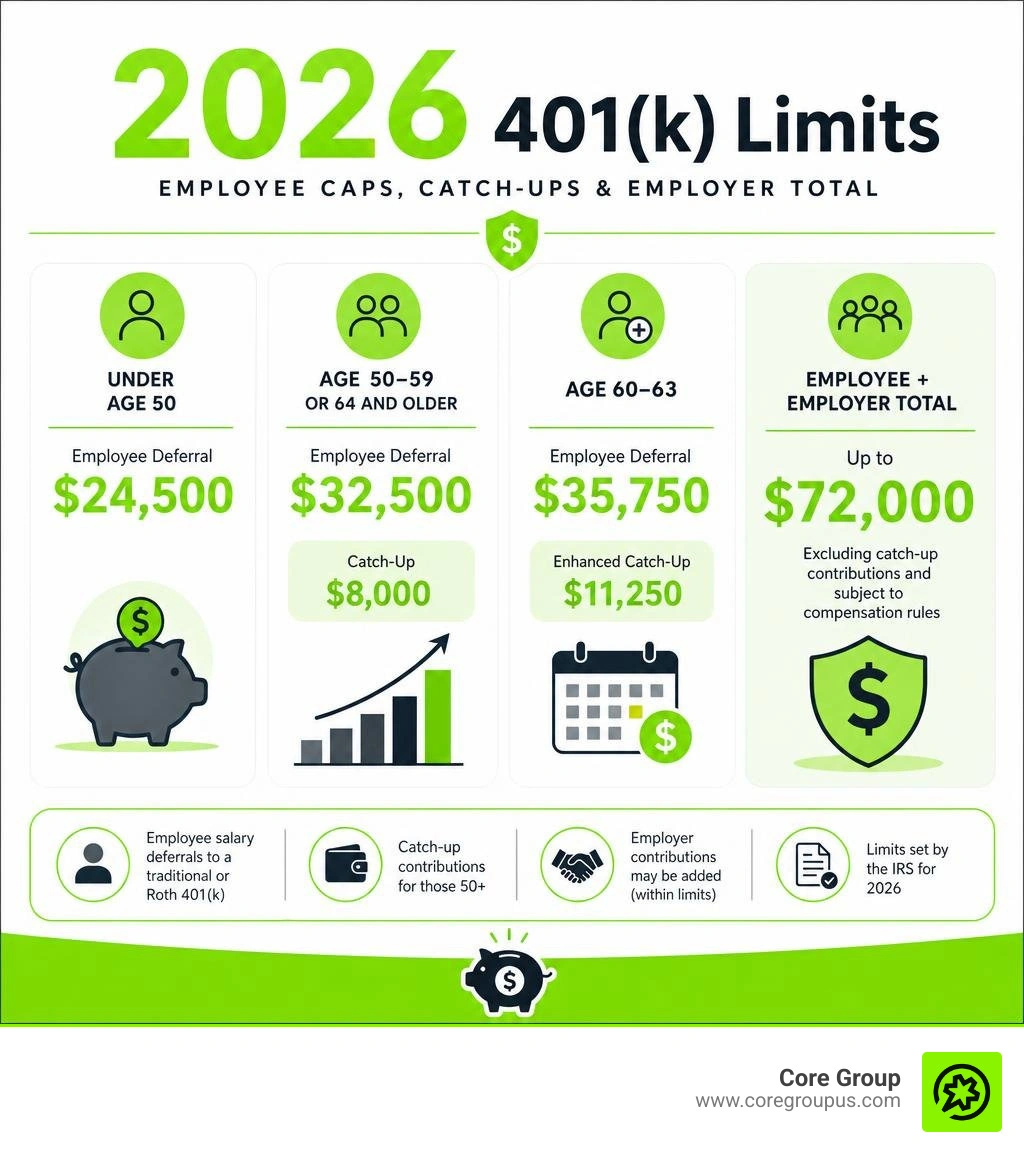
- Under age 50, up to $24,500 in employee salary deferrals
- Age 50 to 59 or 64 and older, up to $32,500, including an $8,000 catch-up contribution
- Age 60 to 63, up to $35,750, including the $11,250 enhanced catch-up if the plan permits it
- Employee and employer total, up to $72,000, excluding catch-up contributions and subject to compensation rules
For creative entrepreneurs and other busy professionals, the important part is not just knowing the cap. It is setting payroll contributions early, capturing every available employer match, and coordinating retirement savings with uneven income, taxes, and cash flow. Roth and traditional 401(k) contributions share the same employee limit, though they receive different tax treatment.
I’m Christian Brim, and I’ll walk through how these IRS limits work so you can save with more confidence and fewer costly surprises.
Simple guide to 401k 2026 contribution limit irs
Breakdown of the 401k 2026 Contribution Limit IRS Rules
Every autumn, the Treasury Department evaluates inflation metrics to establish cost of living adjustments for defined contribution retirement plans. For 2026, these statutory formulas yielded a meaningful increase across multiple savings categories.
Two distinct statutory frameworks govern these parameters. Internal Revenue Code Section 402(g) establishes the cap on personal elective salary deferrals, while Section 415(c) caps total annual additions from all sources combined. Understanding how these separate thresholds operate ensures that business owners and employees can build long-term wealth without running afoul of tax compliance rules.
| Contribution Category | 2025 Limit | 2026 Limit | Change |
|---|---|---|---|
| Standard Employee Elective Deferral | $23,500 | $24,500 | +$1,000 |
| Standard Catch-Up (Ages 50-59, 64+) | $7,500 | $8,000 | +$500 |
| SECURE 2.0 Super Catch-Up (Ages 60-63) | $11,250 | $11,250 | $0 |
| Total Defined Contribution Plan Limit | $70,000 | $72,000 | +$2,000 |
| Section 401(a)(17) Compensation Cap | $350,000 | $360,000 | +$10,000 |
| Individual Retirement Account (IRA) Limit | $7,000 | $7,500 | +$500 |
Standard Employee Deferrals Under the 401k 2026 Contribution Limit IRS Notice
For the 2026 calendar year, the statutory employee elective deferral cap stands at $24,500. This $1,000 bump gives workers additional room to shelter earned income from current-year taxation or build substantial tax-free growth inside designated Roth accounts.
Understanding these broader 401k Changes 2026 helps both individuals and growing businesses structure their monthly cash flow around realistic payroll withholdings. The formal guidance outlined in the WASHINGTON The Internal Revenue Service today announced cost of living adjustments applicable to dollar limitations for pen also extends identical deferral caps to Section 403(b) programs, governmental 457(b) plans, and the federal Thrift Savings Plan.
Catch Up Rules and the 401k 2026 Contribution Limit IRS Framework
Workers entering their peak earning years receive substantial advantages through age-based catch-up contributions. For participants who reach age 50 by December 31, 2026, the standard catch-up limit increases to $8,000. When combined with the baseline employee deferral, eligible individuals can sock away up to $32,500 in total elective contributions.
Under the SECURE 2.0 Act, a specialized super catch-up tier provides an even larger window for savers aged 60, 61, 62, and 63. If an employer plan supports this provision, participants in this narrow age band can contribute up to $11,250 in catch-up deferrals instead of the standard $8,000, creating a maximum individual employee deferral of $35,750 for 2026. Evaluating the 2026 Maximum 401k Contribution Over 50 is an effective way to accelerate your retirement timeline during the critical final stretch of your career. Once a participant turns 64, the allowable catch-up simply resets to the standard $8,000 allowance.
Total Employer and Employee Additions for 2026
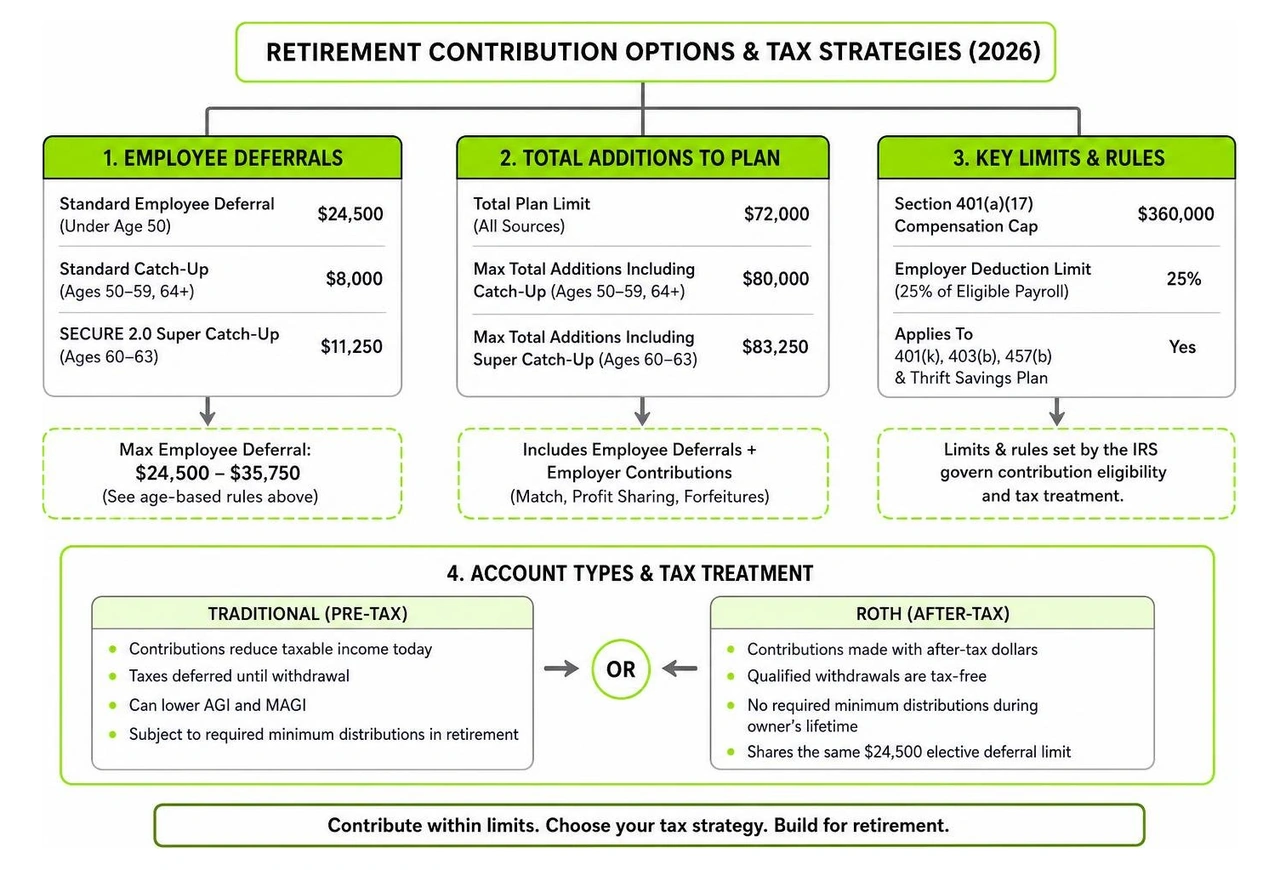
Beyond personal salary deferrals, workplace retirement plans accommodate matching contributions, discretionary profit sharing, and forfeiture allocations. Under Section 415(c)(1)(A), total combined additions across all sources cannot exceed the lesser of 100% of employee compensation or $72,000 for 2026.
When factoring in age-based catch-up contributions, total annual additions can reach $80,000 for savers aged 50 and over, or $83,250 for participants utilizing the super catch-up between ages 60 and 63. Plan sponsors must also account for the statutory 401k Company Match Limit and the updated $360,000 annual compensation cap under Section 401(a)(17). Federal guidelines detailed on Retirement topics - 401(k) and profit-sharing plan contribution limits | Internal Revenue Service restrict employers from deducting defined contribution plan contributions that exceed 25% of total eligible payroll.
Essential Tax Rules and Account Types for 2026
Structuring retirement contributions involves more than simply hitting dollar targets. Deciding where those dollars sit can produce vastly different tax outcomes throughout your career and into retirement.
Traditional Versus Roth 401k Contributions
Choosing between traditional pre-tax savings and designated Roth deferrals comes down to current tax rates versus anticipated tax brackets in retirement. Traditional contributions reduce gross taxable income today, which can be valuable for high earners seeking immediate deductions. Roth contributions require you to pay income tax on salary today, but all qualified withdrawals in retirement emerge completely tax-free.
When analyzing how these decisions impact broader tax return metrics, questions often arise regarding whether Do 401k Contributions Reduce MAGI. Pre-tax elective deferrals directly lower both adjusted gross income and modified adjusted gross income, potentially preserving eligibility for various tax credits and deductions. Both contribution types share the unified $24,500 elective deferral ceiling, allowing you to split contributions across both buckets in any proportion you choose.
Mandatory Roth Catch Up Contributions for High Earners
A major compliance milestone under SECURE 2.0 takes effect in 2026, altering how top earners fund catch-up contributions. Employees whose prior-year Social Security wages shown in Box 3 of Form W-2 exceed $150,000 must make all age-based catch-up contributions on an after-tax Roth basis.
This requirement removes the option for high earners to take upfront tax deductions on catch-up contributions. If a business sponsors a 401(k) plan that lacks a designated Roth feature, high-earning staff members cannot make catch-up contributions at all until the plan document is amended. Creative agencies and growing companies must verify their payroll systems and plan administration documents to ensure seamless compliance with this rule.
After-Tax Deferrals and Mega Backdoor Strategies

Participants looking to save beyond the $24,500 elective deferral threshold can explore voluntary after-tax contributions if their plan allows them. These non-Roth after-tax deferrals bridge the gap between standard salary deferrals, employer contributions, and the total $72,000 defined contribution plan limit.
Leveraging a 401k After Tax Contribution forms the foundation of the popular Mega Backdoor Roth strategy. Under this structure, an employee contributes after-tax dollars up to the Section 415 limit and quickly performs an in-plan conversion to a Roth 401(k) or rolls the funds into an outside Roth IRA. Earnings on regular after-tax contributions remain taxable upon withdrawal, but converting them immediately locks in tax-free compounding growth for years to come.
How 401k Limits Interact with Other Accounts and Excess Contributions
Retirement planning rarely happens in a vacuum. Managing multiple retirement plans requires tracking cumulative contribution limits across different vehicles to prevent accidental administrative errors.
Coordinating with IRAs 403b Plans and Multiple Employers
Personal elective deferral limits apply per individual rather than per plan. If you change employers mid-year or participate in both a corporate 401(k) and a 403(b), your total salary deferrals across all plans cannot exceed $24,500. Governmental 457(b) plans represent an exception to this aggregation rule, featuring their own independent $24,500 deferral cap that can be fully utilized alongside a standard 401(k).
Individual Retirement Accounts operate on a separate track as well. For 2026, the IRA limit rises to $7,500, with a $1,100 catch-up limit for savers aged 50 and older. Understanding your full 401k Max Per Year potential allows you to max out workplace plans while concurrently funding an IRA, subject to standard modified adjusted gross income deductibility thresholds.
What Happens If You Overcontribute to Your Plan
Exceeding the annual deferral cap can happen easily when transitioning between jobs or running separate businesses. If an excess deferral occurs, you must notify your plan administrator promptly and request a corrective distribution of the excess funds along with attributable net earnings before April 15 of the following tax year.
Missing the April 15 correction window triggers harsh double taxation penalties. The excess amount gets taxed in the year contributed and gets taxed a second time upon ultimate distribution from the account. Corrective payouts processed on time are reported on Form 1099-R, ensuring the excess is taxed only once in the original contribution year while avoiding early withdrawal penalties on the removed funds.
Actionable Strategies to Maximize Your 2026 Retirement Savings
Reaching maximum retirement contributions requires intentional planning throughout the year. We recommend adopting a disciplined profit-first savings approach to capture tax advantages without jeopardizing working capital.

- Capture your full employer match. Never leave free compensation behind, as an employer match provides an immediate return on your savings.
- Automate annual escalation. Increase your contribution rate by 1% each year or whenever you secure a rate increase or business bonus.
- Target a 15% overall savings rate. Strive to set aside at least 15% of gross income toward long-term accounts, counting both personal and company contributions.
- Establish plan protections. Business owners can review a Safe Harbor 401k Complete Guide to bypass annual nondiscrimination testing, enabling owners and key employees to max out contributions without risk of forced refunds.
- Coordinate irregular cash flow. Creative entrepreneurs should front-load contributions during high-revenue quarters to comfortably hit annual targets.
Frequently Asked Questions About 2026 Retirement Limits
How much can I contribute to my 401k if I am 62 years old in 2026?
A 62-year-old worker can contribute up to $35,750 in personal elective salary deferrals in 2026. This total consists of the baseline $24,500 employee deferral limit plus the SECURE 2.0 enhanced super catch-up of $11,250 for participants aged 60 through 63. To use this higher tier, your employer-sponsored plan must officially adopt the enhanced catch-up provisions.
Can I max out both a 401k and an IRA in 2026?
Yes, you can fully max out both accounts during the same calendar year. For 2026, an individual under age 50 can contribute $24,500 to a workplace 401(k) and $7,500 to a Traditional or Roth IRA, achieving $32,000 in total tax-advantaged annual retirement contributions. Your income level may affect whether your Traditional IRA contribution is tax-deductible or whether you can contribute directly to a Roth IRA.
What is the deadline to fix an excess 401k contribution for 2026?
The statutory deadline to correct an excess 401(k) deferral is April 15, 2027. You must alert your plan administrator in advance so they have sufficient time to calculate associated earnings and issue a corrective distribution before the cutoff, preventing double taxation on the overcontributed funds.
Conclusion
The 2026 retirement adjustments provide significant opportunities for forward-thinking professionals and entrepreneurs. By adjusting payroll deferrals to the new $24,500 cap, tapping into higher catch-up tiers, and planning around mandatory Roth rules for high earners, you can position your personal wealth for sustainable long-term success.
At Core Group, we specialize in delivering financial management, bookkeeping, and proactive tax services for creative entrepreneurs. Our no-fluff profit-first playbook guarantees peace of mind and saves you valuable time, allowing you to focus on growing your creative business while we keep your finances running smoothly, all backed by our MacBook Pro guarantee. To learn more about optimizing your retirement strategy and keeping more of what you earn, explore our guide on 401k and MAGI or reach out to our team today.