New 401(k) Rules for 2026: Higher Limits and the Roth Catch-Up Twist
What You Need to Know About 401k Changes in 2026
The biggest 401k changes 2026 brings are higher contribution limits across the board and a brand-new rule that forces some high earners to make catch-up contributions as Roth (after-tax) dollars instead of pre-tax.
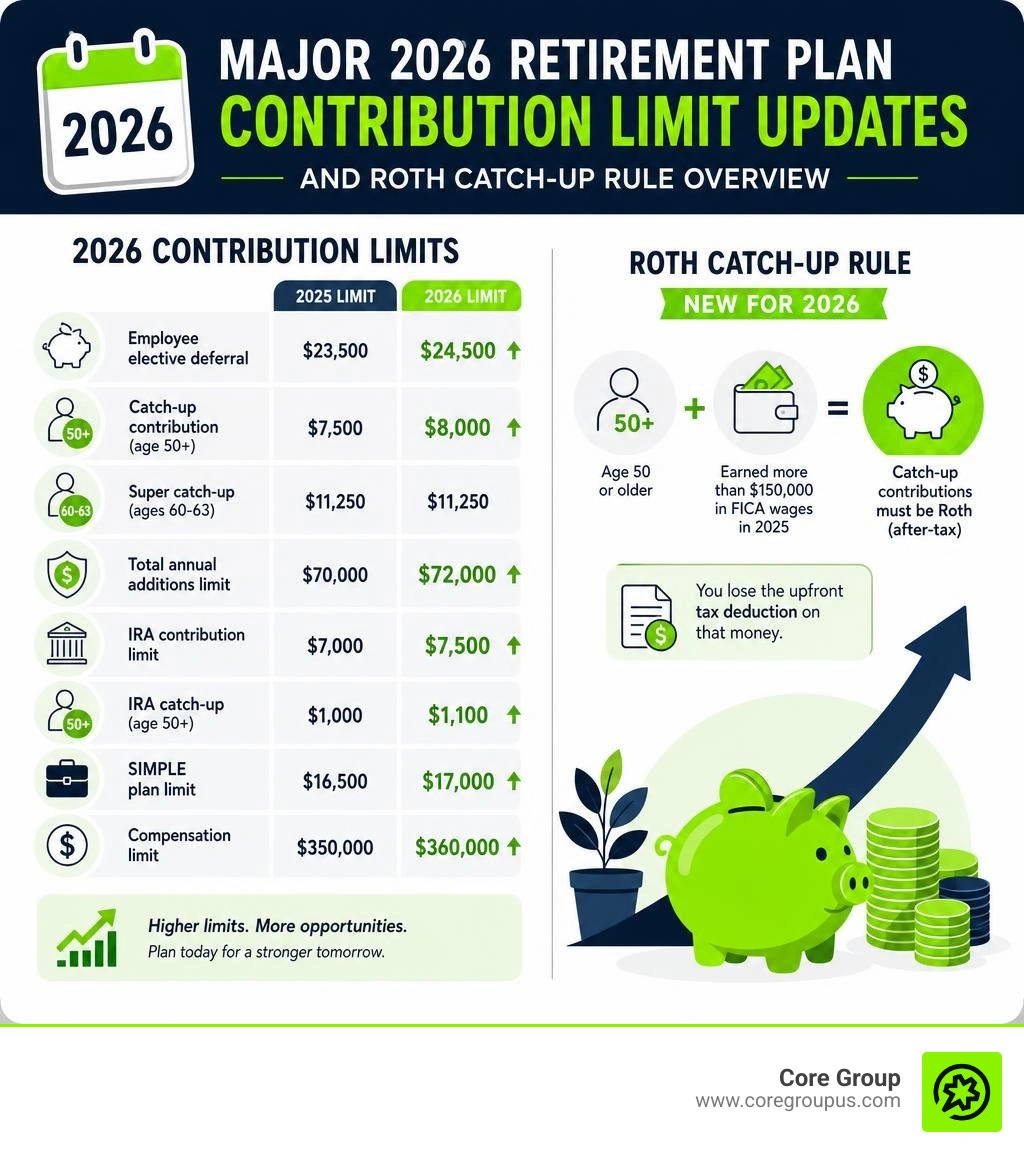
Here is a quick summary of the key changes:
| What Changed | 2025 Limit | 2026 Limit |
|---|---|---|
| Employee elective deferral | $23,500 | $24,500 |
| Catch-up contribution (age 50+) | $7,500 | $8,000 |
| Super catch-up (ages 60-63) | $11,250 | $11,250 |
| Total annual additions limit | $70,000 | $72,000 |
| IRA contribution limit | $7,000 | $7,500 |
| IRA catch-up (age 50+) | $1,000 | $1,100 |
| SIMPLE plan limit | $16,500 | $17,000 |
| Compensation limit | $350,000 | $360,000 |
New for 2026 If you are age 50 or older and earned more than $150,000 in FICA wages in 2025, your catch-up contributions must go into a Roth account. You lose the upfront tax deduction on that money.
For creative entrepreneurs and freelancers, these changes are not just technical footnotes. They directly affect how much you can shelter from taxes each year and how your retirement savings are treated at withdrawal. If you run your own production company, work as an independent filmmaker, or manage your finances as a sole proprietor, understanding these shifts now means fewer surprises at tax time.
The changes stem from two sources. The IRS issued its annual cost-of-living adjustments, lifting the base deferral limit by $1,000. The Roth catch-up rule comes from the SECURE 2.0 Act, signed into law in 2022, which is rolling out new provisions through 2026 and beyond.
401k changes 2026 vocabulary
Key 401k changes 2026 and New Contribution Limits
The retirement landscape is expanding in 2026, giving you more room to build your nest egg. For creative business owners who experience fluctuating income, knowing these exact numbers allows you to adjust your savings plan during high-revenue months.

The base employee elective deferral limit increases to $24,500 for the 2026 tax year. This is a $1,000 increase from the $23,500 limit in 2025. If you are under age 50, this is the maximum amount you can personally contribute to your workplace retirement plan through salary deferrals.
For those who are age 50 and older, the standard catch-up contribution limit rises to $8,000, up from $7,500 in 2025. This means a worker in their 50s can defer a total of $32,500 into their 401k plan in 2026.
The SECURE 2.0 Act introduced a special tier called the super catch-up contribution. This ruleset targets workers exactly in the age sixty to sixty-three bracket. In 2026, the super catch-up limit remains $11,250. When you combine this with the new $24,500 base limit, savers in this specific age range can contribute a maximum of $35,750 of their own salary. Once a participant turns 64, their catch-up limit reverts back to the standard age-50 limit of $8,000.
To make sure you stay within the law, you can review the official IRS 401k and profit sharing plan contribution limits page. If you want to dive deeper into how to structure your business to support these higher limits, explore our detailed guide on the 401k Maximum Contribution 2026.
The New Roth Catch-Up Rule for High Earners
One of the most talked-about elements of the 401k changes 2026 rollout is the mandatory Roth catch-up rule for high-income earners. Originally slated for an earlier implementation, the IRS provided a two-year transition period that officially ends as we enter 2026.

Under SECURE 2.0 Section 603, if your wages from your current employer exceeded $150,000 in the prior calendar year, any catch-up contributions you make must be designated as Roth contributions. This threshold is specifically tied to your W-2 Box 3 Social Security wages.
If your 2025 W-2 shows Social Security wages over $150,000, you cannot make pre-tax catch-up contributions in 2026. Instead, every dollar of your $8,000 catch-up contribution (or $11,250 super catch-up) must go into a Roth account using after-tax dollars. You can read more about how this transition operates on the Fidelity guide on Roth catch up rules.
How the Roth Catch-Up Twist Impacts 401k changes 2026
This rule change represents a major shift in tax planning. Historically, high-income savers relied on catch-up contributions to lower their current-year taxable income. By forcing these contributions into Roth accounts, affected employees will experience a loss of their upfront tax deduction.
The silver lining is that Roth accounts offer tax-free growth and completely tax-free qualified withdrawals in retirement. To secure tax-free status on the earnings, you must satisfy the five-year holding period, which begins on January 1 of the year you made your first Roth contribution to the plan.
For creatives in peak earning years, this requires a careful look at your current versus future retirement tax brackets. While you lose the immediate tax break, you build a pool of tax-free liquidity that can protect you against higher tax rates in the future.
Employer Compliance and Payroll Adjustments for 401k changes 2026
For business owners, this rule introduces significant administrative duties. Employers must work closely with their payroll providers and plan recordkeepers to ensure systems can identify affected high earners based on prior-year W-2 wages.
If your business offers a 401k plan with catch-up contributions, you must offer a Roth option. Under the law, if a plan does not have a Roth feature, no participant in that plan (regardless of income) is allowed to make catch-up contributions. To keep your plan compliant and attractive to top talent, you may need to adopt formal plan amendments.
For business owners looking to simplify their administration while maximizing contributions, a safe harbor plan can be an excellent path. You can learn more about how to set this up in our Safe Harbor 401k Complete Guide.
Traditional versus Roth 401k Contributions
Deciding where to direct your retirement dollars requires a solid understanding of how traditional pre-tax and Roth after-tax contributions affect your bottom line today and in the future.
With a traditional 401k, your contributions are deducted from your paycheck before taxes are calculated. This lowers your adjusted gross income for the current year, providing immediate tax relief. However, when you withdraw the money in retirement, both your original contributions and the investment earnings are taxed as ordinary income.
With a Roth 401k, you make contributions with after-tax dollars. You do not get a tax break today, but your investments grow tax-free, and qualified withdrawals in retirement are completely tax-exempt.
To help visualize these differences, we have outlined the core characteristics of each option below.
| Feature | Traditional 401k | Roth 401k |
|---|---|---|
| Upfront Tax Break | Yes, lowers current taxable income | No, funded with after-tax dollars |
| Growth Treatment | Tax-deferred | Tax-free |
| Withdrawal Taxation | Taxed as ordinary income | Tax-free if qualified |
| Age 50+ Catch-Up Option | Yes, unless FICA wages exceed $150k | Yes, required if FICA wages exceed $150k |
| Impact on Current MAGI | Reduces MAGI | Does not reduce MAGI |
Understanding how these options impact your overall tax profile is essential. For instance, pre-tax contributions can help lower your modified adjusted gross income, which can affect your eligibility for other tax credits and deductions. You can read more about this interaction in our guide on how Do 401k Contributions Reduce MAGI.
Employer Matching and Overall Annual Additions Limits
The employee elective deferral limit of $24,500 is only one part of the retirement equation. The IRS also places a cap on the total amount of money that can enter your 401k account in a single year. This is known as the Section 415(c) annual additions limit.
In 2026, the annual additions limit increases to $72,000, up from $70,000 in 2025. This limit represents the combined total of your personal employee elective deferrals, employer matching contributions, and any employer profit-sharing allocations. If you qualify for catch-up contributions, your personal maximum cap rises to $80,000 (or $83,250 if you qualify for the super catch-up).
To calculate these limits, the IRS uses an annual compensation limit, which rises to $360,000 in 2026. This means any employer match or profit-sharing formula cannot calculate contributions based on compensation above this amount.
As a business owner, designing a matching formula that rewards your team while keeping plan administration simple is a delicate balance. If you want to explore stable and secure ways to structure your company retirement benefits, take a look at our analysis of Safe 401k Options.
Comparing 401k Limits with IRAs and SIMPLE Plans
If you do not have access to a traditional 401k, or if you want to save even more outside of your workplace plan, you have several other retirement vehicles to consider.
The IRA contribution limit increases to $7,500 in 2026, up from $7,000 in 2025. The catch-up contribution limit for individuals age 50 and older also gets an adjustment, rising to $1,100, which allows a total contribution of $8,600.
For Roth IRAs, the income phase-out ranges are moving upward. In 2026, the phase-out range for single taxpayers is $153,000 to $168,000. For married couples filing jointly, the range is $242,000 to $252,000. If your income exceeds these limits, you cannot contribute directly to a Roth IRA.
For small businesses, SIMPLE retirement accounts remain a popular option. The SIMPLE contribution limit increases to $17,000 in 2026, up from $16,500, with the catch-up limit rising to $4,000.
Lower-income and middle-income savers can also benefit from the Saver's Credit. In 2026, the income limit to qualify for this credit increases to $80,500 for married filing jointly, $60,375 for heads of household, and $40,250 for single filers. You can read the full breakdown of these adjustments in the official IRS announcement on 2026 limits.
Frequently Asked Questions about 2026 Retirement Rules
What is the maximum 401k contribution limit for 2026
For the 2026 tax year, the maximum individual elective deferral limit is $24,500. If you are age 50 or older, you can add an $8,000 catch-up contribution, bringing your personal limit to $32,500. If you are between the ages of 60 and 63, you qualify for the super catch-up limit of $11,250, allowing you to contribute up to $35,750.
Who is affected by the mandatory Roth catch-up rule
This rule affects savers who are age 50 or older, make catch-up contributions to their employer-sponsored plan, and had W-2 FICA wages exceeding $150,000 from that same employer in the prior calendar year. If you meet these criteria, your catch-up contributions must be made as after-tax Roth contributions.
Can I contribute to both a 401k and an IRA in 2026
Yes, you can contribute to both plans because their limits are entirely separate. However, if you or your spouse are active participants in an employer-sponsored retirement plan, your ability to deduct traditional IRA contributions on your tax return may be limited or phased out based on your modified adjusted gross income.
Conclusion
Navigating the 401k changes 2026 brings can feel overwhelming, especially when you are focused on running a creative business. Between adjusting payroll systems, understanding the new Roth catch-up rules, and figuring out how to maximize your tax savings, retirement planning requires a clear strategy.
At Core Group, we provide expert financial management, bookkeeping, and tax services specifically tailored for creative entrepreneurs. We use a simple, profit-first playbook that cuts through the noise, saves you time, and guarantees total peace of mind. We are so confident in our ability to streamline your business finances that we back our services with our signature MacBook Pro guarantee.
Let us handle the numbers so you can focus on your creative passion. If you want to understand how your retirement contributions impact your overall tax picture, check out our guide on 401k and MAGI, or reach out to our team today to build your custom path forward.