401k Maximum Employer Contribution: What is the Absolute Limit?
What Is the 401k Maximum Employer Contribution in 2026
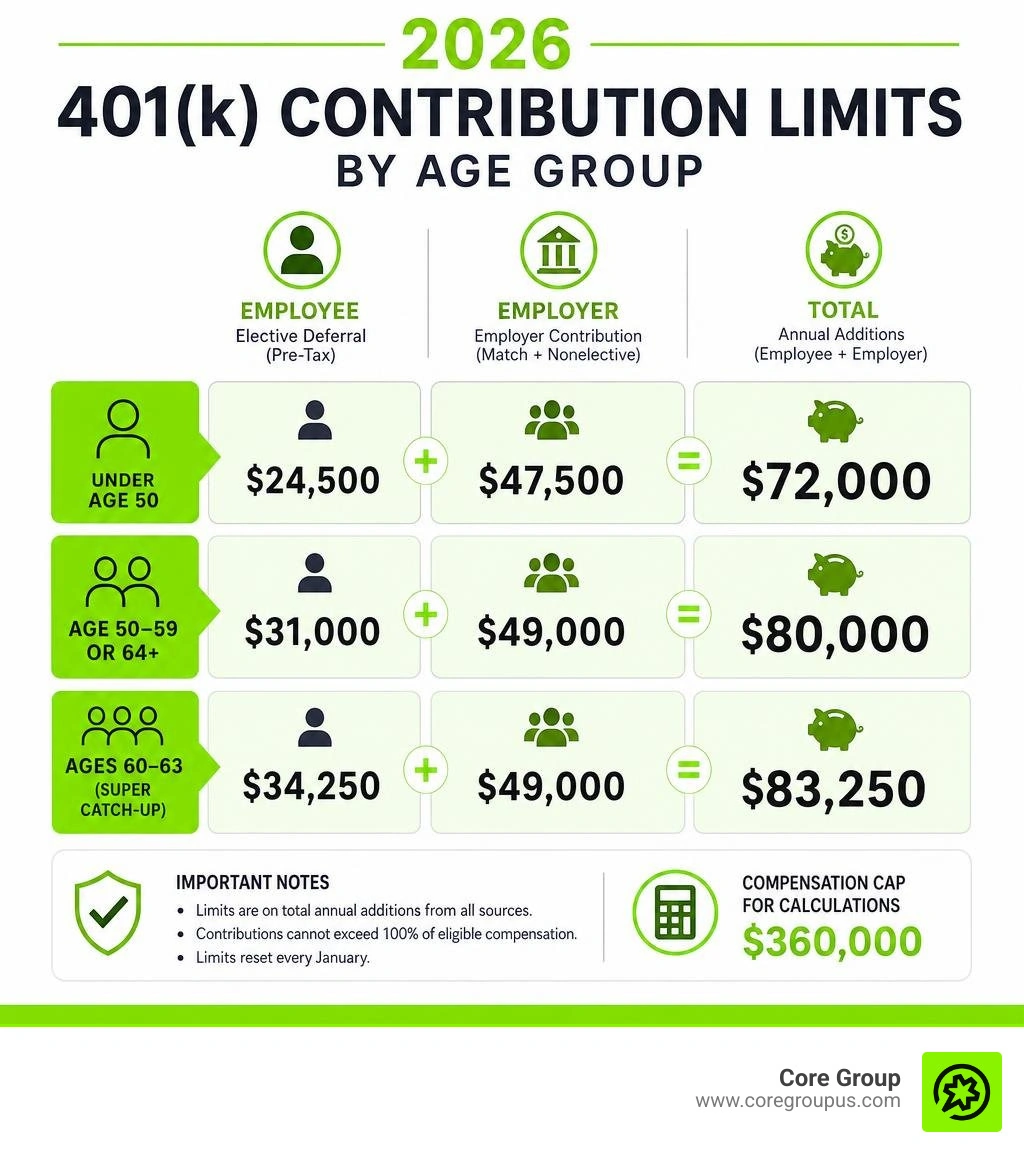
The 401k maximum employer contribution is one of the most important numbers a business owner or employee needs to know before the year ends. In 2026, the IRS sets a hard cap on how much can go into a 401(k) from all sources combined, including your own deferrals, your employer's match, and any extra after-tax contributions.
Here is a quick answer to the most common question.
| Situation | 2026 Total Limit |
|---|---|
| Under age 50 | $72,000 |
| Age 50 to 59 or 64+ | $80,000 |
| Ages 60 to 63 (super catch-up) | $83,250 |
| Employee elective deferral only (under 50) | $24,500 |
| Compensation cap for calculations | $360,000 |
A few key points to keep in mind right away.
- The $72,000 cap covers all contributions, from both you and your employer
- The employer's share is whatever is left after your own contributions
- Total contributions can never exceed 100% of your eligible compensation
- The $360,000 compensation limit applies when calculating what your employer can contribute
These numbers reset every January, and missing them can mean real tax headaches down the road. Whether you are a creative freelancer with a solo 401(k) or a media company matching contributions for your team, knowing exactly where the ceiling sits helps you plan smarter and keep more of what you earn.
Understanding the 401k Maximum Employer Contribution and Overall Limits
To fully grasp how much money can enter your retirement account, we have to look at the rules established under Section 415 of the Internal Revenue Code. Specifically, Section 415(c) sets the limit on what the IRS refers to as annual additions. These additions include your personal employee elective deferrals, any employer matching contributions, nonelective employer contributions, and any forfeiture allocations that might get redistributed to your account during the year.
For the tax year 2026, the overall annual additions limit is capped at $72,000. This is a notable increase from the $70,000 limit we saw in 2025 and the $69,000 limit from 2024. The IRS adjusts these limits periodically to keep pace with inflation, helping savers build a bigger nest egg over time.
But do not let the $72,000 number fool you into thinking your employer can simply hand you a check for that entire amount. This cap is a combined limit. It represents the total sum of everything contributed by you and your company. To understand how much your employer can contribute, you first have to subtract your own elective deferrals from that total. You can read the official government details on this via the IRS 401(k) and Profit Sharing Plan Limits page.
How the 401k Maximum Employer Contribution Works with Employee Deferrals
For 2026, the maximum amount an employee under the age of 50 can contribute through salary deferrals is $24,500. This applies to traditional pre-tax contributions and Roth contributions combined.
If you decide to max out your personal employee elective deferrals at $24,500, the 401k maximum employer contribution for an employee under 50 is calculated by subtracting your contribution from the overall limit.
$72,000 overall limit minus $24,500 employee deferral equals $47,500 maximum employer contribution.
If you choose not to contribute a single penny of your own money, your employer could theoretically contribute the entire $72,000 on your behalf, provided your compensation is high enough. This often happens in profit-sharing plans or solo 401(k) setups where the business owner makes nonelective contributions to their own account.
Employers can structure their contributions in a couple of ways.
- Matching contributions, where the employer matches a percentage of what the employee puts in
- Nonelective contributions, where the employer contributes a flat percentage of the employee's salary regardless of whether the employee contributes
For business owners wanting to simplify their plan administration and avoid complex compliance testing, utilizing a safe harbor design is a fantastic option. You can learn more about how these structures work in our Safe Harbor 401k Complete Guide.
Calculating the 401k Maximum Employer Contribution for High Earners
When calculating matching or profit-sharing contributions, we cannot simply use an employee's entire salary if they are a very high earner. The IRS imposes a strict limit on the amount of compensation that can be taken into account. For 2026, this annual compensation limit is $360,000.
This cap means that even if an executive or successful creative entrepreneur earns $500,000, any employer contribution calculations must treat their salary as exactly $360,000.
Additionally, employers face a deduction limit. A business can generally deduct employer contributions to a defined contribution plan up to 25% of the total eligible compensation paid to all participating employees. For an individual employee, the maximum deductible profit-sharing or nonelective contribution is 25% of their eligible compensation.
Let us look at how this plays out for a high-earning creative director earning $360,000 or more.
25% of the $360,000 compensation limit equals $90,000.
However, because the Section 415(c) individual limit is $72,000, the absolute maximum the employer can actually put into the account is capped at $72,000.
For business owners looking to maximize their own tax deductions while staying compliant, exploring various safe harbor and profit-sharing options is key. We break down these strategies in our guide on Safe 401k Options.
Age Based Catch Up Contributions and Super Catch Ups in 2026
If you are 50 or older, the IRS grants you the ability to save even more for retirement through catch-up contributions. These catch-up amounts are added on top of the standard limits, allowing older workers to accelerate their savings as they approach retirement.
For 2026, the standard catch-up contribution limit for individuals aged 50 to 59, as well as those aged 64 and older, is $8,000. This brings their personal elective deferral limit up to $32,500.
But there is an even better benefit for those in their early 60s. Under rules introduced by the SECURE 2.0 Act, individuals who are aged 60, 61, 62, or 63 qualify for a special super catch-up contribution. For 2026, this super catch-up limit is $11,250. This raises their personal elective deferral limit to a massive $35,750.
These catch-up contributions also expand the overall annual additions limit for these age groups. While the employer contribution itself does not increase, the total amount of money that can enter the account from all sources is higher.
| Age Group | Employee Deferral Limit | Overall Limit (Employee plus Employer) |
|---|---|---|
| Under Age 50 | $24,500 | $72,000 |
| Age 50 to 59 | $32,500 | $80,000 |
| Ages 60 to 63 | $35,750 | $83,250 |
| Age 64 and Older | $32,500 | $80,000 |
It is important to note that starting in 2026, a new rule requires high earners with prior-year wages exceeding $145,000 to make their catch-up contributions on a Roth basis. This means those catch-up dollars will be made with after-tax money, though they will grow and can be withdrawn tax-free in retirement.
What Counts Toward the Combined Annual Additions Limit
Understanding what counts toward the $72,000 limit is essential to avoid accidentally over-contributing. The annual additions limit is a bucket, and several different types of contributions fill it up.
The following items count toward your combined annual additions limit.
- Pre-tax elective deferrals made by the employee
- Roth elective deferrals made by the employee
- Employer matching contributions
- Employer nonelective or profit-sharing contributions
- Forfeiture allocations, which are non-vested account balances left behind by departing employees that are redistributed to remaining participants
- After-tax non-Roth contributions
After-tax non-Roth contributions are a unique tool. Some plans allow employees to make traditional after-tax contributions beyond the $24,500 elective deferral limit. If your plan allows this, you can contribute extra after-tax money to fill the gap all the way up to the $72,000 limit. This is the foundation of the popular mega backdoor Roth strategy, where those after-tax contributions are quickly converted into Roth funds.
Knowing how these contributions affect your tax picture is vital. For example, pre-tax contributions reduce your current-year taxable income, which can lower your Adjusted Gross Income. To see how this impacts your overall tax planning, take a look at our article on Do 401k Contributions Reduce MAGI.
Rules for Multiple Plans and Excess Contributions
If you work for more than one company or run a business while also working a W-2 day job, you might have access to multiple 401(k) plans. This is a common scenario for freelance designers, writers, and consultants. However, the rules for multiple plans can be tricky.
Your personal elective deferral limit of $24,500 is an individual limit. It applies to you, not to the plans. This means that no matter how many 401(k) plans you participate in, your total combined salary deferrals across all of them cannot exceed $24,500 in 2026.
However, the Section 415(c) overall annual additions limit of $72,000 applies per employer, provided the employers are completely unrelated. If you work for two entirely separate companies, you can theoretically receive up to $72,000 in total contributions in each plan.
If you accidentally contribute too much, you must act quickly. Excess employee deferrals must be corrected and distributed back to you by April 15 of the following year. If you fail to remove the excess by this deadline, you face double taxation. The excess amount is taxed in the year you contributed it, and it is taxed again in the year it is distributed to you.
Frequently Asked Questions About 401k Limits

What is the absolute maximum an employer can contribute to a 401k in 2026
The absolute maximum an employer can contribute to a 401(k) plan for an individual under age 50 in 2026 is $72,000. This is only possible if the employee makes zero elective deferrals of their own. If the employee does contribute, the employer's maximum contribution is reduced dollar-for-dollar by the employee's contribution. Additionally, the contribution cannot exceed 100% of the employee's eligible compensation.
Do employer contributions count toward the employee elective deferral limit
No, employer matching and nonelective contributions do not count toward your personal elective deferral limit of $24,500. You can fully contribute your $24,500, and your employer can still add their match or profit-sharing contribution on top of that, up to the combined $72,000 annual additions limit.
How does the 2026 compensation cap affect employer contributions
The 2026 compensation cap of $360,000 limits the amount of salary that can be used to calculate employer contributions. For example, if a plan offers a 5% matching contribution, the maximum match an employee can receive is 5% of $360,000, which equals $18,000, even if their actual salary is $500,000. This cap also influences overall business tax strategies, such as the Qualified Business Income deduction. For a deeper dive into how business deductions work, read our guide where the QBI Deduction Explained helps clarify these complex rules.
Conclusion

Navigating the rules around the 401k maximum employer contribution does not have to feel like decoding a foreign language. At Core Group, we specialize in helping creative entrepreneurs and small business owners cut through the financial noise. Our no-fluff, profit-first playbook is designed to give you ultimate peace of mind, saving you time so you can focus on doing what you love. We are so confident in our services that we back them with our MacBook Pro guarantee.
Whether you are trying to maximize your personal savings or structure a competitive retirement plan for your growing creative agency, we are here to guide you every step of the way. To learn more about how your retirement planning affects your overall tax bracket and financial health, check out our insights on 401k and MAGI. Let us help you keep your business profitable, compliant, and ready for a secure future.