Double Taxation Explained: Strategies to Protect Your Profits
Why Double Taxation Costs You More Than You Think
Avoid double taxation and you could keep thousands of dollars that would otherwise flow straight to the IRS, sometimes twice over.
Here are the main ways to do it
- Choose a pass-through entity like an S corp, LLC, or partnership so income is only taxed once, at your personal level
- Pay yourself a salary instead of dividends from a C corp, making it a deductible business expense
- Retain earnings inside your corporation rather than distributing them as dividends
- Claim the Foreign Earned Income Exclusion (up to $130,000 for 2025) if you earn income abroad
- Use the Foreign Tax Credit (Form 1116) to offset taxes already paid to another country
- Leverage US tax treaties with over 70 countries to reduce or eliminate overlapping tax obligations
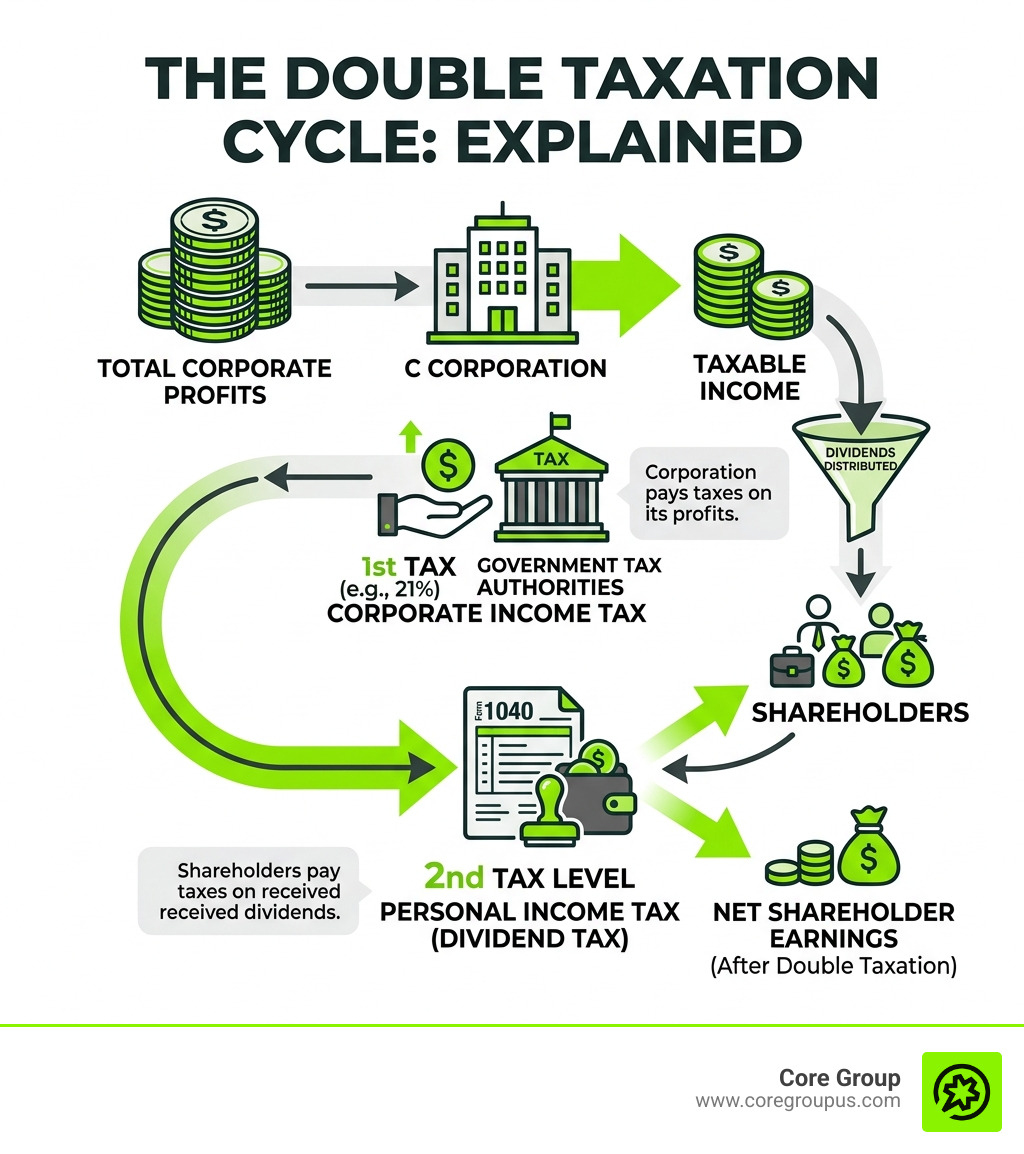
Double taxation happens when the same income gets taxed at two separate levels. For business owners, that typically means a C corporation pays a 21% federal tax on its profits, and then shareholders pay personal income tax again on any dividends they receive from those same profits.
For Americans living or working abroad, it works differently. The US is one of only two countries in the world (alongside Eritrea) that taxes its citizens based on citizenship rather than where they actually live. That means even if you're paying taxes in Germany, France, or Thailand, the IRS still expects a cut of your worldwide income.
It's a frustrating reality. You earn money once, and two governments want a piece of it.
But here's the good news. There are legitimate, IRS-approved strategies to significantly reduce or completely eliminate double taxation, whether you're a film producer structured as a C corp, a freelance creative working from abroad, or a media entrepreneur with income crossing state lines.
How Business Owners Can Avoid Double Taxation

In tax planning, double taxation is often seen as the ultimate penalty for choosing the wrong business structure. When we look at a standard C corporation, the IRS views the business as a completely separate legal person. This "person" earns a profit and pays a flat 21 percent corporate tax rate on those earnings.
However, the tax journey doesn't end there. If the corporation wants to reward its owners by sending those profits home, it issues dividends. Those dividends are then taxed again at the individual level at rates ranging from 10 percent to 37 percent. This creates a scenario where more than half of your hard-earned profit could disappear before it ever hits your personal bank account.
According to Investopedia's explanation of double taxation, this system is designed to prevent wealthy individuals from using corporations as a tax shelter to avoid personal income taxes indefinitely. But for a creative entrepreneur trying to grow a business, it often feels like an unfair double dip.
One way to mitigate this is through retained earnings. Instead of distributing every dollar of profit, we can keep that money inside the corporation to buy new equipment, hire staff, or invest in marketing. Since no dividend is paid, the second layer of tax is deferred.
Another powerful strategy is reasonable compensation. If you work in your business, you can take a salary. Unlike dividends, salaries are a tax-deductible expense for the corporation. This means the money you take as a paycheck reduces the corporation's taxable income, effectively moving that money from the double-taxed category into a single-taxed category.
| Tax Feature | C Corporation | S Corporation |
|---|---|---|
| Entity Level Tax | 21 percent flat rate | Generally zero |
| Owner Level Tax | Taxed on dividends | Taxed on share of profits |
| Double Taxation | Yes | No |
| Deductible Salary | Yes | Yes |
Using S Corporations to Avoid Double Taxation
For many of the creative entrepreneurs we work with, the S corporation is the holy grail of tax planning. An S corp is not actually a separate type of business entity like an LLC; it is a tax election you make with the IRS.
When you meet the S Corp Eligibility Requirements, your business becomes a pass through entity. This means the business itself does not pay federal income tax. Instead, the profits "pass through" to the owners and are reported on their individual tax returns. You get the same liability protection as a C corp but with only one layer of taxation.
We often discuss this in The Essential Guide To S Corporations because it allows you to avoid the double hit on your income while still maintaining a professional corporate structure that investors and banks prefer.
Paying Salaries Instead of Dividends
If you decide to stick with a C corp structure, perhaps because you want to attract venture capital or plan for an eventual IPO, you must be surgical about how you extract cash.
By paying yourself and your family members a salary for actual work performed, you create a deductible business expense on Form 1120. This process is known as income splitting. You take enough salary to cover your living expenses, which the business deducts, and you leave the rest in the company to grow. This effectively lets you avoid double taxation on a significant portion of your earnings.
The IRS does keep a close eye on this, though. You cannot simply pay yourself a $500,000 salary for a job that normally pays $50,000 just to avoid taxes. The compensation must be "reasonable" for the work you are doing. If the IRS decides your salary is too high, they may reclassify the excess as a dividend, bringing back that pesky double taxation.
International Relief for Expats and Global Income

The reach of the IRS is truly global. If you are a US citizen living in a villa in Italy or a studio in Tokyo, you are still required to file a US tax return every year. This creates a high risk of being taxed by both the US and your host country.
To prevent this, the IRS provides several relief mechanisms. The first is the Foreign Tax Credit (FTC), claimed on Form 1116. This allows you to take the taxes you paid to a foreign government and use them as a dollar-for-dollar credit against what you owe the US. If you paid $10,000 in tax to Germany and your US tax bill is $12,000, you only pay the $2,000 difference to the IRS.
The second major tool is the Foreign Earned Income Exclusion (FEIE), filed on Form 2555. For the 2025 tax year, this allows you to exclude up to $130,000 of your foreign-earned income from US taxation entirely. If you and your spouse both work abroad, you could potentially exclude $260,000 from your joint return.
According to official guidance on international double taxation, these methods are vital for maintaining the mobility of the global workforce. Without them, many expats would find it financially impossible to live and work overseas.
Leveraging Tax Treaties to Avoid Double Taxation
The US has entered into formal tax treaties with over 70 countries. These agreements act like a set of "tie-breaker" rules. They determine which country has the primary right to tax certain types of income, such as royalties, pensions, or business profits.
To claim a benefit under a treaty, you often need to file Form 8833. This tells the IRS that you are following a treaty rule that might override standard US tax law. India, for example, has comprehensive double taxation relief agreements with 88 countries to ensure that investment and talent can flow across borders without being penalized.
One thing to watch out for is the saving clause. Most US tax treaties contain a provision that allows the US to continue taxing its own citizens as if the treaty didn't exist. While this sounds scary, the treaties still provide significant protections for specific types of income and help define your residency status.
Understanding Bilateral Tax Agreements
Bilateral tax agreements are the foundation of international tax law. Most of these agreements follow models developed by the OECD (Organisation for Economic Co-operation and Development). They focus on reducing withholding rates on things like dividends and interest, which helps businesses expand globally.
As explained in the guide on Understanding Bilateral Tax Agreements to Avoid Double Taxation, these treaties also help prevent tax evasion by allowing countries to exchange information. To benefit from these reduced rates, you may need a residency certification from the IRS to prove to a foreign government that you are a US taxpayer.
Managing Multi State Tax Issues for Remote Workers
You don't have to leave the country to run into double taxation problems. With the rise of remote work, many creative professionals live in one state but work for a company based in another.
The general rule is the 183 day rule. If you spend more than half the year in a state, that state usually considers you a resident for tax purposes. However, the state where you actually perform the work may also want to tax that income.
To solve this, many states have reciprocity agreements. For example, if you live in Virginia but work in Maryland, these states have an agreement where you only pay taxes to your home state. This is a huge win for simplicity and helps you avoid double taxation without filing multiple complex returns.
If no reciprocity agreement exists, you can usually claim an out of state credit. This means your home state will give you a credit for the taxes you paid to the state where you worked. You can find more details in this State Tax Reciprocity Guide.
As FreeTaxUSA notes, you generally file a non-resident return in the state where you worked and a resident return in your home state, applying the credit to ensure you aren't paying twice on the same dollar.
Frequently Asked Questions about Tax Relief
What IRS forms are needed to claim relief?
Navigating the paperwork is often the hardest part of tax planning. Here are the heavy hitters you need to know
- Form 2555 is used to claim the Foreign Earned Income Exclusion.
- Form 1116 is used to claim the Foreign Tax Credit for individuals.
- Form 8833 is used to disclose a treaty-based return position.
- Form 1040-NR is the return filed by non-resident aliens who have US-source income.
How do pass through entities prevent double taxation?
Pass through entities like partnerships and S corporations are not taxed at the entity level. Instead, the income flows directly to the owners. Whether you are looking at Single Member LLC Taxes or a multi-partner creative agency, the result is the same with one layer of tax at your individual rate. This bypasses the corporate 21 percent tax entirely.
What should expats do if they are behind on filing?
If you've been living abroad and didn't realize you had to file US taxes, don't panic. The IRS offers Streamlined Filing Compliance Procedures. This program allows non-willful taxpayers to catch up on three years of back taxes and six years of FBAR (Foreign Bank Account Report) filings without facing heavy penalties. It is a path to peace of mind for those who simply didn't know the rules.
Conclusion
At Core Group, we understand that you didn't start your creative business to become a tax expert. You started it to create, to innovate, and to build something meaningful. But the reality is that taxes are often the biggest expense your business will ever face.
Our "no-fluff, profit-first playbook" is designed to help creative entrepreneurs navigate these complex waters. We focus on strategies that guarantee peace of mind and save you time, so you can get back to what you do best. Whether it's choosing the right entity to avoid double taxation or managing your bookkeeping so you never miss a deduction, we've got your back.
We are so confident in our ability to streamline your financial life that we even offer a MacBook Pro guarantee. If you're ready to stop worrying about the IRS and start focusing on your profits, check out our Tax Planning Resources today. Let's make sure your hard-earned money stays where it belongs with you.