A Practical Guide to Single Member LLC Taxes
What You Actually Need to Know About Single Member LLC Taxes

Single member LLC taxes are simpler than most people expect, but missing a few key details can cost you thousands of dollars each year.
Here is the short version.
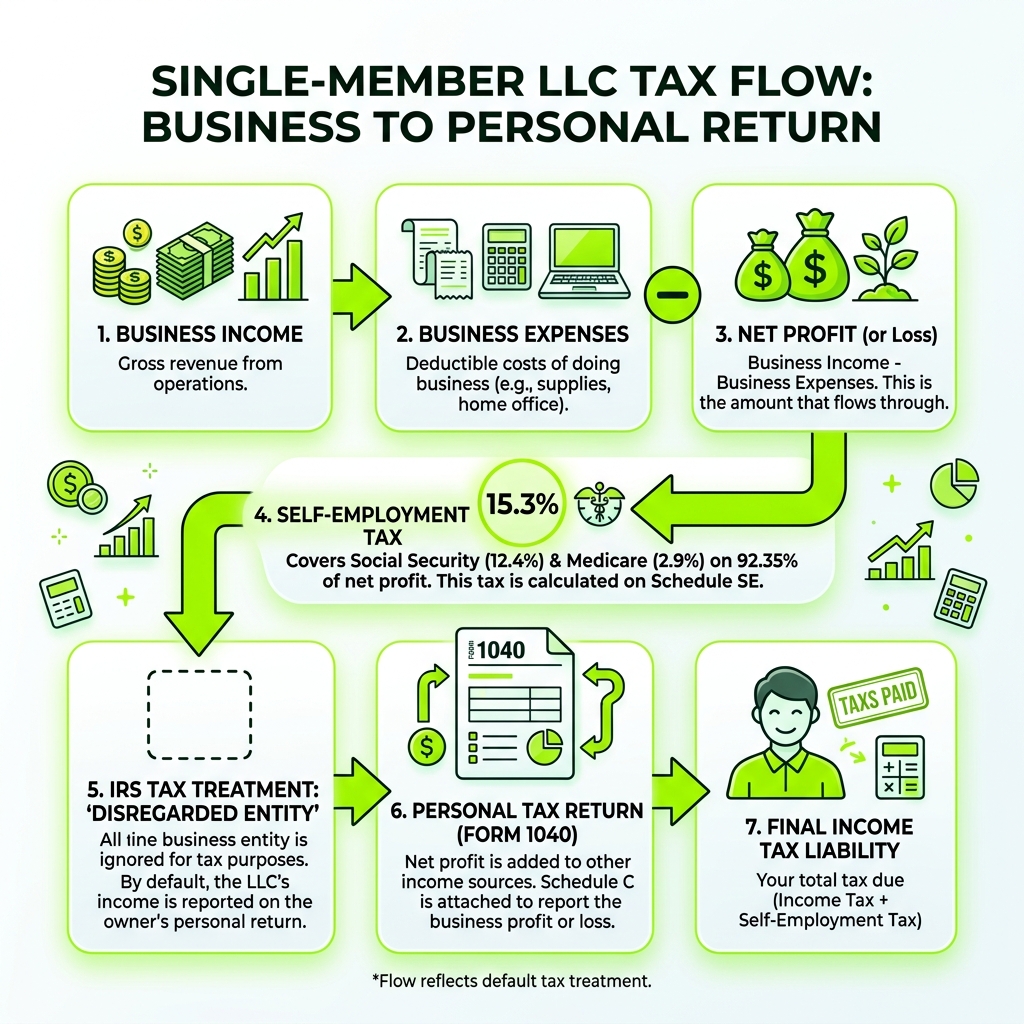
- Default tax treatment - The IRS treats your single member LLC as a "disregarded entity." Your business income flows straight to your personal tax return.
- Main form you file - Schedule C, attached to your Form 1040.
- Self-employment tax - You owe 15.3% on 92.35% of your net profit (this covers Social Security and Medicare).
- Tax elections available - You can elect S corp or C corp taxation instead of the default, which can reduce your tax bill at higher income levels.
- You do not file a separate business return by default.
That covers the basics. But if you are running a creative business or freelance operation, there is a lot more money on the table once you understand your options.
Over 33.2 million small businesses in the US are individually operated. Most of them start as sole proprietors or single member LLCs without realizing how much their structure affects what they owe each year.
The good news is that a single member LLC gives you two things a sole proprietorship does not - personal asset protection and flexibility to change how you are taxed as your income grows.
This guide walks through everything you need to manage your LLC taxes with confidence, from basic filing requirements to advanced strategies that can save you real money.
Handy single member llc taxes terms are listed below.
How the IRS Defines and Handles Single Member LLC Taxes
When we talk about an LLC, we are talking about a legal structure created by state law. However, the IRS does not have a specific tax category for an LLC. Instead, they look at how many owners the business has to determine the default tax rules.
According to IRS Publication 3402, a single member LLC is defined as an entity with only one owner. For federal income tax purposes, the IRS classifies this as a disregarded entity. This means the IRS ignores the LLC structure for income tax and treats the owner and the business as one and the same.
However, there is a catch. While the LLC is a disregarded entity for income taxes, it is treated as a separate entity for employment taxes and certain excise taxes. If you hire employees, your LLC must use its own name and Employer Identification Number (EIN) to report and pay payroll taxes.
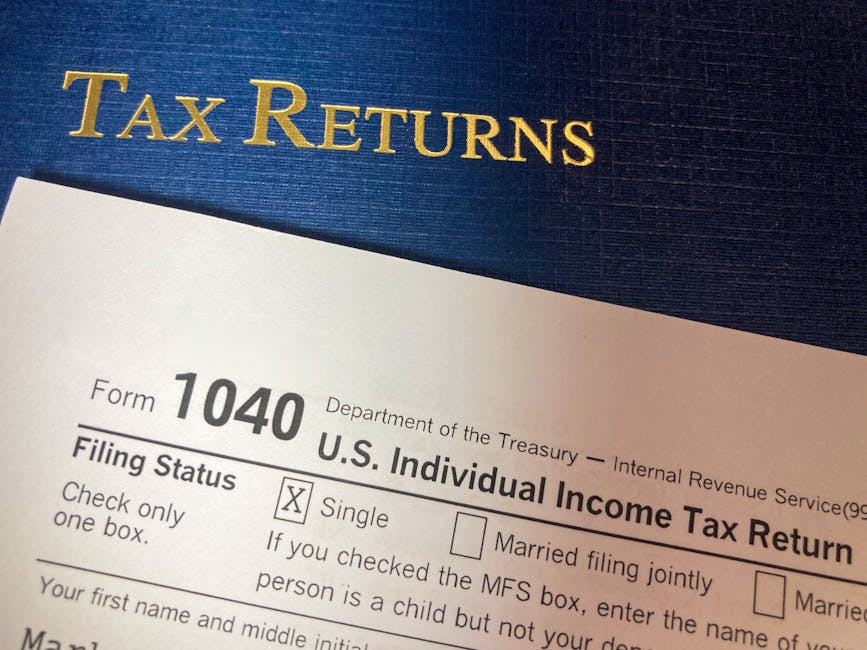
This dual nature is why many creative entrepreneurs get confused. You are a single person for your income tax return, but you might be a separate business entity when it comes to paying a virtual assistant or a studio manager. Understanding this distinction is the first step toward staying compliant and avoiding IRS notices.
Federal Filing Requirements and Self Employment Tax Obligations
If you stick with the default tax status, your filing process is relatively straightforward. You do not need to file a separate corporate tax return. Instead, you report all business income and deductible expenses on Schedule C (Form 1040).
The net profit calculated on your Schedule C flows to your personal Form 1040. This is what we mean by pass through taxation. The business itself does not pay income tax. You pay the tax on your personal return at your individual tax rate.
The Reality of Self Employment Tax
One of the biggest surprises for new business owners is the self employment tax. When you work for a boss, they pay half of your Social Security and Medicare taxes, and you pay the other half. When you own a single member LLC, you are both the employer and the employee.
You are responsible for the full 15.3% self employment tax rate. This consists of these specific parts.
- 12.4% for Social Security
- 2.9% for Medicare
The Social Security portion is capped at a certain income level each year. For 2026, that cap is $176,100. The Medicare portion has no cap, meaning you pay 2.9% on every dollar of profit. If your income exceeds certain thresholds ($200,000 for individuals or $250,000 for married couples filing jointly), you may also owe an additional 0.9% Medicare tax.
Quarterly Estimated Payments
Because there is no employer withholding taxes from your paycheck, the IRS requires you to pay as you go. If you expect to owe $1,000 or more in single member llc taxes for the year, you must make quarterly estimated tax payments. These are typically due in April, June, September, and January. Failing to make these payments can result in underpayment penalties.
Comparison of Tax Savings
As your business grows, the default taxation might not be the most efficient choice. Below is a look at how an S Corp election can change the math for a business with $100,000 in net profit.
| Tax Feature | Default LLC (Disregarded) | LLC Taxed as S Corp |
|---|---|---|
| Taxable Base | $92,350 (92.35% of profit) | $60,000 (Example Salary) |
| Self Employment Tax Rate | 15.3% | 15.3% (on salary only) |
| Total SE/FICA Tax | $14,130 | $9,180 |
| Estimated Compliance Costs | $0 | $4,000 |
| Total Tax + Compliance | $14,130 | $13,180 |
In this scenario, the S Corp election saves about $950. As profits climb toward $150,000 or $200,000, these savings become much more significant.
Strategic Tax Elections for Your Business
One of the best things about an LLC is its flexibility. You are not stuck with the default status forever. You can choose to change your tax classification by filing Form 8832 for C Corp status or Form 2553 for S Corp status.
There is an important rule to keep in mind called the 60 month rule. Generally, once you change your tax election, you cannot change it again for another 60 months (five years). This makes it vital to choose the right path after looking at your long term growth projections.
Benefits of Electing S Corp Status for Single Member LLC Taxes
For many creative entrepreneurs, the S Corp election is the "sweet spot" for tax planning. When you form an S corp, you become an employee of your own business.
This allows you to split your income into two buckets.
- A reasonable salary - You pay yourself a W-2 wage. This amount is subject to FICA taxes (Social Security and Medicare).
- Distributions - The remaining profit is paid to you as a distribution. This bucket is not subject to self employment or FICA taxes.
Deciding if creative entrepreneurs should become an S corp usually depends on profit levels. Most experts suggest waiting until your net profit is at least $75,000 to $80,000. This is because the tax savings must be high enough to outweigh the extra costs of running payroll and filing a separate business tax return (Form 1120-S).
Choosing C Corp Taxation via Form 8832
While less common for solo operators, you can elect to be taxed as a C Corp. Under this structure, the business pays a flat federal corporate income tax rate of 21%.
The main downside here is double taxation. The business pays tax on its profits, and then you pay personal income tax on any dividends you receive. However, for certain high growth companies that want to reinvest all profits back into the business, a C Corp might offer some advantages. Most single member LLC owners find the pass through nature of an S Corp or default LLC much more attractive.
Maximizing Deductions and Managing State Compliance
Every dollar you deduct is a dollar you do not have to pay taxes on. For a single member LLC owner, your "taxable income" is your total revenue minus your business expenses.
Top Deductions for Single Member LLC Taxes
To be deductible, an expense must be both ordinary (common in your industry) and necessary (helpful for your business). We have put together a full llc tax deductions guide to help you find every penny, but here are the heavy hitters.
- Home Office Deduction - If you use a portion of your home exclusively for business, you can deduct a percentage of your rent, mortgage interest, utilities, and insurance. You can use the simplified method ($5 per square foot up to 300 square feet) or the actual expense method.
- Mileage - For 2026, the standard mileage rate is $0.70 per mile. Keeping a detailed log of your business trips is essential for this deduction.
- Health Insurance - You can often deduct 100% of the health insurance premiums you pay for yourself and your family.
- Retirement Contributions - Using a Solo 401(k) or SEP IRA can significantly lower your tax bill. For 2026, the contribution limit for a Solo 401(k) is up to $69,000.
- Qualified Business Income (QBI) Deduction - Most single member LLC owners can deduct up to 20% of their qualified business income from their taxes, thanks to the permanent status of this deduction under recent legislation.
- Health Reimbursement - You might consider a section 105 plan to reimburse yourself for medical expenses, which can be a powerful strategy if you are married and can hire your spouse.
State Specific Fees and EIN Requirements
While federal taxes are the biggest hurdle, you cannot ignore state requirements. Every state has different rules for LLCs. For example, if you are looking into Maryland llc tax rules, you will find specific annual report fees that must be paid to keep your business in good standing.
The national average for LLC filing fees is about $132, but this ranges from $35 to $500 depending on where you live. Some states, like California, also charge a minimum annual franchise tax (currently $800).
You should also obtain an EIN (Employer Identification Number) from the IRS. While a disregarded entity with no employees can technically use the owner's Social Security number, having an EIN is better for privacy and is usually required to open a business bank account.
Common Questions Regarding Small Business Tax Compliance
Compliance is about more than just filing forms on time. It is about protecting the legal "shield" your LLC provides. If you treat your business bank account like a personal piggy bank, a court could "pierce the corporate veil" and hold you personally liable for business debts or lawsuits.
How should I pay myself as an LLC owner?
If you are a default disregarded entity, you pay yourself through an owner's draw. You simply transfer money from your business account to your personal account. You do not take a formal salary or receive a W-2. You are taxed on the total profit of the business, regardless of how much money you actually moved to your personal account.
If you have elected S Corp status, you must pay yourself a "reasonable salary" through a payroll system, complete with tax withholdings. Any additional profit can then be taken as a distribution.
Does a husband and wife owned LLC count as a single member?
In most cases, an LLC with two owners is treated as a partnership. However, there are two exceptions.
- Community Property States - If you live in a community property state (like Arizona, California, Nevada, or Texas), a husband and wife owned LLC can choose to be treated as a single member disregarded entity.
- Qualified Joint Venture - In other states, you might qualify as a Qualified Joint Venture if both spouses materially participate in the business, allowing you to avoid the complexity of a partnership return.
When is an EIN required for my business?
You must get an EIN if you meet any of these conditions.
- Hire employees
- Elect to be taxed as a corporation
- Open a business bank account (most banks require it)
- File pension or excise tax returns
Even if not strictly required, we always recommend getting one to keep your Social Security number off of W-9 forms provided to clients.
Conclusion
Managing single member llc taxes does not have to be a source of constant stress. By understanding your status as a disregarded entity, keeping clean records, and knowing when to make a strategic tax election, you can keep more of what you earn.
At Core Group, we specialize in helping creative entrepreneurs navigate these waters. Our "no-fluff, profit-first playbook" is designed to take the guesswork out of your financial management. We handle the bookkeeping and tax strategy so you can get back to the work you love. We are so confident in our ability to streamline your business that we even offer a MacBook Pro guarantee.
If you are ready to stop worrying about the IRS and start focusing on growth, explore our Tax Planning Resources or reach out to us today. Let us help you find the peace of mind that comes with a perfectly managed tax strategy.