How to Report C Corp Income Without a 1099 in 3 Simple Steps
Does a C Corp Get a 1099 for Its Income?
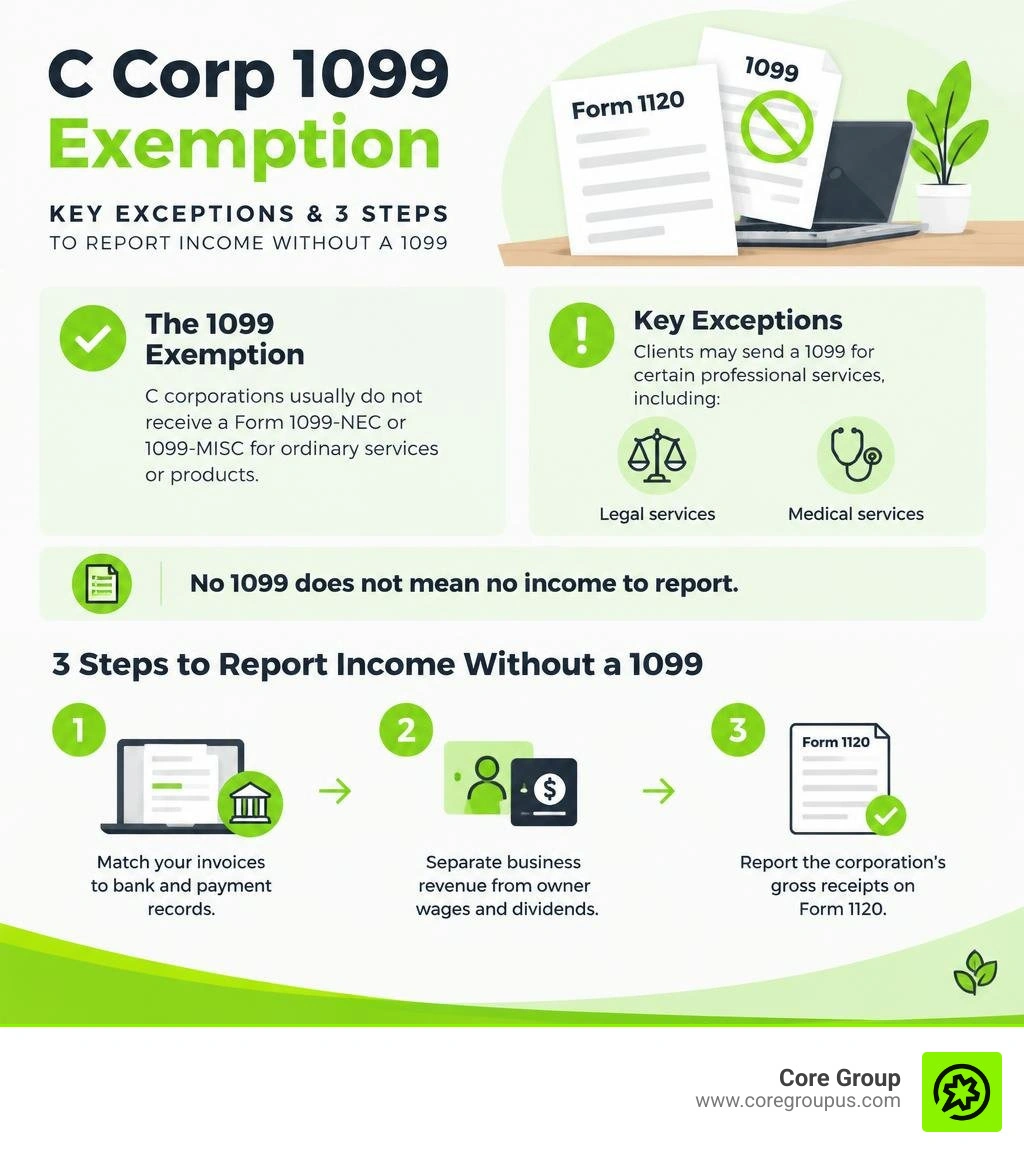
Usually, no. Clients generally do not send a C corporation Form 1099-NEC or Form 1099-MISC for ordinary services or products. Payments for legal or medical services are key exceptions. No 1099 does not mean no income to report.
To report C corp income without a 1099, match your invoices to bank and payment records, separate business revenue from owner wages and dividends, and report the corporation's gross receipts on Form 1120.
I'm Christian Brim, and I'll walk you through those three steps so a missing 1099 does not leave a gap in your books.
Helpful resources on corporate and contractor tax reporting
Does a C Corp Get a 1099? The General Exemption and Strict Exceptions

Whether a C corp gets a 1099 for routine client work usually turns on its federal tax classification. A client normally does not issue Form 1099-NEC for nonemployee services or Form 1099-MISC for ordinary payments to a federally recognized C corporation, including a creative agency, consulting firm, or production company. The corporate reporting exemption applies to routine payments, subject to the legal, medical, and other exceptions discussed below.
Federal law creates this exemption because corporations already operate under rigorous internal accounting requirements, balance sheet tracking, and distinct corporate tax returns. However, many business owners mistake the absence of an informational tax form for tax-free revenue. Every dollar of taxable revenue earned by a corporation must still appear on its corporate tax return, regardless of whether a client reports it to the IRS.
When clients make payments to vendors, they consult federal guidelines on reporting nonemployee compensation and official rules for reporting payments to independent contractors. The following table outlines how different entity structures trigger or avoid standard information reporting forms.
| Entity Type | Form 1099-NEC for Services | Form 1099-MISC for Rent or Prizes | Exceptions Requiring a 1099 |
|---|---|---|---|
| Sole Proprietorship | Required if threshold met | Required if threshold met | None, always reportable |
| Single-Member LLC | Required if threshold met | Required if threshold met | None, treated as disregarded |
| Partnership / Multi-Member LLC | Required if threshold met | Required if threshold met | None, standard reporting applies |
| S Corporation | Exempt | Exempt | Legal services, medical payments |
| C Corporation | Exempt | Exempt | Legal services, medical payments, federal agency payouts |
When Does a C Corp Get a 1099 for Legal and Medical Services?
The corporate exemption is broad, but it is not absolute. The IRS carves out explicit statutory exceptions where payers must issue an information return even if the payee is incorporated as a C corp or S corp.
The most common exception involves legal fees. Under Treasury regulations, any business that pays an attorney or law firm for professional legal services must report those payments in Box 1 of Form 1099-NEC. If the payment represents gross proceeds from a legal settlement where the attorney fee cannot be neatly separated, the payer must report the full amount in Box 10 of Form 1099-MISC. Both requirements apply even if the legal provider operates as an incorporated professional corporation.
A second major exception applies to medical and health care payments. Businesses making payments to corporate medical providers, laboratories, or health clinics for professional health services must report these amounts on Form 1099-MISC. Additionally, federal executive agencies must report all vendor payments for services rendered by corporations on Form 1099-NEC. Knowing these distinctions is essential for teams mastering how to issue a 1099 to a contractor without making costly reporting errors.
How LLC Tax Classification Determines 1099 Eligibility
Confusion frequently arises when dealing with limited liability companies. An LLC is a legal entity created under state law, but the IRS does not recognize an LLC as a distinct tax classification. Instead, an LLC is taxed based on its default classification or by making a specific corporate tax election.
A single-member LLC defaults to a disregarded entity and receives standard 1099 forms under the owner's Social Security Number or entity EIN. A multi-member LLC defaults to a partnership and also receives 1099 forms. However, if an LLC files Form 8832 to elect C corporation status, it adopts the corporate exemption rules. Payers determine this eligibility by collecting a signed Form W-9 before issuing payment. Box 3 of Form W-9 reveals whether an LLC has elected corporate status. Understanding how LLCs handle 1099 reporting alongside the structural difference between LLCs and corporations protects your business from sending redundant forms.
3 Steps to Report C Corp Revenue When You Don't Receive a 1099

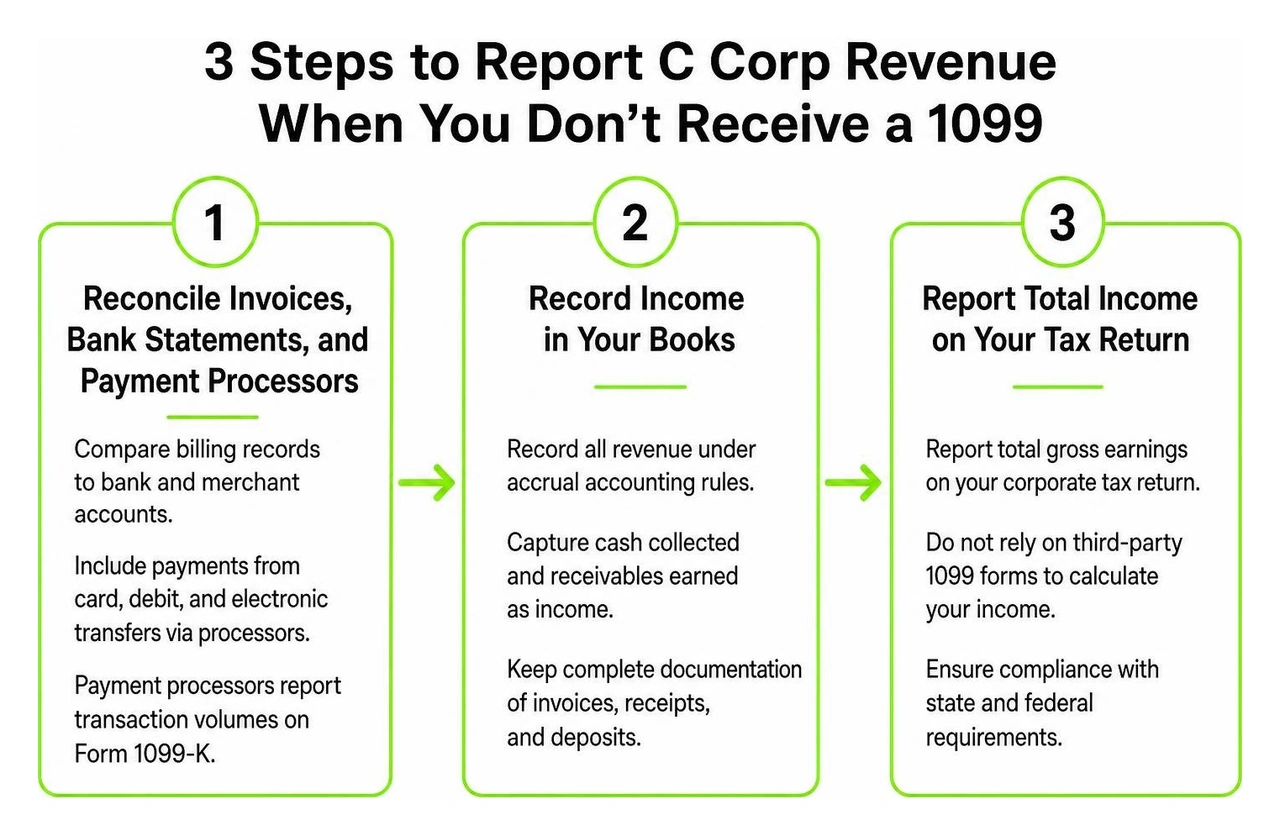
Operating without 1099 forms requires an internal accounting process that captures all incoming revenue. You cannot rely on third-party tax documents to calculate your corporate income. Following a disciplined three-step process guarantees your books reflect total gross earnings accurately while keeping you fully compliant with state and federal authorities.
Step 1 Reconcile Invoices, Bank Statements, and Payment Processors
The first step in reporting income without a 1099 is performing an exhaustive reconciliation across all operational accounts. This ensures that every invoice issued matches cash collected or receivables earned under accrual accounting rules.
Begin by comparing your billing software records against your primary business checking and merchant settlement accounts. If your business accepts credit cards, debit cards, or electronic transfers through third-party processors, those entities track gross transactions independently. Under federal rules, payment processors report transaction volumes on Form 1099-K. However, your internal bookkeeping should already capture these amounts directly from sales receipts.
Reconcile your accounts receivable ledger to catch unapplied customer deposits, outstanding customer balances, and chargebacks. By verifying bank deposits against closed sales invoices, you establish a reliable audit trail that verifies every dollar of gross corporate income.
Step 2 Separate Corporate Profit from Owner Compensation and Dividends
C corporations are separate legal and tax entities from the individuals who own and manage them. You cannot treat corporate revenue as personal income or take informal owner draws without triggering tax penalties.
Shareholders who perform services for the corporation must receive reasonable compensation processed through a formal payroll system with appropriate tax withholdings. These earnings are reported on Form W-2 at year-end, never on a 1099 form. Classifying officer labor as contract work is an error that invites IRS scrutiny.
When the corporation distributes net earnings to shareholders outside of payroll, those payments represent equity distributions. Corporate distributions are treated as dividends and must be reported on Form 1099-DIV. Separating corporate revenue from executive payroll and dividend distributions ensures your corporate books stay clean and audit-ready.
Step 3 Report Gross Receipts on IRS Form 1120
Once your revenue and corporate disbursements are reconciled, you report the corporation's financial activity on IRS Form 1120, the U.S. Corporation Income Tax Return.
Total corporate sales flow directly to Line 1a (Gross receipts or sales) on Form 1120. Net returns and customer allowances are subtracted on Line 1b to reach your net corporate revenue. From there, you deduct ordinary and necessary business expenses, such as cost of goods sold, employee wages, rent, advertising, and professional fees, to calculate corporate taxable income.
C corporations pay a flat 21 percent federal corporate income tax rate on net taxable earnings. Depending on where your business operates, you must also file corresponding state corporate tax returns following local guidelines such as the Colorado Corporate Income Tax Guide. Maintaining clean source records makes corporate tax filing seamless, even without receiving a single 1099.
2026 Reporting Rules, Deadlines, and Penalties for Corporate Payers
Understanding corporate reporting rules also requires staying up to date on payer obligations. If your C corporation hires independent contractors or unincorporated service providers, your business must issue the correct forms by established federal deadlines.
Information returns for nonemployee compensation must be delivered to recipients and submitted to the IRS by January 31 following the close of the tax year. Understanding guidelines on when 1099s are due prevents late filing interest. Payers filing 10 or more information returns across all form types must submit their filings electronically through the IRS Information Returns Intake System (IRIS) or the Filing Information Returns Electronically (FIRE) application.
Why Does a C Corp Get a 1099 Under 2026 IRS Threshold Rules?
Federal reporting rules have evolved, establishing specific financial thresholds that determine when an information return is required. While standard payments for corporate services remain exempt, statutory exceptions must meet defined monetary triggers before a form is generated.
Under updated statutory thresholds, nonemployee compensation rules outlined in Form 1099-NEC rules apply when cumulative payments for services reach $2,000 in a calendar year. However, specific exceptions carry distinct thresholds. Royalties require reporting on Form 1099-MISC once payments reach $10, while legal settlement proceeds reported to attorneys carry a $600 threshold.
When a payee fails to provide a valid Taxpayer Identification Number on Form W-9, payers must implement mandatory backup withholding at a flat 24 percent rate. Monitoring these payment thresholds year-round prevents year-end compliance scrambles.
Penalties for Failing to File or Report Corporate Payments
The IRS enforces information reporting compliance through statutory penalties assessed under Internal Revenue Code Sections 6721 and 6722. These penalties apply separately for failing to file a correct information return with the IRS and failing to furnish a correct payee statement to the recipient.
Penalties are tiered based on how quickly the error is resolved. For returns filed up to 30 days late, the penalty is $60 per return. That amount increases to $130 per return if filed between 31 days late and August 1, and reaches $340 per return for filings submitted after August 1 or not filed at all. If the IRS determines that a business deliberately ignored its filing obligations, the penalty rises to $680 per form or 10 percent of the total amount of items required to be reported, with no maximum limitation.
Frequently Asked Questions About C Corp 1099 Requirements
Does a C corp get a 1099-NEC for consulting services?
No. General consulting, creative, design, marketing, and technical services provided by a C corporation are exempt from 1099-NEC reporting. When your C corp delivers consulting services to a client, you provide a completed Form W-9 indicating your corporate tax classification. Your client keeps this document on file as proof of your exemption and does not issue a 1099-NEC.
Can a C corp owner issue a 1099 to themselves?
No. An owner who works for their C corporation is legally classified as an employee and corporate officer. Compensation for services performed must be paid as wages through formal payroll and reported on Form W-2 with appropriate payroll tax withholdings. Attempting to issue a 1099-NEC to yourself to avoid payroll taxes can lead to severe IRS reclassification penalties, back payroll taxes, and late payment fines.
What forms do C corporations receive instead of a 1099?
Rather than receiving standard Form 1099-NEC forms, C corporations typically track their revenue through internal accounting records, sales invoices, and bank deposits. Depending on operations, a C corporation might receive Form 1099-K from credit card processors or online merchant platforms, Form 1099-DIV for investments held in other corporations, or Form 1042-S for certain foreign-sourced income streams.
Conclusion
Navigating corporate information returns does not have to be confusing. While C corporations are generally exempt from receiving Form 1099-NEC and Form 1099-MISC for standard services, strict statutory exceptions exist for legal fees and medical payments. More importantly, operating without 1099 forms places the responsibility for accurate revenue tracking entirely on your internal bookkeeping systems.
By reconciling your accounts monthly, keeping corporate earnings distinct from owner payroll, and reporting gross receipts directly on Form 1120, your business maintains spotless financial records that easily withstand tax scrutiny.
At Core Group, we provide comprehensive financial management, bookkeeping, and tax services tailored specifically for creative entrepreneurs. Our no-fluff, profit-first playbook delivers complete peace of mind and saves you valuable time, allowing you to focus on expanding your business, backed by our MacBook Pro guarantee. Explore our specialized single-member LLC and corporate 1099 reporting solutions to streamline your tax workflow and keep your corporate accounting fully compliant year-round.