Detailed Guide to Comparing Contractor Payroll Services
How to Compare Contractor Payroll Services
To choose contractor payroll services, first confirm which workers are independent contractors. Then compare how each service collects tax forms, pays contractors, tracks payment records, and prepares year-end reporting. Check the full cost, including monthly fees and payment charges, before you sign up.
Contractor payments are not the same as employee payroll. Businesses generally do not withhold payroll taxes from payments to properly classified U.S. contractors, but they still need accurate records and may need to file Form 1099-NEC. A payment tool can help with paperwork, but it cannot decide a worker's legal status for you.
I'm Christian Brim, and I'll walk you through the checks that matter most when choosing a service.
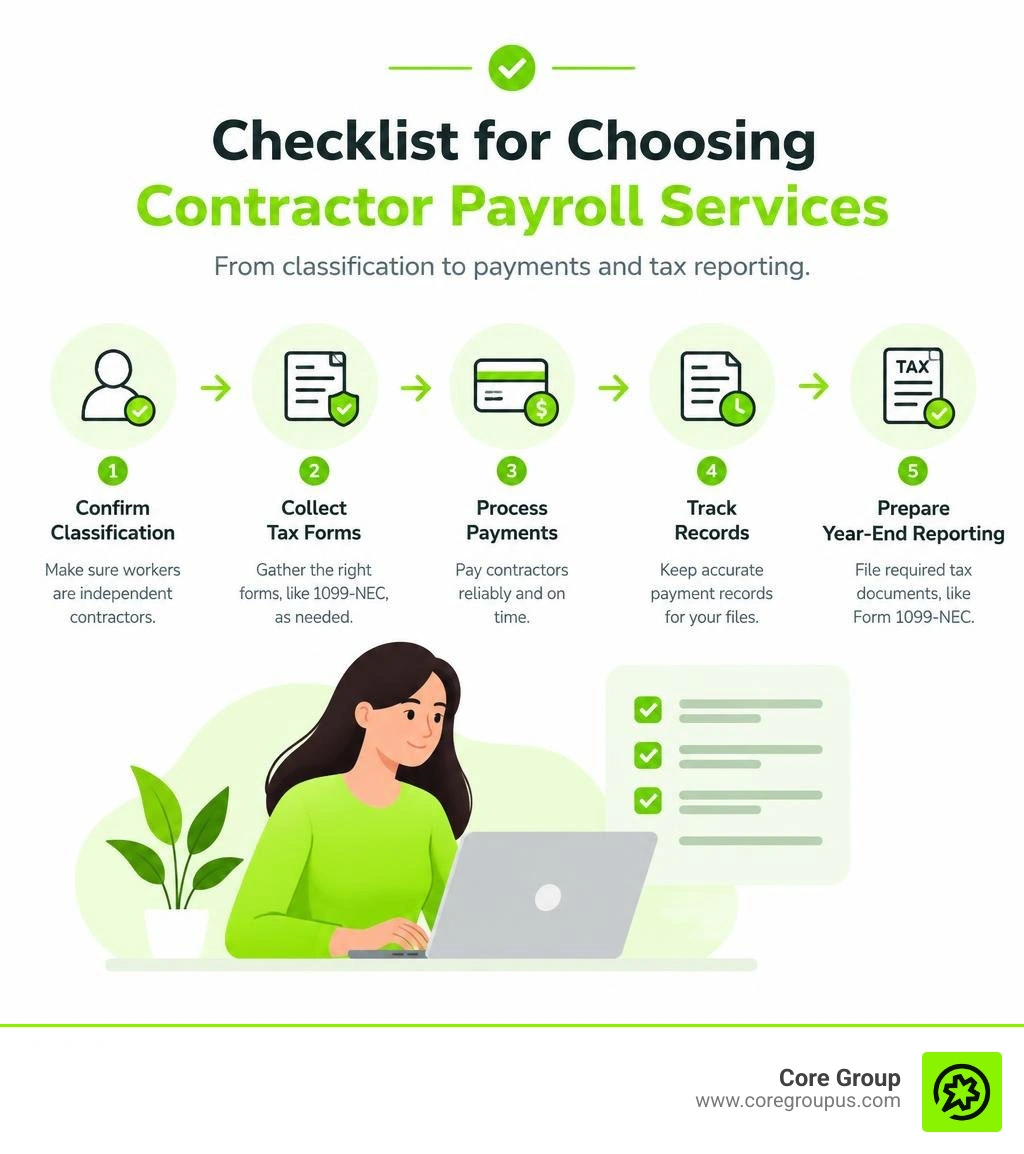
Contractor payroll services vocabulary explained
How Contractor Payroll Services Differ from Traditional Employee Payroll
Managing an independent workforce requires a completely different operational playbook than running a standard staff payroll. When paying conventional employees, employers act as tax collectors. We must calculate federal, state, and local income tax withholdings, deduct Social Security and Medicare taxes, pay unemployment insurance, and provide statutory benefits.
Independent contractors operate as separate business entities. When you distribute nonemployee compensation, you do not withhold standard payroll taxes. Instead, contractors invoice for completed project milestones or hourly work and handle their own self-employment taxes.
While manual spreadsheets or ad-hoc bank transfers might seem sufficient when you work with one or two freelancers, manual processing quickly breaks down as your team grows. Dedicated platforms automate wage distribution, verify taxpayer identification numbers, maintain digital audit trails, and ensure you remain fully compliant with state and federal authorities.

Key Differences Between 1099 Contractors and W-2 Employees
The distinction between independent contractors and traditional employees centers on control. When analyzing worker status, regulatory agencies examine three core categories.
- Behavioral control focuses on whether your business directs how, when, and where the work is performed. If you mandate rigid working hours, dictate specific operational workflows, and provide direct day-to-day supervision, the worker looks like an employee.
- Financial control assesses whether the worker has unreimbursed business expenses, invests in their own tools and equipment, and has the freedom to offer services to other clients in the open market.
- Relationship terms review the presence of written contracts, the permanence of the working relationship, and whether the services performed are a core aspect of your everyday business operations.
Misclassifying a worker carries severe financial consequences. Misclassifying an individual can cost that worker nearly $20,000 per year in lost income, safety protections, and statutory benefits. For business owners, regulatory audits can lead to substantial back taxes, hefty interest charges, and stiff penalties. When evaluating payroll and benefits, establishing clear boundaries around control and autonomy ensures everyone is protected.
Form Requirements for Nonemployee Compensation
Staying compliant requires collecting the right documentation before issuing any funds. Every independent contractor must complete Form W-9 before starting work. This form captures their legal name, business structure, and Taxpayer Identification Number or Employer Identification Number.
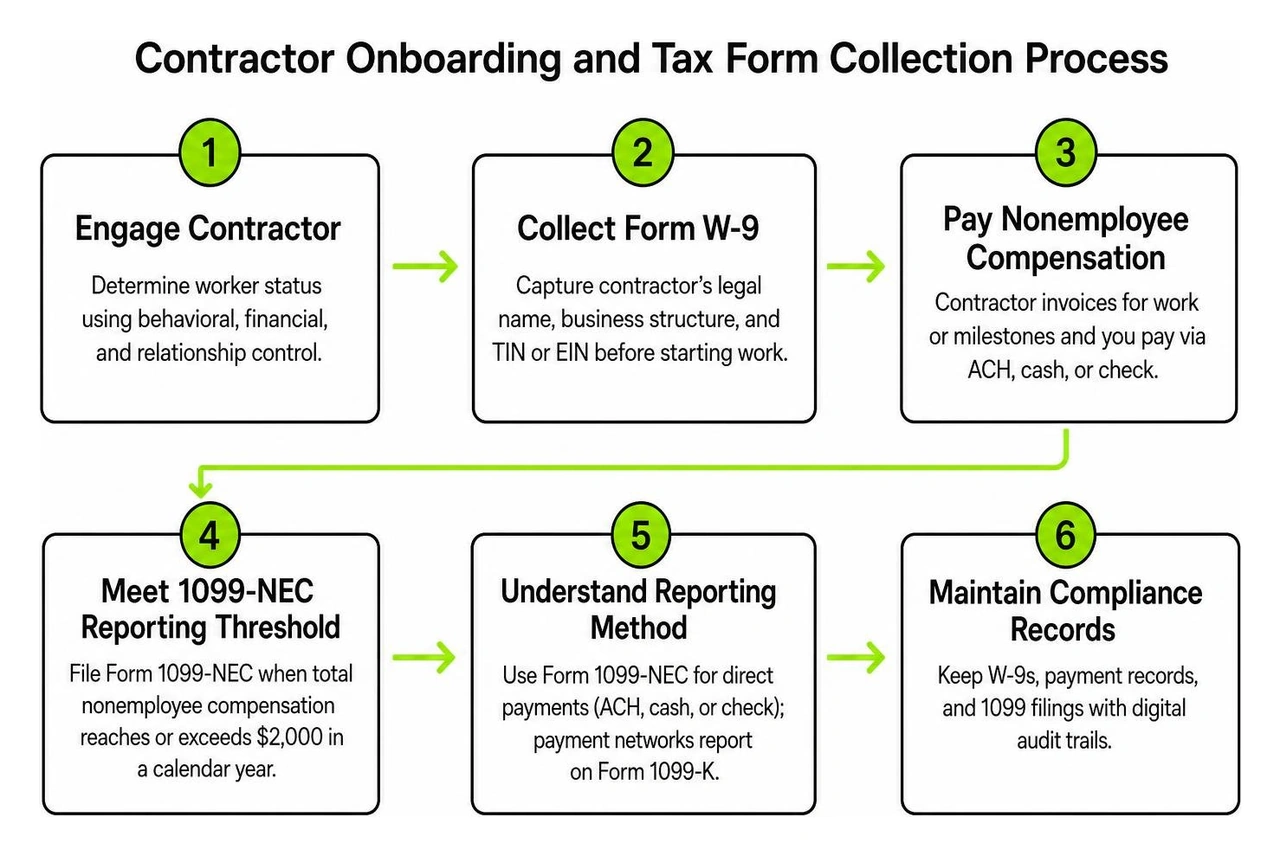
At tax time, businesses report payments using specific informational returns. For tax reporting in 2026, the IRS updated the reporting threshold for Form 1099-NEC. Businesses must now file Form 1099-NEC when total nonemployee compensation reaches or exceeds $2,000 in a calendar year, an increase from the long-standing $600 threshold.
It is also important to understand the difference between Form 1099-NEC and Form 1099-K. When you pay a contractor via direct ACH deposit, cash, or company check, your business must file Form 1099-NEC. However, if you settle invoices through third-party payment settlement entities, such as credit card processors or third-party digital payment apps, those payment networks handle reporting on Form 1099-K instead.
For a deeper look at your reporting duties, read our guides on understanding Form 1099-NEC requirements, reporting nonemployee compensation, and the exact steps to issue a 1099 to a contractor.
Essential Features to Evaluate in Contractor Payroll Platforms
Selecting the right system goes beyond merely picking software that can send money. Modern contractor management requires an ecosystem that saves administrative hours, prevents human error, and integrates smoothly into your overall financial architecture.

Core Capabilities of Modern Contractor Payroll Services
To keep your business running smoothly, look for platforms that offer these essential operational capabilities.
- Self-service onboarding portals that allow freelancers to upload direct deposit details, complete Form W-9 digitally, and download year-end tax forms securely.
- Accelerated direct deposit speeds, including two-day or same-day ACH transfers, so your independent talent gets paid quickly upon invoice approval.
- Flexible off-cycle payment tools that let you pay project milestone bonuses or sudden invoice revisions without waiting for standard payroll dates.
- Multi-state tax compliance that monitors regional reporting thresholds and handles required new-hire registrations across state jurisdictions.
For a broader look at designing an efficient administrative system, review our comprehensive small business payroll guide for 2026.
International Contractor Payments and Global Compliance
Creative businesses frequently tap into global talent pools to scale their operations. Paying overseas contributors, however, introduces currency conversions, cross-border banking fees, and international tax rules.
When onboarding non-U.S. individuals, you must collect Form W-8BEN or Form W-8BEN-E to verify foreign status and establish tax treaty eligibility. Global platforms simplify this process by offering automated cross-border payouts in local currencies and supporting modern payment methods like regional digital wallets. These systems help you work with top international talent without requiring foreign business entities in every country where you hire.
Industry-Specific Needs for General and Construction Payroll
General business payroll focuses primarily on simple hourly tracking, milestone billing, and tax document generation. Certain specialized fields, such as construction, introduce distinct regulatory hurdles.
Construction payroll requires specialized tracking for certified payroll reporting and Davis-Bacon Act compliance on government projects. These environments demand exact prevailing wage calculations, tracking for multi-tiered union pay structures, and precise project job costing. General platforms handle typical freelance needs, but construction teams often require software built specifically to handle multi-site job codes and union reporting mandates.
Comparing Pricing Models and Service Structures
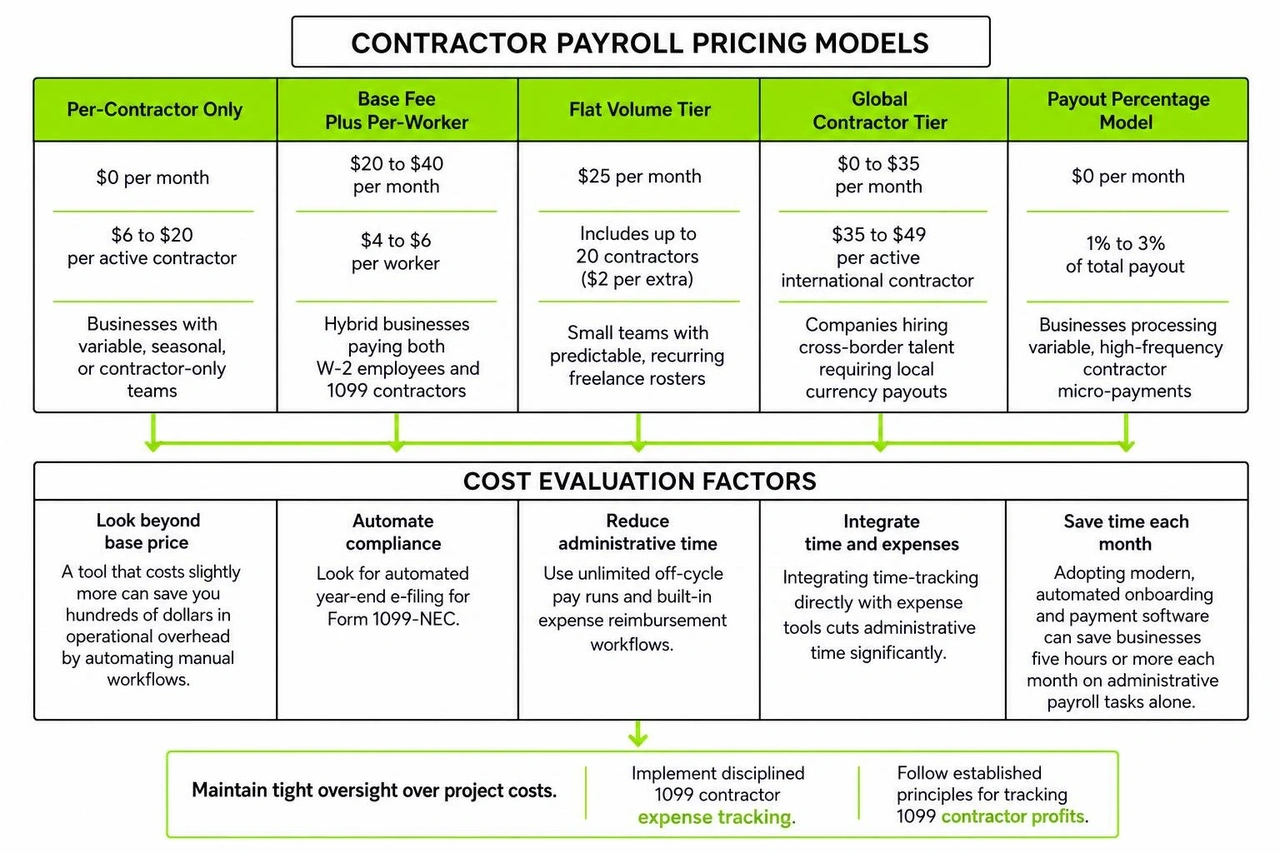
Contractor payment systems use several common pricing structures. Understanding these fee models helps you project actual costs as your freelance team fluctuates.
| Pricing Structure | Typical Base Monthly Fee | Per-Contractor Fee | Best Fit For |
|---|---|---|---|
| Per-Contractor Only | $0 per month | $6 to $20 per active contractor | Businesses with variable, seasonal, or contractor-only teams |
| Base Fee Plus Per-Worker | $20 to $40 per month | $4 to $6 per worker | Hybrid businesses paying both W-2 employees and 1099 contractors |
| Flat Volume Tier | $25 per month | Includes up to 20 contractors ($2 per extra) | Small teams with predictable, recurring freelance rosters |
| Global Contractor Tier | $0 to $35 per month | $35 to $49 per active international contractor | Companies hiring cross-border talent requiring local currency payouts |
| Payout Percentage Model | $0 per month | 1% to 3% of total payout | Businesses processing variable, high-frequency contractor micro-payments |
Evaluating Cost Efficiency Across Contractor Payroll Services
When calculating software return on investment, look beyond the base subscription price. A tool that costs slightly more per month can save you hundreds of dollars in operational overhead if it automates manual workflows.
Look for services that offer automated year-end e-filing for Form 1099-NEC, unlimited off-cycle pay runs, and built-in expense reimbursement workflows. Integrating time-tracking directly with expense tools cuts administrative time significantly. In fact, research shows that adopting modern, automated onboarding and payment software can save businesses five hours or more each month on administrative payroll tasks alone.
Maintaining tight oversight over project costs also safeguards your margins. To keep your books clean, implement disciplined 1099 contractor expense tracking and follow established principles for tracking 1099 contractor profits.
Step-by-Step Selection and Implementation Guide
Transitioning to a dedicated contractor payment platform creates a smoother experience for your vendors and ensures your financial records remain accurate. Follow this structured roadmap to select and implement your platform.
- Assess your workforce structure. Count your active domestic contractors, identify any international contributors, and determine whether you operate on hourly timesheets, project milestones, or flat monthly retainers.
- Verify state-level compliance. Review regional reporting rules across your operational locations, consulting official guidelines like state payroll compliance standards to confirm new-hire reporting obligations.
- Review entity classification requirements. Identify the tax structure of each contractor before setting up payment profiles. Pay close attention to single-member LLCs, checking our guides on single-member LLC 1099 reporting and LLC contractor 1099 rules.
- Connect your accounting and bookkeeping tools. Choose a platform that syncs automatically with your general ledger to eliminate duplicate data entry.
- Launch self-service onboarding. Invite your contractors to fill out digital W-9s, enter banking details, and review payment schedules through a secure portal.
- Run a test payment cycle. Process an initial payout to verify bank routing accuracy, direct deposit timelines, and general ledger synchronization.
Frequently Asked Questions About Contractor Payroll
What is the Form 1099-NEC threshold for 2026?
For payments made in 2026, the federal reporting threshold for Form 1099-NEC is $2,000 in nonemployee compensation per contractor per calendar year. If you pay an independent contractor $2,000 or more via cash, check, or direct bank transfer (ACH) during the year, you must furnish a copy of Form 1099-NEC to the worker and file a copy with the IRS by January 31.
How do contractor payroll platforms prevent worker misclassification?
Payroll platforms help mitigate misclassification risks by creating clear digital audit trails. They collect signed contractor agreements, store W-9 forms, track distinct project-based invoices, and separate nonemployee compensation from traditional employee wage schedules. However, software alone does not determine legal classification. Business owners must still ensure their actual operational relationship respects the worker's independence and behavioral autonomy.
Can contractor payroll systems manage global contractor payments?
Yes, many modern systems support global contractor payments. They collect Form W-8BEN during digital onboarding, manage currency conversions, and route funds through international banking networks or local digital wallets. These features enable businesses to work with international talent without setting up foreign legal entities.
Conclusion
Managing an independent workforce should fuel your business growth, not bog you down in administrative headaches and tax paperwork. By choosing a dedicated payment system, you protect your business against misclassification risks, ensure on-time payouts, and automate required tax reporting.
At Core Group, we provide complete financial management, proactive bookkeeping, and strategic tax services tailored specifically for creative entrepreneurs. Guided by our no-fluff, profit-first playbook and our MacBook Pro guarantee, we take the stress out of back-office operations so you can focus entirely on growing your creative business with total peace of mind. To master your payroll strategy, read our comprehensive small business payroll services guide for 2026 and partner with our team today.