Filing 1099 Forms for Independent Contractors Without the Headache
Understanding Form 1099 NEC Rules and Eligibility Criteria
When working with freelancers, creative professionals, and outside vendors, staying on top of tax requirements is critical. Form 1099-NEC is the specific information return used by business owners to report nonemployee compensation. If you want to know more about the basics of this form, check out our guide on 1099-NEC Explained to get a full foundation.
The IRS requires businesses to file Form 1099-NEC whenever they make payments to nonemployees for services rendered during the course of regular trade or business. Understanding who qualifies for this form prevents awkward tax season surprises for both your business and your vendors. You can also review our detailed deep dive on Nonemployee Compensation for specific scenario breakdowns.
The Four Conditions for Nonemployee Compensation
The IRS establishes four very clear rules to determine if a payment must be reported as nonemployee compensation. If your payment meets all four criteria, you are required to issue a form.
First, the payment must be made to an individual or business entity who is not your legal employee.
Second, the payment must be for services performed in the course of your trade or business. Personal payments, such as paying a contractor to fix the sink in your personal residence, do not qualify and should never be reported on a 1099.
Third, the payment must be made to an individual, a partnership, an estate, or in specific regulatory cases, a corporation.
Fourth, the total reportable payments made to that recipient during the calendar year must reach or exceed the federal minimum threshold. If you check off all four boxes, you have a reportable nonemployee compensation situation on your hands.
The Updated Reporting Thresholds and Exempt Payments
For years, small business owners had the number $600 burned into their brains. However, for tax years beginning after 2025, the IRS increased the minimum payment reporting threshold to $2,000. This threshold is scheduled to be adjusted for inflation starting in calendar year 2027. That means if you pay an independent contractor less than $2,000 across the entire calendar year 2026, you generally do not need to issue them a Form 1099-NEC.
There are also several major exemptions where payments do not belong on a 1099-NEC, even if they exceed $2,000.
Payments made for physical goods, merchandise, freight, and office supplies are completely exempt.
Payments made to C Corporations and S Corporations are generally exempt from receiving a 1099-NEC. However, legal fees paid to attorneys represent a major exception. Payments to law firms must always be reported on a 1099 regardless of whether the firm is incorporated.
Another huge exemption involves payment processing methods. If you pay a contractor using a credit card, PayPal, Venmo, or another third-party payment network, you should not report those payments on Form 1099-NEC. Third-party settlement organizations report those transactions separately on Form 1099-K. Double reporting these payments creates unnecessary headaches for your contractors. For official IRS guidelines on these exclusions, you can review the official Instructions for Forms 1099-MISC and 1099-NEC.
Step by Step Guide on How to Issue a 1099 to a Contractor

Now that you understand who qualifies, let us walk through the exact steps for how to issue a 1099 to a contractor smoothly. Taking a systematic approach during onboarding and year-end bookkeeping makes this task fast and effortless.
Gather Worker Info and Learn How to Issue a 1099 to a Contractor
The single best piece of advice we give our clients is to collect Form W-9 before paying a contractor their first dollar. Trying to track down a busy freelancer in late January when taxes are due is like chasing a cat through a thunderstorm.
Form W-9 collects essential taxpayer data such as
- The contractor's full legal name or legal business name
- Business entity classification (such as sole proprietor, single member LLC, partnership, C Corp, or S Corp)
- Legal mailing address
- Taxpayer Identification Number (TIN), which is either a Social Security Number (SSN) or an Employer Identification Number (EIN)
Once you collect Form W-9, verify the TIN information. We recommend using IRS TIN Matching tools to verify that the contractor name and number match official tax records. If a contractor fails to provide a correct TIN or refuses to submit a Form W-9, your business may be legally required to initiate backup withholding at a flat rate of 24% and remit those funds directly to the IRS.
Calculate Cumulative Annual Payments
At the end of the tax year, review your accounting system to aggregate all payments made to each contractor during the calendar year.
To ensure complete accuracy, break down contractor payment histories using these rules.
- Filter all payment ledger accounts by vendor name from January 1 through December 31.
- Separate payments made via bank transfer (ACH), paper check, or direct cash from payments made via payment processing cards.
- Deduct credit card, debit card, and third-party payment network transactions from the total, as these belong on Form 1099-K returns.
- Sum up the remaining direct check and ACH payments to see if the vendor hits the $2,000 threshold.
Maintaining clean year-round accounting ledgers prevents miscalculating totals or accidentally including exempt merchandise purchases.
Filing Methods and How to Issue a 1099 to a Contractor Online
Once your numbers are confirmed, it is time to submit the forms. You must furnish Copy B of Form 1099-NEC to the contractor and submit Copy A to the IRS.
If you choose paper filing, you must mail Copy A along with Form 1096, which serves as the official transmittal summary for paper information returns. That Form 1096 is only used for physical mail filings and is never required when filing electronically.
However, electronic filing is faster, more secure, and significantly reduces clerical error rates. Businesses can e-file directly through the IRS online intake portal or through integrated accounting software platforms. E-filing automatically creates the digital records necessary to prove timely filing compliance.
Key Deadlines and Mandatory Electronic Filing Requirements
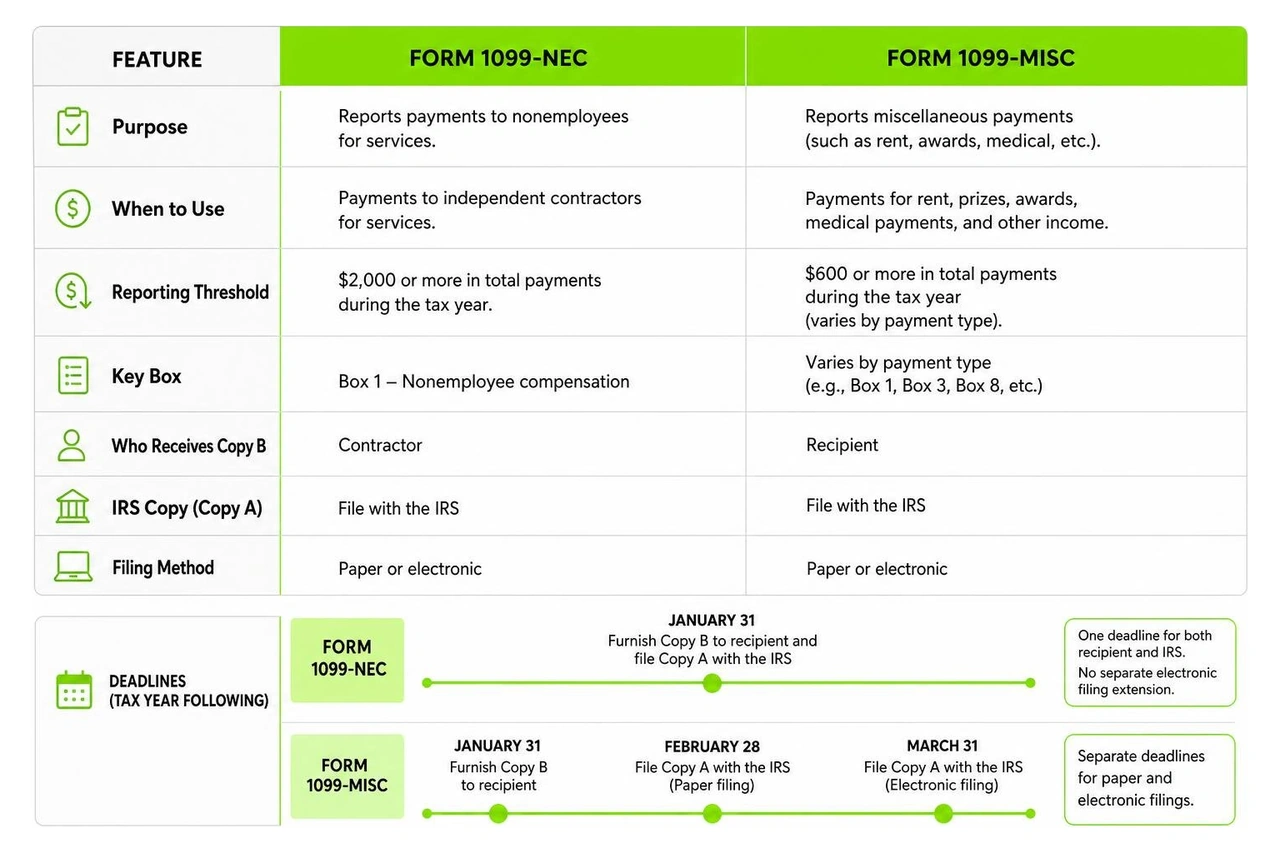
Filing deadlines for contractor information returns are strictly enforced by federal and state tax agencies. Missing these dates can trigger automatic financial penalties that grow larger the longer you delay.
Form 1099-NEC features a single deadline. You must file Form 1099-NEC with the IRS and furnish the recipient copy to your contractor on or before January 31 following the close of the tax year. Unlike other tax forms, there is no separate extended deadline for electronic filing of Form 1099-NEC. To get a complete overview of key tax dates, see our resource on When Are 1099s Due.
Form 1099-MISC follows a slightly different schedule. While payee copies must still be furnished by January 31, paper filings sent to the IRS are due by February 28, and electronic filings are due by March 31.
The Ten Return Electronic Filing Mandate
In recent years, the IRS significantly lowered the hurdle for mandatory electronic filing. Under modern regulations, any employer or business filing 10 or more information returns in aggregate across a calendar year must file electronically.
The 10-return rule is cumulative across almost all information return series. To determine if you meet the threshold, you must add together these returns
- All Form 1099-NEC forms
- All Form 1099-MISC forms
- All Form W-2 forms provided to employees
- Other information returns such as Form 1042-S
For example, if your business has 6 W-2 employees and 4 independent contractors requiring 1099-NEC forms, your aggregate total is 10 forms. You are legally mandated to e-file every return. Failing to e-file when required can lead to paper returns being rejected and penalized as non-filings. For additional statutory guidance, refer to the IRS General Instructions for Certain Information Returns.
IRS IRIS System and Retirement of FIRE Portal
For decades, business entities relied on the IRS FIRE (Filing Information Returns Electronically) system. However, the IRS is officially retiring the legacy FIRE portal and replacing it entirely with the Information Returns Intake System (IRIS).
The IRIS Taxpayer Portal is a free, secure, web-based platform designed specifically for small businesses to file Form 1099 series returns online.
Key benefits and requirements of the IRIS portal include these features
- Free online manual data entry or bulk CSV file uploads for simple submissions
- Automatic error detection before final submission
- Instant digital electronic receipts and confirmation status updates
- Requirement to apply for an IRIS Transmitter Control Code (TCC) in advance, which can take up to 45 business days to process
If you plan to e-file directly through the IRS this tax season, apply for your IRIS Transmitter Control Code early to avoid last-minute portal access delays.
Common Misclassification Risks and Avoidable Penalties

One of the largest hidden risks in contractor management is worker misclassification. Simply putting the title contractor on a service agreement does not make someone an independent contractor in the eyes of the IRS or the Department of Labor.
The IRS uses established common law rules to determine whether a worker is an employee or an independent contractor. These rules focus primarily on three main categories.
- Behavioral Control. Does the business control or have the right to control what the worker does and how the worker does their job? Employees are usually given specific hours, tools, and direct instruction, whereas contractors control their own methods and working schedules.
- Financial Control. Are the business aspects of the worker’s job controlled by the payer? Contractors typically have unreimbursed business expenses, invest in their own equipment, offer services to the general public, and can experience a direct financial profit or loss.
- Type of Relationship. Are there written contracts or employee-type benefits such as health insurance, paid vacation, or pension plans? Work that is a core, permanent operational function of the business is more likely to be classified as an employee relationship.
If you or a worker are unsure of proper tax classification, either party can submit IRS Form SS-8 to request an official worker status determination.
Misclassification Penalties and Failure to File Fines
Misclassifying employees as independent contractors carries severe legal and financial consequences. If an IRS audit determines that you incorrectly treated employees as contractors, your business can be held liable for back payroll taxes, unpaid workers' compensation insurance, back overtime, and statutory interest.
Additionally, independent contractors are responsible for paying full self-employment tax, which totals 15.3% (12.4% for Social Security and 2.9% for Medicare). When a worker is misclassified, they are forced to cover tax obligations that should have been shared by the employer.
Separate from misclassification, the IRS imposes statutory penalties for late or incorrect 1099 filings.
- Filing within 30 days past the deadline results in small per-return fines.
- Filing after 30 days but before August 1 increases the per-return fine significantly.
- Filing after August 1 or failing to file altogether incurs maximum statutory penalties per return.
- Intentional disregard of filing rules leads to severe, uncapped per-return penalties with no maximum limit.
How Accounts Payable Automation Simplifies Compliance
Managing 1099 preparation manually using spreadsheets and paper files creates massive administrative overhead and opens the door to avoidable mistakes. Implementing accounts payable automation streamlines contractor tracking from onboarding through year-end tax season.
Modern financial management tools eliminate manual stress in several ways
- Automatically sending digital Form W-9 requests during new vendor onboarding
- Storing tax documents, EINs, and addresses in a centralized vendor management database
- Categorizing expenses in real time to exclude credit card payments automatically
- Integrating directly with core accounting systems to generate standard e-file packages
Automating these back-office processes guarantees clean vendor records and gives creative business owners total peace of mind every January.
Frequently Asked Questions About Independent Contractor Tax Forms
What is the minimum payment threshold for issuing a 1099 NEC
For tax years beginning after 2025, the minimum threshold for issuing Form 1099-NEC for nonemployee compensation is $2,000 paid to a single vendor within the calendar year. Prior to this tax update, the traditional threshold was $600. If you pay an independent contractor less than $2,000 via cash, check, or direct ACH transfer during 2026, you generally do not need to submit a Form 1099-NEC.
Are payments made by credit card reported on Form 1099 NEC
No, payments made via credit card, debit card, or third-party payment networks are explicitly exempt from Form 1099-NEC reporting. The payment settlement entities and merchant processors report those transaction totals on Form 1099-K. When preparing your annual 1099-NEC filings, exclude all card-based payments from your vendor calculation totals to prevent double-reporting contractor income.
How do state filing requirements differ for 1099 forms
State-level 1099 filing rules vary depending on where your business operates and where your contractors live. Many state tax agencies participate in the Combined Federal/State Filing (CFSF) Program, which automatically forwards electronically filed federal 1099 returns to participating state revenue departments.
However, several states require direct reporting or have lower dollar reporting thresholds and separate state tax withholding rules. Always consult state tax guidelines across all states where you do business to confirm local compliance requirements.
Conclusion
Understanding how to issue a 1099 to a contractor does not have to be an overwhelming annual headache. By collecting Form W-9 upfront, tracking payments accurately, understanding the updated $2,000 reporting threshold, and taking advantage of modern digital e-filing through IRIS, you can master your contractor tax compliance in record time.
At Core Group, we provide comprehensive financial management, bookkeeping, and tax services tailored specifically for creative entrepreneurs. We take care of back-office tax mechanics so you can stay focused on building a profitable, growing business. If you operate an active creative business, review our detailed guide on Single Member LLC 1099 Reporting to make sure your structure is fully optimized.
Our team delivers a structured playbook that guarantees operational peace of mind and saves you valuable time every single month. Contact Core Group today to learn how we can take financial management off your plate for good!