How to Handle Design Firm Overtime Tax Reconciliation the Right Way
How to Reconcile Overtime Taxes at a Design Firm
For design firm overtime tax reconciliation, start with employee classification, not the invoice. Confirm who is eligible for overtime under federal law. Then match approved timesheets to payroll, separate the federally required overtime premium from other overtime pay, and check that the qualified amount flows to Box 12, Code TT on each 2026 W-2.
This matters because long hours alone do not qualify. An exempt architect may work late without earning federally required overtime. A non-exempt designer may earn overtime under state rules that does not all qualify for the federal deduction. Payroll taxes and normal withholding still apply, so your records need to support both the W-2 and your project costs.
I’m Christian Brim, and I’ll walk you through a practical way to get those records in sync without losing sight of your firm’s profit.
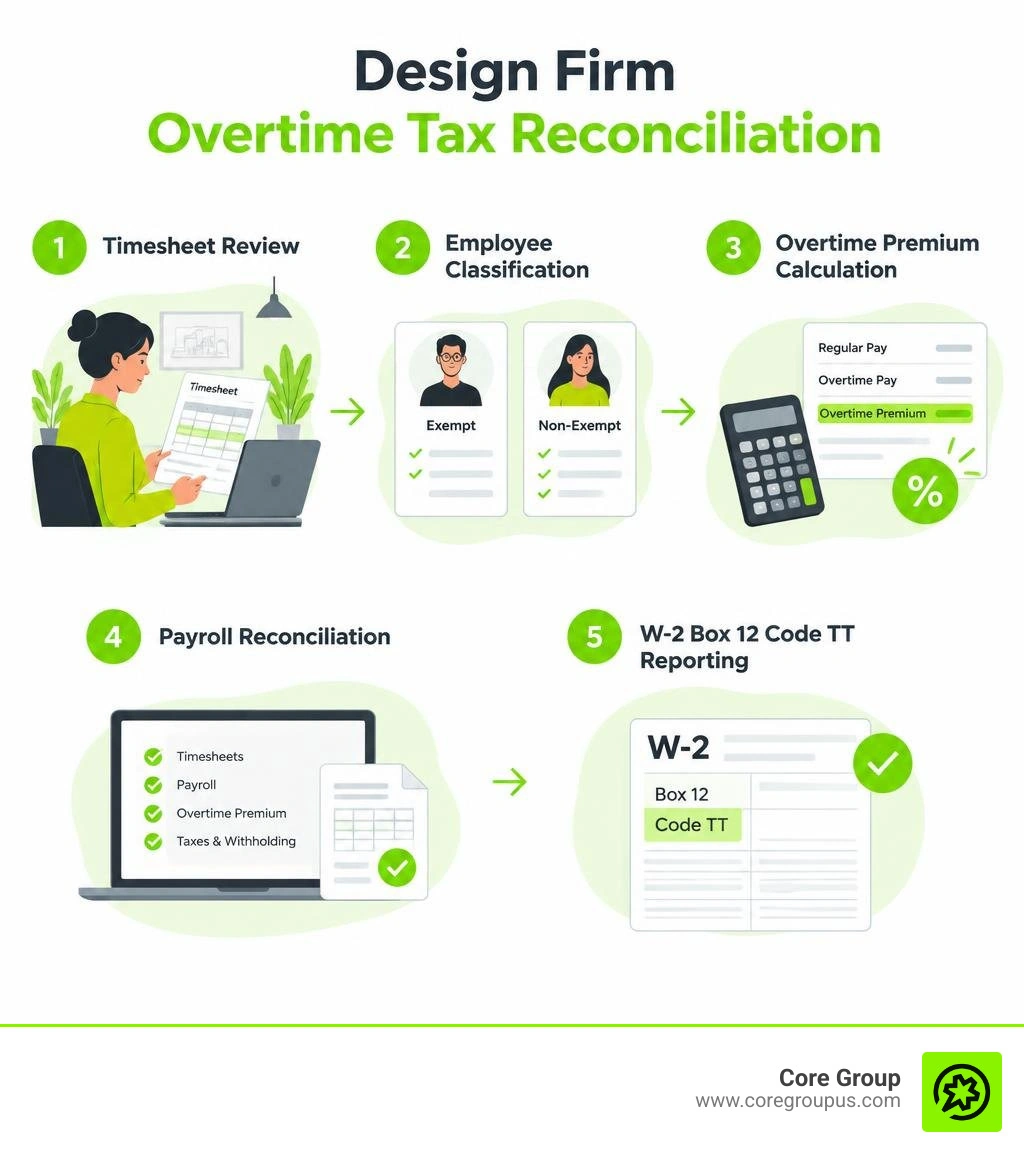
Design firm overtime tax reconciliation terms to learn include overtime tax savings for artists, managing overtime taxes small creative business, and creative studio overtime tax optimization.
Qualified Overtime Compensation Rules for Architecture and Design Practices
Navigating federal tax changes requires design leaders to separate political headlines from operational payroll facts. Under the One Big Beautiful Bill Act, the federal tax code introduces a specialized above the line deduction for qualified overtime compensation under Section 225.
Many studio owners initially assume that all overtime pay is now entirely tax free. In reality, the deduction applies strictly to the 50 percent overtime premium required under Section 7 of the Fair Labor Standards Act, not the employee base hourly wage. When an employee works overtime at time and a half, the base hourly portion remains subject to standard income tax rules, while only the additional half time premium qualifies for the deduction.
Understanding these mechanics is essential when tracking tax planning strategies across your studio. Federal income tax and payroll taxes like Social Security and Medicare must still be withheld from every single paycheck throughout the year. The tax relief occurs when the eligible worker files their annual federal tax return using the reported figures on their year end wage statements. Recent legislative updates on overtime pay deductions highlight that accurate bookkeeping during the year is mandatory for employees to claim these benefits.
FLSA Exempt vs. Non-Exempt Classifications in Design Roles
The primary hurdle for creative agencies lies in employee classification. The design industry relies heavily on professional white collar exemptions under the Fair Labor Standards Act.
Licensed architects, professional structural engineers, and senior creative directors are generally classified as exempt salaried professionals if they satisfy both the salary basis test and the professional duties test. Because exempt staff do not earn statutory overtime pay under federal law, none of their compensation qualifies as qualified overtime compensation, regardless of how many late nights they pull to meet a project submission deadline.
In contrast, technical production staff frequently qualify as non-exempt hourly employees. These roles include junior drafters and CAD technicians translating design concepts into construction documents, render artists and graphic production assistants working under direct creative supervision, and model makers, fabrication crew members, and studio administrative coordinators.
Project managers often occupy a gray area depending on their level of independent discretion and salary levels. If a firm attempts an artificial reclassification of salaried staff to hourly roles solely to unlock tax deductions, it exposes the business to severe legal risks and back pay audits.
Deduction Caps and High-Earner Phase-Outs
The deduction incorporates statutory limits that directly affect high earning design professionals. The maximum annual deduction is capped at $12,500 for individual tax filers and $25,000 for married couples filing jointly.
The deduction also includes strict income phase-outs based on modified adjusted gross income. The benefit begins phasing out at $150,000 for single filers and $300,000 for married couples filing jointly, reducing by $100 for every $1,000 of income above those thresholds.
Because many senior associates and design studio principals earn base compensation or distributions above these limits, they cannot benefit from the deduction even if they receive hourly premium pay. Managing these compensation boundaries requires a firm grasp of how overtime pay taxes interact with overall taxable income.
Step-by-Step Guide to Design Firm Overtime Tax Reconciliation

Reconciling overtime taxes requires bridging the gap between project timesheets, general ledger wage accounts, and year end tax forms. The reconciliation process ensures that your firm correctly isolates the federally mandated premium rate without overstating tax deductible amounts.
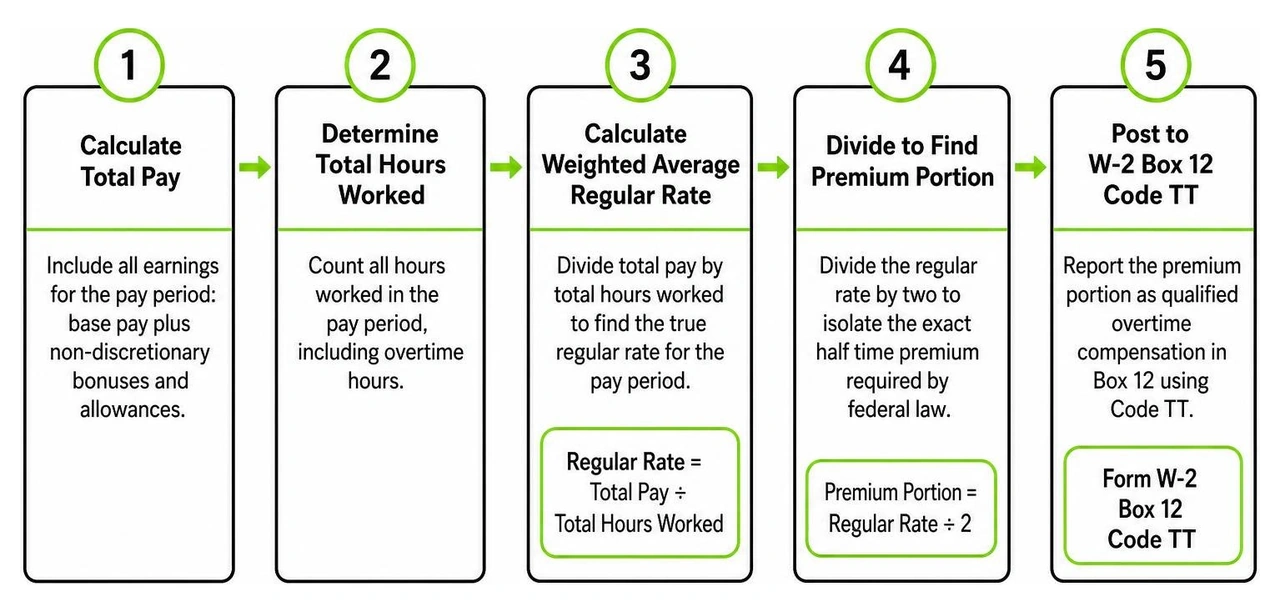
To perform a clean reconciliation, calculate the weighted average regular rate for any non-exempt employee who works varying hourly rates during a single pay period. Once you establish the true regular rate, divide it by two to pinpoint the exact half time premium required by federal law.
Independent policy research on overtime tax exemptions shows that failure to isolate the regular rate from discretionary bonuses or double time leads to widespread reporting errors. Creatives should understand how to calculate overtime tax rate baselines across every project phase before closing out quarterly payroll ledgers.
Executing a Design Firm Overtime Tax Reconciliation in Payroll
When executing your year end payroll runs, your software must direct qualified overtime compensation to Form W-2, Box 12, using Code TT. This reporting mechanism informs the Internal Revenue Service of the exact dollar amount eligible for the above the line adjustment on Schedule 1 of Form 1040.
The following table demonstrates how standard payroll figures must be separated for accurate tax reporting.
| Compensation Element | Payroll Entry Example | W-2 Box 1 Taxable Wages | W-2 Box 12 Code TT Entry | Deductible by Employee on Return |
|---|---|---|---|---|
| Regular Base Pay (40 hrs @ $40/hr) | $1,600.00 | Included ($1,600.00) | Excluded ($0.00) | No |
| Overtime Base Portion (10 hrs @ $40/hr) | $400.00 | Included ($400.00) | Excluded ($0.00) | No |
| FLSA Premium Portion (10 hrs @ $20/hr) | $200.00 | Included ($200.00) | Reported ($200.00) | Yes |
| Discretionary Project Rush Bonus | $300.00 | Included ($300.00) | Excluded ($0.00) | No |
| Total Pay Period Breakdown | $2,500.00 | Total $2,500.00 | Total $200.00 | Eligible $200.00 |
Year-End True-Up and Documentation Protocols
Before distributing annual wage statements, your financial team should execute a formal true-up protocol. This involves cross referencing project time tracking logs against the payroll register to confirm that every hour coded to Box 12 Code TT strictly represents work performed past 40 hours in a standard workweek under FLSA Section 7.
Using a standardized design business overtime tax worksheet helps record these calculations cleanly for your internal audit trail. Maintaining detailed records protects your studio from escalating IRS penalty tiers for incorrect informational returns, which start at $60 per form for minor corrections and can exceed $660 per form for intentional disregard.
Multi-State Payroll Rules and Worker Classification Pitfalls
Design practices regularly handle projects outside their home state, requiring staff to work remotely or travel to out of state client sites. This introduces severe complexities when state labor statutes exceed federal requirements.
For example, California mandates daily overtime pay for hours worked beyond 8 hours in a single day, regardless of whether the employee reaches 40 hours in that workweek. However, federal qualified overtime compensation rules only recognize overtime required under federal statute, meaning hours worked past 40 in a workweek.
If a junior designer in California works four 10 hour days, they earn 8 hours of daily overtime under state law. Because their total weekly hours equal 40, none of that overtime premium satisfies the federal threshold for Box 12 Code TT reporting. Studios must verify is overtime taxed at a higher rate in California while maintaining separate reporting buckets for federal deductions.
Conversely, states like Alabama have established specific overtime pay tax exemption rules at the state level that require distinct state wage tracking. Union collective bargaining agreements that establish contractual overtime after 35 hours similarly cannot pass non-statutory premiums into federal tax deduction buckets.
Managing Contractor vs. Employee Status on Tight Deadlines
When major project deadlines loom, creative studios often bring on freelance specialists. It is critical to maintain clear boundaries between 1099 independent contractors and W-2 employees.
Independent contractors do not receive Form W-2 and cannot utilize Box 12 Code TT deductions. Misclassifying an individual who functions as an employee to avoid overtime obligations exposes the firm to severe payroll tax penalties, workers' compensation liabilities, and unpaid wage claims.
Apply established behavioral and financial control standards when engaging creative talent. Behavioral control evaluates whether your firm dictates the exact working hours, software tools, and step by step processes used. Financial control reviews whether the contractor maintains their own business equipment, invoices multiple clients, and realizes independent profit or loss. Relationship type checks for written contractor agreements and the absence of employee style benefit packages.
Mitigating Audit Risks in Design Firm Overtime Tax Reconciliation

Tax agencies and labor departments closely monitor unusual shifts in overtime patterns. When implementing changes, integrate labor cost controls with your overall business tax optimization strategy to ensure total compliance.
Auditors look for artificial wage manipulation, such as lowering an employee's base hourly wage while inflating scheduled overtime hours to maximize tax exempt payouts. Studios must preserve detailed timecards, signed project change orders, and labor allocation logs to demonstrate that all overtime hours reflect legitimate project demands.
Client Invoicing and Project Billing Alignment
Maintaining profitability requires aligning payroll costs directly with client invoicing methods. When your firm pays overtime premiums to deliver client work on compressed timelines, your contracts must define how those labor burdens are recovered.
A comprehensive bookkeeping for creatives complete guide emphasizes capturing direct labor costs alongside secondary payroll burdens. Unrecovered overtime premiums will rapidly erode project fee margins on fixed fee or capped time and materials agreements.
Billing Overtime Premiums as Direct Project Costs
One common billing strategy treats the overtime premium as a reimbursable direct cost. Under this approach, the standard hourly billing rate covers the base labor and overhead, while the additional premium rate is billed directly to the project account.
When setting up billing terms in your firm management software, configure the job cost multiplier to apply solely to approved project rush hours. This ensures that the client covers the direct cost of expedited project delivery while your payroll records maintain the clean separation needed for tax reconciliation.
Displaying Separate Overtime Hours on Client Invoices
An alternative approach displays overtime hours as distinct line items on client invoices. This provides complete transparency by showing regular design hours at the standard billable rate and overtime hours at the agreed upon premium rate.
Displaying hours separately offers distinct operational advantages.
- Provides clients with full visibility into how deadline accelerations impact project fees
- Establishes a clear audit link connecting approved client timesheets to payroll wage registers
- Reduces fee disputes by requiring upfront client authorization for overtime phases
Preparing for the 2028 Sunset and Compensation Structure Planning
The qualified overtime compensation deduction is a temporary provision scheduled to sunset after December 31, 2028. Creative practices must plan ahead to avoid organizational disruption when the tax code reverts to prior standards in 2029.
Firms should explore broader creative overtime tax savings strategies that support employee retention without relying permanently on temporary tax carve outs.
Updating Employee Handbooks and Overtime Policies
Design firms must maintain clear internal guidelines governing overtime work. Review and update your employee handbook to set transparent expectations across all project teams.
Your policy should require advance written authorization from project directors before non-exempt staff incur overtime hours. It must also mandate accurate daily time tracking, explicitly forbidding off the clock drafting or production work. Clear communication prevents employee misunderstandings regarding how the tax deduction operates on personal returns.
Designing Sustainable Long-Term Bonus and Base Pay Structures
Relying on overtime pay as a primary talent retention tool creates operational instability when project volumes fluctuate. Studio leaders should establish resilient compensation packages that combine competitive base wages with performance based profit sharing.
Structured bonus programs reward project efficiency and design excellence without distorting payroll classifications. Focusing on sustainable compensation models ensures steady firm profitability and long term team morale well past the 2028 tax sunset.
Frequently Asked Questions About Overtime Tax Reconciliation
Can salaried design professionals claim the Qualified Overtime Compensation deduction?
No, salaried professionals classified as exempt under the Fair Labor Standards Act cannot claim the deduction. The tax code restricts qualified overtime compensation to statutory overtime pay earned under FLSA Section 7. Because exempt salaried employees do not receive federally mandated overtime pay, they have no qualifying premium wages to report in Box 12, Code TT.
How does California's 8-hour daily overtime rule interact with federal Box 12 Code TT reporting?
California daily overtime pay does not automatically qualify for the federal deduction. Box 12 Code TT reporting is strictly limited to overtime hours that exceed the federal 40-hour weekly threshold. Any daily overtime pay generated during a workweek where total hours remain at or below 40 must be excluded from federal qualified overtime compensation reporting.
What happens if an employee's total compensation exceeds the phase-out limit after year-end?
Employers remain legally obligated to report all qualified FLSA overtime premiums in Box 12, Code TT on Form W-2, regardless of the employee's total annual income. The modified adjusted gross income phase-out thresholds ($150,000 for single filers and $300,000 for joint filers) are applied individually by the worker when completing Schedule 1 on their personal Form 1040 tax return.
Conclusion
Managing overtime tax reconciliation requires absolute precision across employee classification, payroll systems, and client billing terms. By isolating statutory FLSA premiums, maintaining clean audit trails, and properly reporting wages in Box 12 Code TT, your design firm can maintain compliance while delivering clear tax advantages to eligible team members.
At Core Group, we provide financial management, bookkeeping, and tax services built specifically for creative entrepreneurs. Our no-fluff, profit-first playbook provides complete peace of mind and saves you valuable time, allowing you to focus on leading your design studio while we handle complex payroll reconciliations and optimize your firm's overtime tax rate strategy.