7 Awesome Tax Planning Strategies to Try Today
What Are Tax Planning Strategies and Why They Matter in 2026
Tax planning strategies are legal methods you use to reduce what you owe the IRS each year. For creative entrepreneurs juggling client work, invoices, and deadlines, taxes can feel overwhelming. But a few smart moves can save you thousands.
Here are the core tax planning strategies to know right now:
- Maximize retirement and health savings accounts - contribute to your 401(k) (up to $24,500 in 2026), IRA, and HSA to lower taxable income
- Bunch your deductions - combine multiple years of charitable gifts or medical expenses into one year to beat the $31,500 standard deduction for married filers
- Time your income and expenses - defer income to a lower-bracket year or accelerate deductions into a higher-bracket year
- Harvest capital losses - sell underperforming investments to offset gains and reduce your tax bill
- Use business deductions - claim Section 179 expensing, bonus depreciation, and the qualified business income (QBI) deduction if you run a pass-through entity
- Give strategically - use donor-advised funds or gifting strategies to reduce both income and estate taxes
- Do a Roth conversion - move money from a traditional IRA to a Roth IRA during a lower-income year to lock in today's lower rate
The current date is May 2026, and several important updates are in effect. The One Big Beautiful Bill Act (OBBBA), signed July 4, 2025, raised the SALT deduction cap to $40,000 and permanently set the lifetime estate tax exemption at $15 million per person. These changes create real opportunities if you plan ahead.
Tax planning is not a once-a-year scramble in April. It is a year-round process. The earlier you act, the more options you have.
The strategies below are practical, legal, and designed for people who want to keep more of what they earn without losing sleep over it.
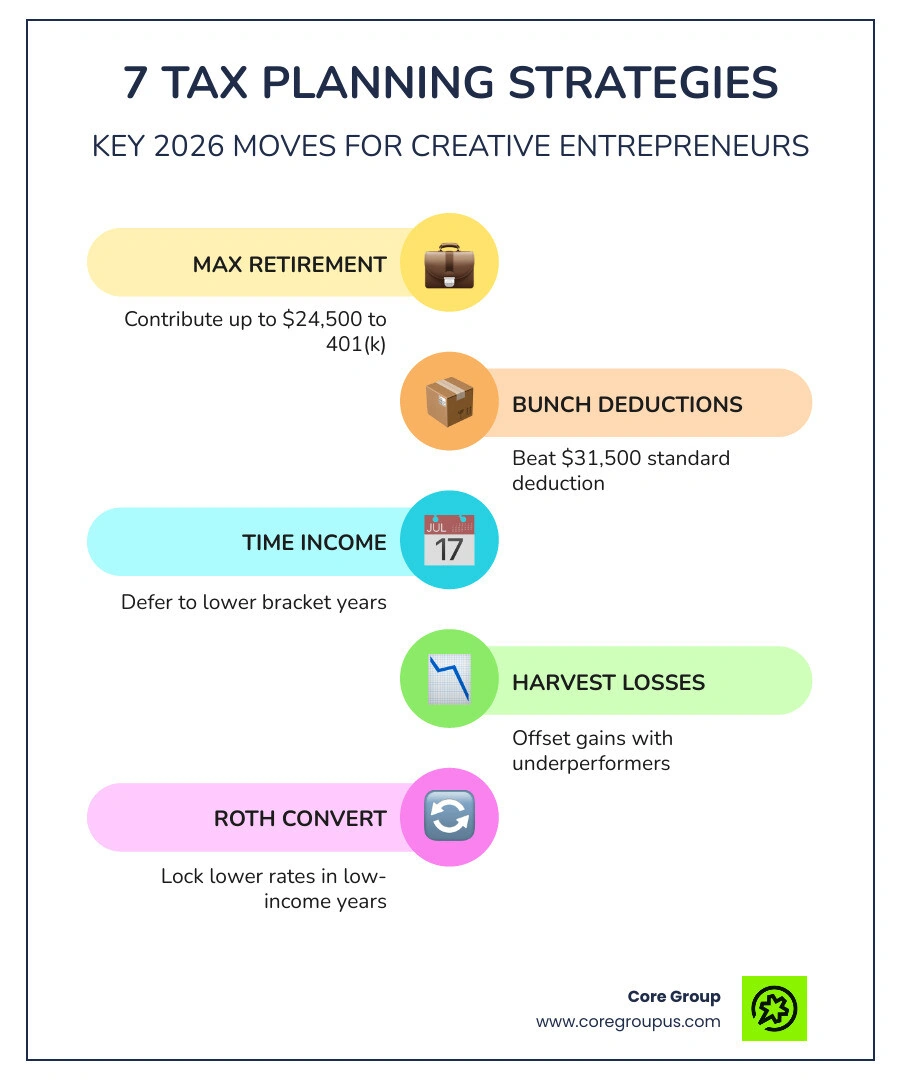
Tax planning strategies terms to remember:
Maximize retirement and health savings contributions
One of the most powerful ways to lower your tax bill is to pay your future self. When you contribute to traditional retirement accounts, you often get an immediate tax deduction. For 2026, the 401(k) contribution limit has climbed to $24,500. If you are age 50 or older, you can add a catch up contribution of $8,000, bringing your total to $32,500. For those aged 60 to 63, special rules now allow an even higher catch up of $11,250.
IRA limits are also higher this year. You can put away $7,500, or $8,600 if you are 50 plus. These contributions help your money benefit from tax deferred growth, meaning you do not pay taxes on the gains until you take the money out in retirement.
If you are looking for a triple tax advantage, look no further than the Health Savings Account (HSA). It is the only account where the money goes in tax free, grows tax free, and comes out tax free for medical expenses. In 2026, you can contribute up to $4,400 for self only coverage or $8,750 for family coverage. If you are 55 or older, you can add another $1,000.
Many people confuse HSAs with Flexible Spending Accounts (FSAs). Here is a quick look at how they differ:
| Feature | Health Savings Account (HSA) | Flexible Spending Account (FSA) |
|---|---|---|
| 2026 Limit (Family) | $8,750 | $3,400 (per employer) |
| Rollover Rules | All funds roll over every year | Use it or lose it (limited carryover) |
| Ownership | You own the account for life | Employer owns the account |
| Eligibility | Must have a High Deductible Health Plan | Available through most employers |
Beyond just saving, you need to think about the timing of your taxes. Roth conversions are a popular strategy when you expect to be in a higher tax bracket later in life. You pay taxes on the converted amount now, but the future withdrawals are tax free. On the flip side, if you are already in retirement, you must manage your Required Minimum Distributions (RMDs) to avoid steep penalties. Using How to Save on Taxes strategies like Qualified Charitable Distributions (QCDs) can help you meet your RMD requirements without adding to your taxable income.
Master the art of bunching deductions to exceed the standard amount
Since the standard deduction amounts have increased significantly, many taxpayers find it hard to itemize. For 2026, the standard deduction for married couples filing jointly is $32,200. If your individual deductions like mortgage interest and property taxes fall just short of that, you get no extra benefit from them.
This is where the bunching strategy comes in. Instead of giving a steady amount to charity every year, you might combine two or three years of donations into a single tax year. This pushes your total deductions well above the standard amount, allowing you to itemize and save more. In the "off" years, you simply take the standard deduction.
Donor advised funds are perfect for this. You can make a large contribution to the fund today, take the full tax deduction this year, and then distribute the money to your favorite charities over several years. This is a favorite among those interested in Tax planning: How the wealthy aim to cut their 2026 IRS bills because it provides flexibility while maximizing the tax break.
The OBBBA changes have also made bunching more attractive for state and local taxes (SALT). The cap on SALT deductions was famously limited to $10,000 for years, but the new law has increased that cap to $40,000 through 2029. This means homeowners in high tax states can finally deduct more of their property and state income taxes.
Medical expenses are another area where bunching works. You can only deduct medical costs that exceed 7.5 percent of your adjusted gross income. If you have a year with heavy dental work or elective surgeries, try to schedule them all in the same calendar year to clear that 7.5 percent hurdle.
Implement effective tax planning strategies for business owners
If you are a creative entrepreneur or freelancer, your business is your biggest tax shelter. One of the best tax planning strategies for business owners is leveraging Section 179 expensing. This allows you to deduct the full price of qualifying equipment, like a new camera, computer, or even certain vehicles, in the year you buy them rather than depreciating them over several years. The limit for Section 179 in 2026 is $1.29 million, with a phaseout starting at $3.22 million.
Bonus depreciation is also a key tool, though it is currently in a phase down period. For 2026, bonus depreciation allows you to deduct 20 percent of the cost of eligible property immediately. While this is lower than in previous years, it still provides a significant upfront tax break for those investing in their business.
The Qualified Business Income (QBI) deduction, also known as Section 199A, remains a massive benefit for pass through entities like sole proprietorships, partnerships, and S corporations. This allows eligible business owners to deduct up to 20 percent of their qualified business income from their taxes. You can find a detailed breakdown in our QBI Deduction Explained guide.
For those just starting out, understanding the nuances of your entity type is vital. Whether you are looking at Tax Planning for Freelancers or diving into our LLC Tax Deductions Guide 2026, the goal is to ensure you are not leaving money on the table.
Single member LLCs have their own specific rules. You can learn more about Single Member LLC Taxes and how they relate to the Federal Income Tax LLC structure to avoid surprises at year end. We also help our clients manage business interest deductions, which are generally limited to 30 percent of adjusted taxable income for larger businesses but offer more flexibility for smaller creative firms.
Optimize investment portfolios and manage estate liabilities

Your investment portfolio should work for you, not for the IRS. Tax loss harvesting is the practice of selling securities at a loss to offset capital gains. If your losses exceed your gains, you can use up to $3,000 of the excess loss to offset ordinary income like your salary. Just be careful of the wash sale rule, which prevents you from claiming the loss if you buy a substantially identical security within 30 days.
For those with large capital gains, Opportunity Zones offer a unique way to defer and even reduce taxes. By reinvesting your gains into a Qualified Opportunity Fund within 180 days, you can defer taxes until 2026 or whenever you sell the investment. If you hold the investment for at least ten years, you pay zero capital gains tax on any appreciation of the fund itself.
When building a tax efficient portfolio, consider these assets:
- Municipal bonds (interest is usually federal tax free)
- Index funds and ETFs (generally more tax efficient than active mutual funds)
- Growth stocks held for more than a year (taxed at lower long term capital gains rates)
- Dividend paying stocks in tax deferred accounts
Estate planning has also shifted with the OBBBA. The lifetime estate and gift tax exemption is now a permanent $15 million per person. This means most people can pass on significant wealth without ever triggering the 40 percent federal estate tax. However, you should still use the annual gift tax exclusion, which allows you to give up to $19,000 per recipient in 2026 without using up any of your lifetime exemption.
For California residents and those in other high value areas, Top Estate Planning Tax Strategies often involve more than just avoiding taxes. It is about protecting the legacy you have built. You can see How Firms Integrate Estate Investment Tax Planning Strategies to understand how we coordinate your investments with your long term family goals.

Frequently Asked Questions about Tax Savings
What are the best tax planning strategies for high earners
High earners often face the Net Investment Income Tax (NIIT), an extra 3.8 percent tax on investment income for those earning over $250,000 (married filing jointly). To fight this, we often recommend income exclusion strategies like investing in municipal bonds or using Roth IRA conversions during lower income years.
Another great tool is the Qualified Charitable Distribution (QCD). If you are over 70 and a half, you can send up to $111,000 directly from your IRA to a charity. This satisfies your RMD and keeps that money out of your adjusted gross income entirely. We also use threshold planning to keep your income just below certain tax bracket jumps or phaseout limits for credits and deductions.
How do tax planning strategies differ from tax evasion
Tax planning is the legal, proactive management of your finances to take advantage of the rules the government has put in place. It is about using the tax code to your benefit. Tax evasion, on the other hand, is the illegal non payment or underpayment of taxes through fraud or hiding income.
Our goal is always legal compliance and audit protection. By using lawful deductions and credits, you are simply following the IRS regulations to ensure you do not pay more than your fair share. Proactive management means you have the documentation ready to prove every deduction you claim.
Should I choose the standard deduction or itemize
The answer depends on your total expenses. You should itemize if your total deductible expenses, such as mortgage interest, state and local taxes (up to $40,000), and charitable gifts, exceed the 2026 standard deduction of $32,200 for married couples or $16,100 for single filers.
A quick way to decide is to use tax software or a professional evaluation. If you are close to the limit, the bunching strategy we mentioned earlier is often the best way to get the most value. By pushing two years of charitable gifts into one year, you can itemize this year and take the standard deduction next year, resulting in lower total taxes over the two year period.
Conclusion
At Core Group, we know that creative entrepreneurs do not want to spend their days staring at spreadsheets and tax forms. You want to be creating, building, and growing your business. That is why we offer a no fluff, profit first playbook designed to give you financial peace of mind.
Our team handles the financial management, bookkeeping, and tax planning strategies that save you time and money. We are so confident in our ability to help you that we offer a MacBook Pro guarantee. If we cannot find enough savings or value to cover our costs, we will make it right.
Whether you are based in Florida, New York, or any of the other states we serve, we are here to help you navigate the complexities of the 2026 tax landscape. You deserve a partner who understands the unique needs of creatives and freelancers.
Ready to stop worrying about your tax bill and start focusing on your passion? More info about tax planning services is just a click away. Let us help you keep more of your hard earned profit today.