Show Me the Money: Understanding Your Taxable Earned Income
Why the Earned Income Definition Matters for Your Money
The earned income definition is straightforward, it is money you receive in exchange for work or services you actively perform.
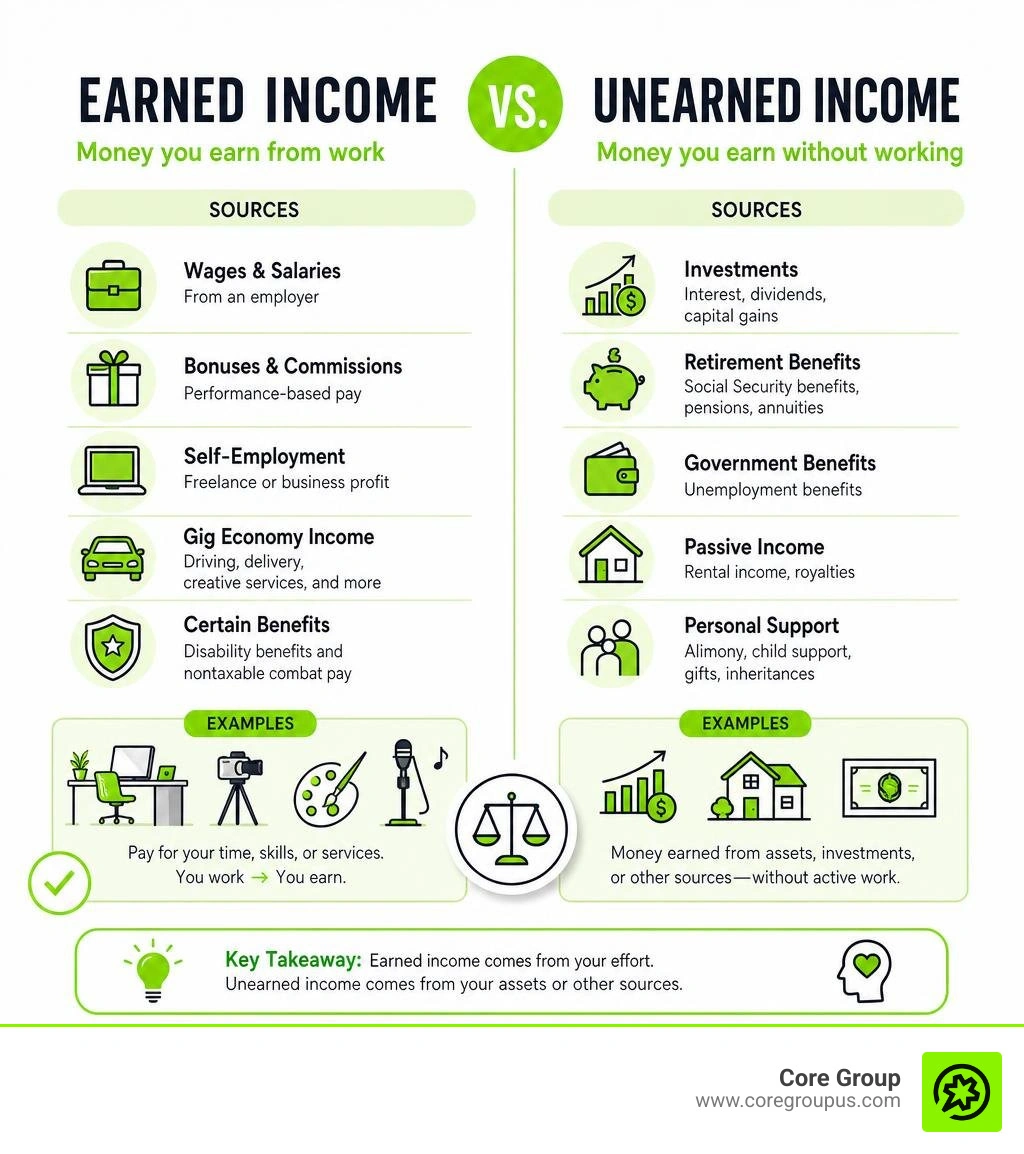
Earned income includes
- Wages, salaries, and tips from an employer
- Bonuses and commissions
- Net profit from self-employment or freelance work
- Gig economy income (driving, selling goods, creative services)
- Certain disability benefits and nontaxable combat pay
Earned income does NOT include
- Interest, dividends, or capital gains
- Social Security benefits or pensions
- Unemployment benefits
- Rental income, alimony, or child support
This distinction matters for one big reason. The IRS uses your earned income to determine whether you qualify for valuable tax credits, including the Earned Income Tax Credit (EITC). It also affects your retirement contributions and other benefits.
If you run a creative business, freelance, or work in film and media, nearly everything you earn from your craft likely counts as earned income. That means it is taxable, and it shapes almost every major tax decision you make.
Understanding exactly what qualifies, and what does not, is the first step toward keeping more of what you earn.
Earned income definition word list
What is the IRS Earned Income Definition

When we look at federal tax law, the Internal Revenue Service has a very specific way of defining what we make. The official federal guidelines are rooted in the Internal Revenue Code, specifically under 26 U.S. Code Section 32. According to this statute, the IRS views earned income as any monetary compensation received from services rendered. This means you must have actively done something, whether that is swinging a hammer, designing a logo, writing code, or managing a team, to receive those funds.
According to the official legal definition of earned income, the term covers all taxable employee pay and net earnings from self-employment. The IRS is not just looking at the cash that lands in your checking account. They look at the relationship between your effort and the payment. If you did not actively participate or provide a service to get the money, the IRS will not classify it as earned.
This legal distinction is critical. If your income is not classified as earned, you cannot use it to contribute to a traditional or Roth IRA. You also cannot use it to qualify for certain tax credits. For creative professionals, understanding how the IRS categorizes every single dollar earned is the secret to building a bulletproof financial plan.
Understanding the Legal Earned Income Definition
To make things simple, we can break down the legal definition into everyday terms. According to the dictionary definition of earned income, it is money earned from working, rather than from investments.
For the average worker, this includes basic wages and hourly salaries. It also includes the tips left by customers, the bonuses awarded by employers at the end of the year, and commissions earned on sales. Every single one of these items must be reported to the government because they represent active labor. Noncash benefits provided by an employer, such as lodging, meals, or a company car, are also counted at their fair market value as part of your overall compensation.
How the Earned Income Definition Applies to Self Employed Workers
For independent creators, freelancers, and small business owners, the application of this definition looks a little different. If you operate as a sole proprietorship, your earned income is your net earnings from self-employment. This is not the total amount of money your clients paid you. Instead, it is your gross business receipts minus your ordinary and necessary business expenses.
If you have structured your business as a limited liability company, you might wonder how your taxes are handled. We have put together a guide on Federal Income Tax LLC rules to help you understand how your business profit flows through to your personal tax return. The profit that remains after deducting your business expenses is considered earned income, and it is subject to self-employment taxes.
Planning for these taxes is one of the biggest challenges for independent professionals. If you are asking yourself, As a Freelancer How Do I Plan for Taxes, the answer begins with tracking your net earnings. Knowing your net self-employment profit allows you to estimate your quarterly tax payments accurately and avoid painful penalties when tax season arrives.
What Counts as Earned Income for Taxpayers

Now that we have established the baseline, let us look closely at what counts as earned income. For most taxpayers, the bulk of their earned income is reported on Form W-2. If you are an employee, this includes your hourly wages, salary, and any overtime pay.
However, the modern workforce is full of non-traditional setups. The gig economy has grown rapidly, and the IRS has adapted. If you drive for rideshare platforms, sell handmade goods online, or provide freelance creative services, all of those net earnings count as earned income.
There are also statutory employees. These are independent contractors who are treated as employees by statute for tax purposes, such as certain life insurance agents or commission drivers. If you are a statutory employee, your employer will check box 13 on your W-2, and your gross income from that work is considered earned. Even strike benefits paid by a labor union count as earned income in the eyes of the IRS.
Because these rules can get complicated, professional guidance is highly recommended. Utilizing specialized Tax Planning for Freelancers can help you categorize your various income streams correctly, ensuring you do not pay more self-employment tax than you legally owe.
Special Rules for Combat Pay and Disability Benefits
The tax code is full of exceptions, and earned income has its fair share. One important exception involves members of the military. Nontaxable combat pay is generally excluded from gross income. However, the IRS allows military personnel to make a special election. You can choose to include your nontaxable combat pay in your earned income calculation if it helps boost your Earned Income Tax Credit.
Disability benefits also have unique rules. If you receive long-term disability payments from an employer-funded plan, those payments are treated as earned income. However, this treatment only lasts until you reach your minimum retirement age. Once you reach that age, the IRS begins treating those payments as a pension, which classifies them as unearned income.
Ministers and members of the clergy have special rules as well. A minister housing allowance is generally excluded from income taxes, but it must be included when calculating net earnings from self-employment. For a deep dive into these unique scenarios, you can consult the official Publication 596 rules provided by the Internal Revenue Service.
What is Excluded from Earned Income Calculations
Understanding what is excluded from your earned income is just as important as knowing what is included. The general rule is simple, if you did not actively work for the money during the tax year, it is not earned. This other side of the coin is known as unearned or passive income.
To help you visualize the differences, we have put together a direct comparison.
Income Source Comparison Table
| Income Source | Categorized As | Subject to Self-Employment Tax | Counts Toward EITC |
|---|---|---|---|
| Hourly Wages and Salaries | Earned Income | No (Subject to FICA) | Yes |
| Freelance and Gig Profits | Earned Income | Yes | Yes |
| Interest and Dividends | Unearned Income | No | No |
| Capital Gains from Stocks | Unearned Income | No | No |
| Social Security Benefits | Unearned Income | No | No |
| Unemployment Benefits | Unearned Income | No | No |
| Alimony and Child Support | Unearned Income | No | No |
| Pensions and Annuities | Unearned Income | No | No |
As you can see, investment returns, such as taxable interest, ordinary dividends, and capital gains, are completely excluded from the earned income calculation. Government assistance, including unemployment benefits and Social Security, is also unearned. Alimony and child support payments are excluded as well.
If you are navigating public assistance programs, you must know how these categories interact. You can learn more about how different income streams are evaluated by reading How Your Income Is Counted, which explains the standards used for various benefit programs.
How Earned Income Affects Your Tax Credits
Your earned income is the primary metric used to determine if you qualify for the Earned Income Tax Credit. The EITC is a highly valuable, fully refundable tax credit designed to assist low- to moderate-income workers. Because it is refundable, if the credit reduces your tax liability below zero, the government will send you the remaining balance as a refund.
To claim this benefit, you must have qualified earned income. If you have zero earned income, you cannot claim the credit, even if your overall gross income is very low. You must also meet specific residency and age requirements. You can review the complete Earned Income Tax Credit eligibility rules to see if your current financial situation qualifies.
Maximizing your eligibility for these programs is a key part of smart tax planning. By structuring your business expenses and tracking your revenue properly, you can position yourself to qualify for valuable breaks. For practical tips on lowering your overall tax bill, check out our guide on How to Save on Taxes.
EITC Income Limits and Maximum Credit Amounts
The IRS adjusts the income limits and credit amounts for inflation every year. For the 2025 tax year, which taxpayers filed in early 2026, the maximum credit amounts and income limits are highly dependent on the number of qualifying children you claim.
- For taxpayers with no qualifying children, the maximum EITC is $649.
- For taxpayers with one qualifying child, the maximum credit rises significantly.
- For taxpayers with two qualifying children, the credit increases further.
- For taxpayers with three or more qualifying children, the maximum credit reaches $8,046.
To qualify for the EITC, your investment income must also remain below a certain threshold. For the 2025 tax year, the investment income limit is $11,950 or less. If your interest, dividends, and capital gains exceed this amount, you are disqualified from claiming the credit entirely.
The maximum Adjusted Gross Income limits for EITC eligibility in the 2025 tax year are capped at $61,555 for single filers with three or more qualifying children. For married couples filing jointly with three or more qualifying children, the maximum AGI limit is $68,675. You can read the exact legal language and phaseout percentages in U.S.C. Title 26 Section 32.
Tax Planning Strategies for Creative Entrepreneurs
If you are a creative entrepreneur, managing your earned income is not just about qualifying for credits. It is about choosing the right business structure to minimize your overall tax burden. Many successful creators start as sole proprietors but eventually find that they are paying too much in self-employment taxes.
One popular path is transitioning to an S-Corporation. If you are wondering, Should Creative Entrepreneurs Become an S-Corp, the answer depends on your net income. An S-Corp allows you to split your business earnings into two categories, a reasonable salary (which is earned income) and shareholder distributions (which are unearned income). This split can save you thousands of dollars in self-employment taxes because distributions are not subject to Social Security and Medicare taxes.
Before making this move, you must verify that you meet the S-Corp Eligibility Requirements. If you qualify, the next step is learning How to Form S-Corp status with the IRS.
Additionally, self-employed creatives should look into the Qualified Business Income deduction. Our guide, QBI Deduction Explained, details how you can deduct up to 20 percent of your qualified business income right off the top. Integrating these tools into your broader Tax Planning Strategies is the best way to secure your financial future.
Frequently Asked Questions About Earned Income
Navigating tax laws can feel like learning a foreign language. To help clear up the confusion, we have answered some of the most common questions we hear from creative business owners.
What is the simplest earned income definition
In the simplest terms, the earned income meaning is money you get for active work. If you had to show up, perform a task, or run a business to get paid, it is earned. If the money came to you passively while you slept, such as stock dividends or bank interest, it is unearned.
Does child support count as earned income
No, child support does not count as earned income. The IRS does not consider child support payments to be taxable income for the recipient, nor are they deductible for the payer. Because it is completely excluded from tax calculations, you cannot use child support payments to qualify for the Earned Income Tax Credit or to make retirement contributions.
How do I report my earned income on my tax return
If you are an employee, your earned income is reported on Form W-2, and you will enter this amount on Line 1 of your Form 1040. If you are self-employed or run a freelance business, you will report your income and expenses on Schedule C. The net profit from Schedule C then flows to your Form 1040.
Because mistakes on your tax return can lead to audits or delayed refunds, working with a certified tax professional is always the safest path. They can help you track your income, identify deductible expenses, and file your paperwork accurately.
Conclusion
Managing your finances does not have to be a source of constant stress. At Core Group, we help creative entrepreneurs find financial peace of mind. We take the confusion out of the tax code, allowing you to focus on what you do best, creating beautiful work.
Our financial services are built around a practical, profit-first playbook. We offer comprehensive bookkeeping, financial management, and tax services designed specifically for creative businesses. We are so confident in our ability to streamline your business that we back our services with a MacBook Pro guarantee.
If you are ready to take control of your business finances and keep more of your hard-earned money, explore our accounting services today. Let us handle the numbers so you can focus on your craft.