A Practical Guide to Tax Planning for Freelancers
What Freelancers Need to Know About Taxes (And How to Pay Less)
Tax planning for freelancers is the process of organizing your income, deductions, and payments throughout the year so you owe as little as possible come April — legally.
Here's a quick overview of the most important steps:
- Know your tax obligations — If you earn $400 or more from self-employment, you must file a return and pay self-employment tax (15.3% on top of regular income tax).
- Track every deductible expense — Home office, equipment, mileage, health insurance, and more can all reduce your taxable income.
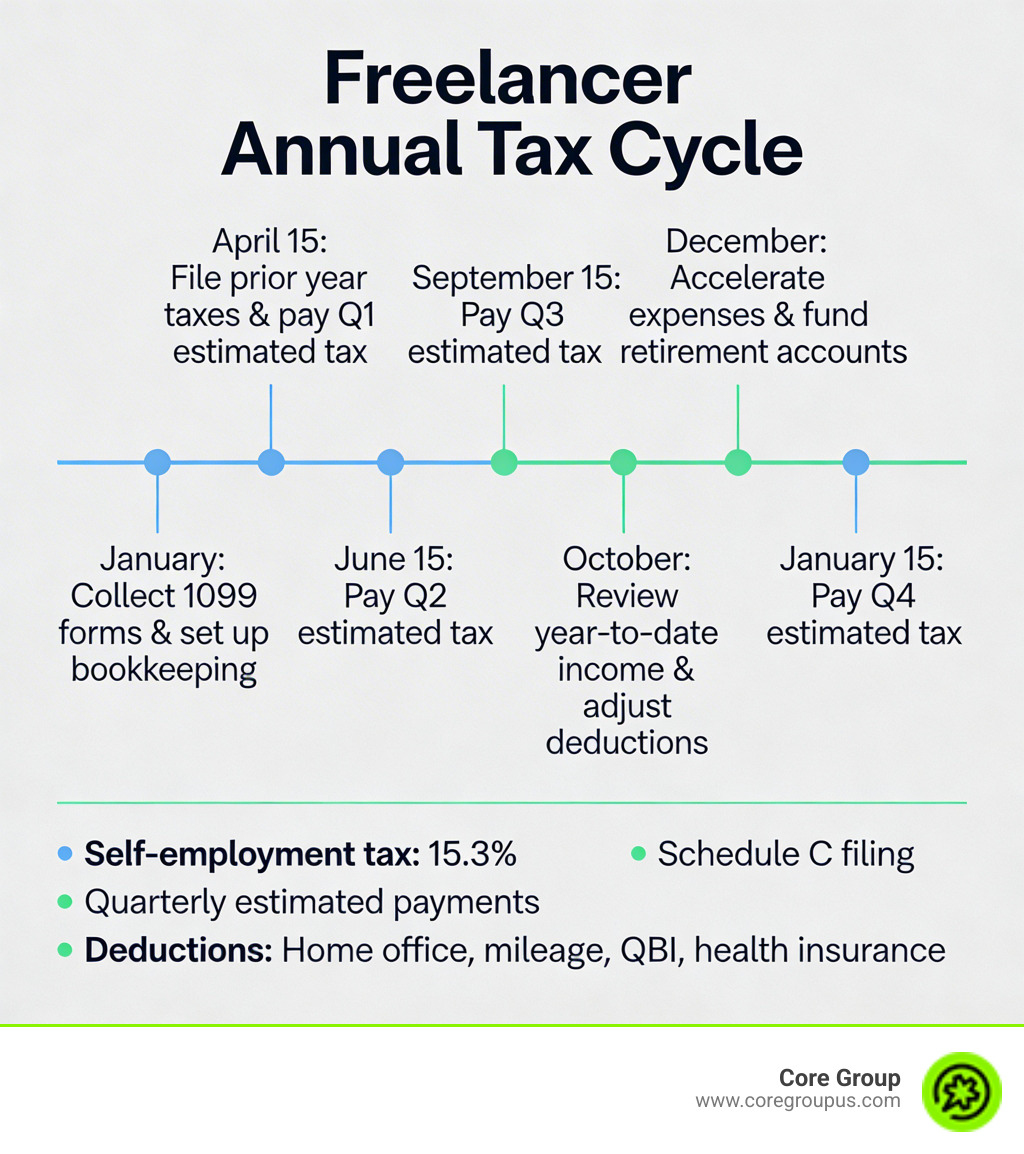
- Pay quarterly estimated taxes — Due April 15, June 15, September 15, and January 15 to avoid IRS penalties.
- Claim the QBI deduction — Most freelancers can deduct up to 20% of their net business income.
- Consider your business structure — An LLC or S corporation election can significantly cut your tax bill as income grows.
- Save for retirement — SEP IRA or Solo 401(k) contributions reduce taxable income dollar for dollar.
Freelancing gives you freedom. It also gives you a tax situation that's nothing like a regular paycheck.
No employer is withholding taxes for you. No one is paying half your Social Security and Medicare. And if you're like most creative freelancers — juggling client invoices, project deadlines, and irregular income — taxes can feel like a trap that springs on you every April.
The good news? Most of the "tax pain" freelancers experience comes from not planning, not from the tax code itself. With the right system, you can reduce what you owe, avoid penalties, and stop dreading tax season.
This guide walks you through everything: your obligations, your deductions, your quarterly payments, and the strategies that actually move the needle.
Understanding your status and tax obligations
Before we can dive into the "savings" part of tax planning for freelancers, we need to get clear on who the IRS thinks you are. If you provide services to clients and they don't treat you as an employee (meaning they don't withhold taxes or provide a W-2), you are generally considered an independent contractor or a sole proprietor.
According to official IRS guidance for self-employed individuals, you are self-employed if you carry on a trade or business as a sole proprietor, an independent contractor, or a member of a partnership. This includes full-time freelancers and "side hustlers" or gig workers who earn money on the side.
The magic number to remember is $400. If your net earnings from self-employment are $400 or more, you are required to file an income tax return.

When tax season rolls around, you won't just be looking at one form. You'll likely receive several:
- 1099-NEC: Clients send this if they paid you $600 or more during the year for your services.
- 1099-K: Payment processors (like PayPal or Venmo) issue this. For 2025, the threshold is generally $20,000 and 200 transactions, though this has fluctuated recently.
- Cash/Checks: Even if you don't get a form for a small gig, you are legally required to report that income.
All of this "top-line" income gets funneled into Schedule C, where you'll list your business expenses to find your net profit. For more details on the "how-to" of this process, check out our guide on how to plan for taxes as a freelancer.
Calculating self employment tax
This is the one that catches most new freelancers off guard. When you work for a boss, they pay half of your Social Security and Medicare taxes, and you pay the other half. When you are the boss, you pay both halves. This is known as the self-employment tax.
The total rate is 15.3%, which breaks down as:
- 12.4% for Social Security (on income up to $176,100 in 2025).
- 2.9% for Medicare (on all your net earnings).
The IRS does give us a small break here. You only pay this tax on 92.35% of your net earnings. Furthermore, you can deduct the "employer-equivalent" portion of your self-employment tax (the 7.65% half) when calculating your adjusted gross income on your 1040. You'll use Schedule SE to crunch these numbers.
Effective tax planning for freelancers through deductions
If self-employment tax is the "bad news," deductions are the "great news." Every dollar you legitimately deduct is a dollar you aren't taxed on. In tax planning for freelancers, deductions are your primary tool for lowering that final bill.
To be deductible, a business expense must be both ordinary (common and accepted in your industry) and necessary (helpful and appropriate for your trade).
One powerful tool is the Section 179 deduction. This allows you to deduct the full cost of qualifying equipment—like a new MacBook Pro for your design business—in the year you buy it, rather than depreciating it over several years. This is a massive win for creative entrepreneurs who need high-end gear to stay competitive.
Other common write-offs include:
- Health Insurance Premiums: If you're self-employed and not eligible for a plan through a spouse's employer, you can typically deduct 100% of your health, dental, and long-term care insurance premiums.
- Education and Certifications: Taking a course to improve your freelance writing or getting a new software certification? That’s deductible.
- Marketing: Website hosting, business cards, and even those LinkedIn Premium fees count.
For a deeper dive into what you can write off, see our guide to LLC tax deductions.
Common deductions in tax planning for freelancers
The home office deduction is perhaps the most famous (and misunderstood) freelancer perk. To qualify, your home office must be used regularly and exclusively for business. This means your "desk in the corner of the playroom" doesn't count, but a dedicated room or a clearly partitioned space does.
You have two ways to calculate this:
- Simplified Method: You deduct $5 per square foot of your home used for business, up to a maximum of 300 square feet ($1,500 max deduction). It’s easy and requires less paperwork.
- Actual Expense Method: You calculate the percentage of your home used for business and apply that percentage to your rent, mortgage interest, utilities, property taxes, and home insurance. This often results in a bigger deduction but requires meticulous record-keeping.
Don't forget the "invisible" office costs: a portion of your phone and internet bill is deductible based on how much you use them for work versus personal life.
Travel and mileage rules
If you drive for work—to meet clients, pick up supplies, or go to a co-working space—you can deduct those costs. For 2025, the standard mileage rate is 70 cents per mile.
To claim this, you must keep a contemporaneous mileage log. This means you can't just guess at the end of the year; you need to record the date, the miles driven, and the business purpose of each trip.
| Expense Type | Standard Mileage Rate | Actual Expense Method |
|---|---|---|
| Calculation | Miles driven x 70 cents (2025) | Gas, oil, repairs, insurance, etc. |
| Record-keeping | Mileage log required | All receipts + mileage log |
| Depreciation | Included in the rate | Calculated separately |
| Best For | High-mileage, fuel-efficient cars | Low-mileage, expensive-to-run vehicles |
When traveling away from your "tax home" for business, you can also deduct lodging and 50% of your business meals. Even client gifts are deductible, though the IRS caps these at $25 per person per year.
Managing quarterly estimated tax payments
Because freelancers don't have an employer sending money to the IRS every payday, the IRS expects you to do it yourself four times a year. These are called quarterly estimated tax payments.
If you expect to owe $1,000 or more in taxes for the year, you generally need to make these payments using Form 1040-ES.
The deadlines are usually:
- Q1 (Jan 1 – March 31): Due April 15
- Q2 (April 1 – May 31): Due June 15
- Q3 (June 1 – Aug 31): Due September 15
- Q4 (Sept 1 – Dec 31): Due January 15 of the following year
If you skip these or underpay, the IRS may hit you with underpayment penalties. To avoid this, most freelancers aim for the "safe harbor" rule: pay at least 90% of your current year's tax liability or 100% of last year's tax liability (whichever is smaller).
If your income is "lumpy"—meaning you make $20,000 in June but $0 in November—you can use the annualized installment method to adjust your payments so you aren't overpaying during lean months. Managing this requires solid bookkeeping for solopreneurs.
Choosing the right business structure for tax savings
When you start out, you’re likely a sole proprietor. It’s easy and requires zero paperwork. However, as your income grows, your business structure becomes a vital part of tax planning for freelancers.
Many freelancers form a Single Member LLC. While an LLC provides liability protection (keeping your personal assets safe from business lawsuits), it doesn't change your tax bill by itself. You still report your income on Schedule C. For more on this, read about reporting 1099 income for LLCs.
The real tax magic often happens with the Qualified Business Income (QBI) deduction. This allows many freelancers to deduct up to 20% of their net business income from their taxes. If you earned $100,000 in profit, you might be able to wipe $20,000 off your taxable income right off the bat.
Advanced tax planning for freelancers with S corporations
Once your freelance profit reaches a certain level (usually around $60,000 to $80,000), it might be time to ask: should creative entrepreneurs become an S Corp?
As an S Corp, you become an employee of your own company. You pay yourself a "reasonable salary" (on which you pay payroll taxes) and take the rest of the profit as a "distribution" (on which you do not pay the 15.3% self-employment tax).
Example Savings:
- On $40,000 of business income, an S Corp structure could save you roughly $2,770 in taxes.
- On $200,000 of business income, those savings could skyrocket to over $15,000.
To do this, you first form an LLC or Corporation and then file IRS Form 2553 for S Corp election. There are strict S Corp eligibility requirements, and the S Corp setup process involves more paperwork (like running payroll), but the tax savings are often worth the effort.
Organizing records and avoiding common mistakes
The biggest mistake freelancers make isn't choosing the wrong structure; it's messy bookkeeping. Mixing personal and business finances is a "red flag" for the IRS and makes it nearly impossible to find all your deductions.
We always recommend:
- Separate Bank Accounts: Open a dedicated business checking account and credit card. Never use your personal card for a business expense if you can help it.
- Use Bookkeeping Software: Whether it's a simple spreadsheet or a professional tool, track your income and expenses weekly.
- Understand "Hobby Loss" Rules: To keep deducting expenses, you must show a "profit motive." The IRS generally wants to see a profit in three out of every five years; otherwise, they may classify your work as a hobby and disallow your deductions.
Tax relief and penalty abatement
If you fall behind or can't pay your bill, don't panic—and don't ignore the IRS. They have several programs to help:
- First-Time Abatements: If you’ve been compliant in the past but messed up this year, you can often get penalties waived.
- Payment Plans: You can set up an installment agreement to pay your debt over time.
- Offer in Compromise: In extreme cases, the IRS may allow you to settle your tax debt for less than the full amount.
Frequently Asked Questions about freelancer taxes
What is the Qualified Business Income deduction?
The QBI deduction (Section 199A) allows sole proprietors, partners, and S Corp shareholders to deduct up to 20% of their qualified business income from their federal income tax. There are income limits and "specified service" rules (for fields like law or health), but most creative freelancers qualify.
How do I calculate my quarterly tax payments?
The easiest way is to use the worksheet in Form 1040-ES. You'll estimate your total income, deductions, and taxes for the year, then divide by four. If your income varies, you can recalculate each quarter based on what you actually earned.
Can I deduct my health insurance premiums?
Yes! As long as you have a net profit for the year and aren't eligible for an employer-subsidized plan elsewhere, you can deduct these premiums as an adjustment to your income. This is a "top-line" deduction, meaning it lowers your adjusted gross income (AGI).
Conclusion
Effective tax planning for freelancers isn't something you do once a year in April. It’s a year-round habit. By timing your income (delaying an invoice to January) or accelerating expenses (buying that new camera in December), you can actively control your tax liability.
Don't forget the power of retirement contributions. Funding a SEP IRA (up to 25% of net profit or $70,000 for 2025) or a Solo 401(k) reduces your taxable income dollar for dollar. Likewise, contributing to a Health Savings Account (HSA)—up to $4,300 for individuals in 2025—gives you a triple tax advantage.
At Core Group, we know that creative entrepreneurs would rather be creating than crunching numbers. Our "no-fluff, profit-first playbook" is designed to give you peace of mind and save you time. We handle the bookkeeping and tax strategy so you can focus on your craft. If you're ready to stop guessing and start saving, explore our professional tax planning resources today.