How Firms Juggle Your Assets Without Dropping the Tax Ball
Why So Many Families Lose Wealth Without an Integrated Tax Plan
How firms integrate estate investment tax planning strategies is one of the most important questions high-net-worth families and real estate investors can ask right now. Here is a quick answer:
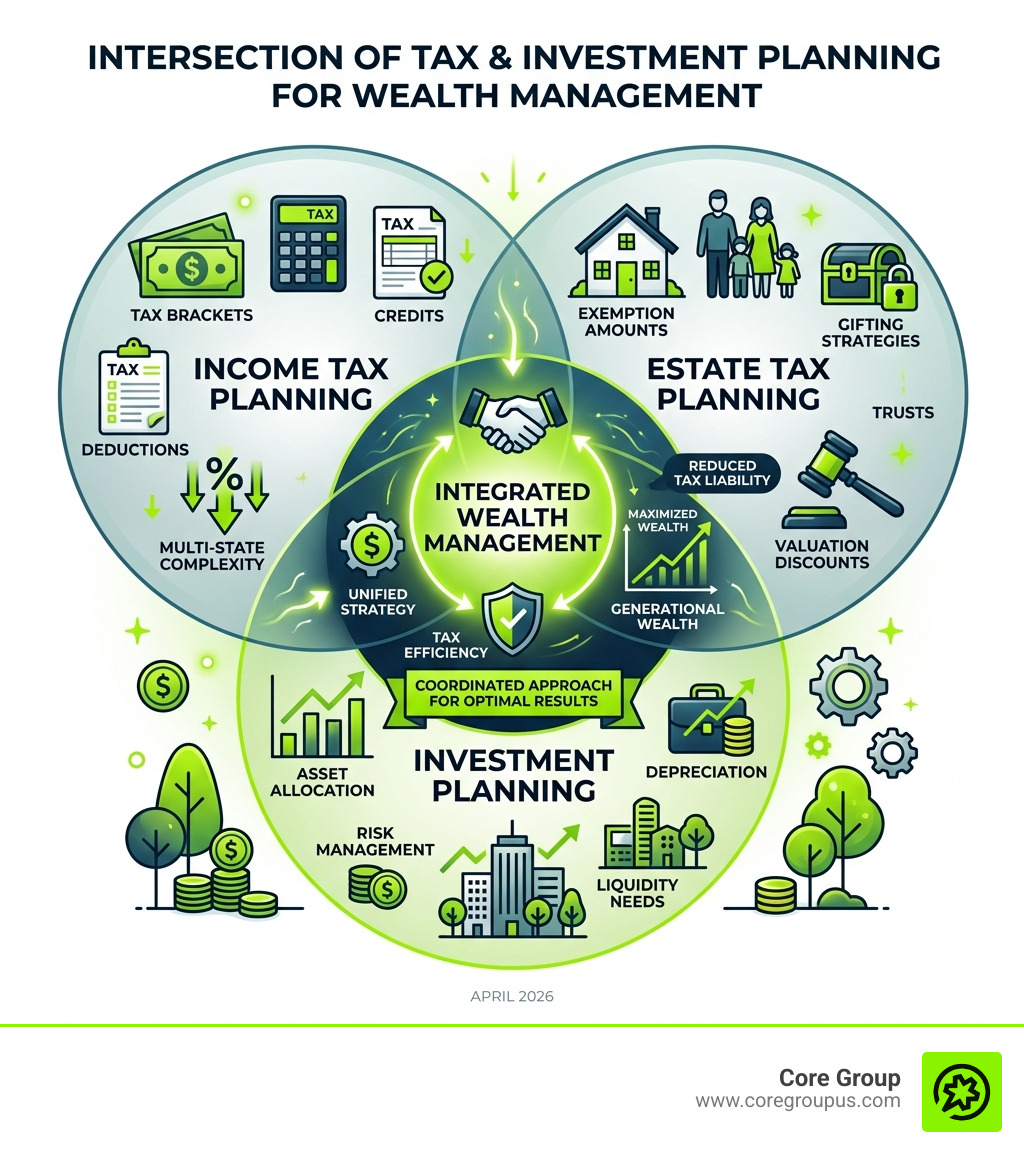
Firms integrate these strategies by combining income tax planning, estate tax planning, and investment decisions into one unified system, rather than treating each as a separate task. This means every move, from buying a rental property to gifting assets to heirs, is made with all three lenses in focus at once.
The core steps firms use to integrate these areas are:
- Assess the full picture - Review all assets, entities, tax exposure, and estate goals together
- Structure ownership wisely - Use LLCs, Family Limited Partnerships, or trusts to protect assets and reduce taxes
- Plan transfers early - Use gifting, valuation discounts, and trust strategies before tax law changes hit
- Solve for liquidity - Identify and close the gap between estate tax bills and available cash
- Align investments with estate goals - Coordinate depreciation, basis planning, and asset allocation with inheritance intentions
- Review regularly - Update the plan after life events, market shifts, or tax law changes
Why does this matter right now, in April 2026?
The stakes are unusually high. The federal estate tax exemption was set to drop from $13.99 million per individual to roughly half that amount, and legislative uncertainty around the One Big Beautiful Bill Act has kept advisors and families on high alert. Meanwhile, new bonus depreciation rules, multi-state tax complexity, and shifting exemption thresholds mean that a plan built even two years ago may already be outdated.
Research using Monte Carlo simulations has shown that families who ignore either income tax efficiency or estate tax planning end up with significantly less generational wealth than those who integrate both. The gap is not small. And for creative entrepreneurs who have built real wealth through their craft, that gap can mean the difference between a lasting legacy and a preventable tax bill.
This guide breaks down exactly how firms juggle all of this without dropping the ball.
Common how firms integrate estate investment tax planning strategies vocab:
The Core Benefits of Integrated Wealth Management
When we look at the big picture of wealth management, it is easy to see why integration is the secret sauce. Many people treat their income taxes and their estate plans as if they live on two different planets. But in reality, they are more like two sides of the same coin.
One of the biggest benefits of a unified approach is compounded wealth growth. When we help families optimize for income tax efficiency today, those extra savings can be reinvested. Over decades, that reinvestment grows. If that growth is also shielded by smart estate tax minimization, the multi-generational preservation of wealth becomes much stronger.
Scientific research on estate resilient portfolios has shown that families who are tax-oblivious achieve substantially lower wealth levels over generations. Using Monte-Carlo simulations, researchers found that efficiency in one tax type actually amplifies the value of efficiency in the other. If you are already saving on income tax, you should be even more eager to optimize your estate tax because you have more wealth to protect.
Avoiding the pitfalls of a disjointed plan is vital for anyone with a significant portfolio. Without integration, you might save a dollar on income tax today only to lose four dollars to estate taxes later. At Core Group, we focus on making sure every piece of the puzzle fits together. You can find more info about tax planning services to see how these pieces align. For those with heavy real estate holdings, checking out scientific research on estate resilient portfolios can provide a deeper look into managing control and liquidity.
How Firms Integrate Estate Investment Tax Planning Strategies for Maximum Efficiency
The heavy lifting of integration often happens within the legal and financial structures used to hold assets. We don't just put things in your personal name and hope for the best. Instead, firms use sophisticated entity organizational charts to create layers of protection and tax efficiency.
A common strategy for multi-state real estate portfolios is the two-tier LLC setup. In this model, individual properties are held in their own specific LLCs. These smaller LLCs then roll up into a single parent LLC. This does a few things at once. First, it helps with liability. If something happens at one property, the others are shielded. Second, it simplifies the tax return process.

In April 2026, we also have to navigate the SALT (State and Local Tax) deduction caps. Currently, 36 states and New York City have passed laws allowing Pass-Through Entity Tax (PTET) elections. This is a brilliant workaround that allows business owners to pay state taxes at the entity level, effectively bypassing the federal cap on personal state tax deductions.
For families looking to move wealth down to the next generation while keeping some control, Family Limited Partnerships (FLPs) are a go-to tool. These allow parents to act as general partners while giving children limited partnership interests. It is a great way to manage assets collectively while preparing for a future transfer. You can explore more info about federal income tax for LLCs to see how these structures impact your bottom line.
How Firms Integrate Estate Investment Tax Planning Strategies through Strategic Gifting
Gifting is not just about writing a check for a birthday. It is a calculated move to reduce the size of a taxable estate before it grows even larger. The annual gift exclusion currently allows individuals to give a certain amount to as many people as they want each year without touching their lifetime exemption.
But firms go much deeper than annual exclusions. Direct payments for tuition and medical expenses are a hidden gem in the tax code. If you pay a school or a hospital directly, there is no limit on the amount, and it does not count against your annual or lifetime gift limits. This is a powerful way to support family members while shrinking a taxable estate.
We also use valuation discounts to make gifts go further. If you gift a minority interest in a family business or real estate LLC, that interest is worth less than the underlying assets because the recipient has a lack of control and a lack of marketability. A $1 million share of a building might be valued at $700,000 for gift tax purposes because of these discounts. This allows us to move more value out of the estate while using up less of the exemption. For fund managers, vertical slice gifting for carried interest ensures that they are transferring a proportional share of all rights in the entity, which helps satisfy IRS requirements.
How Firms Integrate Estate Investment Tax Planning Strategies with Philanthropic Goals
Philanthropy is a beautiful way to align your money with your values while also being smart about taxes. Donor-Advised Funds (DAFs) have become incredibly popular because they offer immediate tax deductions. You can put appreciated securities into a DAF, avoid the capital gains tax you would have paid if you sold them, and then take your time deciding which charities to support.
Charitable Remainder Trusts (CRTs) are another advanced tool. They provide you or your family with income for a set period, with the remaining assets going to a charity later. This can provide a significant income tax deduction today and move assets out of your estate for tomorrow.
Beyond the tax forms, these strategies help establish a family mission statement. By involving heirs in charitable decisions, you are teaching them about the family legacy and how to manage wealth responsibly. It is about more than just numbers; it is about building a lasting impact.
Maximizing Real Estate Returns and Solving the Liquidity Gap
Real estate is a favorite for many investors because the tax code is written to favor it. But to get the most out of it, you have to know which levers to pull. Cost segregation studies are a major part of this. By identifying parts of a building that can be depreciated faster than the standard 27.5 or 39 years, we can create huge tax deductions in the early years of ownership.
Under the One Big Beautiful Bill Act (OBBBA), bonus depreciation and Section 179 expensing continue to be vital tools for accelerating these deductions. However, we have to be careful with state non-conformity. States like California and New York often require you to add back that depreciation on your state return, which is why multi-state planning is so complex.
One of the most valuable benefits for real estate heirs is the step-up in basis. When an owner passes away, the tax basis of the property is adjusted to its current market value. This can wipe out decades of built-up capital gains. For partnerships, making a Section 754 election allows the inside basis of the underlying assets to be stepped up as well, which can provide fresh depreciation for the heirs. You can learn more info about the QBI deduction to see how it adds another layer of savings for real estate businesses. For a deeper dive into these factors, check out the latest research on estate planning factors for real estate.
Addressing Estate Illiquidity Risks
The biggest nightmare for a real estate family is being "land rich and cash poor" when an estate tax bill comes due. The IRS usually wants its money within nine months, but buildings aren't always easy to sell that fast. This is the estate liquidity gap.
Firms use several tools to solve this. Section 6166 allows certain estates to defer tax payments for up to 14 years if the estate is mostly made up of a closely held business. Section 6161 extensions can also be granted for "reasonable cause" if a forced sale would cause economic harm.
| Strategy | Primary Benefit | Key Requirement |
|---|---|---|
| Section 6166 Deferral | 14-year payment plan | Business must be >35% of estate |
| Graegin Loan | Interest is deductible upfront | Loan must be "unavoidable" |
| ILIT (Life Insurance) | Tax-free cash at death | Must be an irrevocable trust |
| Section 6161 Extension | Short-term delay | Must prove "reasonable cause" |
Graegin loans are another specialized tool where an estate borrows money to pay the tax, and the interest on that loan can be deducted immediately on the estate tax return. Irrevocable Life Insurance Trusts (ILITs) are also a staple, providing a pool of tax-free cash exactly when the estate needs it most.
Avoiding Common Real Estate Planning Pitfalls
Even the best plans can hit a snag if they aren't careful with the IRS rules. One common trap is Section 2036, which covers retained interest. If you transfer a property to a trust but still act like you own it by taking the rent or living there without paying fair market rent, the IRS can pull that property right back into your taxable estate.
Passive loss rules post-death are another tricky area. To keep deducting losses against other income, the person managing the estate or trust must meet material participation requirements. This makes fiduciary selection very important. You need an executor or trustee who is actually involved in the business. Regular operating agreement reviews are essential to make sure the language in your legal documents matches your tax and estate goals.
Protecting Assets and Ensuring Multigenerational Success
Asset protection is about building a fortress around your wealth. Irrevocable trusts and Domestic Asset Protection Trusts (DAPTs) are the walls of that fortress. These structures can shield assets from creditors and lawsuits while also removing them from your taxable estate.
With the 2026 sunset risk looming, we are focusing heavily on the Generation-Skipping Transfer Tax (GSTT) exemptions. This allows you to put money into a trust that can benefit your children and grandchildren without being taxed again at each generation. It is a "use it or lose it" opportunity to lock in the current high exemption amounts before they potentially drop.

Leveraging Technology for Integrated Planning
Modern firms are no longer relying on dusty binders and spreadsheets. We use advanced technology platforms like Wealth.com to model multi-state tax scenarios in real-time. These tools allow us to show you exactly how a move in California might affect your tax bill in Florida or New York.
AI tools like Ester can analyze complex tax and estate documents to find risks that a human might miss. These platforms also streamline the execution of a plan, offering things like nationwide deed preparation and mobile notaries. This connectivity ensures that the beautiful plan we draw up on paper actually gets implemented in the real world.
Establishing Strong Family Governance
The best tax plan in the world won't matter if the family falls apart. That is why we emphasize family governance. An Investment Policy Statement (IPS) can set the ground rules for how the family's wealth is managed, including limits on debt and rules for distributions.
Heir education and observer roles are also vital. We often suggest bringing the next generation into meetings so they can learn the ropes before they are in the driver's seat. Business succession planning, including buy-sell agreements, ensures that if a partner wants out or passes away, the business can continue without a messy legal battle. Periodic plan reviews are the final piece of the puzzle, ensuring the plan stays fresh as the world changes.
Frequently Asked Questions about Integrated Tax Planning
What is the impact of the 2026 estate tax sunset?
The federal estate tax exemption is currently at a historic high of $13.99 million per person. On January 1, 2026, this provision is scheduled to sunset, meaning the exemption could be cut roughly in half. If you have an estate larger than $7 million, you are in the "danger zone." Firms are encouraging families to use their exemptions now through gifting or irrevocable trusts to lock in the higher amounts while they still can.
How does the OBBBA affect real estate depreciation?
The One Big Beautiful Bill Act (OBBBA) has shifted the landscape for bonus depreciation. While it provides opportunities for 100% deductions on certain improvements, the big challenge is state non-conformity. For example, if you own property in California or New York, those states do not follow the federal bonus depreciation rules. You might get a huge deduction on your federal return but have to pay it back on your state return. This makes it essential to model your taxes at both the federal and state levels.
Why is a two-tier LLC structure used for multi-state portfolios?
A two-tier structure provides two main layers of benefit. First, it isolates liability. If a tenant in your Arizona rental sues, they can't go after your properties in Texas. Second, it helps with "ancillary probate." If you own property in multiple states in your own name, your heirs might have to go through a separate probate process in every single state. By holding everything in a parent LLC or a trust, you can centralize the management and transfer of those assets, saving your family time and money.
Conclusion
At Core Group, we know that for creative entrepreneurs, your business and your investments are more than just numbers on a page. They are the result of years of hard work and passion. How firms integrate estate investment tax planning strategies shouldn't be a mystery that keeps you up at night.
Our "no-fluff, profit-first playbook" is designed to give you peace of mind. We handle the complex juggling of tax laws, entity structures, and estate deadlines so you can stay focused on what you do best. Whether you are navigating the 2026 sunset or looking to protect a growing real estate portfolio, professional collaboration between your tax advisors, attorneys, and financial team is the key to success.
Ready to secure your legacy and stop worrying about the tax ball? Start your integrated tax planning journey with us today and see how we can help you build a future-proof plan, backed by our MacBook Pro guarantee.