LLC Taxes: A Federal Income Tax Primer
Understanding the Federal Income Tax LLC Classification

Federal income tax LLC rules can feel overwhelming, but here is the short version:
How LLCs are taxed federally (quick answer):
| LLC Type | Default Tax Treatment | Key Form |
|---|---|---|
| Single-member LLC | Disregarded entity (taxed like a sole proprietor) | Schedule C (Form 1040) |
| Multi-member LLC | Partnership (pass-through to each member) | Form 1065 + Schedule K-1 |
| LLC elected as S Corp | Pass-through, salary required | Form 1120-S |
| LLC elected as C Corp | 21% flat corporate tax rate | Form 1120 |
An LLC is a business structure created under state law. But here is the thing most people miss: the IRS does not actually recognize "LLC" as a tax category. That means your LLC does not automatically have a federal tax identity the way a corporation does.
Instead, the IRS looks at how many members you have and whether you have made any elections, then assigns a tax classification from there.
This is actually good news for creative entrepreneurs. It means you get flexibility. You can be taxed as a sole proprietor, a partnership, an S corp, or even a C corp, all while keeping your personal assets protected by the LLC structure.
The core benefit most people form an LLC for is that protection. Your personal savings, equipment, and creative work are shielded from business debts and lawsuits. But the tax side of running an LLC is where most creatives get stuck.
This guide breaks down exactly how federal income taxes work for LLCs, what forms you need to file, and how to keep more of what you earn.
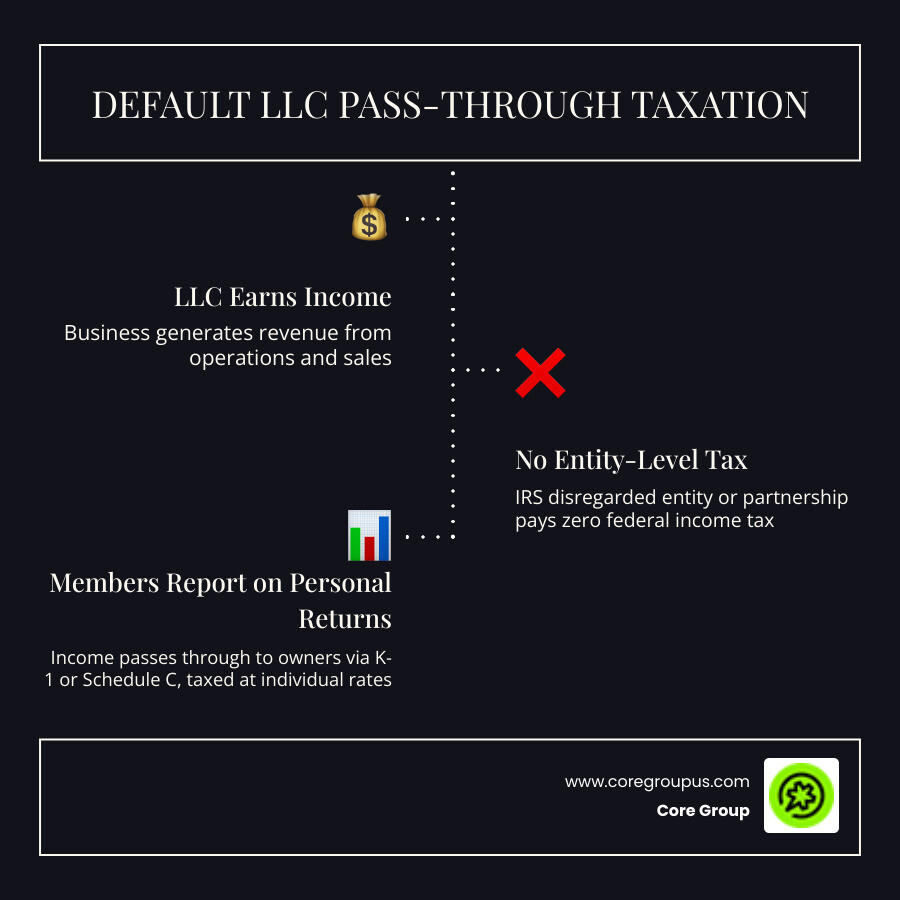

When we talk about a Federal income tax LLC, we are diving into "check-the-box" regulations. Because the IRS doesn't have a specific "LLC" tax bracket, they use IRS Publication 3402 to define how your business will be treated for tax purposes.
By default, the IRS treats a domestic LLC with one member as a disregarded entity. This doesn't mean the IRS is ignoring you (we wish!); it means they don't see the business as separate from you for income tax purposes. If your LLC has two or more members, the default classification is a partnership.
However, there is a twist. While an LLC might be "disregarded" for income taxes, it is treated as a separate entity for employment taxes and certain excise taxes. This means if you hire a studio assistant, the LLC must have its own Employer Identification Number (EIN) to report those payroll taxes, even if you report the business income on your personal return.
How a Federal Income Tax LLC Election Works
One of the best parts of the LLC structure is that you aren't stuck with the default. If your creative business is scaling, you can use Form 8832 to change your entity classification.
There are two major timing rules we always watch out for:
- The 75-Day Window: An election cannot take effect more than 75 days before the date the election is filed, nor more than 12 months after.
- The 60-Month Rule: Generally, once you change your classification, you cannot change it again for another 60 months.
This flexibility allows us to move from a simple disregarded entity to a corporation if the tax math starts to favor that 21% flat rate.
Reporting Income for a Federal Income Tax LLC
For most of us starting out as single-member LLCs, reporting is straightforward. You use Schedule C attached to your Form 1040. You list your creative income, subtract your business expenses, and the "net profit" is what you pay taxes on.
Because it is a pass-through income structure, the money isn't taxed at the business level. Instead, it "passes through" to you and is taxed at your individual tax brackets. This avoids the "double taxation" that C-corporations face, where the business pays tax on profits and then the owner pays tax again on dividends.
Default Tax Rules for Single and Multi Member LLCs
The rules change slightly once you add a partner to your creative venture. Here is how the two default paths compare:
| Requirement | Single-Member LLC | Multi-Member LLC |
|---|---|---|
| Tax Form | Schedule C (Form 1040) | Form 1065 |
| Member Reporting | Included on 1040 | Schedule K-1 |
| Tax Payment | Paid by individual | Paid by individual members |
| Audit Risk | Linked to personal return | Separate entity-level filing |
For multi-member LLCs, the entity files Form 1065, which is an informational return. The LLC itself doesn't pay the tax. Instead, it issues a Schedule K-1 to each member, showing their share of the profits or losses. You can learn more about specific reporting requirements in our guide on Single Member LLC 1099 Reporting.
It is also vital to have a solid operating agreement. This document dictates how profits are split and how the tax burden is shared. If a member leaves or a new one joins, it can trigger a change in tax status. Under Revenue Ruling 99-5 and 99-6, the IRS provides specific paths for converting between a partnership and a disregarded entity without causing a tax nightmare, provided the paperwork is handled correctly.
Electing S Corp or C Corp Status for Better Tax Outcomes
As your creative business grows-maybe you've hit $75,000 or $100,000 in net profit-the default Federal income tax LLC classifications might start to feel expensive. This is when we look at corporate elections.
The S Corp Advantage
By filing Form 2553, your LLC can elect to be taxed as an S Corporation. This is a favorite for many of our clients because it can significantly reduce self-employment taxes.
In an S Corp, you wear two hats you are the owner and an employee. You pay yourself a reasonable salary (subject to payroll taxes) and take the rest of the profit as a distribution (not subject to self-employment tax). However, you must meet S Corp Eligibility Requirements, such as being a domestic entity and having no more than 100 shareholders.
The C Corp Option
While less common for small creative shops, electing C Corp status via Form 8832 subjects the LLC to a 21% flat corporate rate. This can be beneficial if you plan to keep a lot of money inside the business to reinvest in equipment or a studio space. The downside is dividend taxation, where you are taxed again when you take money out for personal use.
Managing Self Employment Taxes and Business Deductions
One of the biggest shocks for new LLC owners is the self-employment tax. When you are an employee, your boss pays half of your Social Security and Medicare taxes. When you are the boss, you pay both halves.
For 2024, the self-employment tax rate is 15.3%. This consists of:
- 12.4% for Social Security: This applies to the first $168,600 of your earnings.
- 2.9% for Medicare: This applies to all your net earnings.
- 0.9% Additional Medicare Tax: This kicks in if you earn over $200,000 (single) or $250,000 (joint).
Maximizing Your Deductions
To fight back against that 15.3%, we have to be aggressive (but legal) with deductions. Our LLC Tax Deductions Guide 2026 covers these in depth, but here are the heavy hitters:
- Qualified Business Income (QBI) Deduction: This allows eligible pass-through entities to deduct up to 20% of their qualified business income from their taxes. For 2024, the full 20% is available for single filers earning under $191,950.
- Retirement Accounts: Contributions to a SEP-IRA or a Solo 401k are often 100% deductible. A Solo 401k, in particular, allows you to contribute as both the employer and the employee, maximizing your tax-deferred savings.
- Health Insurance: If you are self-employed and not eligible for a spouse’s plan, your health insurance premiums are usually deductible "above the line," meaning they reduce your adjusted gross income.
Compliance for Foreign Owners and State Tax Considerations
If you are a non-U.S. resident (for example, a Canadian creative) running a U.S. LLC, the rules get significantly more complex.
A foreign-owned, single-member LLC is still a disregarded entity, but it has a massive reporting requirement: Form 5472. This form must be filed along with a "pro forma" Form 1120. Even if the LLC had zero income, failing to file this form can result in a $25,000 penalty.
Treaty Benefits and State Choices
Many foreign owners utilize tax treaty benefits by filing Form 8833. If you don't have "effectively connected income" (meaning you aren't physically working in the U.S. or have employees there), you might owe zero U.S. federal tax.
State selection also matters:
- Delaware: Famous for the Court of Chancery, which handles business disputes efficiently. It is great for privacy, though the annual franchise tax is $300.
- Wyoming: Often preferred for its low $60 annual fee and high privacy.
- Nevada: Known for having no state income tax and no information sharing with the IRS (though you still have to file your federal taxes!).
Frequently Asked Questions about LLC Taxation
Does an LLC pay federal income tax directly?
No, not by default. As a pass-through entity, the LLC itself does not pay federal income tax. The "bill" passes through to the members, who report the income on their personal tax returns. The only exception is if the LLC elects to be taxed as a C-Corporation.
When is an EIN required for a disregarded entity?
Even if you are a single-member LLC with no employees, you will need an EIN if you want to open a business bank account, file excise tax returns, or if you choose to be taxed as a corporation. We generally recommend getting one regardless to keep your Social Security number off of W-9 forms.
How does the QBI deduction work for LLC members?
The QBI deduction allows you to take 20% of your business profit and essentially "hide" it from income tax. It doesn't reduce your self-employment tax, but it significantly lowers your income tax burden. There are phase-outs for high earners in "specified service trades" (like law or consulting), but many creative businesses qualify fully.
Conclusion
Navigating the Federal income tax LLC landscape doesn't have to be a solo mission. Whether you are choosing between a disregarded entity and an S Corp or trying to figure out if your home studio qualifies for a deduction, the goal is always the same: keep your creative momentum going while staying compliant.
At Core Group, we specialize in helping creative entrepreneurs move away from "shoebox accounting" and into a profit-first playbook. We handle the bookkeeping and tax planning so you can focus on the work you love. Whether you are in Maryland, Arizona, or any of our other locations, we provide the financial peace of mind you need to scale.
Ready to stop stressing about the IRS? Check out our tax planning resources and let's get your creative business on the path to permanent profitability.