Cracking the Code 766 for Your Tax Refund
What IRS Code 766 Actually Means for Your Tax Refund
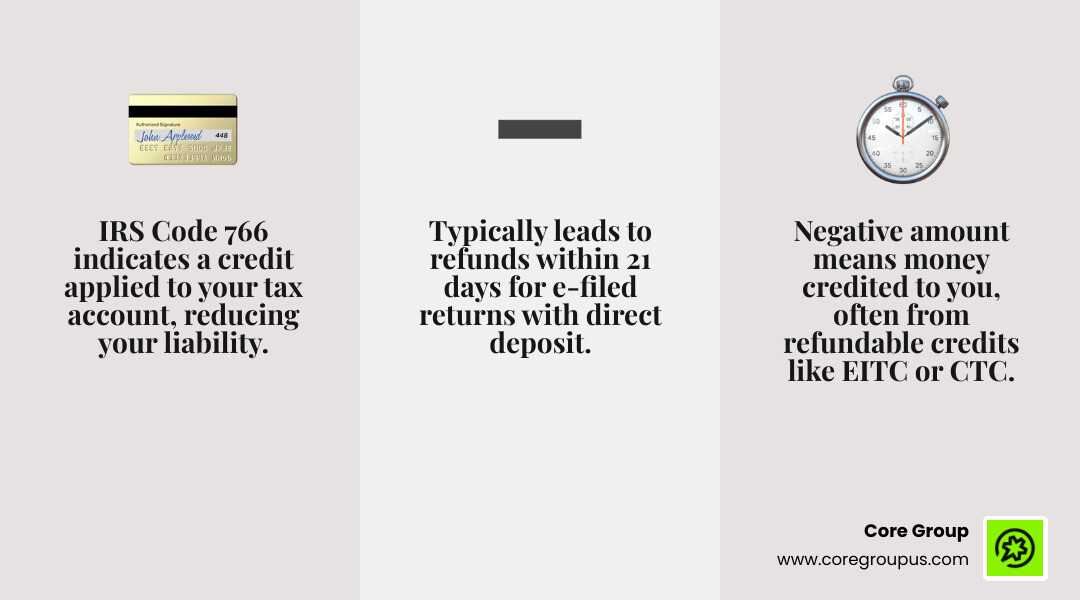
IRS code 766 is a transaction code that appears on your IRS tax transcript, and it means a credit has been applied to your account. In plain terms, it is good news. That credit reduces what you owe in taxes, and if it is larger than your tax liability, the difference comes back to you as a refund.
Here is a quick breakdown of the key facts:
- What it is - a credit posted to your IRS account
- What the negative amount means - money the IRS owes you, not the other way around
- Common sources - Earned Income Tax Credit (EITC), Child Tax Credit, overpayments, stimulus credits
- Does it guarantee a refund - not always, since other debts can offset it first
- Typical refund timeline - within 21 days for e-filed returns with direct deposit
For most taxpayers, especially creative freelancers juggling irregular income and complex credits, seeing Code 766 on a transcript can feel confusing or even alarming. It is not. But understanding what comes next, and how it interacts with other codes on your transcript, is what really determines when and whether money lands in your account.
This guide walks you through everything you need to know.
Understanding irs code 766 and Your Tax Transcript
When you look at your tax transcript, you are essentially looking at the IRS internal ledger for your tax year. It records every action taken on your return, from the moment it is received to the day a check is mailed or a direct deposit is sent. Among the many numbers and dates, irs code 766 stands out because it represents a specific type of financial movement.
In tax accounting, this is known as a refundable credit or an offset reversal. While the official terminology can be dense, the impact on your wallet is straightforward. This code signals that a specific dollar amount has been credited to your tax account. This might be because of a tax credit you claimed, such as the Child Tax Credit, or because you overpaid your taxes earlier in the year.
Think of your tax transcript as a scoreboard. If you want to dive deeper into how the IRS schedules these updates, you might want to learn What Is an IRS Cycle Code to understand the timing of these postings. Essentially, irs code 766 is the IRS acknowledging that you have "points" on the board that can be used to pay off your tax bill or be sent to you as a refund.

Why irs code 766 appears with a negative amount
One of the most common points of confusion for our clients at Core Group is seeing a negative sign next to a dollar amount. In most bank accounts, a negative number is a bad thing. However, on an IRS transcript, the logic is reversed.
The IRS uses a credit and debit system where a positive number represents a tax liability (money you owe them) and a negative number represents a credit (money they owe you or that is sitting in your account). When you see irs code 766 with a negative amount, it is actually positive news. It means the IRS has applied a credit that reduces your total tax liability. If your total credits (negative numbers) are greater than your total tax (positive numbers), the result is an overpayment that usually leads to a refund.
For more details on how these credits function within the broader context of your return, you can read about What Does Code 766 Mean on Tax Transcript? to see how it impacts your bottom line.
How to obtain a tax transcript to see irs code 766
To find out if irs code 766 has been applied to your account, you need to access your official IRS transcripts. There are several types of transcripts, but for tracking credits and refunds, the Account Transcript or the Record of Account are your best bets.
You can obtain these documents through the following methods:
- Get Transcript Online - This is the fastest method. You can create an account on the IRS website, verify your identity, and download a PDF of your transcript immediately.
- Form 4506-T - If you prefer the paper route, you can mail or fax this form to the IRS to request a transcript be sent to you by mail.
- Get Transcript by Mail - You can request a transcript through the IRS website or by calling 800-908-9946, and it typically arrives within 5 to 10 calendar days.
As we move through April 2026, many taxpayers are actively checking these transcripts to see if their expected credits have been processed. Seeing the code is the first step in confirming the IRS has processed the credits you claimed on your Form 1040.
Common Credits Associated with Transaction Code 766
The IRS uses irs code 766 for a wide variety of credits. It is a bit of a "catch-all" code for many refundable and non-refundable tax credits. Understanding which credits apply to you can help you verify if the amount listed on your transcript is correct.

For many of the creative entrepreneurs we work with, these credits are vital for maintaining cash flow. Some of the most common credits associated with this code include:
- The Child Tax Credit (CTC) - For the 2024 tax year, you can claim up to $2,000 per child under 18. Up to $1,600 of this can be refundable, meaning it can show up as a Code 766 credit even if you owe no tax.
- Earned Income Tax Credit (EITC) - This is a significant credit for low to moderate-income working individuals and families. Depending on your income and family size, the EITC can range from $600 to $7,430.
- Adoption Credits - Credits for qualified adoption expenses.
- American Opportunity Tax Credit (AOTC) - A credit for qualified education expenses for the first four years of higher education.
- Overpayment from a previous year - If you chose to apply last year's refund to this year's taxes, it often appears here.
When these items flow through to your personal return, especially if you are an S-Corp owner, the rules in 26 U.S. Code § 1366 - Pass-thru of items to shareholders dictate how income and credits are handled. Your tax bracket also plays a role in how much of a benefit you receive from non-refundable credits. You can check the Tax Brackets 2024 Married Jointly to see where you stand.
Multiple entries of irs code 766 on one transcript
It is very common to see irs code 766 appear multiple times on a single transcript. This does not mean the IRS is making a mistake. Instead, each entry usually represents a different credit.
For example, if you have two children and qualify for the EITC, you might see one Code 766 for the Child Tax Credit and another Code 766 for the Earned Income Tax Credit. Each will have its own dollar amount and date. During years when stimulus payments or recovery rebate credits were issued, those also appeared as separate Code 766 entries. If you see multiple entries, compare the amounts to the credits you claimed on your tax return to ensure everything matches up.
Impact of irs code 766 on tax liability and overpayments
The primary function of irs code 766 is to reduce your tax liability. If you owe the IRS $5,000 in income tax but have a Code 766 credit for $2,000, your remaining liability drops to $3,000.
However, many of the credits associated with this code are "refundable." This means that if the credit amount is larger than the total tax you owe, the IRS will pay you the difference. This results in an overpayment. For creative professionals who might have high expenses or fluctuating income, these credits can often turn a potential tax bill into a significant refund check.
In some cases, if you have an overpayment from a previous year that you didn't claim as a refund, the IRS may apply it to your current year's account using this code. This is a great way to reduce your current year's tax burden without having to write a check.
How Code 766 Interacts with Other IRS Codes
A tax transcript is like a puzzle, and irs code 766 is just one piece. To understand when your refund will arrive, you need to see how it interacts with other common codes.
| Code | Meaning | Impact on Refund |
|---|---|---|
| 766 | Generated Refundable Credit | Increases potential refund |
| 806 | W-2/1099 Withholding | Shows tax already paid via your employer |
| 768 | Earned Income Credit | Specific entry for EITC |
| 570 | Additional Liability Pending/Hold | Pauses the refund process |
| 846 | Refund Issued | The "Gold Standard" - your money is on the way |
| 898 | Refund Offset (Garnishment) | Money taken for other debts |
| 767 | Credit Reversal | A previously applied 766 credit is removed |
The sequence of codes 806 766 570 and 768
Sometimes, taxpayers see a specific sequence of codes that can be confusing. A common pattern is seeing Code 806 (withholdings), Code 766 (credits), and Code 768 (EITC) followed by Code 570.
If you see Code 570, it means there is a temporary hold on your account. This often happens when the IRS needs to verify information, such as your identity or the validity of the credits claimed. While it can be frustrating, it does not mean your refund is denied. It simply means the IRS is taking a closer look.
In some specialized cases, such as commodity broker issues, the treatment of property can get complex. While not applicable to most individual filers, 11 U.S. Code § 766 - Treatment of customer property shows how specific codes and laws govern the distribution of funds in legal proceedings. For the average taxpayer, the sequence of 806, 766, and 768 is usually the IRS "gathering" all your payments and credits before finalizing the return.
Misconceptions about irs code 766 and refund guarantees
A major misconception is that seeing irs code 766 guarantees you will receive a refund check for that exact amount. This is not always the case.
First, the credit is first applied to any tax you owe for the current year. Second, the IRS has the right to "offset" your refund to pay for other debts. This is where Code 898 comes in. If you owe back taxes from a previous year, unpaid child support, or certain student loan debts, the IRS can take the money from your Code 766 credit and apply it to those debts instead of sending it to you.
Additionally, if the IRS discovers an error in your filing, they might issue a Code 767, which is a credit reversal. This means they have decided you were not actually eligible for the credit previously listed under Code 766. This is why it is so important to ensure your return is accurate before filing.
Refund Timelines and Potential Delays
Once you see irs code 766 and eventually Code 846 (Refund Issued), the wait for your money begins. In April 2026, the IRS continues to process most electronic returns with direct deposit within 21 days. However, several factors can extend this timeline.
If you filed a paper return, you should expect to wait much longer, often six weeks or more. For freelancers, managing this timing is part of a larger strategy. We often recommend Tax Planning for Freelancers to help bridge the gap between filing and receiving those credits.
Potential delays can be caused by:
- Errors on the tax return
- Incomplete information
- Identity theft or fraud concerns
- Claims for the EITC or Additional Child Tax Credit (which by law cannot be issued before mid-February)
- The return requiring a manual review by an IRS agent
When to contact a professional about your refund
If you have seen irs code 766 on your transcript for more than a few weeks but have not seen Code 846, it might be time to take action. We generally suggest the "six-week rule." If it has been more than six weeks since you filed (or since the credit appeared) and your status on the "Where's My Refund" tool hasn't updated, you should start investigating.
You should also contact a professional if you receive an IRS notice in the mail. These notices often explain why a credit was reversed or why a hold (Code 570) was placed on your account. If you are feeling overwhelmed by these codes, our Tax Prep Pro services can help you navigate the system and get the answers you need.
What to do if you see Code 766 on your transcript
If you spot irs code 766 on your transcript, here is a simple checklist of what you should do:
- Verify the amount - Check the negative number against the credits you claimed on your tax return (like the Child Tax Credit or EITC).
- Check for Code 846 - Look further down the transcript to see if a refund has been authorized yet.
- Look for "Future Dates" - IRS transcripts often show dates in the future. This is usually the date the IRS expects the transaction to be "official" in their system. Don't panic if the date hasn't arrived yet.
- Monitor "Where's My Refund" - This tool is often more user-friendly than reading a transcript for daily updates.
- Keep your documents - Ensure you have all the receipts and records for the credits you claimed, just in case the IRS moves from a Code 766 to a Code 570 (hold) and asks for proof.
Conclusion
Navigating the maze of IRS transaction codes can be a daunting task, especially when you are trying to run a business or manage a creative career. Seeing irs code 766 is a positive sign that credits are being applied to your account, but it is just one part of the journey toward your tax refund.
At Core Group, we specialize in helping creative entrepreneurs take the guesswork out of their finances. Our "no-fluff, profit-first playbook" is designed to give you peace of mind and save you time, so you can focus on what you do best, creating and growing your business. We are so confident in our ability to streamline your financial life that we even offer a MacBook Pro guarantee.
Whether you are in Maryland, California, or anywhere in between, we are here to help you crack the code on your taxes and maximize your financial potential. If you want to move beyond just reading transcripts and start building a proactive strategy, explore our resources on Tax Planning today. We can help you ensure that every Code 766 that belongs on your transcript is claimed correctly, helping you keep more of your hard-earned money.