What Do IRS Codes 806 and 766 Mean for Your Refund?
What IRS Codes 806 and 766 Actually Mean for Your Refund
If you have ever pulled up your IRS account transcript and seen IRS code 806 and 766 staring back at you, here is the short answer.
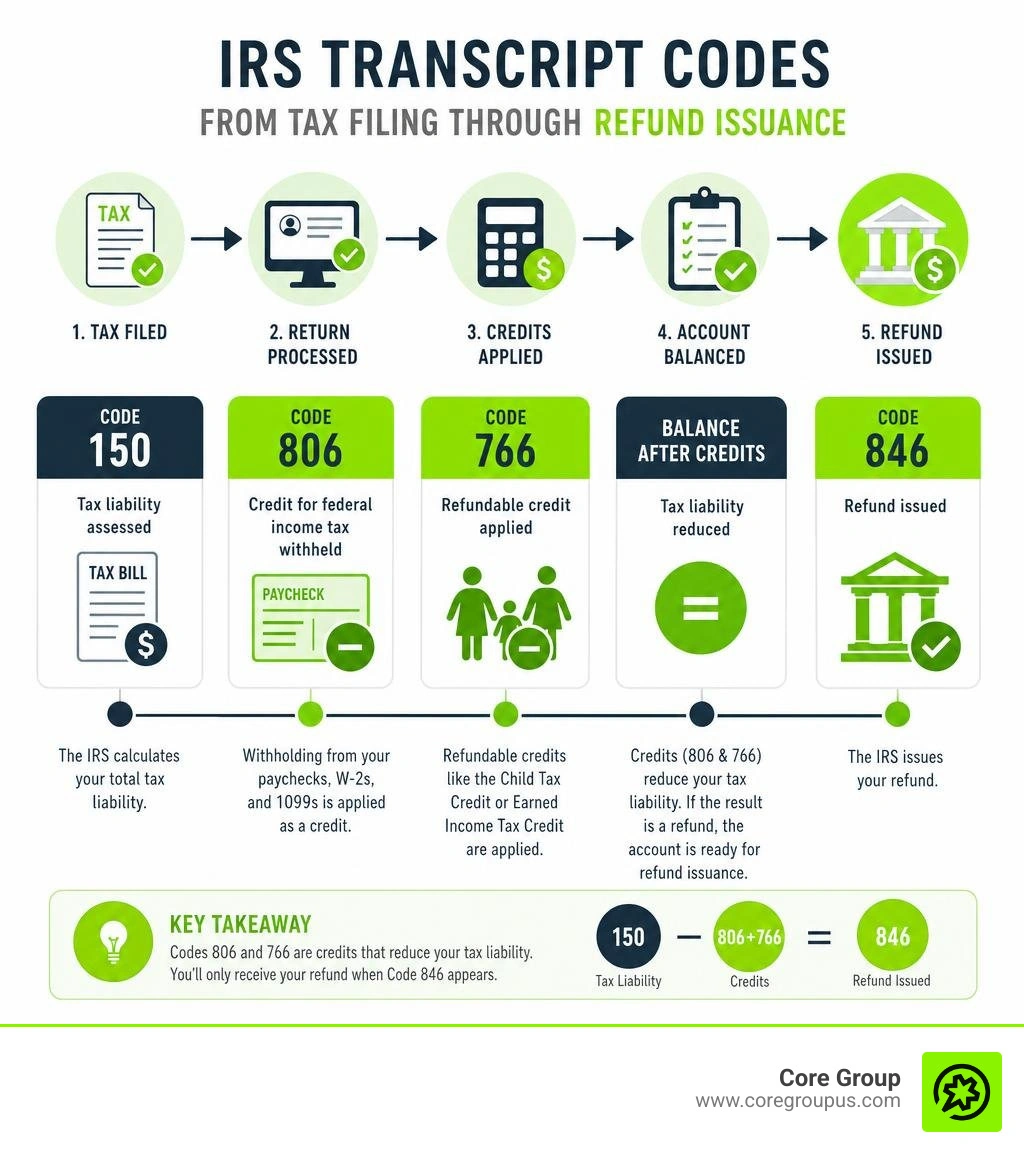
- Code 806 is a credit for federal income tax withheld from your paychecks, W-2s, and 1099s throughout the year
- Code 766 is a refundable credit applied to your account, such as the Child Tax Credit or Earned Income Tax Credit
- Both codes show as negative numbers, which is actually good news in IRS accounting because it means money is credited toward your refund
- Neither code alone confirms your refund has been issued; you need Code 846 for that
Together, these two codes represent the core of how the IRS calculates what it owes you back.
Think of it this way. Code 806 is money you already paid in, and Code 766 is money the government is adding on top because you qualified for certain credits. Subtract your tax liability (Code 150) from those totals, and you have a rough picture of your expected refund.
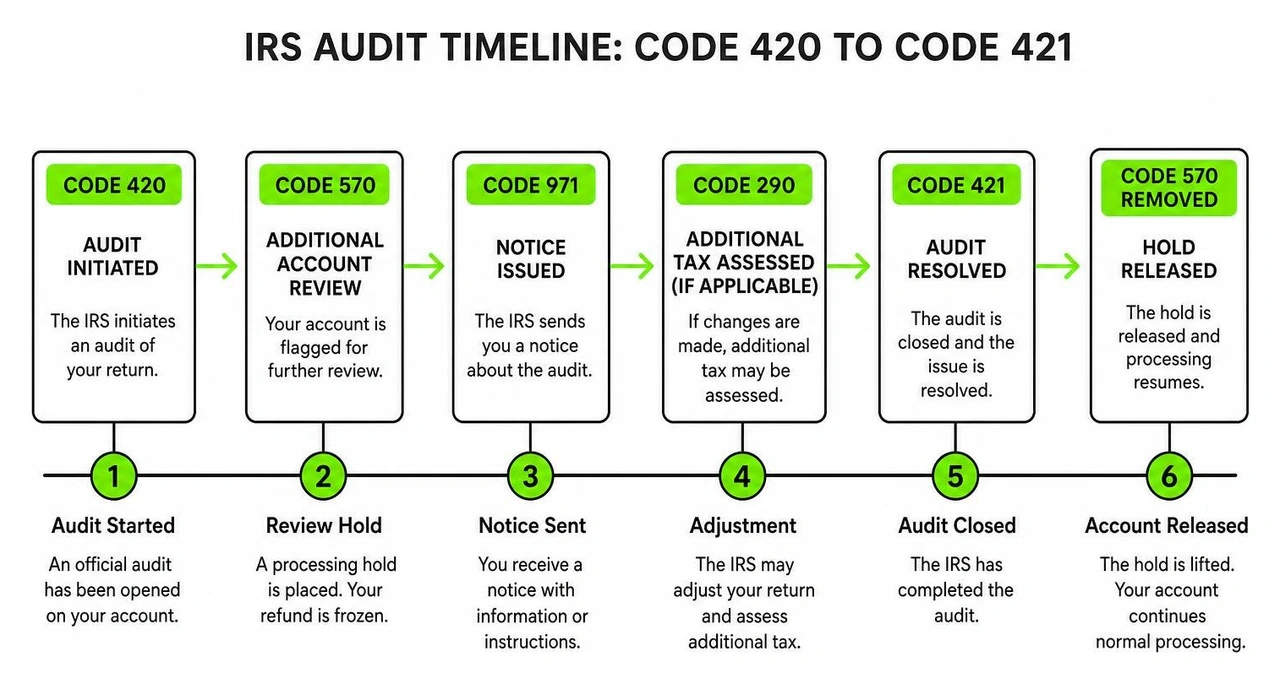
But seeing these codes does not mean your refund is on its way yet. Other codes like 570 (account hold) or 420 (audit initiated) can freeze everything, even when 806 and 766 are sitting there looking promising.
That confusion is exactly what this guide is here to clear up.
Irs code 806 and 766 glossary
Understanding IRS Code 806 and 766 on Your Transcript
When you log into your IRS online portal to pull your account transcript, you are greeted by a confusing spreadsheet of transaction codes, dates, and dollar amounts. It can feel like trying to read ancient hieroglyphics. However, understanding these numbers is the fastest way to know exactly where your hard-earned money is sitting.
Your IRS transcript is the official master ledger of your tax account. The IRS uses three-digit transaction codes to record every single action, assessment, credit, and hold applied to your tax return. When we look at how your refund is built, the transition from filing your taxes to receiving your direct deposit is heavily documented by these codes.
To get a clear picture of your account, you need to look at both irs code 806 meaning and irs code 766. Together, they tell the story of your payments and your government incentives.

The Role of IRS Code 806 and 766 in Calculating Your Refund
The mathematical relationship between these codes is actually quite simple once you get past the backward way the IRS displays numbers. In the upside-down accounting world of the IRS, negative numbers are a cause for celebration. A negative sign next to a dollar amount on your transcript does not mean you owe money; it means the IRS owes you.
When you file your tax return, the IRS first assesses your tax liability. This is recorded as Code 150, which represents your actual tax bill. This is usually shown as a positive number.
To satisfy that tax bill, the IRS looks at your credits. First, they apply irs code 806, which aggregates all the tax you have already paid throughout the year through paychecks or 1099 withholding. If you see a tax code 806 with negative balance, that is the running credit showing the total amount withheld.
Next, the IRS adds any refundable credits you are eligible to receive, which are recorded under Code 766. To find your actual refund amount, you add the negative credit totals from Code 806 and Code 766, then subtract the positive tax liability from Code 150. If the resulting number is negative, that is the refund amount that should eventually be sent to your bank account.
Key Differences Between Withholding and Refundable Credits
While both codes result in negative numbers that lower your tax liability, they represent entirely different financial buckets.
Code 806 represents withholding credits. This is money that was physically taken out of your W-2 paychecks or gig-work 1099 payments and sent directly to the IRS by your employers or clients. It is your own earned income that was pre-paid to cover your estimated tax burden.
Code 766, on the other hand, represents refundable credits. This is not money you pre-paid. Instead, it is money the government gives you back as part of social policy programs. Common examples include the Child Tax Credit and the Earned Income Tax Credit.
For the 2024 tax year, the Child Tax Credit provides up to $2,000 per child under the age of 18, with up to $1,600 of that amount being fully refundable even if you have zero tax liability. For the same tax year, the Earned Income Tax Credit maximum benefit can reach up to $7,430 for families with three or more qualifying children.
It is also important to clear up a common point of confusion. Some taxpayers searching for tax laws online accidentally stumble upon 26 U.S.C. § 806 Repealed. This is an old, repealed section of the Internal Revenue Code that used to govern deductions for small life insurance companies before it was eliminated by the Tax Cuts and Jobs Act of 2017. Do not worry; this repealed statute has absolutely nothing to do with the active Transaction Code 806 on your modern individual tax transcript.
How These Codes Interact with Holds and Audits
Under normal circumstances, your transcript codes will flow smoothly from assessments and credits straight to a refund. But sometimes, the gears of the IRS grinding machine get stuck. If the IRS computers detect even a tiny discrepancy between what you reported and what your employers reported, they will put a temporary freeze on your account.
When this happens, you will see a combination of codes that indicate the processing has stopped. Typically, this involves irs code 150 806 and 570 appearing together, occasionally followed by a 290 additional tax assessed code if the IRS adjusts your return and changes your overall tax liability.

Identifying Refund Delays with Code 570 and Code 420
If you are monitoring your transcript and notice Code 570, it means an additional review has been initiated and a processing hold is in place. This code freezes your refund, preventing Code 846 from posting.
If the IRS decides your return requires a deeper look, you might also see Code 420, which indicates that an official audit has been initiated. If you see Code 420 followed by Code 570, your refund is locked in place until the review is finished.
Once the IRS resolves the issue or finishes the audit, they will post Code 421, which means the audit is concluded. However, many taxpayers are surprised to find that their refund remains frozen for several weeks even after Code 421 appears. This is because the system requires a manual or batch-processed release to clear the Code 570 hold.
You can find a deep dive into these specific scenarios in this expert discussion on IRS Transcript Codes 806 766 570 Explained for Refund Delay.
Why Code 806 and 766 Have Future Dates on Your Transcript
One of the most confusing parts of reading an IRS transcript is seeing future dates next to your credits. For example, if you file your taxes in February, you might see Code 806 and Code 766 listed with a date of April 15 of that year.
This does not mean the IRS is making you wait until April to process your return. In the eyes of the tax code, all withholding taxes and refundable credits are legally considered to have been paid on the official tax filing deadline, which is April 15. The future date is simply a legal placeholder.
The actual processing schedule of your return is determined by your IRS cycle code. This code is an eight-digit number that tells you exactly when your return was entered into the IRS master file. If you want to know how the IRS schedules its weekly processing cycles, you can read our guide on what is an irs cycle code or check out our quick reference on the cycle code irs.
What to Do When Your Refund Is Stuck
Staring at an unchanged transcript week after week can be incredibly stressful, especially when you are counting on that money to fund your business or pay down personal bills. If your transcript shows Code 806 and Code 766 but is missing the coveted 846 refund issued code, there are active steps you can take to identify and resolve the bottleneck.
To help you navigate this process, we have put together an irs cycle code complete guide that explains how to track your processing cycle and estimate your release date.
Steps to Take If You See IRS Code 806 and 766 But No Refund Issued Code
If several weeks have passed and your refund is still missing in action, you should start by performing a basic self-reconciliation.
First, gather all of your W-2 and 1099 documents. Add up the federal income tax withheld from Box 2 of every W-2 and the corresponding withholding boxes on your 1099s. Double-check this total against the amount listed next to Code 806 on your transcript. Even a simple one-dollar typo on your tax return can trigger an automated matching mismatch, causing the IRS computers to flag your return for a manual review.
Second, check your mail. If your return is held up, the IRS will usually send a letter, such as a Form 4464C or a Form 5747C, asking you to verify your identity or submit copies of your wage statements.
If your reconciliation matches perfectly and you have received no letters, you can contact the IRS directly at 1-800-829-1040. If you are facing severe financial hardship due to the delay, you can also reach out to the Taxpayer Advocate Service, an independent organization within the IRS designed to help taxpayers resolve ongoing processing issues.
Understanding Multiple Occurrences of Code 766
It is completely normal to see Code 766 listed multiple times on a single transcript. Because Code 766 is a generic transaction code for generated refundable credits, each separate credit you claim will get its own line item.
For example, you might see one line with Code 766 for the Child Tax Credit, a second line with Code 766 for an education credit, and a third line with Code 766 for an energy-efficiency credit. Each occurrence represents a distinct incentive applied to your account.
However, you must also look out for associated codes that modify these credits. If you see Code 766 paired with Code 767, it indicates a credit reversal. This happens if the IRS audit determines you were ineligible for a credit you claimed, resulting in the credit being removed from your account.
Additionally, if Code 766 is paired with Code 898, it means your credit was garnished. The Bureau of the Fiscal Service routinely diverts tax refunds to pay off non-tax debts, such as past-due child support, outstanding student loans, or state tax liabilities.
Frequently Asked Questions About Transcript Codes
Why is the amount next to Code 806 negative
In standard business accounting, a negative number usually means you are in the red. But on an IRS transcript, the rules are reversed. The IRS uses negative numbers to represent credits to your account. Because Code 806 records the taxes already withheld from your paychecks, it represents money you have pre-paid. The negative sign simply indicates that this money is sitting on the credit side of your ledger, waiting to be used to pay off your tax liability or be returned to you as a refund.
Does Code 766 guarantee that I will receive a refund
No, Code 766 does not guarantee a refund check is on the way. It only guarantees that a refundable credit has been approved and applied to your tax account ledger. If you owe back taxes from prior years, have an outstanding state tax debt, or owe unpaid child support, the IRS will use that credit to offset your debts first. Any remaining balance after those offsets are satisfied will then be issued as a refund.
How long does it take to get a refund after these codes appear
If your transcript is clean and does not contain any hold codes like Code 570, you can generally expect your refund to be issued within 7 to 21 days of the codes appearing. If you filed electronically and chose direct deposit, the transfer is usually very quick.
However, if you claimed the Earned Income Tax Credit or the Additional Child Tax Credit, the PATH Act legally requires the IRS to hold your entire refund until mid-February. Even if Code 806 and Code 766 appear on your transcript in January, the IRS cannot release the funds until the mandatory hold lift date has passed.
Conclusion
Navigating the labyrinth of IRS transcript codes can make any business owner feel overwhelmed. When you are trying to build a business, the last thing you want to do is spend your valuable time decoding numbers like 806, 766, and 570 or waiting on hold with the IRS.
At Core Group, we help creative entrepreneurs skip the headache entirely. We provide standard financial management, bookkeeping, and tax services across our many locations, ensuring your business stays compliant and your tax filings are accurate. Our no-fluff, profit-first playbook is designed to give you complete peace of mind, allowing you to focus on your creative work while we handle the numbers. We are so confident in our services that we back them with our unique MacBook Pro guarantee.
If you are ready to stop stressing over transcript codes and start maximizing your business profits, Get expert help with your IRS transcript codes and let us take the tax burden off your shoulders.