Decoding Business Structures: LLC vs. Sole Proprietorship vs. Corporation
What Type of Business Entity Is an LLC
Is an LLC a sole proprietorship or corporation is one of the most common questions new business owners ask, and the short answer is neither, and both.
An LLC is its own distinct legal structure. But depending on how many members it has and what tax elections are made, it can be taxed like a sole proprietorship, a partnership, or a corporation.
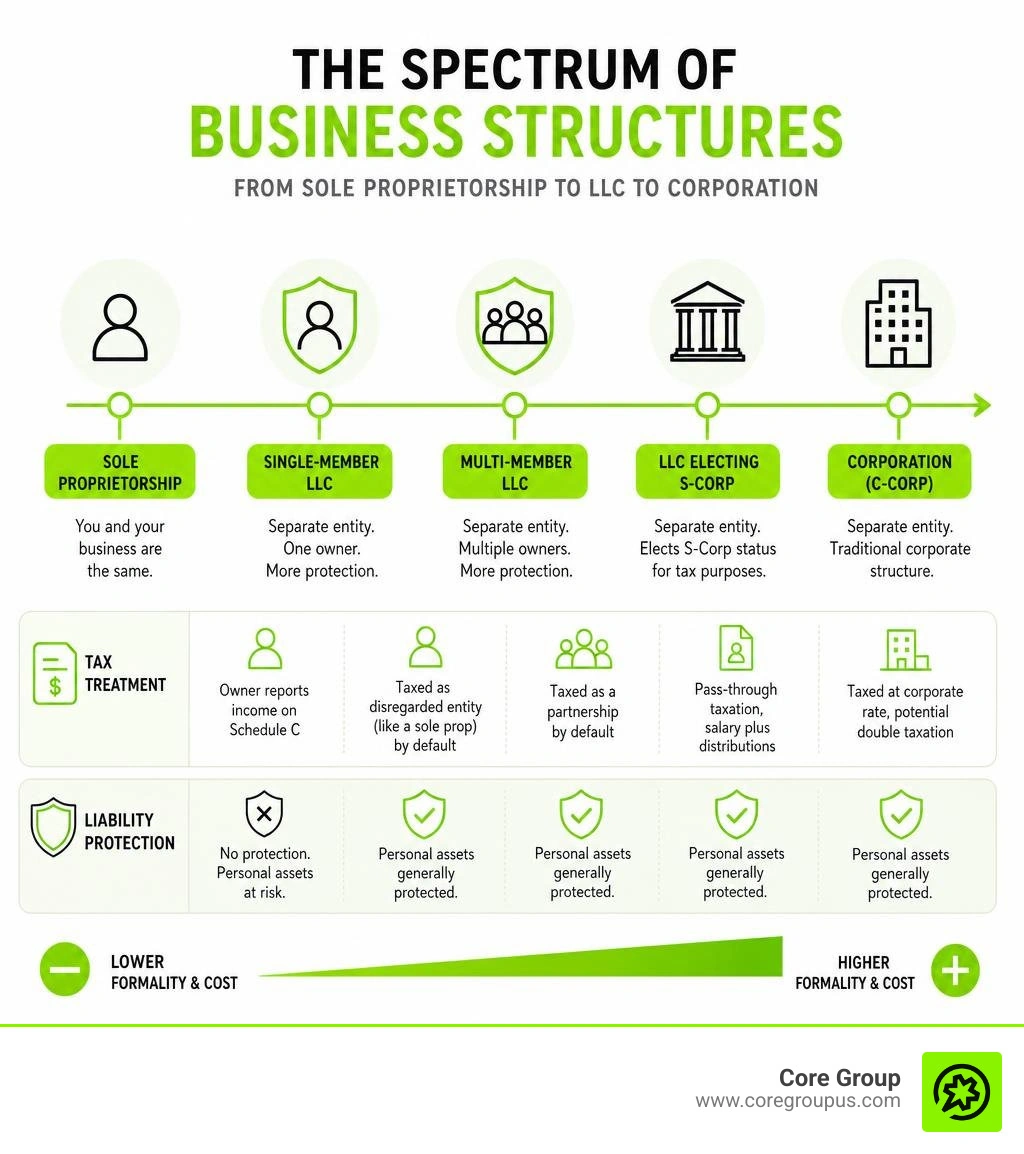
Here is a quick breakdown of how these structures compare.
| Structure | Legal Entity | Default Tax Treatment |
|---|---|---|
| Sole Proprietorship | No separate entity | Owner reports income on Schedule C |
| Single-Member LLC | Separate legal entity | Taxed as disregarded entity (like a sole prop) by default |
| Multi-Member LLC | Separate legal entity | Taxed as a partnership by default |
| Corporation (C-Corp) | Separate legal entity | Taxed at corporate rate, potential double taxation |
| LLC electing S-Corp | Separate legal entity | Pass-through taxation, salary plus distributions |
The key insight is that tax status and legal structure are two different things. An LLC can be taxed like a sole proprietorship while still giving you the legal protections of a corporation. That flexibility is exactly what makes it so popular with small business owners, freelancers, and creative entrepreneurs alike.
For someone running a film production company, a media consultancy, or a creative agency, understanding this distinction is not just a legal formality. It directly affects how much tax you pay, whether your personal savings are at risk, and how seriously clients and lenders take your business.
Related content about is an llc a sole proprietorship or corporation
Is an LLC a Sole Proprietorship or Corporation
To clear up the confusion, we must look at how the law defines these entities. According to Is an LLC a Corporation or Sole Proprietorship? | TRUiC , a Limited Liability Company is a hybrid structure. It is not a corporation, nor is it a sole proprietorship. Instead, it is a unique legal entity created by state statute that borrows the best features of both worlds.
When you form an LLC, you establish a clear legal distinction between the business and you as the owner. This legal separation means the business can own property, sign contracts, and be held responsible for its own debts. A sole proprietorship has no such legal separation, while a corporation has a much more rigid, formalized version of it. The beauty of the LLC lies in its business entity flexibility, allowing you to choose how you want to be treated in the eyes of the law and the tax collector.
Why People Ask Is an LLC a Sole Proprietorship or Corporation
The main reason for the confusion is pass-through taxation. When you run a single-member LLC, you do not file a separate corporate tax return by default. Instead, your business profits pass through to your personal tax return, and you pay taxes on them exactly like a sole proprietor does. Because the IRS treats a single-member LLC as a disregarded entity for income tax purposes, many owners assume the two structures are identical.
However, as we discuss in the honest comparison of LLCs and sole proprietorships in 2026 on FreeNetLaw, they are entirely different beasts under state law. A sole proprietorship requires no formal registration, meaning you and the business are legally one and the same. This affects everything from business naming to operational control. With an LLC, you must register with the state, appoint a registered agent, and maintain clear boundaries to keep your liability protection intact.
How the IRS Answers Is an LLC a Sole Proprietorship or Corporation
The Internal Revenue Service looks at an LLC as a chameleon. In the official guidance on the Limited liability company (LLC) | Internal Revenue Service page, the federal government explains that it does not have a specific tax classification for LLCs. Instead, the IRS fits them into existing tax boxes based on how many owners they have and what elections those owners make.
If you want to change how your LLC is taxed, you can file Form 8832, which is the Entity Classification Election. This form tells the IRS to treat your LLC as a corporation rather than its default classification. Understanding your Single Member LLC Taxes options is crucial because choosing the wrong federal tax status can lead to paying thousands of dollars in unnecessary self-employment taxes.
Legal and Liability Differences Between the Three Entities
Understanding the legal boundaries of each structure is the best way to safeguard your future.

As outlined by the US Chamber of Commerce comparison of sole proprietorships and LLCs, the level of personal liability and asset protection you receive varies dramatically across these three structures. Let we look at how each one handles legal separation.
Sole Proprietorships and Unlimited Personal Liability
A sole proprietorship is the default structure for anyone doing business alone. According to the Sole proprietorships | Internal Revenue Service guidelines, it is an unincorporated business owned by a single individual. Because there is no legal separation between the owner and the business, you face unlimited personal liability.
If a client sues your creative agency over a copyright dispute, or if your business runs up debts you cannot pay, your personal assets are completely at risk. This means your personal bank accounts, your car, and even your home could be seized to settle business liabilities. It is the easiest structure to start, but it leaves you entirely exposed to lawsuit risk.
Limited Liability Companies and the Asset Protection Shield
An LLC solves the liability problem by establishing a separate legal entity. This creates a legal shield between your personal wealth and your business activities. If your LLC is sued, only the assets owned by the LLC are on the table. Your personal savings, home, and investments remain safe.
However, this protection is not absolute. If you commingle your personal and business funds, fail to maintain a written operating agreement, or commit fraud, a court can pierce the corporate veil. This means the court disregards the LLC structure and holds you personally liable. Keeping a clean set of books and following basic rules is essential to keeping your shield strong.
Corporations and the Corporate Veil
A corporation is the most formal business structure. It is owned by shareholders, managed by a board of directors, and run by officers. This structure offers a very strong corporate veil, but it comes with strict legal formalities.
Corporations must draft corporate bylaws, hold regular shareholder meetings, take detailed minutes, and file extensive annual reports. While ownership transferability is incredibly easy through the sale of stock, the administrative burden and high setup costs make it less appealing for solo creative entrepreneurs who just want to focus on their craft.
Tax Implications and IRS Classifications
Taxes are where the differences between these structures show up in your bank account. To help you visual the tax landscape, we have broken down how different entities file and pay their taxes.
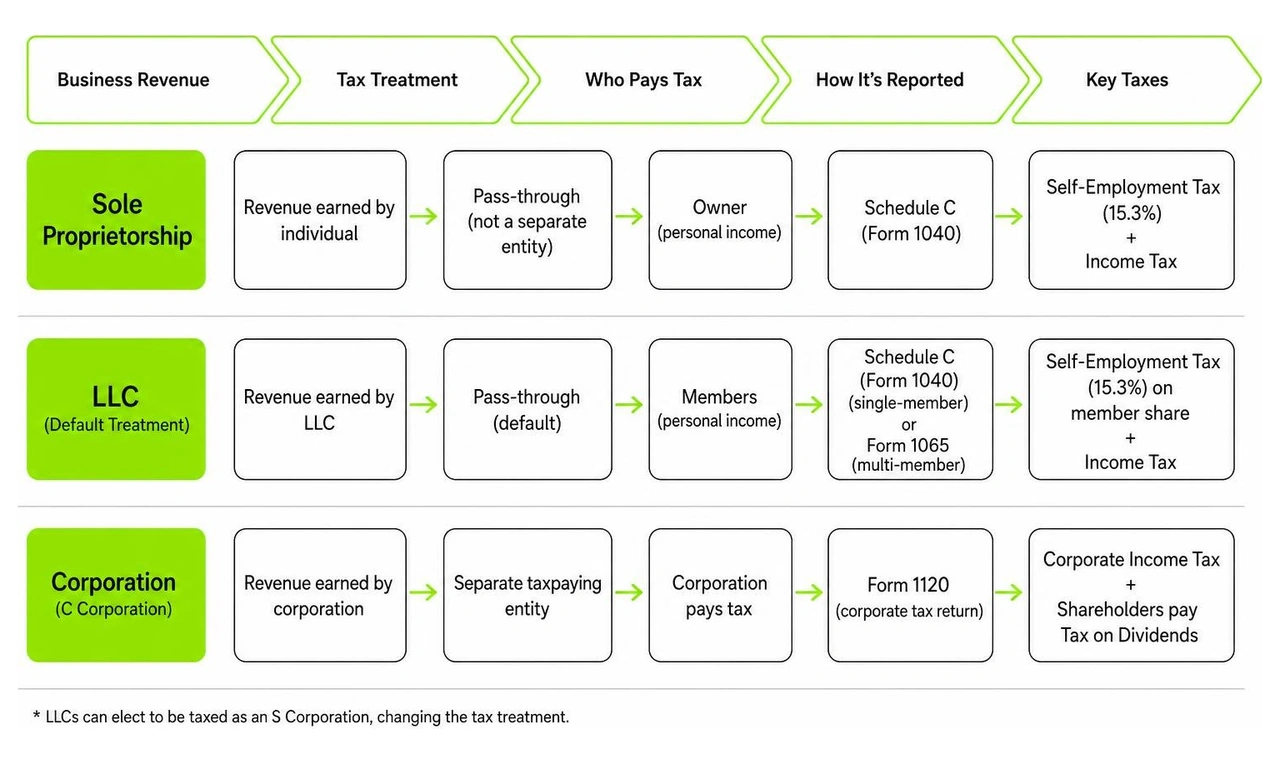
When you look at your tax bill, you must understand how self-employment tax, Schedule C filings, and pass-through taxation work. For a deeper dive into maximizing your business write-offs, check out our LLC Tax Deductions Guide 2026.
Default Tax Treatment for Single Member and Multi Member LLCs
By default, the IRS ignores the existence of a single-member LLC for tax purposes. Under the rules for Federal Income Tax LLC, you are treated as a disregarded entity. You report all business income and expenses on Schedule C of your personal Form 1040, paying the standard 15.3 percent self-employment tax on all net profits.
If your LLC has two or more members, the default tax treatment shifts to partnership taxation. The LLC must file Form 1065, which is an informational return, and issue a Schedule K-1 to each partner. Each partner then reports their share of the profits on their personal tax return.
Electing S Corporation or C Corporation Tax Status
One of the greatest advantages of an LLC is the ability to choose a different tax status. If your net profits start climbing, you can elect S-Corp tax status by filing Form 2553 with the IRS. To learn the exact steps, you can read our guide on How to Form an S-Corp and explore the S-Corp Business Structure details.
With an S-Corp election, you can split your income into a reasonable salary, which is subject to payroll taxes, and shareholder distributions, which are not. This strategy can save you thousands of dollars in self-employment taxes. You can also elect C-Corp tax status using Form 8832, which subjects the business to flat corporate tax rates. If you choose this path, you must plan carefully to Avoid Double Taxation, where corporate profits are taxed at both the business level and again on your personal return as dividends. You can read more about these rules on the LLC filing as a corporation or partnership | Internal Revenue Service page.
Let we look at a real-world tax comparison. If you run a creative agency earning $100,000 in net profit as a sole proprietor or default LLC, you will pay roughly $15,300 in self-employment tax. If you operate as an LLC with an S-Corp election, pay yourself a reasonable salary of $60,000, and take the remaining $40,000 as a distribution, you only pay self-employment taxes on the salary. This simple shift saves you over $6,120 per year.
Choosing the Right Structure for Your Business
Deciding on a structure requires looking at your long-term goals.

The official IRS guide on Choosing a Business Structure emphasizes that there is no single right answer. Your choice depends on your business growth plans, your personal risk tolerance, and whether you plan on raising capital from outside investors.
Comparing Formation Requirements and Ongoing Compliance Costs
When comparing these structures, you must account for both setup and maintenance costs. As detailed in the Delaware Inc guide on whether to form an LLC or sole proprietorship, a sole proprietorship costs virtually nothing to start.
An LLC requires filing Articles of Organization with your state and paying a filing fee, which typically ranges from $50 to $500. You also face ongoing compliance costs, such as hiring a registered agent and filing annual reports. Some states impose steep annual fees. California charges an $800 annual franchise tax on all LLCs, while New York requires publishing a notice in local newspapers, which can cost between $500 and $1,800.
For state-specific rules, you can review the Starting a Business – Entity Types - California Secretary of State portal, the Connecticut business structure guide on CT.gov, the Business Structure FAQs, Business Licensing, Division of ... page, and the [PDF] Business Income Filing Requirements guide for Alabama.
Key Factors for Creative Entrepreneurs to Consider
If you are running a low-risk side hustle making a few thousand dollars a year, a sole proprietorship might be enough to get started. But once your revenue crosses a meaningful threshold, or if you begin signing contracts with large corporate clients, forming an LLC becomes essential.
An LLC builds professional credibility, making it easier to secure business licensing, open commercial bank accounts, and sign deals with major brands. It also helps you manage the administrative complexity of your business, giving you a solid foundation as you scale your creative ventures.
Frequently Asked Questions About Business Structures
Can a sole proprietor have employees
Yes, a sole proprietor can absolutely hire employees. However, doing so increases your personal liability exposure significantly. If an employee makes a mistake that harms a client or causes an accident, you are personally responsible for the damages.
If you hire help, you must obtain an Employer Identification Number from the IRS, handle employment taxes, file Form 941 quarterly, and pay Federal Unemployment Tax using Form 940. Because of the high risks involved with managing staff, we highly recommend forming an LLC before bringing on your first team member.
What happens to a single member LLC when the owner dies
Unlike a sole proprietorship, which legally ends the moment the owner passes away, an LLC can enjoy business continuity.
By default, state laws may require an LLC to dissolve unless you have planned ahead. You can prevent dissolution by drafting a clear operating agreement that outlines succession plans. This estate planning step ensures your creative assets, intellectual property, and business accounts can be transferred smoothly to your heirs without disrupting operations.
Does a sole proprietorship require a separate business bank account
Legally, a sole proprietorship is not required to have a separate business bank account. However, mixing your personal and business funds is a recipe for financial chaos.
Opening a dedicated business checking account is the best way to maintain financial organization. It makes tracking your expenses simple, ensures you do not miss valuable tax deductions, and builds professional credibility when clients write checks to your business name rather than your personal name.
Conclusion
Choosing between a sole proprietorship, an LLC, and a corporation is one of the most important decisions you will make. It sets the stage for how you protect your assets, pay your taxes, and grow your creative business.
At Core Group, we understand that you did not get into business to spend your weekends wrestling with tax forms and bookkeeping spreadsheets. We provide financial management, bookkeeping, and tax services tailored specifically for creative entrepreneurs. Our no-fluff, profit-first playbook is designed to guarantee your peace of mind and save you time, giving you the freedom to focus entirely on your craft. We even back our services with a MacBook Pro guarantee, showing just how committed we are to your success.
To make sure you are meeting all of your federal compliance obligations, Learn more about single member LLC reporting requirements and let us help you build a profitable, stress-free business.