Everything You Need to Know About 1099-NEC
What You Need to Know About 1099-NEC at a Glance

1099-NEC explained: Form 1099-NEC (Nonemployee Compensation) is an IRS tax form that businesses use to report payments of $600 or more made to freelancers, independent contractors, and other self-employed workers during the tax year.
Here is a quick summary of the key facts:
- Who files it: Any business or individual that pays a non-employee $600+ for services in a tax year
- Who receives it: Freelancers, independent contractors, gig workers, and other self-employed individuals
- Deadline: January 31 — for both sending copies to recipients and filing with the IRS
- Current threshold: $600 (rising to $2,000 starting in tax year 2026)
- Where to report it (recipients): Schedule C of your Form 1040, plus Schedule SE for self-employment tax
If you're a creative professional — a filmmaker, designer, consultant, or media producer — you'll likely deal with this form either as the one sending it or the one receiving it. Either way, getting it wrong can mean IRS penalties or a surprise tax bill.
This guide breaks down everything simply, so you can stay compliant and get back to the work you actually love.
What is IRS Form 1099-NEC and why does it exist
If you feel like the 1099-NEC just "appeared" out of nowhere a few years ago, you aren't imagining things. While the form technically existed decades ago, the IRS brought Form 1099-NEC, Nonemployee Compensation back into the spotlight starting in the 2020 tax year.
Before this change, businesses reported payments to independent contractors and the self-employed in Box 7 of Form 1099-MISC. However, having different types of income on one form with different deadlines created a massive headache for the IRS. To solve this, they separated "Nonemployee Compensation" into its own dedicated form: the 1099-NEC.
This form is the cornerstone of tax reporting for the modern gig work economy. It ensures that the IRS knows exactly how much money a business paid to a non-employee, and it helps the recipient track their earnings for tax season. Whether you are a videographer or a marketing consultant, understanding how this works is a vital part of how to plan for taxes as a freelancer.
Understanding Form 1099-NEC for Business Owners
As a business owner, you are essentially a "tax collector" and "reporter" in the eyes of the IRS. If you hire help that isn't on your official payroll (meaning you don't send them a W-2), you likely have a 1099-NEC filing requirement.

Currently, for the 2025 tax year, the $600 threshold remains the golden rule. If you pay a service provider $600 or more over the course of the year, you must file. However, big changes are on the horizon. Beginning in tax year 2026, the threshold for Form 1099-NEC will increase to $2,000. After that, the limit will be indexed for inflation each year in $100 increments.
This is a welcome relief for many small businesses, but for now, we have to stick to the $600 limit. Keeping your books clean throughout the year makes this process much easier, which is why we recommend checking out our LLC tax deductions guide to ensure you're tracking every dollar correctly.
Who Needs to File Form 1099-NEC for Their Business
You must file Form 1099-NEC if you made payments for services in the course of your trade or business. This is an important distinction: if you hire a contractor to paint your home office (business expense), you file a 1099. If you hire someone to paint your living room (personal expense), you do not.
Common scenarios where you need to file include:
- Professional Fees: Payments to attorneys (even if they are incorporated), accountants, or architects.
- Creative Services: Hiring freelancers for web design, copywriting, or video editing.
- Influencer Marketing: If you are a brand paying for taxes for influencers, these payments often fall under nonemployee compensation.
- Commission & Fees: Fee-splitting or referral fees paid to other professionals.
We often get asked about single member LLC 1099 reporting. If you are a solopreneur running your business through an LLC, you are still considered a "business" and must issue 1099s to any contractors you hire who meet the threshold.
Key differences between Form 1099-NEC and Form 1099-MISC
One of the biggest points of confusion in 1099-NEC explained is the difference between the NEC and the MISC. While they look similar, they serve very different purposes. Think of it this way: 1099-NEC is for work performed, while 1099-MISC is for everything else.
| Feature | Form 1099-NEC | Form 1099-MISC |
|---|---|---|
| Primary Purpose | Nonemployee Compensation (Services) | Miscellaneous Income (Non-Services) |
| Common Examples | Freelancers, contractors, attorneys | Rent, royalties, prizes, awards |
| IRS Deadline | January 31 | Feb 28 (Paper) or March 31 (E-file) |
| Threshold | $600 ($2,000 starting 2026) | Varies ($10 for royalties, $600 for rent) |
It is also vital to understand Each form and its relationship to Form 1099-K. If you pay a contractor via credit card, debit card, or a third-party processor like PayPal or Venmo (Business), you generally do not file a 1099-NEC. Those payments are tracked and reported by the payment processor on Form 1099-K. This "no double reporting" rule saves you a bit of paperwork, provided you keep good records of how you paid your vendors.
How to file Form 1099-NEC and meet important deadlines
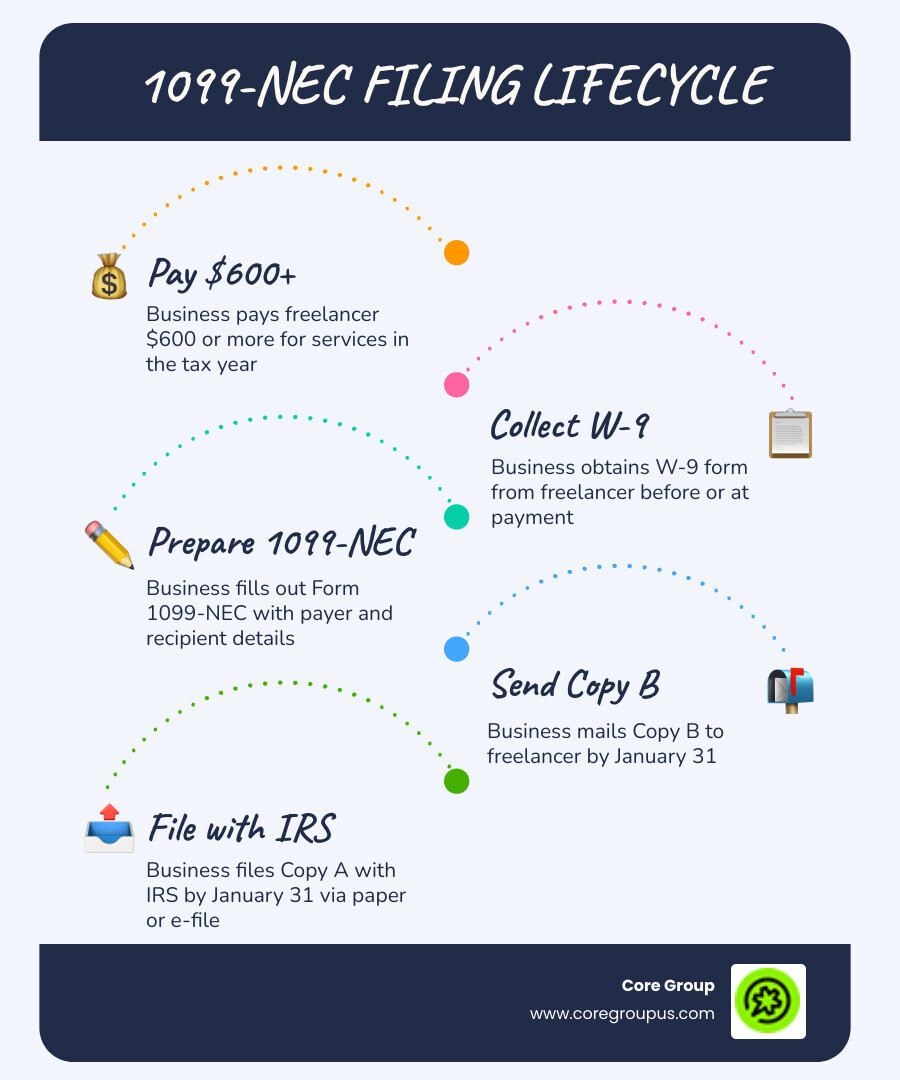
The most important date on your calendar for 1099s is January 31. This is the deadline to both furnish the form to the recipient and file it with the IRS. There is no automatic 30-day extension for the 1099-NEC, so waiting until the last minute is a recipe for stress.
The IRS has also made a major push toward digital filing. Effective January 1, 2024, the e-file threshold was lowered to just 10 returns. This means if you are filing 10 or more information returns in total (including W-2s, 1099-NECs, and 1099-MISCs combined), you must file electronically. We highly recommend using the IRS IRIS portal for a smooth experience.
Failing to meet these deadlines or filing incorrect information can lead to IRS penalties. These penalties range from $60 to $340 per form, depending on how late you are. For a creative business with a dozen contractors, those fines can add up faster than a high-speed camera. Staying organized with a complete guide to bookkeeping for creatives is the best way to ensure you have the data ready before the January rush.
Step-by-Step Guide to Filing 1099-NEC for Payers
Filing doesn't have to be a nightmare if you follow a system. Here is our "no-fluff" approach to getting it done:
- Collect W-9s Early: Never pay a contractor until they have provided a completed Form W-9. This form gives you their correct name, address, and Taxpayer Identification Number (TIN).
- Verify Information: Use the IRS TIN Matching tool to ensure the name and number match IRS records. This prevents "B-Notices" and penalties later.
- Calculate the Total: Total up all payments made to the individual for the calendar year. Remember to include any sales tax they charged you for their service, but exclude payments made by credit card.
- Fill Out the Boxes:
- Box 1: Enter the total nonemployee compensation.
- Box 2: Check this only if you made direct sales of $5,000 or more of consumer products for resale.
- Box 4: Enter any federal income tax withheld (this only happens if "backup withholding" applies).
- Submit: File Copy A with the IRS and send Copy B to your contractor.
What to do if you receive a 1099-NEC for your services
If you are the one receiving the form, it’s a reminder that you’re a business owner, even if you’re a "business of one." The amount in Box 1 is considered self-employment income.
You will report this income on Schedule C of your Form 1040. This is also where you’ll list your business expenses to arrive at your net profit. If your net earnings are $400 or more, you’ll also need to file Schedule SE to calculate your self-employment tax (which covers your contributions to the Social Security Administration).
Because no taxes were withheld from your pay throughout the year, the IRS expects you to pay as you go. This means making quarterly estimated tax payments. If you wait until April to pay everything at once, you might get hit with underpayment penalties. Proper tax planning and bookkeeping for solopreneurs will help you set aside the right amount from every check so you aren't caught off guard.
Frequently Asked Questions about 1099-NEC
What if a business accidentally files a 1099-MISC instead of a 1099-NEC
If you realize you used the wrong form, don't panic, but do act quickly. You should file a "Corrected" version of the 1099-MISC (showing $0 in the box you originally filled) and then file a new, accurate 1099-NEC. Marking the "Corrected" box at the top of the form is essential to let the IRS know you are fixing an error, not reporting new income.
Are there any exceptions to filing Form 1099-NEC for corporations
Generally, you do not need to issue a 1099-NEC to a corporation (C-Corp or S-Corp). However, there are a few "gotcha" exceptions. You must issue a 1099-NEC to corporations for:
- Medical and healthcare payments.
- Attorneys' fees (even if the law firm is a corporation).
- Cash payments for fish (yes, really).
- Federal executive agency payments for services.
What if a recipient does not receive their form by the deadline
If you’re a contractor and January 31 passes without a form in your inbox, reach out to the payer first. They may have an old address or a digital portal you haven't checked. If you still can't get the form, you are still legally required to report the income. Use your own records (invoices and bank statements) to report the correct amount on your tax return. The IRS cares more that you reported the income than whether you had the physical piece of paper.
Conclusion
Navigating 1099-NEC explained is just one part of running a successful creative business. While the rules can feel like a maze of boxes and deadlines, they are ultimately there to keep the "tax engine" running smoothly.
At Core Group, we believe that you shouldn't have to spend your weekends deciphering IRS instructions. Our "no-fluff, profit-first playbook" is designed specifically for creative entrepreneurs who want to grow their business without the financial headache. We provide the financial management and tax expertise you need to ensure total peace of mind—all backed by our unique MacBook Pro guarantee.
If you're ready to stop worrying about forms and start focusing on your next big project, we’re here to help. Contact us for more info about accounting services and let’s get your finances on the right track.