The Ultimate Guide to Ohio LLC Operating Agreements and Templates
What Every Ohio Business Owner Should Know About LLC Operating Agreements
An Ohio LLC operating agreement is a legal document that defines how your limited liability company is owned, managed, and operated. Ohio law does not require you to have one, but skipping it is one of the most costly mistakes a business owner can make.
Here is what you need to know right away.
- Required by law? No. Ohio does not legally require LLCs to have an operating agreement.
- Recommended? Absolutely yes, for every LLC, including single-member ones.
- Filed with the state? No. It is an internal document you keep with your business records.
- What it covers Ownership percentages, voting rights, profit distribution, management structure, and dissolution rules.
- What happens without one? Ohio's default state rules take over, which may not reflect what you actually want for your business.
Think of it this way. Without an operating agreement, you are handing control of your business decisions to a government rulebook written for the average company, not yours.
This is not just a theoretical risk. In Germano v. Beaujean (Ohio, 2013), the absence of a proper operating agreement led to serious member disputes that ended up in costly litigation, with the outcome decided by Ohio's default statutes rather than the members' own intentions.
Whether you are a solo filmmaker, a two-person media company, or a growing creative studio, having a clear operating agreement protects your assets, your relationships, and your ability to focus on the work you actually love.
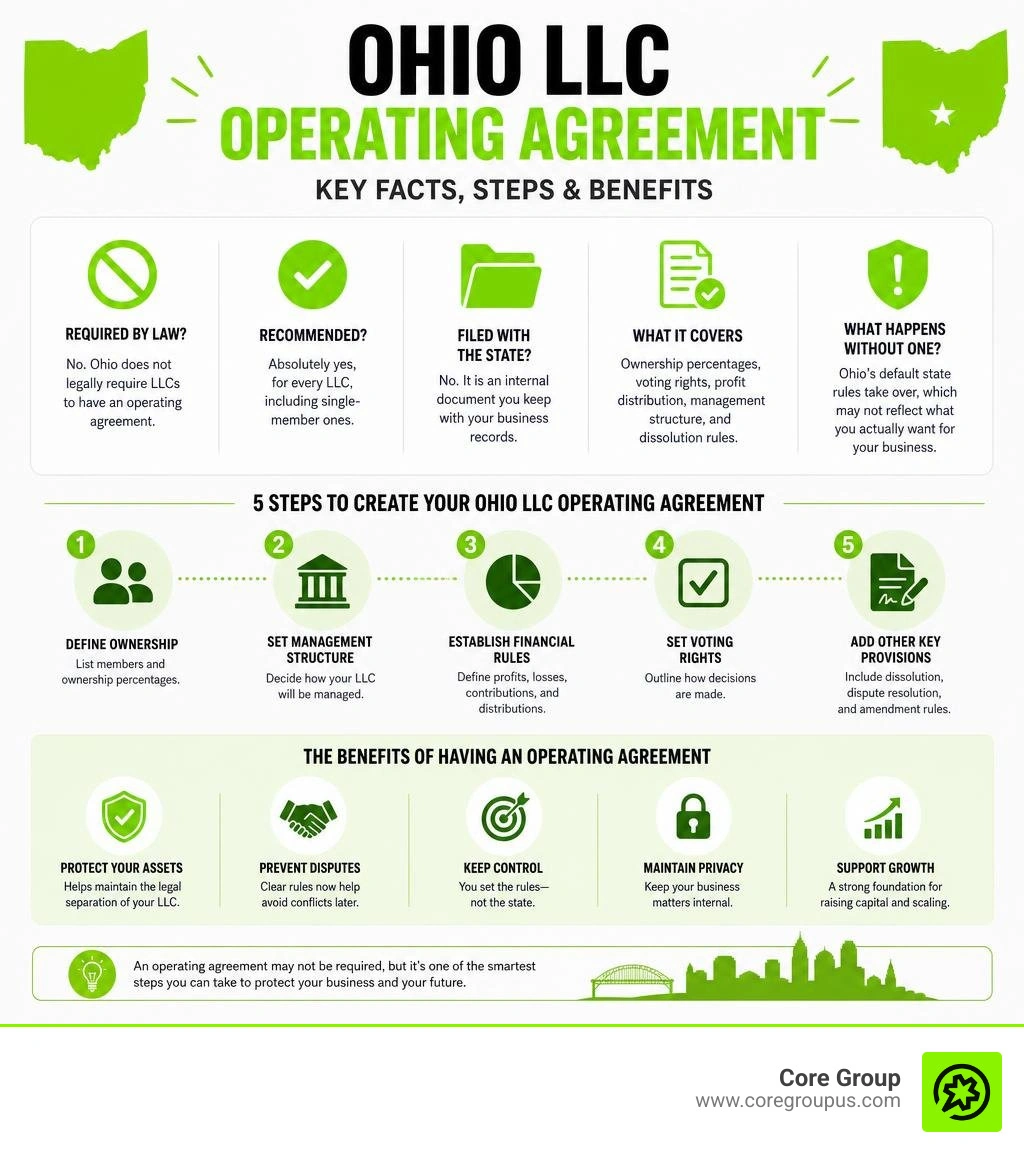
Ohio LLC operating agreement terms to learn
Understanding the Ohio LLC Operating Agreement and State Requirements
When you take the leap to start a business in the Buckeye State, the legal jargon can feel overwhelming. You file your Articles of Organization with the Secretary of State, pay your ninety-nine dollar filing fee, and suddenly you are officially a business entity. However, the paperwork does not stop there.
To govern your internal operations, you need an internal document. This is where the operating agreement comes into play.
In Ohio, the primary laws governing these agreements have evolved. Under Section 1706.08 of the Ohio Revised Code, the state outlines what an operating agreement can and cannot do. This statute provides incredible flexibility, allowing business owners to draft rules that fit their unique situations.
Even though this statute exists, Ohio does not require you to submit your operating agreement to the Secretary of State. It is not a public document. It remains safely tucked away in your internal business files, protecting your privacy and the confidentiality of your financial arrangements.
If you choose not to draft an agreement, the state of Ohio has a backup plan for you. The state uses its own default rules to govern your LLC. These default rules are rigid and might not align with how you want to run your business. For instance, state defaults might require equal split of profits even if one partner contributed ninety percent of the startup cash. By drafting a custom agreement, you override these default rules and design a system that actually makes sense for your team.
Key Benefits of Having an Operating Agreement in Ohio
Starting a business is an adventure, and like any good adventure, you want to be prepared for the unexpected. While it is easy to focus on branding and launching your services, establishing a strong legal foundation is what keeps your business alive in the long run.
An operating agreement provides structure, credibility, and ultimate protection. It shows banks, courts, and future investors that you are running a legitimate operation, not just a casual side project.

Protecting Limited Liability Status
The main reason business owners choose the LLC structure is to protect their personal assets. You want to make sure your personal savings, your home, and your car are completely separate from your business liabilities. This separation is known as the corporate veil.
If your LLC is ever sued, a court will look closely at how you operate. If you do not have an operating agreement, a cynical lawyer might argue that your LLC is just an alter ego for your personal finances. They might try to pierce the corporate veil to access your personal assets.
By having a signed, formal operating agreement, you demonstrate that your LLC is a distinct legal entity with its own set of rules and financial boundaries. To learn more about how these structures work across different states, you can check out our ultimate operating agreement template guide.
Preventing Member Disputes and Overriding Default Rules
If you are running a business with partners, disagreements are bound to happen. You might disagree on how to spend profits, when to hire help, or what to do if a partner wants to leave the business.
Without a written agreement, these disagreements can turn into expensive, relationship-ending lawsuits. In the case of Germano v. Beaujean, the business owners learned this lesson the hard way. Because they lacked a clear, written agreement, their internal disputes had to be resolved by a judge using Ohio's generic default laws.
You can avoid this headache entirely by using a high-quality Ohio LLC operating agreement template to establish clear rules from day one. You can outline exactly how decisions are made, how disputes are resolved, and how a member can exit the company without bringing the whole business down.
Why Single Member LLCs Need an Ohio LLC Operating Agreement
If you are a solo entrepreneur, you might think you do not need an operating agreement. After all, you are not going to sue yourself.
However, single-member LLCs actually need this document just as much as multi-member companies. First, banks almost always ask to see your operating agreement before they will let you open a business bank account. Second, having this document is crucial for maintaining your limited liability protection. If a court sees that you are a single member with no operating agreement and sloppy bookkeeping, they may decide your LLC is not a real separate entity.
To establish your single-member entity properly, you can utilize templates like the Practical Law Single Member Operating Agreement. If you want to see how other states handle these solo structures, take a look at our California LLC operating agreement guide.
Multi Member and Family LLC Structures
For family-owned businesses or multi-member partnerships, the stakes are even higher. You have to consider long-term scenarios like retirement, disability, or the death of a member.
Ohio law allows family LLCs to establish a successor in interest. This means you can use transfer-on-death registrations to pass ownership smoothly to the next generation without going through probate court. Your operating agreement is the perfect place to outline these succession plans and protect your family's hard work.
Here is a quick look at how the requirements and benefits compare for different LLC structures.
| Feature or Requirement | Single-Member LLC | Multi-Member LLC | Family LLC |
|---|---|---|---|
| Legal requirement in Ohio | No | No | No |
| Proves ownership to banks | Yes | Yes | Yes |
| Protects the corporate veil | Critical | Highly important | Highly important |
| Defines voting percentages | Simple | Crucial for partners | Crucial for family |
| Succession planning | Recommended | Essential | Critical for inheritance |
Essential Provisions to Include in Your Ohio LLC Agreement
Now that you understand why you need this document, let us look at what actually goes inside it. A good operating agreement should be comprehensive, covering daily operations, financial strategies, and worst-case scenarios.
Ownership Structure and Capital Contributions
Your agreement should clearly list who owns the company and how much they own. This is usually based on capital contributions, which is the money, property, or services each member contributes to get the business started.
You should document the initial capital contributions of each member and their resulting percentage of ownership. This section should also explain how the business will handle future capital calls if the company needs more money down the road. Keeping these records accurate is essential for complying with federal income tax LLC rules.
Management and Voting Rights in an Ohio LLC Operating Agreement
How will your business make decisions? You have two main choices here.
- Member-managed The owners run the day-to-day operations of the company.
- Manager-managed The owners hire a manager, or designate a specific member, to run the daily operations while the other owners take a hands-off role.
You can even establish a board of directors to manage the company, similar to a corporation. Your agreement should detail the voting power of each member, whether decisions require a simple majority, and which major decisions require unanimous consent.

Tax Classification and Financial Allocations
An LLC offers incredible tax flexibility. By default, a single-member LLC is taxed as a sole proprietorship, and a multi-member LLC is taxed as a partnership. However, you can also elect to be taxed as an S corp or a C corp if it saves you money on self-employment taxes.
Your operating agreement should state your chosen tax classification and outline how profits and losses are allocated to members. If you want to dive deeper into how this impacts your personal tax return, check out our guide on single member LLC taxes.
Dissolution and Transfer Restrictions
What happens if a partner wants to sell their share of the business? What if you all decide to close the business down?
Without clear rules, these transitions can be incredibly messy. Your agreement should include transfer restrictions, such as a right of first refusal, which requires a departing member to offer their share to existing members before selling to an outsider. It should also outline the step-by-step winding up process for dissolving the company and distributing any remaining assets.
Frequently Asked Questions About Ohio LLCs
Navigating business laws can raise a lot of questions. Here are the answers to the most common questions we hear from Ohio business owners.
Do I need to file my operating agreement with the Ohio Secretary of State
No. Your operating agreement is a private, internal document. You do not file it with the Ohio Secretary of State, and there are no state filing fees associated with it. You should sign it, have all members sign it, and keep it stored safely with your other important business records.
What happens if an Ohio LLC does not have an operating agreement
If you do not have an operating agreement, your business is governed entirely by Ohio's default LLC statutes. This leaves you vulnerable to unexpected legal outcomes, potential personal liability, and internal member disputes that must be resolved by a court rather than your own team.
Can an operating agreement be amended after formation
Yes. Your business will grow and change, and your operating agreement should change with it. Your original agreement should outline the amendment process, which typically requires the written consent of all members or a specific majority vote. When you make changes, simply draft an amendment, have everyone sign it, and attach it to the original document.
Conclusion
Building a successful business in Ohio is an exciting journey. Whether you are launching a creative agency, a consulting firm, or a local shop, taking the time to set up your legal foundations correctly gives you the freedom to create with confidence.
At Core Group, we specialize in financial management, bookkeeping, and tax services specifically tailored for creative entrepreneurs. We understand that you want to spend your time designing, writing, and building, not drowning in spreadsheets and legal documents.
That is why we offer our no-fluff, profit-first playbook. We handle the numbers, guarantee your peace of mind, and save you valuable time, all backed by our famous MacBook Pro guarantee.
Let us help you build a profitable, protected business that lasts. Explore our library of Core Group resources to get started on your path to financial clarity today.