Don't Go Breaking My Art-icles: The California LLC Operating Agreement Guide
Why Every Creative Business Owner Needs a California LLC Operating Agreement
A California LLC operating agreement is one of the most important documents you can have as a business owner in the state. It is a written contract between LLC members that spells out how the business is owned, managed, and run.
Here is a quick summary of what you need to know
- What it is - A legal document that defines ownership, management rules, and financial arrangements for your LLC
- Is it required - California law requires LLCs to adopt an operating agreement, but it is not filed with the Secretary of State; you keep it in your own records
- Written or oral - It can technically be oral, but a written agreement is strongly recommended
- Who manages it - Either the members themselves (member-managed) or appointed managers (manager-managed)
- Why it matters - It protects your personal assets, prevents disputes, and keeps your LLC from falling under California's default rules
California is home to over 500,000 active LLCs. Many of them are run by creative entrepreneurs who are brilliant at their craft but less confident when it comes to legal paperwork. If you have formed an LLC to protect your creative work, a solid operating agreement is what actually makes that protection real.
Without one, California's default laws under the Revised Uniform Limited Liability Company Act (RULLCA) step in and make decisions for you. Those default rules may not match what you and your partners actually want.
This guide breaks down everything you need to know, in plain language, so you can get your agreement right from the start.
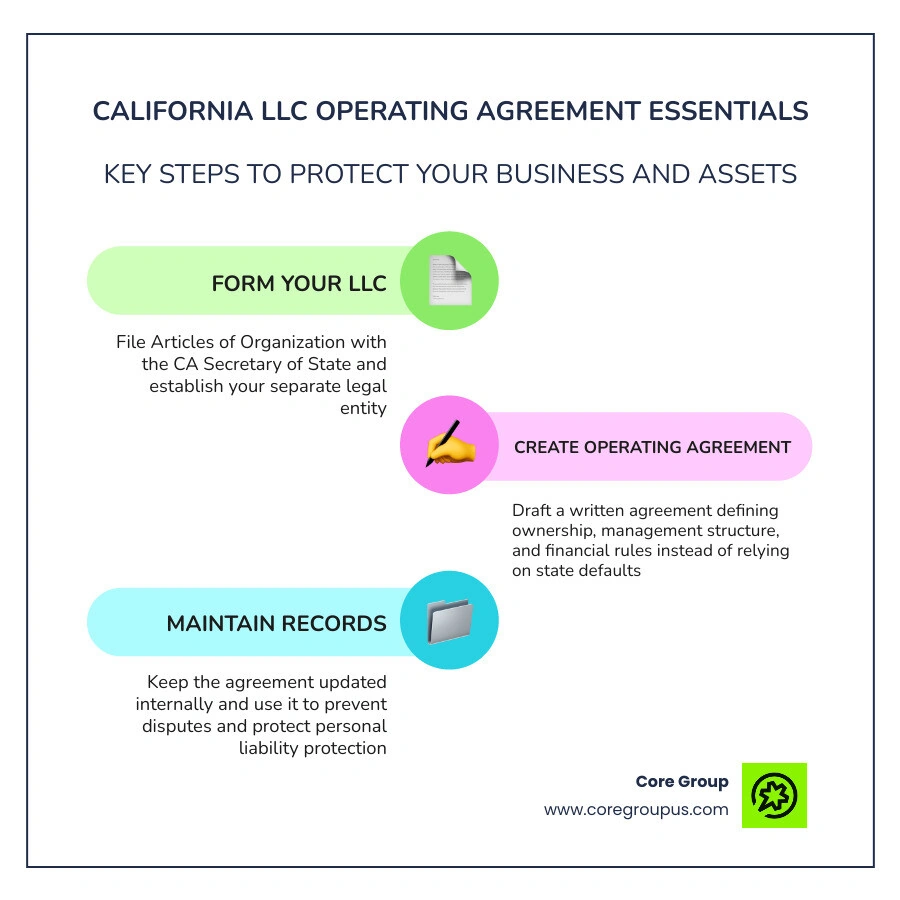
Easy California LLC operating agreement word list
Understanding the California LLC Operating Agreement and Why It Matters
When we start a new creative venture, we often focus on the fun parts like branding, designing, and launching our services. However, establishing a strong legal foundation is what keeps our business safe over the long haul. A California LLC operating agreement serves as the internal blueprint for your limited liability company. It establishes the ground rules for your business operations, financial choices, and member relations.

Many business owners believe that filing Articles of Organization with the California Secretary of State is the only step required to form an LLC. While those articles officially register your company with the state, they do not outline how your business will run day to day. That is where the operating agreement comes in.
If you do not create a customized agreement, your LLC will automatically be governed by the default rules of the California Revised Uniform Limited Liability Company Act, also known as RULLCA. These default state laws are designed as a one size fits all solution. They might dictate that profits must be split equally among members, even if one partner contributed ninety percent of the startup cash. By drafting your own agreement, you can override most of these default rules and customize your business structure to fit your exact needs.
To understand how this document fits into your broader business planning, you can explore our Ultimate Operating Agreement Template Guide.
It is important to know that you do not file this document with the California Secretary of State. Instead, it is kept as an internal record at your principal place of business. This keeps your business arrangements private and out of the public eye. Under California Code CORP 17704.07, the state outlines how members and managers hold authority, but having your own written agreement gives you the final say on how these statutory powers are applied to your creative agency or studio.
Is a California LLC operating agreement legally required
Yes, California is one of the few states where having an operating agreement is a statutory requirement. Under the California Corporations Code, every LLC formed in the state must adopt an operating agreement.
The law allows this agreement to be oral, written, or even implied. However, relying on an oral agreement is a massive risk for any business. If a dispute arises between partners, proving the terms of an oral agreement in a California court is incredibly difficult. A written agreement is the only way to ensure everyone is on the same page.
For single member LLCs, a written agreement is just as vital. It shows banks, investors, and courts that you operate as a legitimate corporate entity rather than a personal hobby. If you need a starting point to draft your document, you can access a LLC Operating Agreement California Free PDF and Word Template to help structure your initial draft.
How a California LLC operating agreement protects your limited liability status
The primary reason creative entrepreneurs form an LLC is to protect their personal assets. You want to make sure that if your business is sued or faces financial trouble, your personal savings, home, and car are safe. This protection is known as the corporate shield.
However, this shield is not automatic. If a creditor or plaintiff sues your business, they may attempt to pierce the corporate veil. This is a legal term for when a court decides that the business and the owner are actually the same entity, making the owner personally liable for business debts.
To prevent this, you must prove that your LLC is a separate legal entity. A written operating agreement is one of the strongest pieces of evidence you can provide. It shows that you follow formal business procedures, maintain separate financial records, and respect the boundaries of the company.
For solo creators, this separation is especially critical. You must treat your business as a separate person. This includes filing your taxes correctly and understanding how your business structure impacts your personal liabilities. You can read more about managing these responsibilities in our guide on Single Member LLC Taxes.
Key Provisions to Include in Your Agreement
When drafting your California LLC operating agreement, you need to make sure it covers all the essential aspects of your business. A good agreement acts like a prenuptial agreement for your business partners, setting expectations before any major issues arise.

Every comprehensive agreement should include the following core sections.
First, you must outline the capital contributions. This section details how much cash, property, or services each member contributes to get the business started. It also explains whether members are required to contribute more money in the future if the business needs it.
Second, you need to establish ownership percentages. This is usually based on the initial capital contributions, but it does not have to be. You can agree to give a partner a larger share of ownership because of their industry expertise or creative talent, even if they contributed less cash.
Third, you must define profit and loss allocations. Your agreement should state how profits and losses will be distributed among the members. These allocations do not have to match ownership percentages, but they must comply with federal tax regulations. For a deeper understanding of how these allocations affect your tax obligations, check out our resource on Federal Income Tax LLC.
Fourth, you must clearly define voting rights. You need to decide if voting power is based on ownership percentages or if each member gets one equal vote. Your agreement should also specify what percentage of votes is required to make major decisions, such as selling the company, taking on debt, or bringing on new members.
Fifth, you should include transfer restrictions. These rules govern what happens if a member wants to sell their share of the company. Usually, agreements include a right of first refusal, which allows existing members to buy out the departing partner before they can sell to an outsider. If you are looking for a concise way to structure these rules for a multi member setup, you can review the Operating Agreement Multi-Member Member-Managed Short Form CA for practical guidance.
Member Managed versus Manager Managed Structures
One of the most important decisions you will make when forming your California LLC is choosing your management structure. California allows LLCs to be either member-managed or manager-managed.
In a member-managed LLC, the owners themselves handle the day to day operations of the business. Every member has the authority to make decisions, sign contracts, and bind the company to legal agreements. This structure is incredibly popular, especially for small creative teams. In fact, over ninety percent of California LLCs are member-managed. It is a great fit for businesses where all partners want to be active participants in the daily work.
In a manager-managed LLC, the members elect one or more managers to run the daily operations. These managers can be members, or they can be hired outsiders. Under this setup, regular members do not have the authority to make daily business decisions or sign contracts on behalf of the company. Instead, they act more like passive investors who retain voting control over major decisions, such as selling the business or dissolving the company.
This structure is ideal if you have passive investors who are contributing capital but do not want to be involved in the creative process, or if you want to centralize decision making in a larger team. Your operating agreement must clearly state which structure you choose and outline the specific voting thresholds required to hire, fire, or override a manager.
Tax Implications and Financial Management for California LLCs
Operating a business in California comes with unique financial responsibilities. As of May 2026, California remains one of the most expensive states to run an LLC due to its mandatory fees and taxes. Regardless of how much revenue your business generates, every California LLC must pay an annual franchise tax of $800. This tax is due by the fifteenth day of the fourth month after you file your Articles of Organization, and then by April fifteenth of every subsequent year.
Managing your cash flow to cover this tax and other operating expenses is crucial. To help you understand the financial differences between various setups, here is a comparison of how single member and multi member LLCs are treated for tax purposes.
| LLC Type | Default Tax Classification | Tax Filing Requirement | California Specific Fees |
|---|---|---|---|
| Single Member LLC | Disregarded Entity | Schedule C on Personal Tax Return | $800 Annual Franchise Tax plus Fee if Gross Revenue is over $250,000 |
| Multi Member LLC | Partnership | Form 1065 Partnership Return | $800 Annual Franchise Tax plus Fee if Gross Revenue is over $250,000 |
To maximize your profitability and offset some of these high California costs, you should take advantage of every legal deduction available to your creative business. We have put together a comprehensive LLC Tax Deductions Guide 2026 to help you keep more of your hard earned money.
In addition to the annual franchise tax, California LLCs must file a Statement of Information biennially with the Secretary of State. This filing keeps your business address and management records up to date. Failing to file this statement on time results in an immediate penalty of $250, which can quickly drain your business accounts if you are not paying attention.
For single member creative businesses, managing independent contractors and handling tax documents is another critical piece of the puzzle. If you hire freelancers to help with your creative projects, you must understand your reporting requirements. You can learn more about this by reading our guide on Single Member LLC 1099 Reporting.
Frequently Asked Questions about California LLCs
Can you amend a California LLC operating agreement after signing
Yes, you can absolutely amend your operating agreement. In fact, as your creative business grows, your agreement should evolve with it. You may need to update the document when you bring on new members, change your management structure, or adjust how profits are split.
To make an amendment, you must follow the process outlined in your original agreement. Typically, this requires the written consent of all members, or a specific supermajority vote. Once the amendment is agreed upon, it must be drafted in writing, signed by the members, and kept with your original corporate records. If you want to see how a standard member-managed amendment process is structured, you can refer to the template resources provided by the California LLC Operating Agreement Member-Managed ILRG.
What are the most common mistakes to avoid when drafting
One of the biggest mistakes we see creative entrepreneurs make is using generic, out of state templates. An operating agreement drafted for a business in another state might not comply with California's unique laws, such as RULLCA regulations or specific community property rules.
Another common mistake is failing to update member records. If a partner leaves or a new creator joins your team, you must update your operating agreement immediately. If you do not, you risk serious legal disputes over ownership percentages and profit distributions down the road. Finally, many owners forget to align their operating agreement with their tax elections, which can lead to costly errors when filing with the IRS and the California Franchise Tax Board.
What happens if an LLC does not have an operating agreement
If your LLC does not have an operating agreement, you are putting your business at the mercy of California's default state laws. Under RULLCA, the state will make critical decisions for you. For example, the state may require all profits and losses to be split equally among members, regardless of who did the actual work or who contributed the startup capital.
Additionally, without a clear, written agreement, any internal disagreement between partners can easily escalate into a costly lawsuit. A court will have to step in and interpret your business relationships, which can lead to outcomes that none of the partners wanted. Having a written agreement is the only way to retain control over your business destiny.
Conclusion
Building a successful creative business in California is an exciting journey, but it requires careful attention to legal and financial details. A robust California LLC operating agreement is the foundation that protects your personal assets, prevents partner disputes, and keeps your business running smoothly under state law.
At Core Group, we understand that you would rather spend your time creating beautiful work than dealing with complex legal forms and tax filings. That is why we offer professional financial management, bookkeeping, and tax services tailored specifically for creative entrepreneurs.
Our unique, no-fluff, profit-first playbook is designed to give you complete peace of mind and save you valuable time. We are so confident in our ability to streamline your business finances that we back our services with our signature MacBook Pro guarantee. Let us handle the numbers so you can focus on your art.
If you are ready to take control of your business finances and protect your creative legacy, visit our Core Group Resources to get started today.