A Comprehensive Guide to Tax Audit Protection for Artists
Protect Your Overtime Deduction Before an Audit
Artists can protect an overtime deduction by keeping pay stubs, detailed time records, project contracts, union call sheets, and employer overtime statements together. The federal deduction under the One Big Beautiful Bill Act applies only to the qualifying premium portion of overtime required by the Fair Labor Standards Act, not all extra pay for late nights, weekends, or rush projects.
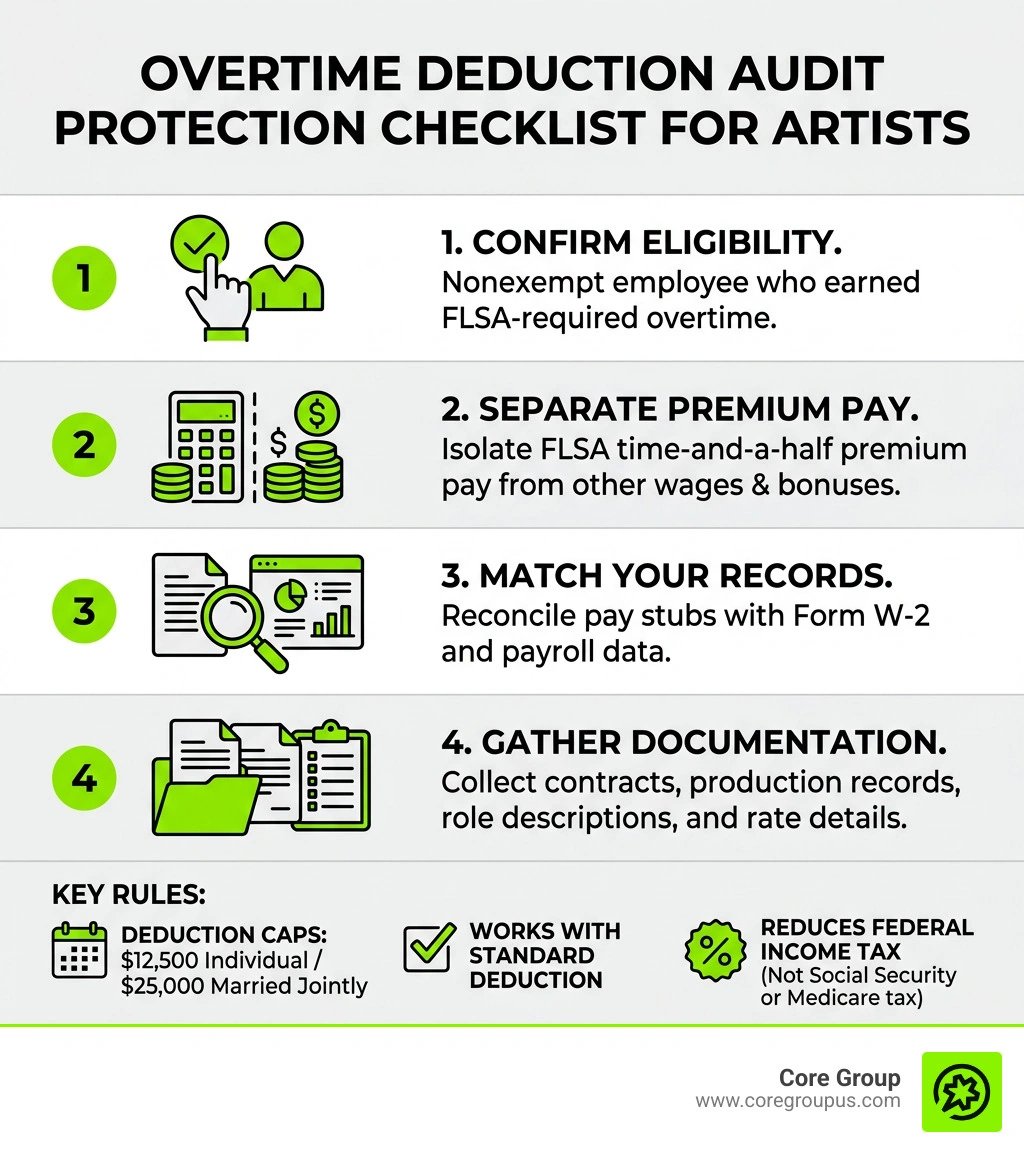
For effective overtime tax audit protection, artists should take these steps now.
- Confirm you are a nonexempt employee who earned FLSA-required overtime.
- Separate qualifying time-and-a-half premium pay from regular wages, bonuses, and state-law premium pay.
- Match your records to your Form W-2, payroll portal, or employer-provided statement.
- Keep contracts and production records that explain your role, hours, rate of pay, and any union terms.
The deduction can be claimed even when using the standard deduction. It is generally capped at $12,500 for an individual or $25,000 for married couples filing jointly, subject to income-based phaseouts. It reduces federal income tax, but not Social Security or Medicare tax.
Creative work often involves irregular calls, multiple employers, and fast-moving productions. That makes clean documentation more than good bookkeeping. It is your proof if the IRS asks why an overtime amount qualifies.
I am Christian Brim, and this guide will show you how to organize overtime records and coordinate this deduction with the wider tax rules that affect artists.
Overtime tax audit protection artists key resources include the following.
Understanding the OBBBA Overtime Deduction Rules for Creatives
The federal tax landscape introduced major changes under the One Big Beautiful Bill Act (OBBBA). For creative workers who log grueling hours to hit production deadlines, this legislation establishes a dedicated above the line tax deduction for qualified overtime earnings. This deduction directly lowers your Adjusted Gross Income (AGI), which means you receive the tax benefit regardless of whether you itemize your deductions or take the standard deduction.
Unlocking these overtime tax savings for artists requires knowing exactly how the deduction operates under the hood. While the deduction shields a portion of your extra earnings from federal income taxes, it does not eliminate payroll taxes. Federal Insurance Contributions Act (FICA) taxes, which fund Social Security and Medicare, still apply to every dollar of overtime you earn. Understanding the distinction between your regular income tax obligations and your payroll tax responsibilities ensures you avoid costly balance-due notices when filing your return.
Qualified Overtime and FLSA Eligibility Guidelines
Not every dollar labeled as overtime on your pay stub qualifies for the federal deduction. Under the statutory guidelines, the deduction is strictly limited to overtime pay mandated by the Fair Labor Standards Act (FLSA). The FLSA requires employers to pay nonexempt employees at least one and a half times their regular hourly rate for all hours worked beyond 40 in a single workweek.
Only the premium half of that time-and-a-half pay qualifies for the tax deduction. If your regular rate is $30 per hour and you earn $45 per hour for overtime, the $15 premium portion is the amount eligible for the deduction.
This rule impacts several creative and production roles.
- Hourly entertainment crew members, such as grips, gaffers, camera operators, and stagehands
- Studio animators and digital visual effects artists paid on an hourly nonexempt basis
- Technical theater staff, including lighting technicians, sound engineers, and costume shop crew
- Art department fabricators and prop builders working on commercial or film sets
Daily overtime required only by specific state laws (such as working over eight hours in a single day) or extra premium pay negotiated under collective bargaining agreements (such as double time or seventh-day premiums) does not automatically qualify unless those hours also exceed the federal 40-hour weekly threshold. Navigating the underlying mechanics of tax on overtime pay helps ensure you only claim the legally permissible premium portion.
Deduction Caps and Phase Out Thresholds
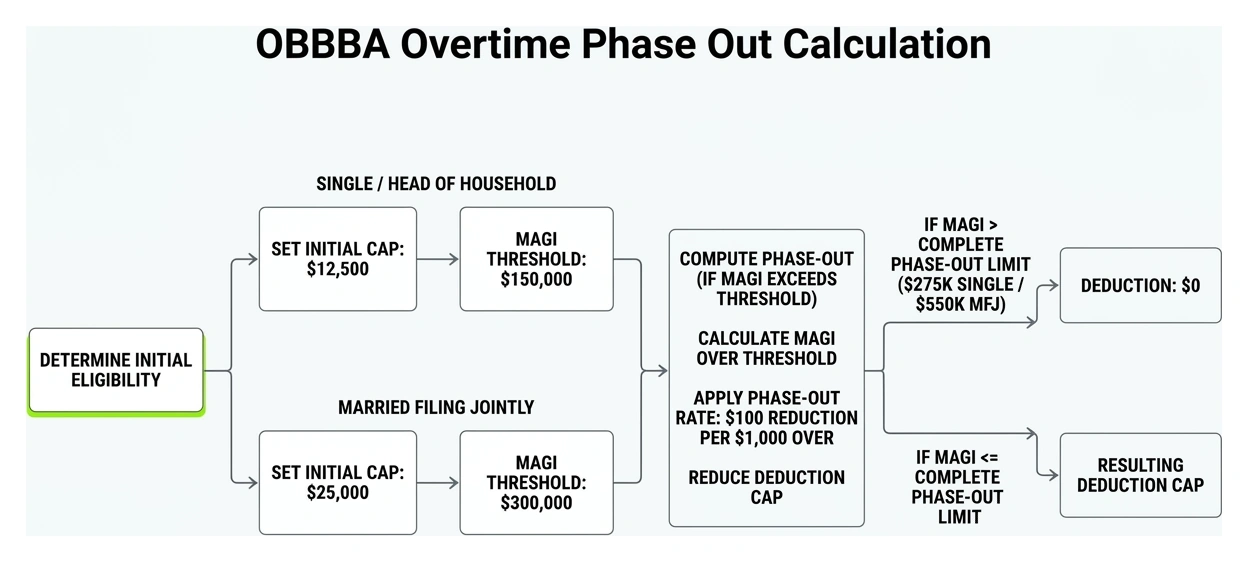
The OBBBA overtime deduction features strict statutory ceilings and phase-out thresholds based on your Modified Adjusted Gross Income (MAGI). These limits prevent high-income earners from claiming the full deduction while preserving the benefit for working-class and middle-income creative professionals.
| Filing Status | Maximum Deduction Cap | MAGI Phase-Out Begins | Phase-Out Rate | Complete Phase-Out Limit |
|---|---|---|---|---|
| Single / Head of Household | $12,500 | $150,000 | $100 per $1,000 over threshold | $275,000 |
| Married Filing Jointly | $25,000 | $300,000 | $100 per $1,000 over threshold | $550,000 |
If your MAGI exceeds the initial threshold, your maximum allowable deduction is reduced systematically. For example, a single animator with a MAGI of $160,000 has exceeded the baseline by $10,000. Their deduction cap is reduced by $1,000, leaving them with an allowable deduction limit of $11,500 for that tax year.
Essential Overtime Tax Audit Protection Artists Need for Compliance
Because above the line deductions directly reduce your taxable income base, the IRS monitors these entries closely. Implementing robust overtime tax audit protection artists need begins with understanding how examiners evaluate creative industry tax returns. IRS examiners rely heavily on the IRS Entertainment Audit Technique Guide when reviewing creative professionals. This guide directs auditors to scrutinize classification statuses, verify employment relationships, and challenge any deductions lacking contemporaneous proof.
Under tax law, the burden of proof rests entirely on the taxpayer. If an auditor questions your overtime deduction, you must substantiate that the compensation was earned as a nonexempt employee, complied with FLSA thresholds, and matched the figures reported to the government.

Substantiation and Recordkeeping for Overtime Tax Audit Protection Artists
To defend your deduction against an IRS inquiry, you must maintain organized, contemporaneous records for at least three to seven years. Relying solely on year-end estimates or memory will lead to disallowed deductions and substantial accuracy-related penalties.
Essential substantiation records include the following.
- Digital time-tracking logs and timecards reflecting daily clock-in and clock-out timestamps
- Union call sheets, production schedules, and gig deal memos showing designated call times and shoot durations
- Pay stubs that clearly separate regular hourly earnings from FLSA-qualified overtime premiums
- Formal project contracts outlining your job classification, hourly compensation, and working conditions
Building a structured documentation routine is a cornerstone of our accounting for artists complete guide, providing you with total peace of mind when filing season arrives.
Resolving Reporting Discrepancies and Employer Form W 2 Transition Relief
For the initial rollout in tax year 2025, the IRS implemented transition relief for employers regarding how overtime earnings appear on information returns. The IRS announced that employers would not face penalties if their standard Form W-2 or Form 1099 filings lacked separated overtime breakouts, as outlined in IRS Publication 5774.
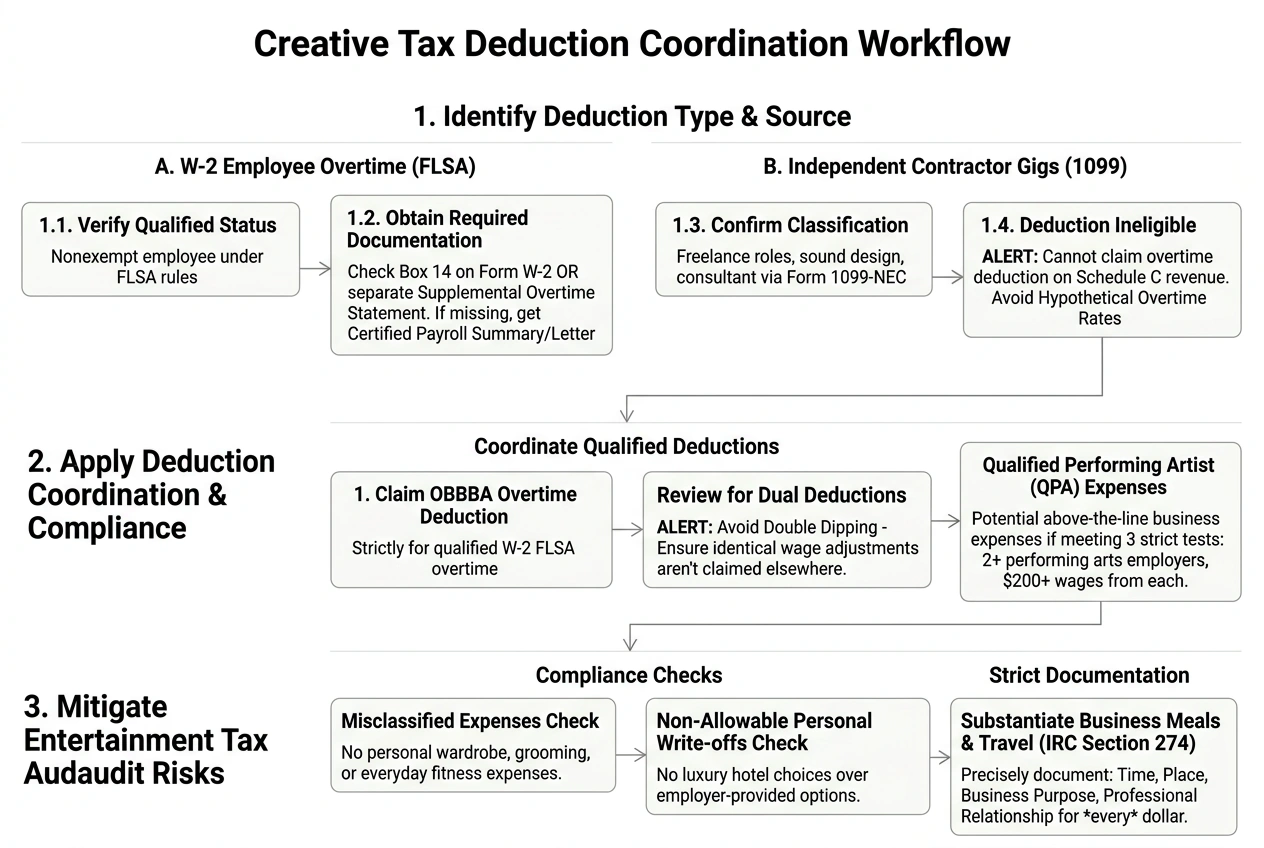
As of 2026, many employers report qualified FLSA overtime directly in Box 14 of Form W-2 or issue formal supplemental overtime statements alongside year-end tax forms. If your employer did not provide a separate breakdown on your W-2, you must obtain a certified payroll summary or letter from their payroll department confirming your qualifying FLSA overtime hours and premium pay totals before claiming the deduction on your federal return.
Key Risks and Common Traps in Entertainment Tax Audits
Creative professionals face unique audit risks because their income frequently blends multiple W-2 production roles, 1099 freelance contracts, and union fringe benefits. IRS auditors frequently review entertainment returns looking for misclassified expenses, non-allowable personal write-offs, and duplicate deductions.

Avoiding Pitfalls with Overtime Tax Audit Protection Artists Strategies
Auditors look for specific red flags when reviewing entertainment tax filings. Implementing proactive compliance strategies ensures your tax return remains audit-proof.
Primary documentation red flags to avoid include the following.
- Claiming the overtime deduction on independent contractor revenue reported on Schedule C
- Double dipping by claiming an overtime tax deduction while simultaneously deducting identical wage adjustments elsewhere
- Deducting personal wardrobe, grooming, or everyday fitness expenses under the guise of production costs
- Failing to substantiate business travel and meals according to strict IRC Section 274 rules
Under IRC Section 274, business meals and travel must include documentation showing the precise time, place, business purpose, and professional relationship for every dollar spent. In addition, personal preferences, such as choosing a luxury hotel over an employer-provided travel accommodation, are never deductible as business expenses. For deeper insights into managing your creative write-offs safely, explore our creative overtime tax savings strategies.
Distinguishing Independent Contractor Gigs from Employee Overtime
A frequent mistake creative workers make is assuming that any long hours worked on a project qualify for the overtime deduction. The statutory language of the OBBBA limits the overtime deduction strictly to nonexempt employees working under FLSA rules.
If you work as a freelance illustrator, independent sound designer, or creative consultant receiving Form 1099-NEC, you are classified as an independent contractor. Independent contractors set their own project rates and do not earn statutory FLSA overtime. Attempting to calculate a hypothetical overtime rate on Schedule C gross revenue is a direct audit trigger that will result in disallowance and penalties.
Coordinating the Overtime Deduction with Other Creative Tax Breaks
Smart tax planning requires coordinating the OBBBA overtime deduction with other specialized tax provisions available to the arts community. By stacking legal deductions correctly, you can dramatically reduce your taxable income while remaining fully compliant with federal standards.
Qualified Performing Artist Deductions and Business Expenses
Performing artists who work as W-2 employees may also qualify for above the line business expense deductions under IRC Section 62(a)(2)(B). To qualify as a Qualified Performing Artist (QPA), you must meet three strict tests.
- You performed services in the performing arts as an employee for at least two employers during the tax year.
- You received at least $200 in wages from each of those two employers.
- Your allowable performing arts business expenses exceeded 10 percent of your gross income from those services.
The historical AGI limitation for QPA status has been $16,000 ($32,000 for married couples filing jointly). If you meet these criteria, your unreimbursed employee expenses (such as audition travel, coaching, and headshots) can be deducted directly above the line, working side by side with your OBBBA overtime deduction.
State Tax Variations and Multi State Filing Concerns
State tax codes do not automatically conform to every federal tax update. While federal law permits the OBBBA overtime deduction, individual states handle conformity differently.
- Rolling conformity states automatically incorporate federal above the line changes into their state tax calculations.
- Fixed-date or static conformity states follow the Internal Revenue Code as it existed on a specific date, requiring an explicit legislative update to allow the deduction.
- Non-conforming states decouple entirely from federal overtime breaks, requiring you to add back the deducted overtime amount when calculating your state taxable income.
For touring performers, crew members, and studio artists working across state lines (such as shoots in California, Georgia, New York, or New Mexico), you must track your hours and income on a state-by-state basis. Ensuring your state tax withholdings and multi-state tax credits match your payroll allocations protects you from state-level tax audits.
Frequently Asked Questions About Overtime Deductions and Audits
How does the IRS verify overtime hours for studio and production workers?
The IRS verifies overtime claims through automated matching algorithms and documentation requests. Examiners compare the numbers entered on your tax return against the information reported by your employer on Form W-2 Box 14 or supplemental payroll files. If a discrepancy arises, the IRS requests copies of your timecards, employer wage statements, and union collective bargaining agreements to confirm that your overtime hours exceeded 40 hours per week and met nonexempt statutory criteria.
Can self employed freelance artists claim the federal overtime deduction?
No. The OBBBA overtime deduction is restricted to employees covered by the overtime rules of the Fair Labor Standards Act. Independent contractors, sole proprietors, and partners filing on Schedule C cannot claim this deduction on self-employment earnings. Freelancers should focus on maximizing legitimate Schedule C business deductions, retirement plan contributions, and qualified business income deductions to lower their taxable liability.
Does claiming the overtime deduction increase my risk of an IRS audit?
Claiming any significant above the line deduction can elevate your return's Discriminant Information Function (DIF) score, which the IRS uses to select returns for examination. However, taking a legitimate deduction that you can substantiate does not mean you should avoid the tax break. Maintaining pristine records, verifying that your pay stubs support your numbers, and matching your tax filings to your Form W-2 details shields you from audit adjustments.
Conclusion
Maximizing your earnings in the creative arts requires taking advantage of every legal tax savings tool while establishing ironclad documentation. The OBBBA overtime deduction offers working artists and production staff substantial tax relief, but its complex FLSA requirements, deduction caps, and phase-out thresholds demand meticulous compliance.
At Core Group, we provide comprehensive financial management, bookkeeping, and tax services designed specifically for creative entrepreneurs. We deliver a proven, no-fluff playbook that gives you total peace of mind, saves you valuable time, and lets you focus on your creative work, all backed by our MacBook Pro guarantee. Explore our strategic insights on effective overtime tax rate management to keep your creative career financially secure and fully protected.