From Canvas to Cash Flow: Essential Accounting for Artists
Why Accounting for Artists Matters for Your Creative Business

Accounting for artists isn't just about tracking expenses—it's about turning your creative passion into a sustainable business. Whether you're a painter, musician, filmmaker, or digital creator, proper financial management helps you focus on your art while staying compliant with tax laws.
Quick Answer: Essential Accounting for Artists
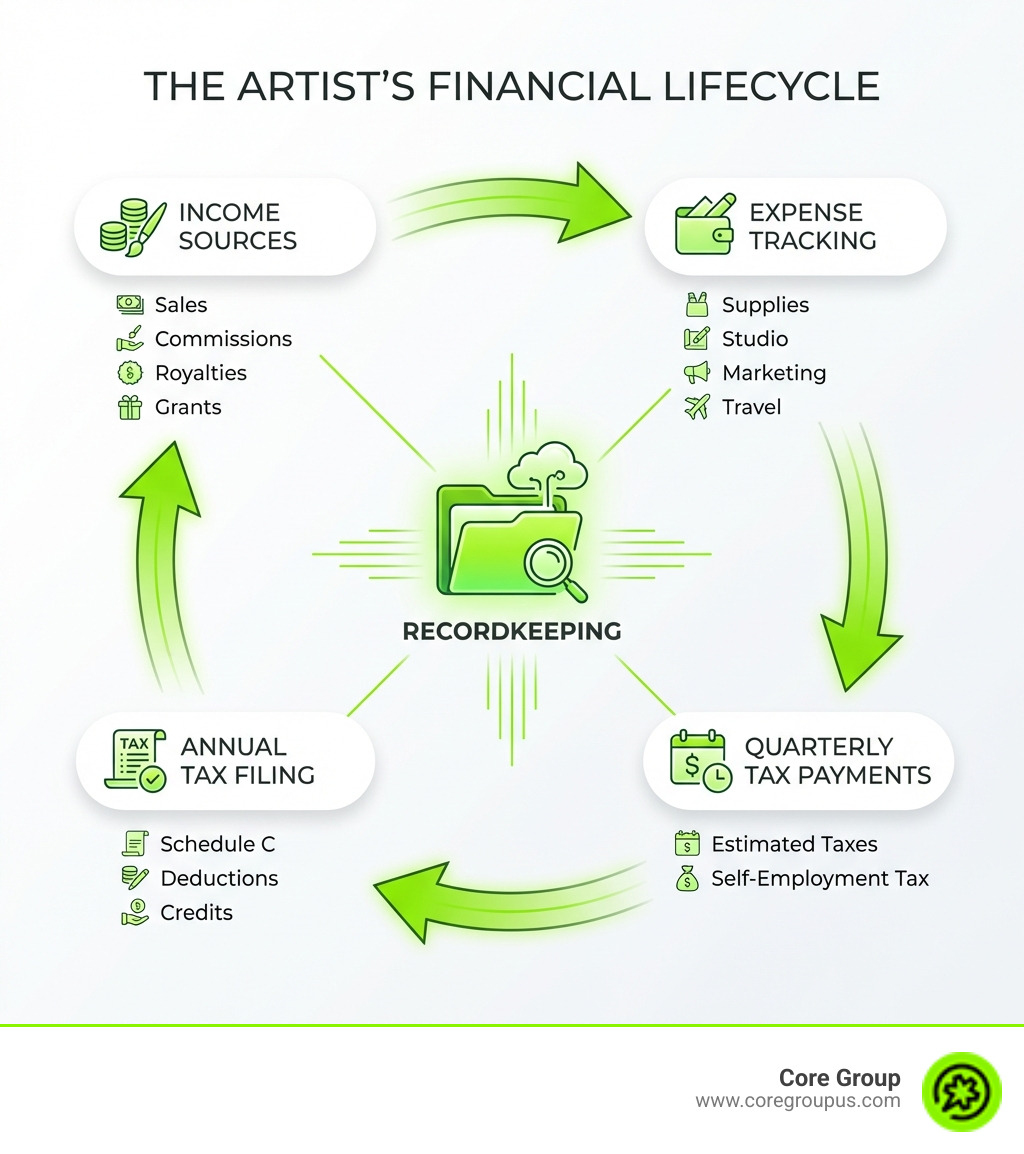
- Track all income - sales, commissions, royalties, grants, and crowdfunding
- Separate business and personal finances - use dedicated bank accounts
- Deduct ordinary and necessary expenses - supplies, studio rent, marketing, travel
- Understand your tax obligations - quarterly estimated taxes, self-employment tax (15.3%)
- Keep detailed records - receipts, invoices, contracts for at least 3 years
- Choose the right accounting method - accrual (required in Canada) or cash basis
- Know your business structure - sole proprietor, LLC, or S-Corp impacts taxes
Nobody becomes an artist because they secretly want to become their own accountant. Yet here you are, receipts scattered across costume pockets and email threads, wondering if you'll turn into a "grumbling, moody tax-troll" every January.
The truth is simpler than you think. Artists who treat their creative work as a business get to keep more of what they earn. The IRS and CRA both recognize artists as legitimate businesses—provided you demonstrate profit motive and business-like behavior.
The challenge? Your income streams are unpredictable. You might receive a grant in January, sell a commission in March, earn royalties in June, and scramble to pay quarterly taxes on income you haven't collected yet. Meanwhile, you're trying to figure out if that new camera is deductible, whether your home studio qualifies for tax breaks, and how to prove to the government that you're running a business, not a hobby.
This guide breaks down everything you need to know about managing artist finances—from basic bookkeeping to tax deductions, business structures to sales tax obligations. You'll learn practical strategies used by successful creative entrepreneurs who've figured out how to manage their finances without losing their minds (or their creative edge).
Mastering the Basics of Accounting for Artists
To successfully manage your creative business, we first need to decide how you will track your money. In accounting for artists, there are two primary paths: cash basis and accrual basis.
Most solo creators start with cash basis because it’s "easy-peasy." You record income when the money hits your bank account and expenses when you actually pay the bill. However, as your business grows or if you are operating in certain jurisdictions like Canada, the accrual method may be required. Accrual accounting recognizes income when it is earned (like when you send an invoice) and expenses when they are incurred, regardless of when the cash actually moves.
| Feature | Cash Basis Accounting | Accrual Basis Accounting |
|---|---|---|
| Income Recognition | When cash is received | When the invoice is sent/earned |
| Expense Recognition | When cash is paid out | When the bill is received/incurred |
| Complexity | Low - great for beginners | High - better for larger studios |
| Tax Impact | Taxed on cash in hand | Taxed on earned income (even if not paid) |
| Best For | Freelancers and solopreneurs | Growing businesses with inventory |
Understanding these methods is the first step in our Bookkeeping for Creatives - Complete Guide. For artists, the accrual method can create "muddy accounting" because you might owe taxes on a large commission you haven't actually been paid for yet. This is why cash flow management is so critical for us.
Best Practices for Accounting for Artists and Recordkeeping
We often say that good bookkeeping is the backbone of artistic freedom. If you know exactly how much is in the bank, you can take creative risks without fear. To get there, we recommend a few "non-negotiable" habits:
- Separate Your Bank Accounts: This is the golden rule. Never mix your grocery money with your paint money. Open a dedicated business checking account and a business credit card. This makes tracking your Tax Information for the Self-Employed a breeze because you won't have to hunt through personal statements.
- The Three-Year Rule: The IRS generally has three years to audit your return. We suggest keeping all tax-related documents for at least three years, and up to six years if you have complex income streams.
- Digitize Everything: Thermal paper receipts from art supply stores fade faster than a cheap watercolor. Use an app or a simple scanner to save digital copies of every receipt.
- Monthly Reconciliations: Once a month, sit down and match your receipts to your bank statements. This ensures no expense goes unrecorded.
Inventory Valuation and Asset Management
If you are a visual artist, your unsold work is considered "inventory." This is where accounting for artists gets a bit technical. Generally, you cannot deduct the cost of the materials used in a painting until that painting is sold.
However, in some cases, such as under certain CRA rules for artists, you can make a "nil election," essentially valuing your inventory at zero so you can deduct costs as they happen. For those of us in the U.S., we typically track the "Cost of Goods Sold" (COGS).
Don't forget about your "big" purchases. Items like kilns, high-end cameras, or computers are considered capital assets. Instead of deducting the full price in one year, you may need to use depreciation (or Capital Cost Allowance in Canada) to spread the deduction over the item's useful life.
Navigating Tax Deductions and Business Expenses

The secret to lowering your tax bill is understanding what counts as an "ordinary and necessary" expense. For us, this includes almost everything required to produce and sell our work.
Common deductible expenses for artists include:
- Art Supplies: Paint, canvas, clay, film, and even specialized software subscriptions.
- Studio Rent: If you rent a space outside your home, 100% of that cost is deductible.
- Marketing: Website hosting, business cards, social media ads, and gallery commissions.
- Professional Development: Books, workshops, and memberships in professional organizations like the Freelancers Union.
For a deeper dive into what you can claim if you've structured as a company, check out our LLC Tax Deductions Guide 2026.
Home Office and Studio Deductions
Many of us create from a corner of our living room or a spare bedroom. To claim a home office deduction, the space must be used regularly and exclusively for your business.
You have two choices for the deduction:
- The Simplified Method: You claim $5 per square foot of your home used for business, up to a maximum of 300 square feet ($1,500).
- The Actual Expense Method: You calculate the percentage of your home used for your studio and deduct that same percentage of your rent, mortgage interest, utilities, and insurance.
If your studio is 200 square feet and your home is 1,000 square feet, you can deduct 20% of your home-related costs. Just make sure to keep a floor plan or photos to document the space in case of an audit!
Travel and Professional Engagement Costs
When you travel for an exhibition, a residency, or to acquire materials, those costs are deductible. This includes airfare, hotel stays, and even 50% of your meals while traveling.
We also get questions about "work clothes." Generally, the IRS is strict here: you cannot deduct clothes you could reasonably wear in everyday life. However, protective clothing (like a welder's mask or specialized smocks) and the cost of hiring formal wear for a specific work-related gala are typically deductible.
Choosing the Right Business Structure for Your Creative Practice
How you legally organize your business changes how you are taxed and your level of personal liability. Most of us start as Sole Proprietorships because it’s automatic and requires no paperwork. You simply report your income on a Schedule C attached to your personal tax return.
As you grow, you might consider:
- Limited Liability Company (LLC): This protects your personal assets (like your house or car) from business debts. It’s a popular choice for artists who have high-value equipment or a physical studio where people visit.
- S Corporation: For high-earning artists, an S-Corp can save you money on self-employment taxes by allowing you to pay yourself a "reasonable salary" and take the rest of the profit as a distribution.
Choosing the right structure is a core part of our Financial Consulting for Artists. You can learn more about the formal definitions on the IRS page for Business structures.
Employee versus Self-Employed Status
The government uses a "control test" to decide if you are an employee or an independent contractor. If a gallery or client tells you exactly when, where, and how to work, they might technically be your employer (W-2). If you provide your own tools, set your own hours, and have the risk of profit or loss, you are self-employed (1099).
Self-employed artists have more deductions but must pay the full 15.3% self-employment tax. Employees have fewer deductions but their employer pays half of their Social Security and Medicare taxes.
Quarterly Tax Obligations and Self-Employment Tax
If you expect to owe more than $1,000 in taxes, the IRS wants you to pay as you go. These are called Quarterly Estimated Tax Payments.
The payments cover two things:
- Income Tax: Based on your tax bracket.
- Self-Employment Tax: This is 15.3% of your net earnings (12.4% for Social Security and 2.9% for Medicare).
For 2024, the deadlines are typically April 15, June 17, September 16, and January 15. Missing these can result in annoying penalties, so we always recommend setting aside 25-30% of every check into a separate "tax savings" account.
Managing Income Streams and Sales Tax Obligations
Modern artists rarely have just one way of making money. We might sell a painting (direct sale), get hired for a mural (commission), license an image for a t-shirt (royalties), and run a Kickstarter (crowdfunding).
Each of these is taxed as ordinary income, but royalties sometimes have different reporting requirements. If you're feeling overwhelmed by all these moving parts, you aren't alone. Transitioning From Intimidated to Empowered: A Creative's Guide to Financial Epiphanies starts with simply naming and tracking these streams.
Modern Accounting for Artists and Global Sales
Selling art online has made the world our marketplace, but it also brought the "Wayfair" headache. Following a landmark Supreme Court decision, you may be required to collect and remit sales tax in states where you have "economic nexus" (usually a certain dollar amount of sales), even if you don't have a physical presence there.
If you sell internationally, you must report all worldwide income to the IRS. However, you can often claim Foreign Tax Credits to avoid being taxed twice on the same dollar. For creators living or selling extensively abroad, the IRS guide for US citizens and resident aliens abroad is an essential resource.
Grants, Awards, and Financial Assistance
Grants are a wonderful "win," but they are usually taxable income. If you receive a $10,000 grant to produce a film, you must report that $10,000. The good news? You can deduct the $10,000 you spend on film equipment and crew to offset that income.
In Canada, artists receive T4A slips for grants, and there is an "art production grant exemption" that allows you to exclude reasonable expenses up to the grant amount (plus a $500 basic exemption). In the U.S., most fellowships and prizes are taxable unless they are used specifically for tuition and required fees at an educational institution.
Frequently Asked Questions about Artist Finances
How does the IRS distinguish between a hobby and a business?
The IRS looks at nine factors to decide if you have a "profit motive." Generally, if you've made a profit in three of the last five years, they presume you are a business. If not, you need to show you operate in a business-like manner—keeping separate books, having a business plan, and spending significant time on your craft.
What are the best tools for tracking artist expenses?
While some of us love a good spreadsheet, many artists prefer specialized software like QuickBooks, Xero, or even FreshBooks. The "best" tool is the one you will actually use consistently. If you're just starting, even a simple ledger book or an accordion file for receipts is better than nothing!
Are gifts of artwork tax deductible for the artist?
This is a common frustration. If you donate a painting worth $5,000 to a charity auction, you generally cannot deduct the $5,000 market value. You can only deduct the cost of the materials (the "basis")—the canvas, the paint, and the frame. However, the recipient (the person who buys it at auction) may be able to claim a deduction for the amount they paid above the fair market value.
Conclusion
At Core Group, we believe that your financial health is the foundation of your creative freedom. Accounting for artists shouldn't be a source of dread; it should be the "no-fluff, profit-first playbook" that gives you peace of mind.
By separating your finances, tracking your deductions, and planning for your taxes, you stop being a "starving artist" and start being a thriving creative entrepreneur. We are here to handle the numbers—the bookkeeping, the tax prep, and the financial strategy—so you can get back to what you do best: creating.
Ready to take control of your cash flow? Explore our Accounting resources or reach out to us today. Let’s turn your artistic vision into a profitable reality.