The Complete Guide to Profit First Bookkeeper Pricing
What Does a Profit First Bookkeeper Cost
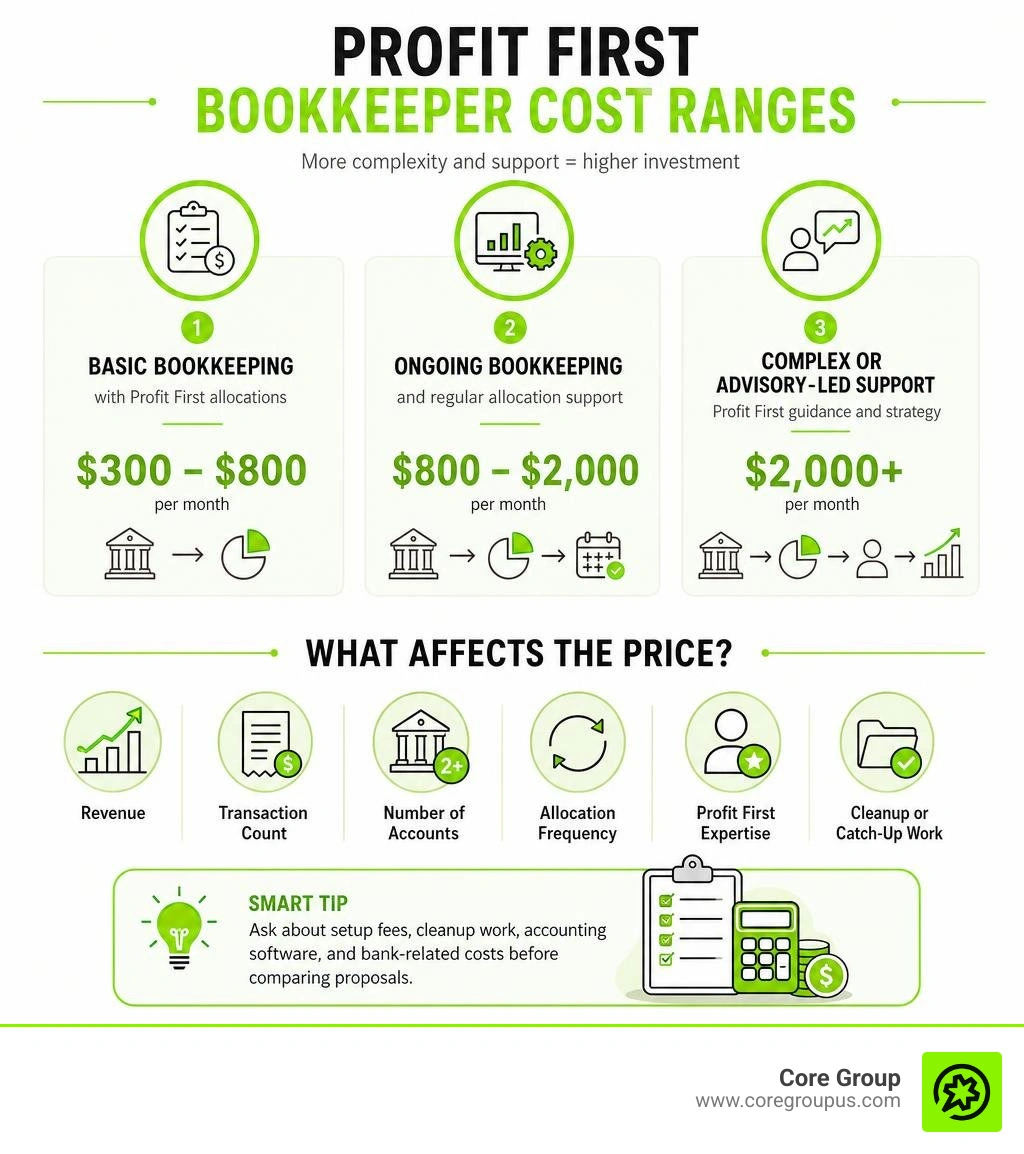
Profit First bookkeeper cost commonly ranges from a few hundred dollars per month for a simple business to several thousand dollars per month for businesses with high transaction volume, multiple bank accounts, catch-up work, or hands-on cash flow support.
| Service level | Typical monthly cost |
|---|---|
| Basic bookkeeping with Profit First allocations | $300 to $800 |
| Ongoing bookkeeping and regular allocation support | $800 to $2,000 |
| Complex or advisory-led Profit First support | $2,000+ |
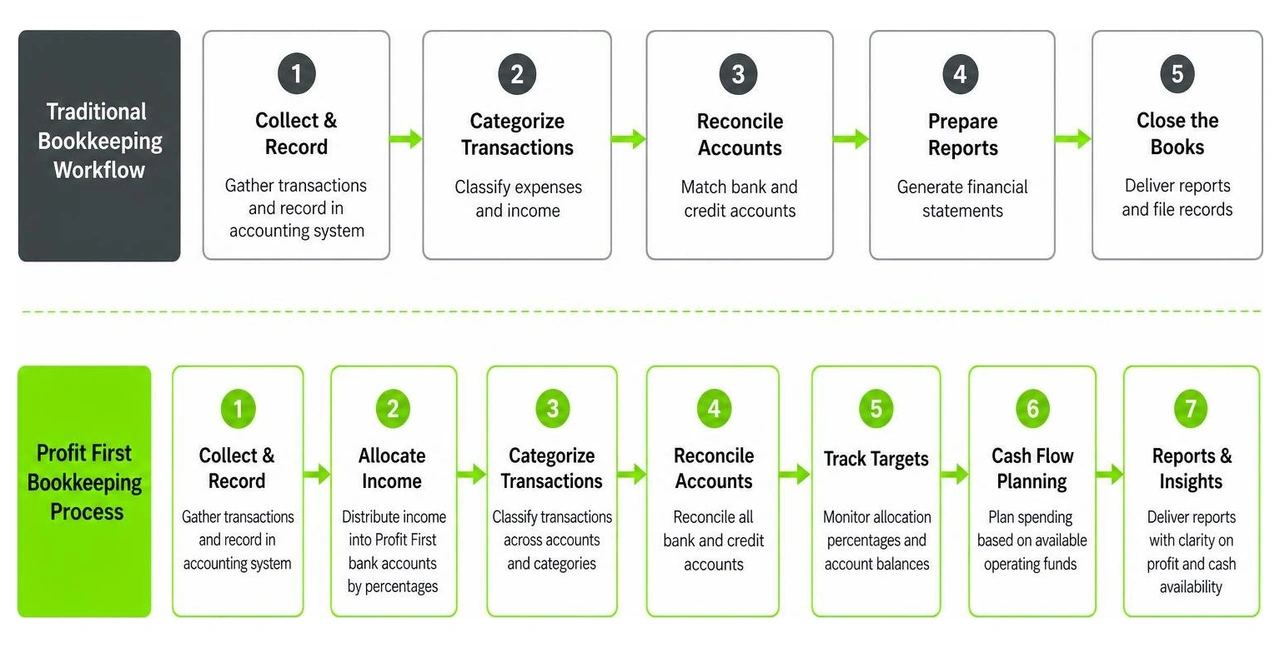
Profit First bookkeeping often costs more than basic bookkeeping because it can include more than categorizing transactions and closing the books. Your bookkeeper may help manage separate bank accounts, track allocation targets, prepare for owner distributions, and create a clearer view of what the business can safely spend.
The right price depends on your revenue, transaction count, number of accounts, how often money is allocated, and whether you need a certified Profit First professional or a general bookkeeper using the method. Be sure to ask about setup fees, cleanup work, accounting software, and bank-related costs before comparing proposals.
I am Christian Brim, and this guide will help you judge the price, scope, and potential return of Profit First bookkeeping for your business.
Profit first bookkeeper cost terms to learn
Understanding Profit First Bookkeeper Cost in 2026
When we evaluate the financial layout for business owners in 2026, understanding the profit first bookkeeper cost requires looking at both basic transaction tracking and strategic cash management. Standard bookkeeping focuses on recording past events. It tells you what happened last month. Profit First bookkeeping is forward-looking. It structures your money so that profit, owner pay, tax reserves, and operating expenses are separated systematically.
Because of this expanded scope, average pricing reflects the extra time and care required. Most small business owners see monthly retainers starting around $500 for lightweight support, while established creative agencies and scaling companies often invest between $1,200 and $3,500 per month. For a comprehensive look at broad market standards, you can review our Bookkeeping Services Rates Guide 2026.
| Feature or Scope | Traditional Bookkeeping | Profit First Bookkeeping |
|---|---|---|
| Primary Focus | Past historical compliance | Future cash flow and profit cash management |
| Account Structure | Single or dual checking account reconciliation | Five core accounts plus custom profit buckets |
| Transfer Management | Rare or non-existent | Regular twice-monthly or weekly allocation transfers |
| Pricing Model | Hourly or low fixed rate ($200 to $600) | Value-based or tiered retainer ($500 to $2,500+) |
| Business Advisory | Minimal cash flow guidance | Active percentage target adjustments and quarterly distribution strategy |
Flat Monthly Fees vs Hourly Billing
We find that most modern Profit First accounting professionals move away from hourly billing in favor of predictable flat monthly fees. Hourly billing often creates alignment issues. If a bookkeeper takes longer to manage your accounts, you pay more, even if the result is delayed.
Flat monthly retainers give creative entrepreneurs total clarity over their overhead expenses. You know exactly what leaves your operating expense account on the first of every month. This approach covers recurring tasks like account reconciliations, transfer calculations, monthly financial reporting, and regular check-in meetings without unexpected charges.
Percentage of Revenue Pricing
Some financial professionals use a percentage of gross revenue model to determine pricing. Under this scalable approach, bookkeeping fees equal a small target percentage of top-line revenue, usually ranging between 1% and 3% for creative and service-based businesses.
This model aligns the success of the bookkeeper with the size of the business enterprise. As your business grows, your cash flow logistics become more complex, requiring tighter tracking and higher levels of internal control. For growing companies, value pricing based on revenue size ensures that advisory support scales naturally as transaction volume and bank accounts expand.
Key Factors That Influence Profit First Pricing

No two businesses carry identical operational burdens. Several practical variables influence the final profit first bookkeeper cost for your organization. Understanding these components helps you evaluate proposals and choose a partner that fits your operational needs.
Key operational variables include
- Total monthly sales volume and merchant processor complexity
- Number of physical bank accounts, credit cards, and credit lines
- Frequency of allocation calculations and transfer management
- Complexity of payroll, contractor payments, and sales tax filings
- Demand for custom financial dashboards and strategic consultation
How Business Size Impacts Your Profit First Bookkeeper Cost
As your revenue scale and organizational structure grow, the workload for your bookkeeping team increases. A solo freelancer running a boutique design firm with ten invoices a month presents a vastly different workflow than an agency generating $2 million in revenue with fifty contractors and multiple merchant accounts.
More revenue typically means more accounts. Under the Profit First methodology, you maintain separate bank accounts for Income, Profit, Owner Compensation, Tax, and Operating Expenses. Larger businesses often add specialized accounts for vault funds, equipment replacement, or material reserves. Reconciling ten accounts each month requires significantly more effort than balancing two, directly impacting total monthly service pricing.
Transfer Frequency and Account Management
The rhythm of your allocation schedule plays a central role in service cost. The standard Profit First cadence recommends completing transfers twice per month, typically on the 10th and 25th. During these regular transfer days, your financial partner calculates exact allocation percentages, verifies available cash, and initiates transfers between your specialized bank accounts.
If your business requires weekly allocation schedules or daily cash monitoring due to tight margins, the manual overhead increases. Managing daily allocation transfers or handling manual banking approvals will adjust the scope of service, resulting in a higher retainer fee to cover the dedicated labor time.
Certified Professionals vs General Bookkeepers
Not all service providers approach Profit First with the same depth of expertise. A major decision point affecting overall cost is choosing between a certified Profit First professional and a general bookkeeper who simply follows the book's concepts.
General bookkeepers may read the book and manually move funds between accounts based on your instructions. However, certified experts go through rigorous training programs to analyze target allocation percentages, identify cash leaks, and guide strategic behavioral shifts.
For additional insights into how dedicated cash experts structure these services, read our dedicated guide on selecting a Profit First Bookkeeper.
Certified Professional vs General Profit First Bookkeeper Cost
Certified professionals command higher fees due to their specialized knowledge and strategic focus. While a general bookkeeper might charge $300 to $600 monthly for standard data entry and basic allocations, a certified professional often charges between $1,000 and $3,000+ per month.
The difference in fee covers proactive advice rather than passive record-keeping. Certified professionals do not just move money. They assess your baseline percentage allocations, evaluate operating expense trends, recommend appropriate distribution schedules, and help adjust targets as your business dynamics shift over time.
Evaluating Service Quality and Implementation
High service quality goes far beyond basic math. Proper execution of the system requires deep knowledge of revenue trends, seasonality, debt reduction plans, and tax management strategies. When reviewing potential accounting partners, consider their experience implementing the system within your specific industry vertical.
Creative businesses experience unique cash cycles, such as project deposit swings, client retainer delays, and contractor expenses. Working with specialists who understand creative cash flows ensures your allocation percentages reflect real-world operational realities. Discover more about core principles in our complete breakdown of the Profit First Method.
Hidden Fees and Additional Expenses

When requesting quotes for profit first bookkeeper cost, it is important to look beyond the headline monthly retainer. Additional expenses can arise during setup, onboarding, or special projects throughout the year.
Common extra expenses to keep in mind
- One-time account setup and bank restructuring fees
- Historical cleanup and prior-year tax reconciliation
- Specialized cloud accounting software and app subscriptions
- Custom bank account fee structures for multiple checking accounts
- Year-end tax prep handoff packages and audit support
Tax planning is often part of the Profit First conversation because separate tax reserves help owners avoid surprise liabilities. For federal estimated tax basics, review the IRS estimated taxes guidance.
To avoid surprises, review our comprehensive Profit First Guide 2026 for practical budgeting tips.
Initial Account Setup and Onboarding
Setting up a Profit First financial foundation is rarely as simple as turning on a switch. Most clients require an initial setup phase. During onboarding, your bookkeeper reviews historical performance, calculates Instant Assessment metrics, sets up bank account structures, and establishes target allocation percentages (TAPs).
This onboarding phase typically carries a one-time setup fee ranging from $500 to $2,500 depending on business complexity. This investment covers bank account integration, cloud software setup, custom chart of accounts organization, and workflow mapping to ensure ongoing transfers run smoothly.
Historical Reconciliation and Catch Up Services
If your accounting records are several months behind, your financial team must clean up historical records before implementing Profit First allocation transfers. You cannot build a forward-looking cash model on inaccurate foundation data.
Catch-up bookkeeping is usually billed as a separate project fee or an hourly rate ranging from $75 to $175 per hour. Alternatively, bookkeepers may charge a fixed cleanup fee per un-reconciled month. Resolving backlog issues ensures your Instant Assessment relies on clear financial facts.
Measuring ROI and Financial Returns
It is easy to treat accounting as a pure overhead expense. However, engaging a Profit First specialist should be viewed as an investment that yields measurable financial returns. When implemented correctly, the discipline of securing profit first transforms your business bank balances.
By locking in profits before paying expenses, business owners frequently discover operational efficiencies, eliminate unused software subscriptions, negotiate better vendor pricing, and reduce waste. A business owner paying $1,200 per month for Profit First bookkeeping often gains multiple times that amount in quarterly profit distributions, debt reduction, and tax savings.
To explore how these cash routines unlock real financial clarity, read our full breakdown on What is the Profit First Method Guide.
Frequently Asked Questions
How Much Does a Profit First Bookkeeper Cost per Month
Most small business owners pay between $500 and $2,000 per month for standard Profit First bookkeeping services. Simple sole-proprietor setups with minimal transactions can start around $300 per month. Mid-sized agencies with higher transaction volumes, custom allocation schedules, and multi-account oversight typically pay between $1,500 and $3,500 monthly.
Is Profit First Bookkeeping Worth the Extra Investment
Yes, for most business owners, the service pays for itself. Traditional bookkeeping provides historic reports that often do not prevent cash shortages. Profit First bookkeeping builds immediate profit reserves, ensures tax obligations are funded, and establishes clear boundaries on operational spending, reducing financial stress and increasing net owner profit.
What Services Are Included in Standard Fees
Standard monthly packages typically include monthly account reconciliations, regular Profit First transfer calculations, bank balance monitoring, financial statement generation, and recurring review meetings. Advanced tiers may add custom cash flow forecasting, budgeting support, tax coordination, and dedicated debt elimination planning.
Conclusion
Finding financial peace of mind in your business requires moving beyond traditional historical bookkeeping. While the overall profit first bookkeeper cost reflects a higher level of strategy and hands-on cash management than standard data entry, the ultimate return on investment comes through guaranteed profit reserves, automated tax preparation savings, and sustainable operational spending.
At Core Group, we provide creative entrepreneurs with a no-fluff profit-first playbook that guarantees financial clarity and saves valuable time. By letting our team manage your cash flow logistics, allocation schedules, and back-office bookkeeping, you can direct your energy toward creative work and core business growth, backed by our MacBook Pro guarantee. Explore our professional options today by visiting Core Group Accounting Resources.