Flip the Formula: A Beginner's Guide to the Profit First Method
Why So Many Business Owners Are Getting the Money Formula Wrong
The profit first method is a cash management system that flips traditional accounting on its head. Instead of waiting to see what is left over after expenses, you take your profit first every single time money comes in.
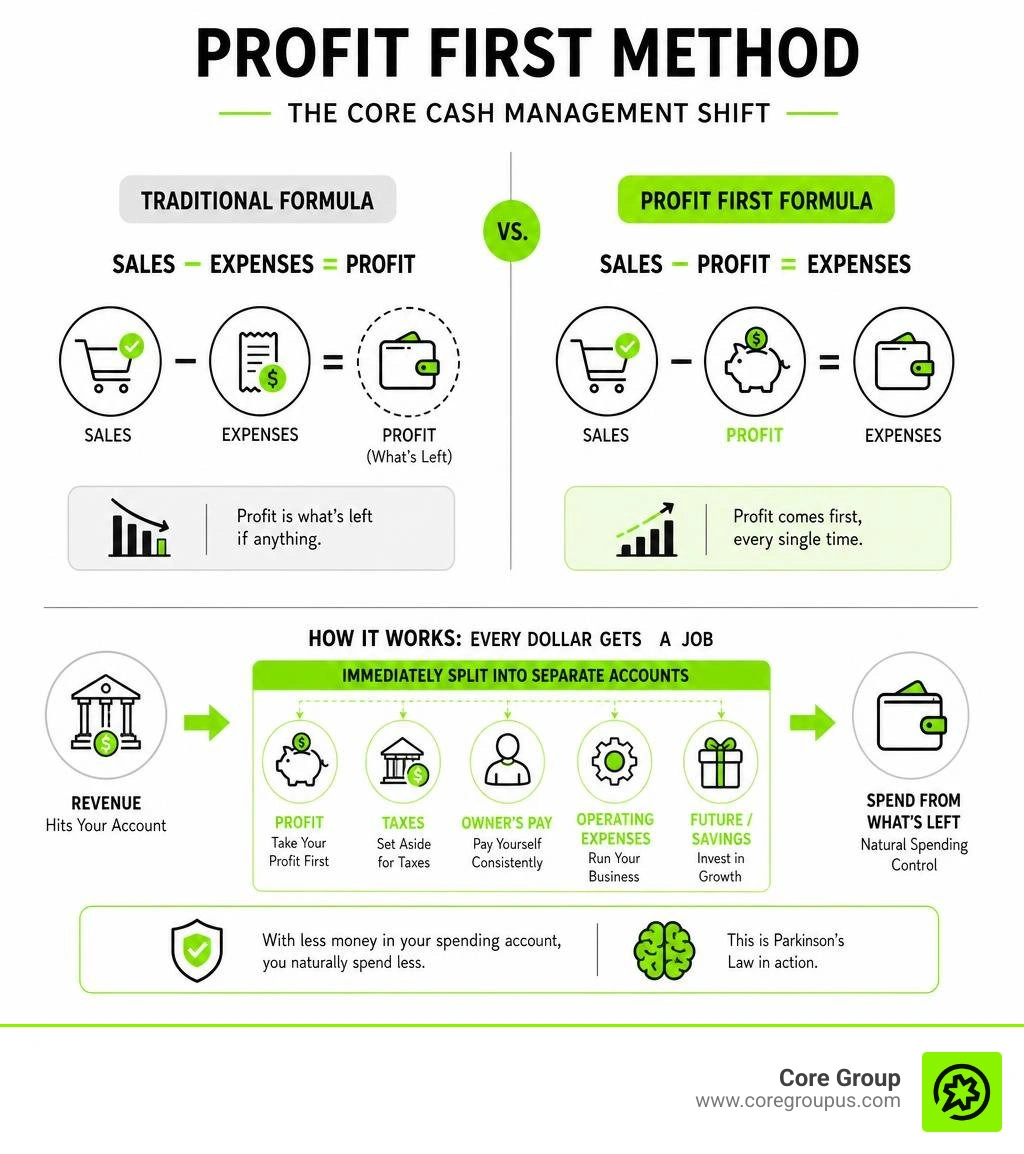
Here is the core idea at a glance
- Traditional formula Sales minus Expenses equals Profit
- Profit First formula Sales minus Profit equals Expenses
- How it works Every time revenue hits your account, you immediately split it across separate bank accounts for profit, taxes, owner's pay, and operating expenses using preset percentages
- Why it works With less money sitting in your spending account, you naturally spend less because this is Parkinson's Law in action
- Who it is for Small business owners, freelancers, creatives, and entrepreneurs who want consistent profit without complex accounting
If you have ever checked your bank account after a strong month of client work and wondered where all the money went, you are not alone. Tens of thousands of businesses including creative studios, agencies, and solo operators bring in solid revenue and still end up stressed about cash.
Mike Michalowicz, who wrote the book after losing nearly everything despite selling two multi-million dollar companies, built this system because he lived that exact reality. The problem was not the revenue. It was the order in which money got allocated.
Most business owners treat profit like dessert, which is something they will enjoy once all the bills are paid. The profit first method argues that is exactly backwards, and that a simple structural change to how you handle incoming cash can transform a financially chaotic business into a predictably profitable one.
By June 2026, over 175,000 companies have implemented this system. The results range from modest improvements in cash clarity to dramatic shifts in net profit. But before diving into the setup and percentages, it helps to understand why the traditional approach keeps so many talented people broke and what the alternative actually looks like in practice.
Profit first method vocab to learn
What is the Profit First Method and How Does It Work
The traditional accounting world relies on Generally Accepted Accounting Principles, commonly known as GAAP. Under this standard framework, the formula is simple. You take your sales, subtract your expenses, and whatever is left over is your profit.
While this makes logical sense on a spreadsheet, it fails because humans are not purely logical creatures. We are emotional, habitual, and easily influenced by what is right in front of us. When we treat profit as a leftover, we treat it as an afterthought. We end up building cash-eating machines instead of profitable companies.
The profit first method changes the math to Sales minus Profit equals Expenses. This means that when a client pays you, you immediately carve out a predetermined percentage for profit. What remains is your actual budget for operating the business. If you cannot afford your expenses on what is left, it is a clear behavioral signal that your operating costs are too high.
This approach works because it leverages bank balance accounting. Instead of logging into complex accounting software to read balance sheets, most entrepreneurs simply check their bank app. If there is cash in the account, they spend it. By moving your profit and tax money out of sight immediately, you protect your business from your own spending impulses. You can read more about this foundational shift in What is The Profit First Method and How Does it Work on Brex to see how it compares to traditional cash flow management.
The Core Philosophy of the Profit First Method
At its heart, this method is a modern business adaptation of the classic envelope budgeting system. If you have ever used physical envelopes to separate cash for groceries, rent, and entertainment, you already understand the psychology.
When all your business revenue sits in one massive checking account, it creates an illusion of wealth. You feel rich, so you greenlight that new software subscription, hire that extra contractor, or upgrade your office gear. This is called expense creep. Your expenses rise naturally to meet your income.
By physically separating your money into dedicated accounts, you create hard boundaries. If your operating account is empty, you cannot buy that new camera lens or software suite, even if your other accounts are full. This structure forces immediate profitability from day one. It guarantees that profit is a daily habit rather than an annual event.
How Parkinson's Law Shapes Your Spending Habits
The psychological engine behind this method is Parkinson's Law. This law states that our demand for a resource always expands to match the supply of that resource.
Think about a tube of toothpaste. When you open a brand new, giant tube, you use a generous dollop without thinking. But when the tube is almost empty, you become incredibly efficient. You squeeze, twist, and flatten the tube to get every last bit, making a tiny speck of toothpaste last for a week.
Money behaves the exact same way in your business. If you have fifty thousand dollars sitting in a single checking account, you will find fifty thousand dollars worth of things to buy. But if you shrink your available resources by moving your profit, taxes, and personal pay into separate accounts, you naturally become more resourceful. You find ways to run lean operations, negotiate better deals, and eliminate unnecessary overhead.
Setting Up Your Five Core Bank Accounts
To make this behavioral system work, you must move past mental math and spreadsheets. You need physical boundaries. This means opening five separate bank accounts at your primary financial institution.
These five accounts create the structural discipline needed to manage your money without constant stress. If you want to dive deeper into the psychology of cash separation, check out our money management tips for creative business owners.
The Income Account and the Profit Account
Your first account is the Income Account. This acts as a central receiving dock. Every dollar your business earns from client projects, digital sales, or services lands here first. You do not pay bills, write checks, or cover payroll from this account. Its sole job is to collect revenue before it gets distributed.
Your second account is the Profit Account. This is your business safety net and your reward center. Every time you perform an allocation, a percentage of your income goes here. This money accumulates over the quarter. At the end of each quarter, you will take half of the balance as a profit distribution to reward yourself as the business shareholder. The other half remains in the account as a permanent cash cushion, building true wealth and peace of mind.
Owner's Compensation and Tax Accounts
The third account is Owner's Compensation. Many creative entrepreneurs treat themselves as the cheapest labor in their own companies, taking whatever scraps are left after paying everyone else. This account ensures you receive a consistent salary for the actual work you do in the business.
The fourth account is the Tax Account. We all know the dread of tax season when your accountant reveals a surprise tax bill and you do not have the cash to cover it. By allocating a percentage of every deposit directly to your Tax Account, you proactively build the funds needed to meet your state and federal obligations.
To make sure you are keeping as much of this hard-earned cash as possible, you can study how to save on taxes and explore advanced strategies to minimize taxes so you do not overpay the government.
The Operating Expenses Account
The fifth and final core account is the Operating Expenses Account, often called OpEx. This is the only account you use to pay your regular business bills, software subscriptions, rent, and marketing costs.
Because you have already carved out your profit, taxes, and salary, the balance in your OpEx account represents your true operating budget. If you cannot afford to pay a bill from this account, you cannot afford it, period. This boundary forces budget discipline and keeps your operations lean.
Determining Your Target Allocation Percentages
Once your accounts are open, you need to decide how much money to send to each one. These are known as your Target Allocation Percentages. Your targets will depend heavily on your business revenue level.
| Real Revenue Range | Profit Target | Owner Pay Target | Tax Target | OpEx Target |
|---|---|---|---|---|
| Under 250,000 dollars | 5 percent | 50 percent | 15 percent | 30 percent |
| 250,000 to 500,000 dollars | 10 percent | 35 percent | 15 percent | 40 percent |
| 500,000 to 1 million dollars | 15 percent | 20 percent | 15 percent | 50 percent |
| 1 million to 5 million dollars | 20 percent | 10 percent | 15 percent | 55 percent |
| Over 5 million dollars | 25 percent | 5 percent | 15 percent | 55 percent |
These targets represent where you want your business to be when it is running at peak health. To figure out where you are starting today, you must perform an Instant Assessment. This means looking at your actual numbers over the past twelve months to see what percentage of your revenue currently goes to profit, your own pay, taxes, and operating expenses. For a structured approach to assessing your starting point, read our guide on budgeting for entrepreneurs.
How to Transition to Your Target Percentages Safely
If your Instant Assessment reveals that your current profit is zero percent and your operating expenses are at eighty percent, do not try to jump to your targets overnight. Doing so will shock your business and cause cash flow panic.
Instead, start incredibly small. Set your initial profit allocation to just one percent. If your business can run on one hundred percent of its income, it can easily run on ninety-nine percent. Move that extra one percent to your Profit Account.
Every quarter, make a gradual adjustment. Increase your profit, tax, and owner's pay allocations by one or two percent while lowering your operating expenses by the same amount. This slow transition allows your business to adapt naturally, ensuring long-term financial stability without disrupting your daily work.
Step by Step Implementation and Best Practices
To make the system stick, you need a predictable routine. Without a schedule, it is too easy to fall back into old habits and let money sit in your main account until it gets spent.

Establishing an allocation schedule ensures that you consistently distribute your revenue. This structured habit is the cornerstone of effective business financial planning.
How to Implement the Profit First Method in Your Daily Operations
On a daily basis, your only financial task is to let your revenue accumulate in your Income Account. You can check your bank balances to stay aware of incoming funds, but do not touch the money yet.
Twice a month, on a set schedule such as the tenth and the twenty-fifth, you perform your transfers. You log into your banking platform and distribute the total balance of your Income Account to your other four accounts based on your current percentages.
Many modern banking platforms allow you to set up automated percentage-based transfers. If your bank offers this feature, use it. Automation removes human hesitation and ensures your allocations happen perfectly every single time, building healthy financial habits without requiring constant willpower.
Quarterly and Annual Financial Routines
At the end of every quarter, it is time to enjoy the fruits of your discipline. You look at the balance of your Profit Account and distribute exactly fifty percent of it to yourself as a shareholder bonus. The remaining fifty percent stays in the account to build your business reserve.
This is also the time to pay your estimated quarterly taxes directly from your Tax Account, eliminating any stress or surprise liabilities.
On an annual basis, you should review your overall financial health and adjust your target percentages for the upcoming year. This is the perfect time to sync with a professional to review your tax planning strategies and make sure your business structure is optimized for growth.
Benefits and Potential Challenges of the System
Like any cash management tool, this framework comes with distinct advantages and potential hurdles. Understanding both sides of the coin will help you implement the system successfully.
If you want to read more about the origins and real-world case studies of this methodology, you can find the original book Profit First by Mike Michalowicz at Penguin Random House to deepen your understanding.
Why Small Businesses Succeed with This Framework
The primary benefit of this system is guaranteed, immediate profitability. You no longer have to wait until the end of the year to see if your efforts paid off. You see your profit grow every single week.
It also provides massive cash flow clarity. Because your tax money and salary are physically separated, you always know exactly how much money your business actually has to spend on growth and operations. This brings an incredible level of financial peace of mind, allowing you to focus on your creative work without constant money anxiety.
Common Pitfalls and How to Avoid Them
The most common challenge is administrative complexity. Opening and managing five separate bank accounts can feel overwhelming if you use a traditional bank that charges high monthly fees or requires high minimum balances. To avoid this, look for modern business banking platforms that support multiple sub-accounts without hidden fees.
Another pitfall is a lack of discipline. When operating expenses get tight, business owners are often tempted to raid their Tax or Profit accounts to cover a bill. To prevent this, you can set up your Tax and Profit accounts at a completely separate bank from your daily operating accounts. Removing these funds from your daily view makes it much harder to borrow from your future self.
Frequently Asked Questions About Cash Management
How long does it take to see results
Most creative business owners notice a profound behavioral shift within the first one to three months of starting. Simply seeing money accumulate in your Profit and Tax accounts provides an immediate psychological boost.
Meaningfully closing the gap between your starting percentages and your ultimate Target Allocation Percentages typically takes six to twelve months of consistent, quarterly adjustments.
Can I use a credit card with this system
Yes, you can use a credit card, but you must maintain strict boundaries to prevent debt.
If you use a credit card for business expenses, treat it as an extension of your Operating Expenses Account. At the end of every month, you must pay the statement balance in full using only the funds available in your Operating Expenses Account. If you do not have enough cash in your OpEx account to cover the card balance, you are overspending and need to cut back.
Do I need an accountant to get started
You do not need an accountant to set up your basic accounts and start your initial one percent allocations. However, as your business grows, working with certified professionals can make a massive difference.
A specialized advisor or a business profit coach can help you run an accurate Instant Assessment, optimize your tax strategies, and act as an accountability partner to ensure you stay on track as your business scales.
Conclusion
At Core Group, we believe that creative entrepreneurs deserve to be highly compensated for their passion and hard work. That is why we designed our financial services around a no-fluff, profit-first playbook that guarantees peace of mind and saves you valuable time.
We handle your financial management, bookkeeping, and tax planning so you can step away from the spreadsheets and focus entirely on your creative vision. We are so confident in our ability to streamline your finances that we back our services with our signature MacBook Pro guarantee.
If you are ready to stop guessing at your numbers and start building a permanently profitable business, read our insights on the profitable creative or explore our complete Core Group Tax Planning Resources to take control of your financial future today.