The Ultimate Guide to Mike Michalowicz's Profit First Method
Why So Many Business Owners Never See a Profit
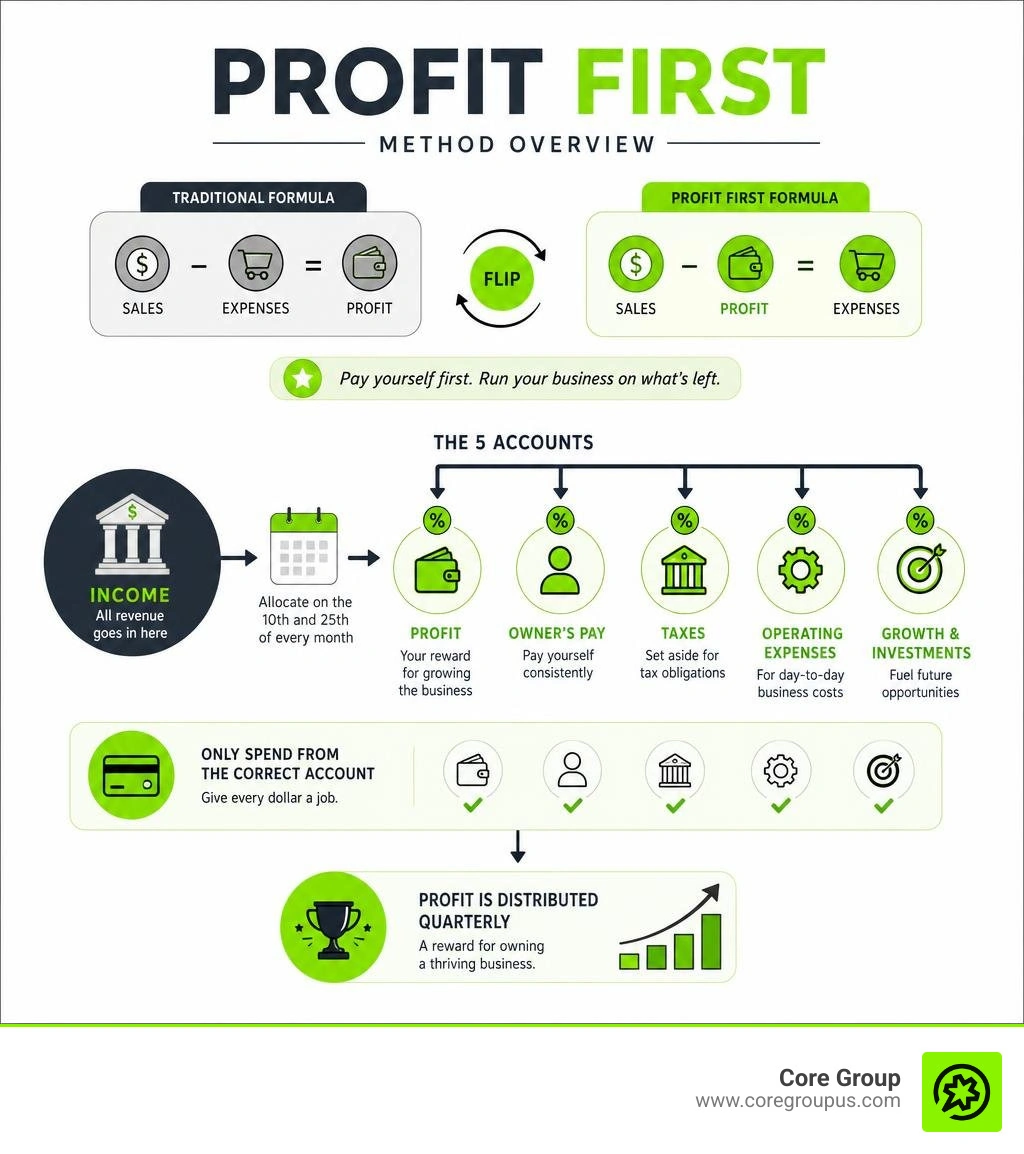
The profit first method is a cash management system that flips the traditional accounting formula. Instead of Sales - Expenses = Profit, it works in a different way.
Sales - Profit = Expenses
You take your profit first, before you pay your bills. Whatever is left over is what you run your business on.
Here is a quick summary of how it works.
- All revenue goes into a main Income account
- You immediately split that revenue across five separate bank accounts, which are Profit, Owner's Pay, Taxes, and Operating Expenses
- You allocate set percentages to each account on the 10th and 25th of every month
- You only spend from the correct account for each purpose
- Profit is distributed to you quarterly as a reward for owning the business
Now here is the uncomfortable truth. Around 50% of businesses fail within their first five years. And 75% of small businesses are carrying a month or less of cash in reserve at any given time.
That is not a revenue problem. For most business owners, it is a behavior problem.
When you see money in your account, you spend it. It is human nature. The traditional formula assumes you will be logical and disciplined. But creative entrepreneurs especially know how this plays out. A big payment lands, and suddenly the account feels flush. Then expenses creep in, and by the end of the month, there is nothing left.
Mike Michalowicz, the author of Profit First, describes this trap well. He built multiple businesses, made serious money, and still ended up broke because he confused revenue with profit.
His solution was not a new spreadsheet. It was a behavioral system that works with how humans actually think.
I'm Christian Brim, and in this guide I'll walk you through exactly how this system works and how to make it fit your creative business.
Profit first basics include
What is the Profit First Cash Management System
At its core, the profit first system is a radical departure from standard bookkeeping. It is designed to change how you interact with your business money on a daily basis. For decades, we have been told that profit is whatever happens to be left over at the very end of the year. But in the real world, nothing is ever left over.
By treating profit as an afterthought, businesses fall into a trap where growth actually makes them poorer. The more they make, the more they spend. This cash management approach shifts the focus from sheer volume to financial health. It forces you to look at cash flow through the lens of human behavior rather than complex accounting sheets.
Traditional Accounting Versus the Profit First Formula
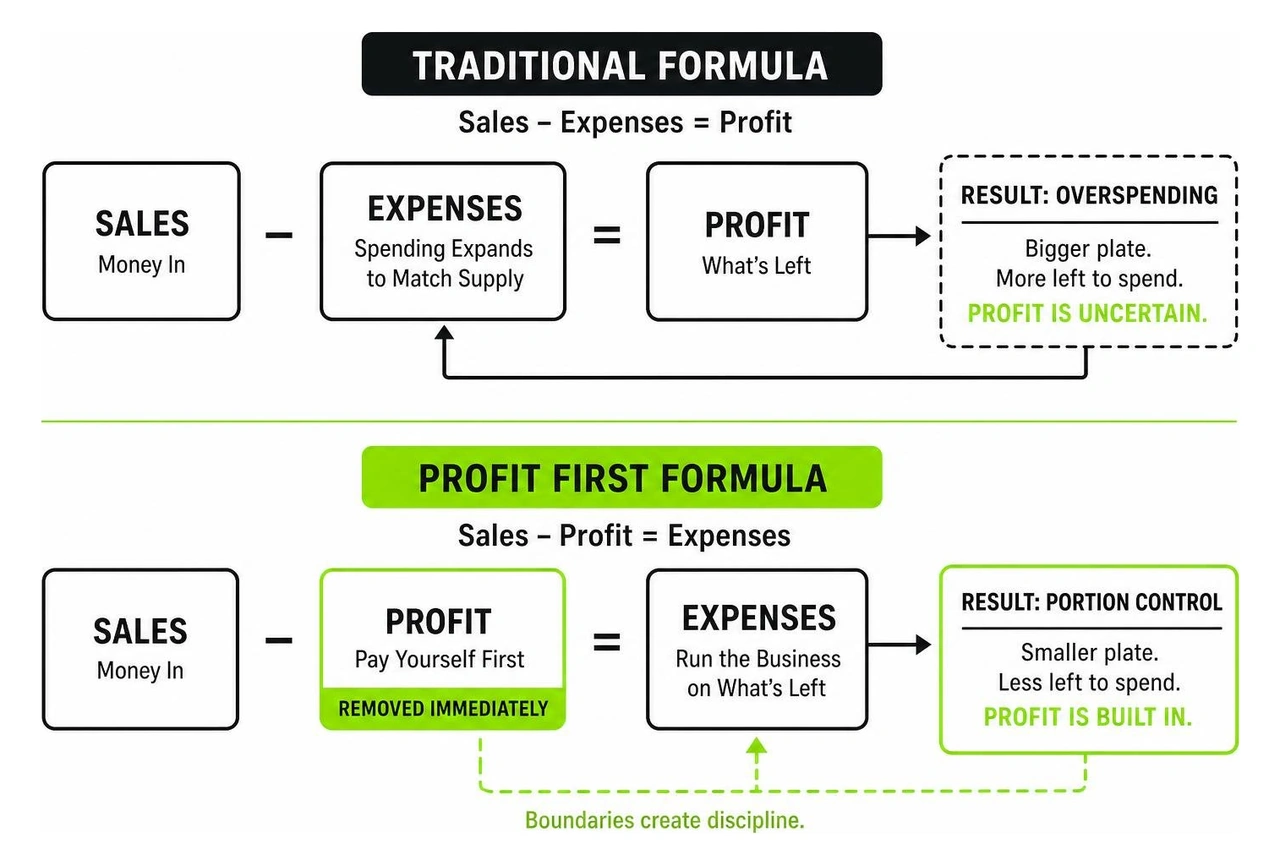
Traditional accounting relies on a logical formula. That formula is Sales minus Expenses equals Profit. On paper, this makes perfect sense. You sell your creative services, you pay your bills, and you keep what remains.
The problem is that humans are not purely logical creatures. We are deeply behavioral. When we see a large pile of resources, we naturally consume them. This phenomenon is known as Parkinson's Law, which states that our demand for a resource expands to match the supply of that resource.
If you have thirty days to complete a project, it will take thirty days. If you have ten thousand dollars in your operating bank account, you will find ten thousand dollars worth of expenses to pay.
The What is the Profit First Method Guide explains that flipping this equation to Sales minus Profit equals Expenses acts like a portion control diet. If you want to lose weight, you do not use a giant plate and try to eat less. You use a smaller plate. By moving your profit and owner's pay out of your main account immediately, you shrink the plate of available operating funds. You force your business to become more innovative and efficient because it has to run on what is left.
The Behavioral Psychology Behind Putting Profit First
The true magic of the profit first system is that it does not try to change your bad habits. Instead, it leverages them. Most creative entrepreneurs do not log into their accounting software every morning to review their balance sheets or profit and loss statements. Instead, they practice bank balance accounting. They log into their mobile banking app, look at the balance, and make spending decisions based on that number.
Under the traditional system, this is incredibly dangerous. A high balance might represent cash that actually belongs to the tax office, or cash that is needed for next month's payroll.
By implementing the Profit First Method, you align your finances with this natural human behavior. When you log in, you see distinct accounts with specific purposes. You know exactly how much money is actually available for operational expenses because the money for taxes, profit, and your own salary has already been moved.
This process of removing temptation is vital. It stops you from borrowing from your future self to pay for present-day business whims.
How to Set Up the Five Foundational Bank Accounts
To get started with this system, you need to open five distinct checking accounts at your bank. Do not worry about your bank teller looking at you strangely. This is the foundation of your financial control.
These five accounts are
- Income; This is your primary deposit account where all customer payments land. No expenses are ever paid from here.
- Profit; This is your holding account for your quarterly profit distributions. It acts as a safety cushion and a reward fund.
- Owner's Pay; This account holds the money dedicated to paying your own salary or distributions for the work you do in the business.
- Tax; This account holds the funds required to cover your business tax obligations and personal income tax liabilities arising from the business.
- Operating Expenses; This is your daily checking account. All business bills, software subscriptions, and vendor payments are paid strictly from here.
Understanding Current and Target Allocation Percentages
Before you start moving money, you must understand where your business stands today and where you want it to go. This is where we compare your Current Allocation Percentages, or CAPs, with your Target Allocation Percentages, or TAPs.
Your CAPs represent the actual percentages of revenue currently going to profit, owner's pay, taxes, and operating expenses. For many businesses starting out, the current profit percentage is zero.
Your TAPs are the healthy goals you want to reach over time. For a typical small business or creative agency making under two hundred and fifty thousand dollars in annual revenue, the recommended TAPs are often quite different from where they start.
To help you visualize this transition, here is a breakdown of how a business might move from its current reality to its ideal target percentages.
| Account Category | Current Allocation Percentages (CAPs) | Target Allocation Percentages (TAPs) |
|---|---|---|
| Profit | 0% | 5% |
| Owner's Pay | 30% | 50% |
| Tax | 5% | 15% |
| Operating Expenses | 65% | 30% |
To learn more about how to calculate these numbers for your specific business size, you can read our guide on Profit First Percentages. The key is to start slowly. If your current operating expenses are 65%, do not try to cut them to 30% overnight. Start by moving your profit allocation to just 1% or 2% and adjust the other accounts accordingly.
Step by Step Instructions for Implementing the System
Once your accounts are open and your initial percentages are set, you can begin the operational rhythm of the system.
First, ensure all customer invoices are paid into your Income account.
Second, establish a strict bi-monthly transfer schedule. The recommended dates are the tenth and the twenty-fifth of every month. On these days, you log into your bank, look at the total accumulated funds in your Income account, and distribute those funds to the other four accounts based on your agreed percentages.
Third, once the transfers are complete, pay your bills strictly from the Operating Expenses account. If there is not enough money in that account to cover your bills, it is a clear warning sign that your operating expenses are too high. Do not transfer money back from the Profit or Tax accounts to cover the shortfall. Instead, use this as an opportunity to review your costs and eliminate unnecessary spending.
Fourth, manage your business debt systematically. If you are carrying significant liabilities, use your allocations to pay down debt while still maintaining a small profit allocation to build the habit. You can find more strategies for managing your operational cash flow in our article on Budgeting for Entrepreneurs.
Benefits and Drawbacks of the System for Different Businesses
While we love the clarity this system brings, it is important to look at both the pros and cons objectively. No financial framework is a magic cure for every single business model.
The primary benefit is that it guarantees profitability from day one. By taking your profit first, you ensure that you are actually rewarded for the risk of entrepreneurship. It also provides incredible clarity for tax planning and guarantees that you can pay yourself a consistent salary.
However, the system does require a high level of administrative discipline. Opening five bank accounts can be tedious, and some traditional banks charge high fees for maintaining multiple accounts. It can also create temporary cash crunches if you set your target percentages too aggressively without adjusting your actual operating expenses first.
Suitability for Startups and Large Enterprises
The suitability of this method often depends on your business structure and funding.
For bootstrapped startups, creative agencies, and solopreneurs, this cash management system is incredibly powerful. It instills financial discipline early on, preventing the typical cash flow roller coaster. If you are running a solo business, our resource on Bookkeeping for Solopreneurs can help you combine these principles with your daily bookkeeping. For slightly larger operations, our guide on Bookkeeping for Small Business offers additional structure.
Conversely, the model can be more challenging for venture-backed startups or hyper-growth companies. These businesses often prioritize rapid market share expansion and immediate reinvestment over short-term profitability. If your goal is to spend every dollar of capital to scale as fast as possible, holding cash in a profit account might conflict with your growth strategy.
Real World Results and Case Studies
The real-world impact of flipping your accounting formula is well documented. Business owners across the globe have used these principles to rescue their companies from the brink of collapse.
For instance, some business owners have reported moving their operations from a stressful break-even state to consistent profitability within a single month of setting up their accounts. In other cases, disciplined entrepreneurs have successfully set aside nearly fifty thousand dollars in profit, taxes, and owner's compensation within their first ten months of implementation.
Others have used the system to systematically eliminate massive liabilities, with some reports showing business owners paying off up to two hundred thousand dollars in debt by using their allocations to curb operational overspending. These results show that when you limit the money available for expenses, you find creative ways to run a leaner, more resilient business.
To read more about the origins of these strategies, you can check out the book Profit First by Mike Michalowicz | Orion - Bringing You News From Our World To Yours .

Common Implementation Mistakes and How to Avoid Them
Even with the best intentions, it is easy to slip back into old habits. Knowing the common pitfalls can help you stay on track.
One major mistake is paying operating bills out of the wrong accounts. When a large, unexpected bill arrives, the temptation to dip into your Tax or Profit account can be overwhelming. To prevent this, some business owners actually set up their Profit and Tax accounts at a completely separate bank. By making those funds harder to see and transfer, you remove the daily temptation to borrow from them.
Skipping Transfers and Setting Unrealistic Percentages
Consistency is the lifeblood of this system. If you skip your bi-monthly transfers because you are busy or because cash feels tight, the system breaks down. You must treat the tenth and twenty-fifth of the month as non-negotiable financial appointments.
Another frequent error is setting unrealistic target percentages too early. If you try to jump directly to a 15% profit allocation when you are currently operating at a loss, you will starve your business of the cash it needs to survive. Start with a tiny, achievable percentage. Build the habit of making the transfers first, then slowly increase your profit allocation by 1% each quarter.
If you find yourself struggling to find the right balance, working with a Business Profit Coach can provide the external accountability and guidance you need to make the transition smooth.
Automating Your Cash Management with Modern Banking Tools
In July 2026, we have access to incredible digital banking tools that make this system far easier to manage than it was years ago. You no longer have to manually calculate and execute every single transfer.
Many modern business banking platforms allow you to set up multiple digital sub-accounts without extra fees. Some platforms even let you establish automated, percentage-based transfer rules. This means that whenever revenue lands in your Income account, the software can automatically distribute the correct percentages to your Profit, Tax, Owner's Pay, and Operating Expenses accounts. Automating this process removes human error and ensures your financial discipline runs in the background while you focus on your creative work.
Frequently Asked Questions About Cash Flow Management
Here are some of the most common questions we hear from business owners as they begin their journey.
Is the system suitable for creative agencies
Yes, it is highly suitable, though creative agencies often have to manage irregular, project-based income. When you have large upfront deposits followed by months of delivery, your cash flow can feel highly unpredictable.
By using the five accounts, you can safely hold those project deposits in your Income account and allocate them slowly over time. This prevents the common mistake of spending a project deposit on general operating expenses before the actual work is completed.
For more tailored advice on managing agency finances, explore our Bookkeeping for Agencies Ultimate Guide and our Bookkeeping for Creatives Complete Guide.
How often should I allocate funds
We highly recommend sticking to the twice-monthly schedule, specifically on the tenth and the twenty-fifth. This frequency matches the natural flow of most business bills and payroll cycles. It is frequent enough to keep your accounts updated but not so frequent that you spend all your time doing administrative work.
Can I use this system to pay off business debt
Absolutely. When you implement the system, your Operating Expenses account will likely shrink, forcing you to run a leaner business. You can use the extra cash generated by this efficiency to aggressively pay down outstanding loans or credit card balances.
Conclusion
Taking control of your business finances does not require a degree in accounting. It requires an understanding of human behavior and a system that works with your natural habits. By putting your profit first, you protect your business, reward your hard work, and build a lasting financial foundation.
At Core Group, we offer financial management, bookkeeping, and tax services specifically for creative entrepreneurs. We operate in the financial services industry across the United States. Our unique value proposition is a no-fluff, profit-first playbook that guarantees peace of mind and saves you precious time, allowing you to focus entirely on your creative business. We even back our services with a MacBook Pro guarantee.

If you are ready to stop worrying about cash flow and start building a truly profitable creative business, we are here to help you implement these principles seamlessly.
Get started with professional accounting services today and let us help you build the profitable business you deserve.