Keep Your Books in Business: A Beginner's Guide to Small Business Accounting
Why Bookkeeping for Small Business Matters More Than You Think
Bookkeeping for small business is the foundation of financial health, yet 70% of small businesses operate without an accountant. Here's what you need to know:
Quick Answer:
- What it is: Recording and organizing all financial transactions (income, expenses, payments)
- Core tasks: Track revenue and expenses, reconcile bank statements, manage invoices, prepare financial reports
- Methods: Choose between cash basis (record when money moves) or accrual basis (record when earned/owed)
- Why it matters: Prevents cash flow problems (the cause of 82% of small business failures), ensures tax compliance, and enables better decision-making
You didn't start your creative business to wrestle with spreadsheets or chase down receipts at tax time. You started it for the freedom to create. But here's the reality: without a solid bookkeeping system, even the most talented creative entrepreneurs can find themselves buried in financial stress.
The good news? Bookkeeping doesn't have to be painful. With the right approach and tools, you can set up a simple system that keeps your finances organized without stealing time from your craft.
Whether you're a filmmaker tracking project expenses, a content creator managing multiple revenue streams, or a media professional juggling client invoices, this guide will walk you through the essential bookkeeping practices that actually work for creative businesses. We'll cover everything from choosing the right accounting method to avoiding common mistakes that trip up small business owners.
Understanding the basics of bookkeeping for small business
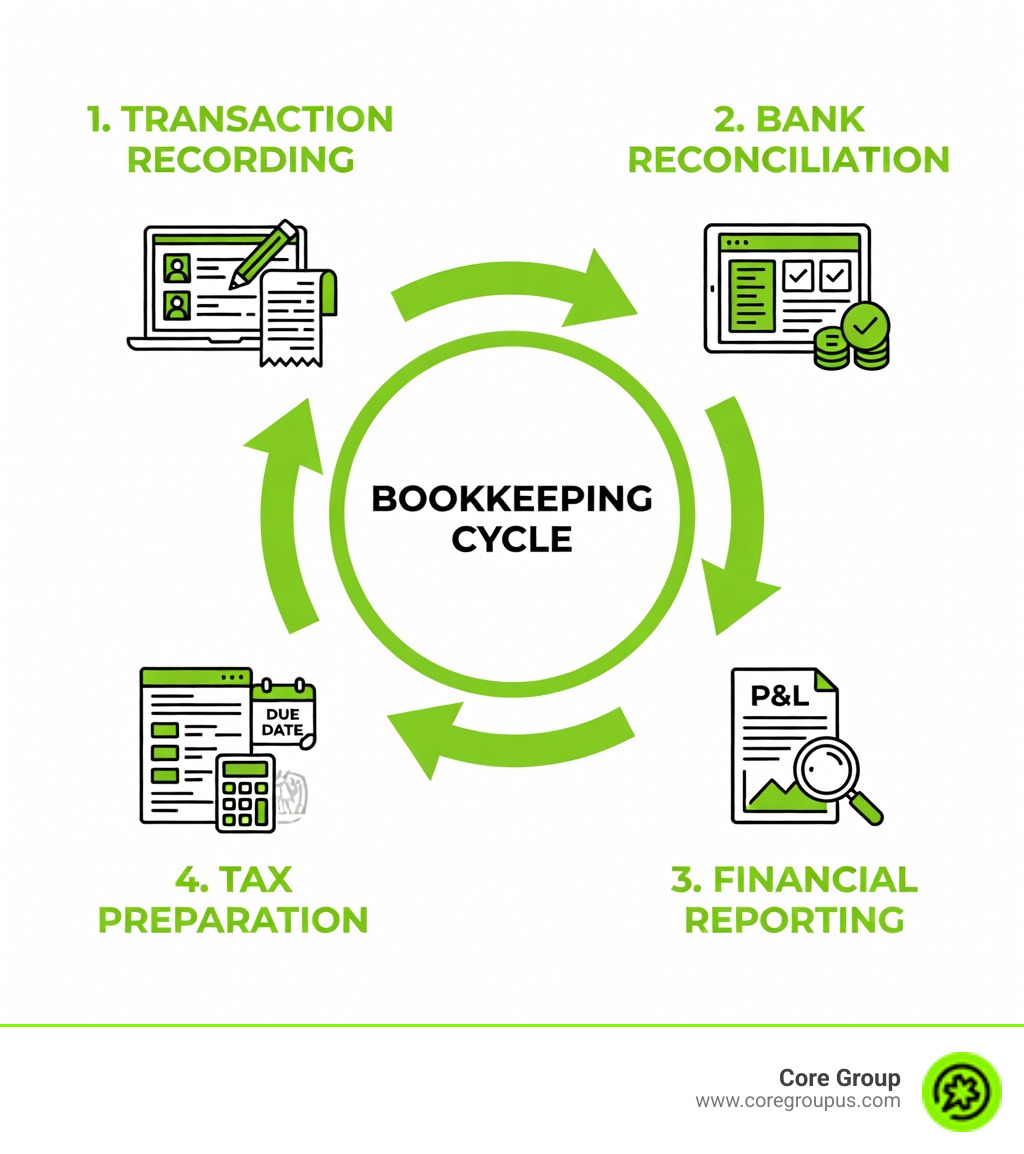
At its core, bookkeeping is the process of recording every single financial transaction that flows through your business. Think of it as the "how" of your financial story. It’s the daily and weekly grind of capturing data, while accounting is the "what"—the analysis and interpretation of that data to make big-picture decisions.
For many of us, the word "bookkeeping" conjures up images of dusty ledgers or complex spreadsheets that look like they belong in a math textbook. In reality, modern bookkeeping for small business is about transparency. It’s about knowing exactly where your money is going so you don't wake up one morning wondering why your bank account is empty despite a record-breaking month of sales.
According to recent industry data, 70% of small businesses operating without an accountant are often flying blind. This lack of oversight is a major contributor to the statistic that 82% of small businesses fail due to cash flow problems. When you don't track your revenue and categorize your expenses, you lose the ability to forecast. You can't tell if that new camera lens was a deductible investment or a luxury that just put you in the red.
Effective bookkeeping provides
- Financial Transparency You see the "real" numbers, not just the "vibes" of your bank balance.
- Audit Protection If the IRS ever comes knocking, you’ll have a clean trail of documentation.
- Improved Decision Making Should you hire an assistant? Can you afford a new studio space? Your books will tell you.
- Tax Readiness Instead of a frantic scavenger hunt in April, you’ll have everything ready to go.
If you are feeling overwhelmed, you don't need a PhD in finance to start. Many entrepreneurs begin by working with Bookkeepers who specialize in their specific niche, ensuring the system is built correctly from day one.
Choosing the right accounting methods and systems
Before you enter your first transaction, you need to decide how you’re going to play the game. There are two primary decisions to make: your entry system (Single vs. Double) and your accounting method (Cash vs. Accrual).
Single Entry vs Double Entry Bookkeeping
Single-entry bookkeeping is like keeping a checkbook. You record transactions as they come in or go out. It’s simple and works for very small, service-based businesses with low transaction volumes. However, it doesn't track assets like equipment or liabilities like loans very well.
Double-entry bookkeeping is the industry standard. For every entry, there is a corresponding and opposite entry in a different account. If you spend $1,000 on a new laptop, your "Cash" account goes down by $1,000, and your "Assets" account goes up by $1,000. This keeps your books balanced and provides a much more accurate picture of your business's health. Most modern software uses this method automatically.
Cash Basis vs Accrual Basis Accounting
This is where things get interesting. The method you choose dictates when a transaction is officially recorded.
| Feature | Cash Basis Accounting | Accrual Basis Accounting |
|---|---|---|
| When is income recorded? | When the money hits your bank account. | When the invoice is sent (earned). |
| When are expenses recorded? | When you actually pay the bill. | When you receive the bill (owed). |
| Complexity | Very simple; easy to track cash flow. | More complex; requires tracking AR/AP. |
| Accuracy | Can be misleading if you have many unpaid invoices. | Provides a better long-term financial picture. |
| Best For | Bookkeeping for Solopreneurs and micro-businesses. | Growing businesses and those with inventory. |
The IRS has specific IRS guidelines on record keeping for small businesses that you should review, especially as your revenue grows. Most small creative businesses start with the cash method because it’s intuitive. If you have $5,000 in the bank, you know you have $5,000. In the accrual method, you might "have" $10,000 on paper because of outstanding invoices, but you can't actually use that money to pay rent yet!
Essential tasks for effective bookkeeping for small business management
Consistency is the secret sauce of stress-free bookkeeping. We recommend setting a "Fiscal Friday" or a similar routine to stay on top of the numbers. If you let it pile up, it becomes a monster under the bed that you’re too scared to look at.
Daily Tasks
- Record Transactions Enter every sale and every expense.
- Deposit Payments Don't let checks sit on your desk. Get them into the business account immediately.
- Track Receipts Use an app to snap a photo of that coffee meeting receipt before it fades into a blank slip of thermal paper.
Weekly Tasks
- Reconcile Bank Accounts Match your software entries to your actual bank statement. This catches errors, double-charges, or forgotten subscriptions.
- Review Unpaid Invoices Send polite reminders to clients who are late. Cash flow is king!
- Pay Bills Stay on top of your accounts payable to avoid late fees.
Monthly Tasks
- Generate a Profit and Loss Statement This shows your total income minus expenses. Are you actually making money?
- Review the Balance Sheet This shows what you own (assets) and what you owe (liabilities).
- Process Payroll If you have a team, ensure everyone is paid and tax withholdings are set aside. This is a great time to review Business Financial Planning for the month ahead.
Quarterly Tasks
- Estimated Tax Payments The IRS generally expects you to pay taxes as you earn income. Don't wait until April to find out you owe $20,000.
- Review Sales Tax If you sell physical products or certain digital goods, ensure your sales tax filings are up to date.
- Adjust the Budget Compare your actual spending to your goals.
Annual Tasks
- File Income Taxes Use your clean books to make this process a breeze.
- Generate Year-End Reports Review your full year's performance to plan for the next.
- Send 1099s If you paid contractors more than $600, you need to send them a 1099-NEC by January 31st.
Setting up your bookkeeping for small business from scratch
If you’re starting from zero, don’t panic. You can have a functional system running in an afternoon. Here is our "no-fluff" setup guide
- Open a Dedicated Business Bank Account This is non-negotiable. Never mix your personal groceries with your business software subscriptions. It makes reconciliation a nightmare and can even threaten your legal liability protection.
- Choose Your Software While spreadsheets work for the first month, they lack the automation needed to scale. Look for a cloud-based accounting platform that offers features like automated invoicing, bank feed integration, and real-time reporting. The right software will grow with your business and simplify your tax preparation.
- Create Your Chart of Accounts This is just a list of categories for your money. Common ones for creatives include "Software Subscriptions," "Equipment Rental," "Contractor Labor," and "Advertising."
- Connect Your Bank Feeds Most modern software will automatically pull in your transactions. Your job is simply to "categorize" them.
- Establish a Digital Filing System Use tools like Google Drive or Dropbox to store digital copies of all invoices and receipts.
For a deeper dive into the nuances of the creative world, check out our Bookkeeping for Creatives Complete Guide.
Common mistakes in bookkeeping for small business
Even with the best intentions, it’s easy to slip up. Here are the pitfalls we see most often
- Mixing Personal and Business Expenses We mentioned it before, but it bears repeating. If you use your business card for a personal vacation, you're creating a mess for your bookkeeper and a "red flag" for the IRS.
- Falling Behind on Data Entry "I'll do it next month" is a lie we tell ourselves. By next month, you’ve forgotten what that $47.12 charge at the hardware store was for.
- Ignoring Financial Reports Your P&L isn't just for tax time; it's a dashboard for your business. If you don't look at it, you won't see that your "small" software subscriptions have ballooned into a $500-a-month drain.
- Not Saving for Taxes A good rule of thumb is to set aside 25-30% of every check into a separate "Tax Savings" account.
- Poor Communication with Your Team If you’re in a larger city and using Bookkeeping Services Dallas, make sure you’re sending them your receipts and answering their questions promptly so your reports stay accurate.
Frequently Asked Questions about small business finances
What is the difference between bookkeeping and accounting?
Think of it like a professional sports team. The bookkeeper is the scorekeeper—they record every play, every point, and every foul as it happens. The accountant is the coach—they look at the scoreboard and the stats to decide on the strategy for the next game. Bookkeeping is about the past and present; accounting is about the future.
How long should I keep business financial records?
The IRS generally recommends keeping records for three years from the date you filed your original return. However, if you have employees or significant assets, keeping records for seven years is a safer bet. Digital storage makes this easy—just scan and save!
Can I do my own bookkeeping as a small business owner?
Absolutely! Especially when you are just starting out. Using professional accounting software can automate much of the heavy lifting. However, as your business grows and your "to-do" list gets longer, your time becomes more valuable. If you find yourself spending more time on spreadsheets than on your creative work, it’s time to look for professional help.
Conclusion
At Core Group, we know that you didn't become a creative entrepreneur to spend your nights staring at a balance sheet. Our mission is to take that burden off your shoulders with our "no-fluff, profit-first playbook." We specialize in helping Content Creators, filmmakers, and agencies turn their passion into a sustainable, profitable business.
We are so confident in our ability to streamline your finances and provide peace of mind that we back our service with a MacBook Pro guarantee. Whether you need help setting up your first system or you're ready to outsource your entire back office, we’re here to ensure your books stay in business so you can stay in your creative flow.
Effective bookkeeping for small business isn't just about math; it's about freedom. It’s the freedom to know you’re profitable, the freedom to invest in your growth, and the peace of mind that comes with being in total control of your financial destiny. So, take that first step today—open that business account, pick a software, and start writing the next successful chapter of your business story.