A Practical Guide to the Profit First Instant Assessment
Financial Health and the Profit First Methodology
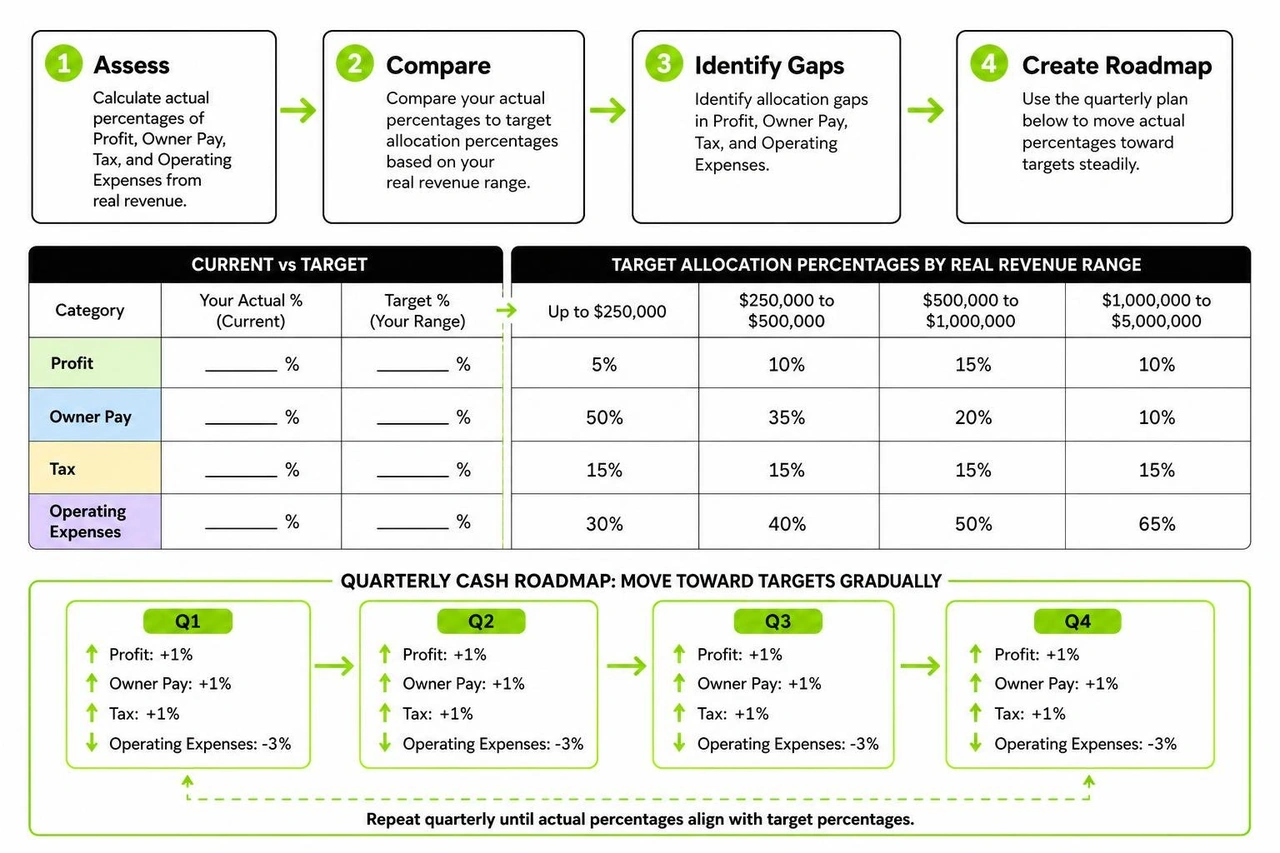
A profit first instant assessment is a rapid diagnostic tool that evaluates your company's actual cash flow allocations against target financial benchmarks. To run the evaluation, subtract materials and subcontractor costs from your annual top line revenue to determine your real revenue. Next, calculate the exact percentages of real revenue currently distributed toward profit, owner pay, taxes, and operating expenses. Comparing these actual percentages to target allocation standards immediately pinpoints cash leaks and operational overspending.
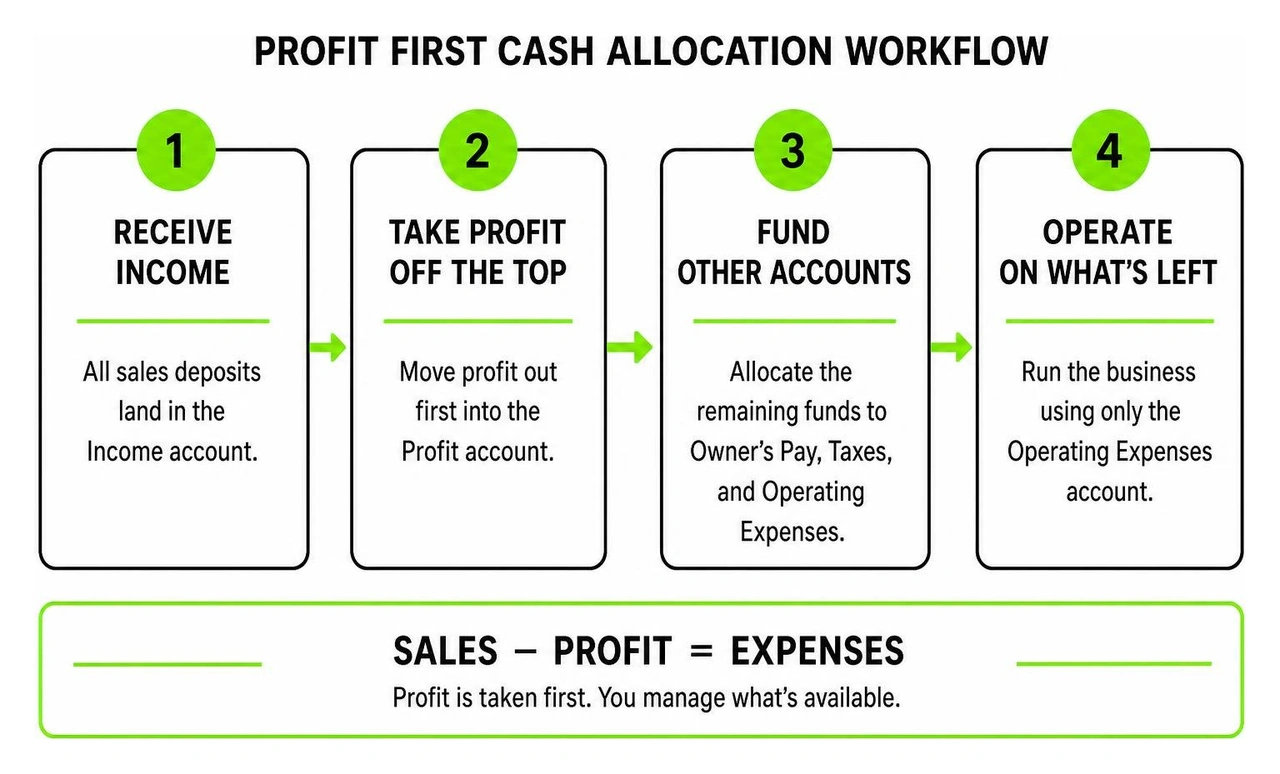
Traditional accounting relies on a basic equation where sales minus expenses equals profit, which often leaves business owners with accidental leftovers. The Profit First framework flips that formula so sales minus profit equals expenses. By taking profit off the top, we force our businesses to operate within the remaining balance. This shift relies on behavioral finance rather than sheer willpower. Instead of trying to change human habits around bank balances, we leverage the natural human tendency to manage what is readily available.
Understanding what is the profit first method guide helps clarify how this cash management philosophy protects small business viability. Over 10,000 businesses worldwide have adopted this cash control approach since its introduction in 2014, showing that structured cash allocation can stabilize companies across every sector. When entrepreneurs ask how does the profit system guide entrepreneurs, the answer lies in providing direct cash visibility without forcing founders to become certified public accountants.
Ideal Candidates for Diagnostic Evaluation
Every business owner can benefit from knowing their baseline, but certain profiles gain immediate clarity from a quick diagnostic. Creative entrepreneurs, marketing agency owners, video production studios, digital service providers, and architectural firms frequently deal with fluctuating project revenue. These businesses often look healthy on an accrual profit and loss statement, yet they struggle to make payroll or cover quarterly estimated taxes.
The diagnostic is ideal for businesses that experience recurring revenue plateaus, inconsistent cash flow, or persistent stress around tax season. If your company brings in healthy top line revenue but your personal bank balance never seems to grow, running this initial check will reveal where the disconnect lives.
Differences Between the Instant Diagnostic and Full Implementation
A diagnostic evaluation provides a snapshot of where your company stands today versus where it should ideally operate. It acts like a routine checkup at the doctor's office, highlighting elevated blood pressure or vitamin deficiencies without performing the actual surgery.
The permanent setup involves opening multiple dedicated bank accounts, establishing twice monthly transfer habits, and systematically tuning your cash flows. Learning the complete profit first method gives you the long term playbook for sustainable growth, while the diagnostic simply shines a light on your current reality.
Step by Step Guide to the Profit First Instant Assessment
Completing your diagnostic takes under fifteen minutes when you have your past twelve months of financial data ready. This evaluation looks at historical facts, not optimistic projections. By looking at actual numbers from the prior four quarters, you remove guesswork and uncover existing profit leaks.
Essential Numbers Needed for the Profit First Instant Assessment
To get started, pull your balance sheet, your tax returns from the most recent tax year, and your trailing twelve month profit and loss statement. You will need five foundational figures.
- Top Line Revenue. This represents your total gross income, meaning all funds collected from clients and customers over the past twelve months.
- Materials and Subcontractors. These are your direct costs of goods sold, external contractor payouts, and physical project supplies necessary to deliver your core service.
- Real Revenue. Subtract your materials and subcontractor expenses from your top line revenue. Real revenue is the true spending power your business has to cover overhead, pay its team, reward the owner, and fund taxes.
- Actual Profit, Owner Pay, Taxes, and Operating Expenses. Review your records to see how much cash was actually transferred into pure profit reserves, how much total compensation went to the owner as salary and distributions, how much was paid in taxes, and how much went toward general operating costs.
Calculating Target Allocation Percentages
Once you calculate your real revenue, compare your current distribution breakdown against established benchmarks known as target allocation percentages. These benchmarks vary depending on your real revenue bracket, ensuring smaller businesses and larger enterprises are held to realistic, scalable standards.
| Real Revenue Range | Target Profit % | Target Owner Pay % | Target Tax % | Target Operating Expenses % |
|---|---|---|---|---|
| Up to $250,000 | 5% | 50% | 15% | 30% |
| $250,000 to $500,000 | 10% | 35% | 15% | 40% |
| $500,000 to $1,000,000 | 15% | 20% | 15% | 50% |
| $1,000,000 to $5,000,000 | 10% | 10% | 15% | 65% |
Reviewing standard profit first percentages shows that as your real revenue increases, the percentage required for owner pay naturally scales down while operational capacity scales up. Calculate your current actual percentages by dividing each actual category total by your real revenue. Comparing your actual percentages to these target figures reveals your exact allocation gaps.

Analyzing Assessment Scores and Identifying Profit Leaks
Your assessment results highlight the financial health of your enterprise. Approximately 90 percent of entrepreneurs who run this diagnostic discover at least one major cash leak. The results usually point toward one of three common issues, including operating expense bloat, founder compensation shortfalls, or missing tax reserves.
Uncovering Hidden Overhead Costs
The most frequent revelation is an operating expense percentage that exceeds target benchmarks by fifteen to thirty percentage points. When overhead consumes the bulk of your real revenue, cash that should reward you or protect you from tax liabilities gets swallowed by recurring expenses.
Companies using these principles reduce their operating expenses by an average of 15 percent in their first quarter simply by conducting an intentional review. Audit every recurring software subscription, cancel redundant cloud tools, renegotiate vendor contracts, and eliminate services that do not directly generate revenue or deliver client value.
Evaluating Owner Pay and Tax Reserves
Many creative entrepreneurs discover they are severely underpaying themselves to keep their businesses afloat. If your business shows a target owner compensation of 35 percent but your actual pay sits at 10 percent, you are personally subsidizing your business operations with unpaid labor.
Similarly, an assessment score showing zero tax reserves means your business is vulnerable to unexpected tax bills. Structuring consistent tax allocations into a separate account prevents panic when tax obligations come due, protecting your personal life from corporate liabilities.
Turning Your Profit First Instant Assessment into Actionable Goals
Knowing your numbers is only valuable if you take decisive action. Moving your actual numbers to your target percentages cannot happen overnight. If your operating expenses are currently at 70 percent and your target is 40 percent, cutting 30 percent immediately could disrupt client delivery and cause operational panic.
Instead, implement gradual adjustments of 1 percent each quarter. Increase your profit allocation by 1 percent, raise your owner pay allocation by 1 percent, boost your tax allocation by 1 percent, and reduce your operating expense spending by 3 percent. Working alongside a certified profit first advisor ensures these adjustments stay manageable while moving your balance sheet steadily toward peak health.
Establishing Sustainable Quarterly Rhythms
Transforming your business requires consistent financial habits. Schedule a quarterly review on your calendar to analyze your actual performance against your target milestones. Over 80 percent of small businesses that stick to these allocation habits experience positive cash flow within six months.
Collaborating with a trained profit first bookkeeper gives you clean monthly ledgers, making quarterly transfers and bonus distributions straightforward. On the last day of each quarter, celebrate your progress by taking 50 percent of the accumulated profit account balance as an owner dividend, leaving the remaining half as an emergency cash buffer.
Common Pitfalls and Assessment Limitations
While a diagnostic evaluation is an exceptional tool, relying solely on a single static score presents clear limitations.
- Single Period Snapshot. Twelve months of historical data might include one off legal expenses, irregular equipment purchases, or unusual seasonal dips that do not represent ongoing realities.
- Delayed Implementation. The most common pitfall is running the assessment, experiencing brief shock at the numbers, and returning to business as usual without opening separate allocation accounts.
- Overly Aggressive Shifts. Slashing overhead too rapidly without evaluating contract commitments or team capacity can harm client delivery.
- Lack of Accountability. Without external oversight, it is easy to borrow money back out of tax or profit accounts to cover operational overspending.
Frequently Asked Questions About Profit Assessments
How long does the instant diagnostic take to complete
The evaluation takes about fifteen minutes once you collect your trailing twelve month profit and loss statement and balance sheet. The math itself requires only a handful of straightforward calculations to find your real revenue and actual allocation percentages.
How often should a business retake the assessment
We recommend revisiting the diagnostic every twelve months, or sooner if your business crosses into a new revenue tier. If your company expands from $400,000 to over $1,000,000 in real revenue, your target allocation percentages will adjust to support a larger operational footprint.
What should you do if your actual profit score is zero
Do not panic if your starting profit allocation is zero percent. Begin by opening a separate profit checking account and transferring just 1 percent of every client payment into it. Building the habit of setting aside profit first matters more in the initial weeks than the absolute dollar amount.
Conclusion
Conducting a quick baseline assessment is the fastest way to replace financial anxiety with clear operational direction. When you know your exact real revenue and compare your current spending habits against proven benchmarks, you gain the power to make intentional decisions about pricing, hiring, and overhead management. Businesses using these allocation principles report an average 30 percent increase in profitability within their first year.
At Core Group, we help creative entrepreneurs transform their financial operations with structured cash management, bookkeeping, and tax guidance. Our team provides a no fluff playbook that frees up your time and delivers total peace of mind, backed by our MacBook Pro guarantee. Explore our comprehensive accounting solutions to build a sustainable, highly profitable business that serves your life.