What is the Profit First Method? A Simple Guide to Cash Management
Why So Many Business Owners Never Actually Keep Their Profits
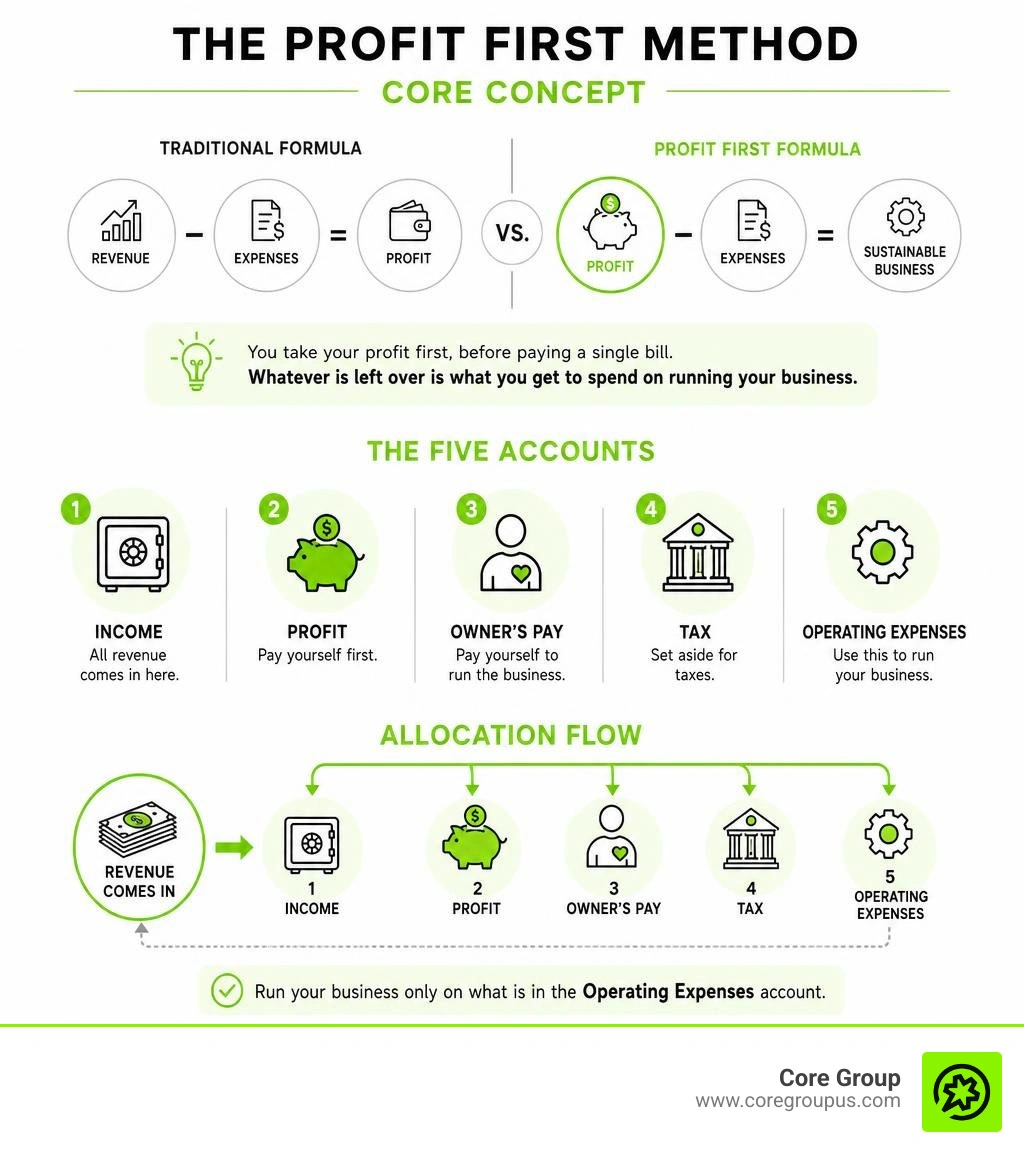
What is the Profit First method? It is a cash management system that flips the traditional accounting formula. Instead of Revenue minus Expenses equals Profit, it works in a specific way.
Revenue minus Profit equals Expenses.
You take your profit first, before paying a single bill. Whatever is left over is what you get to spend on running the business.
Here is a quick summary of how it works.
- Every time revenue comes in, it goes into an Income account
- You immediately move a set percentage into a protected Profit account
- The rest gets divided into accounts for your pay, taxes, and operating costs
- You run your business only on what is in the Operating Expenses account
That is the whole idea. Profit stops being something you hope is left over at the end of the month. It becomes automatic.
Most creative entrepreneurs are great at their craft and terrible at keeping money. Revenue comes in, expenses eat it up, and the cycle repeats. You might be billing more than ever and still feel broke.
The reason is simple. When all your cash sits in one account, it all looks available. So it all gets spent.
The Profit First method fixes this with structure, not willpower.
It was created by author Mike Michalowicz after he sold two companies and still ended up nearly broke. The system he built has since been adopted by over 175,000 businesses worldwide.
Essential what is the profit first method terms include bookkeeping for solopreneurs and business profit coach.
What is the Profit First Method and How Does It Differ From Traditional Accounting
Traditional accounting has been taught the same way for centuries. Under Generally Accepted Accounting Principles, or GAAP, the formula is simple. You take your sales, subtract your expenses, and whatever is left over is your profit. While this makes perfect logical sense, it often fails in the real world because humans are not purely logical creatures.
Mike Michalowicz recognized this flaw after experiencing his own financial rise and fall. He realized that traditional accounting treats profit as an afterthought, like a dessert you only get if you finish all your vegetables. By the time you pay every vendor, software subscription, and utility bill, there is rarely any dessert left.
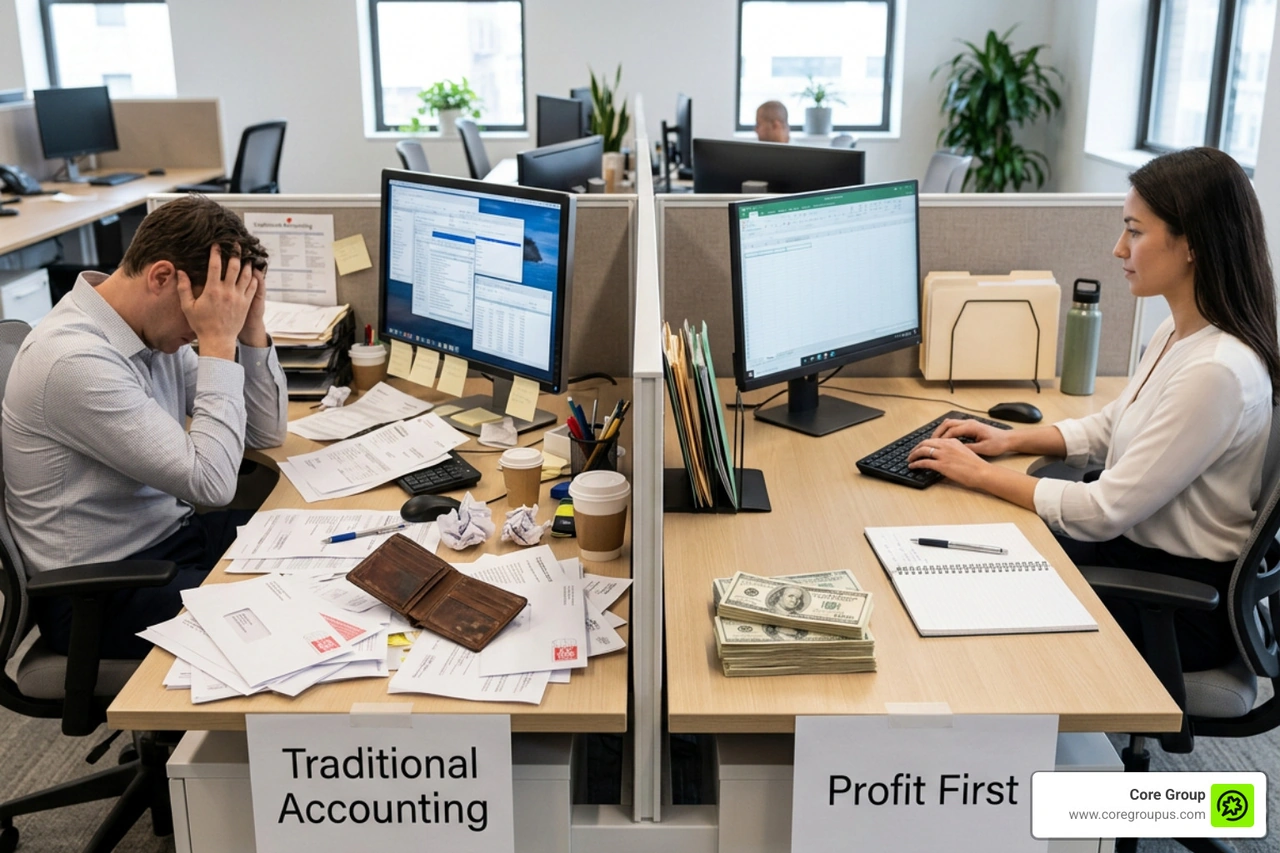
To fix this, we must look at behavioral psychology. The Profit First method flips the equation to Sales minus Profit equals Expenses. This utilizes the primacy effect, which is a psychological principle showing that we naturally focus on and prioritize whatever we put first. When you set aside your profit immediately, you force your business to operate on the remaining balance.
This approach leverages Parkinson's Law, which states that our demand for a resource expands to match its supply. If you have a giant pool of cash in a single checking account, you will find ways to spend it. By intentionally shrinking the amount of money available for expenses, you force your business to become more efficient.
You can read more about how this behavioral shift transforms cash flow in our guide to the Profit First Method. Understanding this system is a crucial part of Business Financial Planning for any growing company. For a deeper look at the mechanics, you can also explore this resource on What is The Profit First Method and How Does it Work?
The Five Core Bank Accounts and How the Allocation Process Works
The backbone of this system is the physical separation of cash. Many business owners try to manage their money using spreadsheets, but mental accounting quickly falls apart under pressure. To make this work, you need to set up five distinct bank accounts.
The five core accounts are the Income account, the Profit account, the Owner's Compensation account, the Tax account, and the Operating Expenses account.
Here is how the cash flows. All revenue from your sales lands in the Income account first. This acts as a holding tank. Then, on designated allocation days, you distribute that money into the other four accounts based on set percentages. Most businesses do this on the 10th and 25th of every month.
We highly recommend reading about Budgeting for Entrepreneurs to see how this fits into your larger financial picture. You can also check out our Money Management Tips for keeping your overhead low. For more context on how this system operates, you can read about What is the Profit First method? to see how other organizations manage their cash flow.
| Account Name | Primary Purpose | How Cash Flows |
|---|---|---|
| Income | Holding tank for all incoming revenue | All client payments land here first and are transferred out on allocation days |
| Profit | Accumulated business profit and cash reserves | Receives a percentage of income and is used for quarterly distributions |
| Owner's Compensation | Salary and payroll for the business owner | Receives a percentage of income to ensure you are paid a fair wage |
| Tax | Funds set aside for state and federal taxes | Receives a percentage of income to cover all business tax liabilities |
| Operating Expenses | Working budget for running the business | Receives the remaining funds to pay for software, rent, and administrative costs |
Step by Step Instructions for Implementing the System
Implementing this system requires a clear plan. You cannot simply jump from zero to your ideal profit margins overnight. It typically takes six to twelve months to fully bridge the gap between where your business is today and where you want it to be.

The first step is to conduct an Instant Assessment. This helps you find your Current Allocation Percentages, which represent how your money is actually being spent right now. Most business owners discover that their operating expenses consume about eighty-five percent of their revenue.
Once you know your starting point, you can set your Target Allocation Percentages. We recommend starting very small. If your business has never kept a profit before, start by allocating just one percent to your Profit account. This small shift builds the habit without starving your operations.
As you gain confidence, you can gradually increase your profit and tax percentages while lowering your operating expenses. This disciplined approach is essential for long term Tax Planning Strategies and overall financial health. If you need help navigating this transition, working with a Business Profit Coach can provide the accountability you need to stay on track.
Here are some common mistakes to avoid during your implementation.
- Setting unrealistic percentages too quickly
- Raiding your tax or profit accounts to cover operational cash shortages
- Skipping scheduled allocation days
- Overcomplicating the system with too many extra accounts
Frequently Asked Questions about Profit First Bookkeeping
What is the profit first method and who created it
Mike Michalowicz created the system and published his book in 2014. He designed it to solve a very specific problem, which is the cash-eating monster that many businesses become. Michalowicz realized that traditional accounting methods do not work for busy entrepreneurs who manage their businesses by checking their bank balances. His system creates a behavioral change that makes profit a habit rather than an event.
What is the profit first method target allocation percentage
Your target percentages depend on your Real Revenue, which is your total revenue minus the cost of materials and subcontractors. For businesses making under two hundred and fifty thousand dollars in Real Revenue, the standard targets are five percent for profit, fifty percent for owner's pay, fifteen percent for taxes, and thirty percent for operating expenses. As your revenue grows, these targets shift. Larger businesses require a smaller percentage for owner's pay but a higher percentage for operating expenses and profit.
Which businesses benefit most from this cash system
Service businesses and creative entrepreneurs benefit immensely from this system because they typically have lower overhead and can easily adjust their spending. However, businesses with extremely high fixed costs or heavy debt challenges may find the system difficult to implement at first. If your business carries significant debt, you must focus on aggressive expense control and revenue generation before you can comfortably meet high profit targets.
Conclusion
Running a creative business should bring you joy and financial freedom, not endless stress over cash flow. At Core Group, we help creative entrepreneurs take control of their finances with a clear, no-fluff playbook that guarantees peace of mind.
Our services are designed to save you time so you can focus on your craft, and we even back our work with a MacBook Pro guarantee. If you are ready to stop worrying about your bank balance and start building a permanently profitable business, we are here to help.
Get professional accounting help today and let us help you put profit first.