S-corp Setup Process 101
Why the S-Corp Setup Process Matters for Creative Entrepreneurs

The S-corp setup process is a tax election that can save creative entrepreneurs thousands annually in self-employment taxes while providing legal liability protection. It involves:
Quick Overview of the S-Corp Setup Process:
- Form a legal entity (LLC or Corporation) with your state
- Obtain an Employer Identification Number (EIN) from the IRS
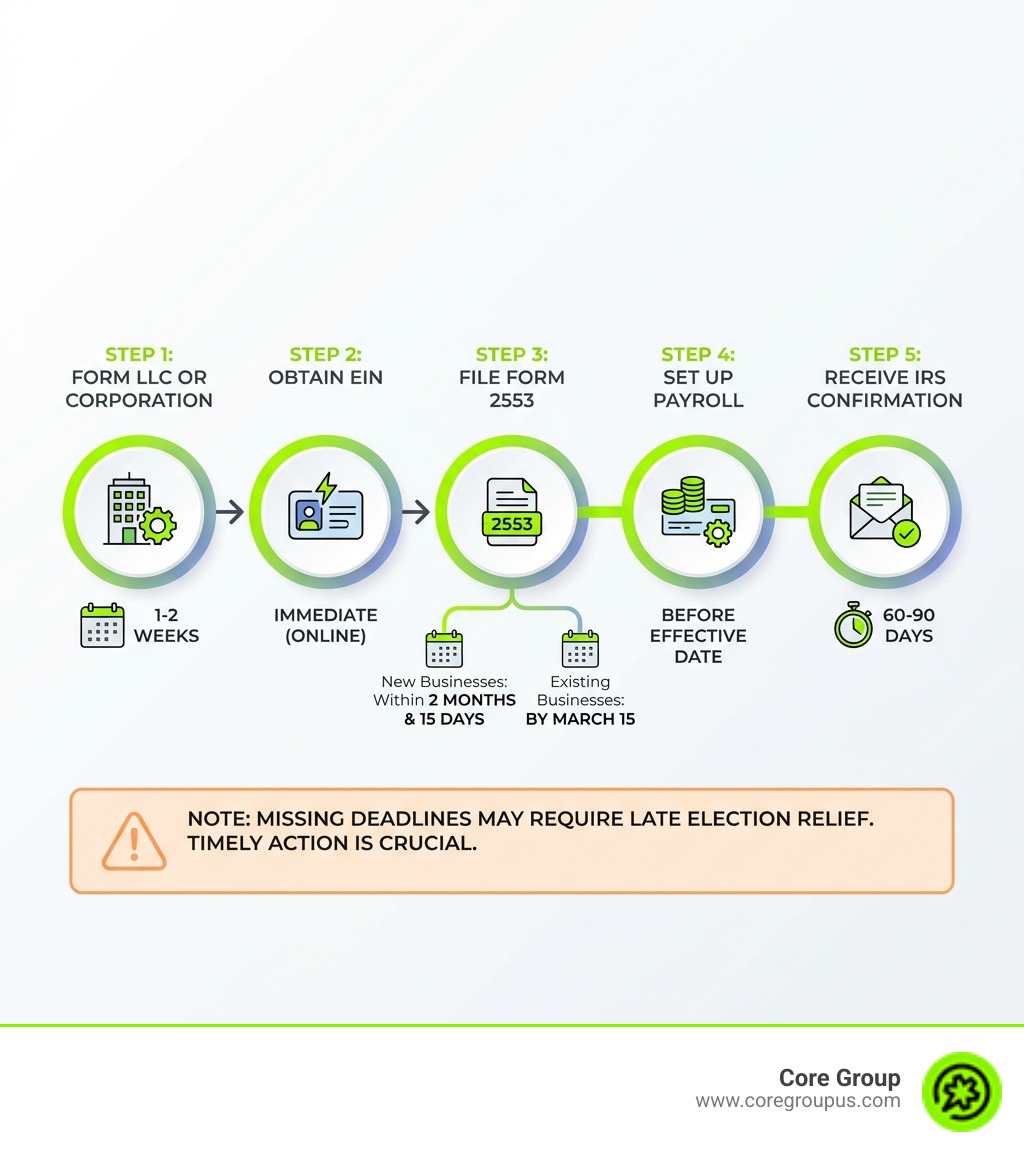
- File Form 2553 to elect S-corp tax status with the IRS
- Set up payroll for yourself as a shareholder-employee
- Maintain compliance with ongoing filing and reporting requirements
Here's the truth: An S-corp isn't actually a business entity. It's a tax election you make with the IRS after forming an LLC or corporation.
S-corp status becomes worthwhile for creative entrepreneurs earning around $40,000-$50,000 in net profit after paying a reasonable salary. At this point, the tax savings typically outweigh the added costs of payroll and compliance.
The process can be overwhelming, involving IRS forms, state filings, and strict deadlines. Mistakes like missing the Form 2553 deadline or setting up payroll incorrectly can delay tax savings by a year or trigger IRS penalties.
This guide breaks down the complete S-corp setup process into clear, actionable steps. We'll cover the two formation paths, critical deadlines, estimated costs, and common mistakes to avoid. Whether you're a filmmaker, photographer, or content creator, you'll learn exactly how to structure your business to maximize tax savings while maintaining your creative focus.
Understanding the S-Corp: A Tax Election, Not a Business Entity
An S-corp, or "Subchapter S Corporation," isn't a business entity you form with your state. It's a federal tax election made with the IRS, referencing Subchapter S of the Internal Revenue Code. This election allows businesses to pass income to shareholders without paying corporate-level tax.
This distinction is crucial: you first form an LLC or C-corporation with your state, then ask the IRS to tax it as an S-corp. Your state only recognizes the underlying legal entity, not the tax election.
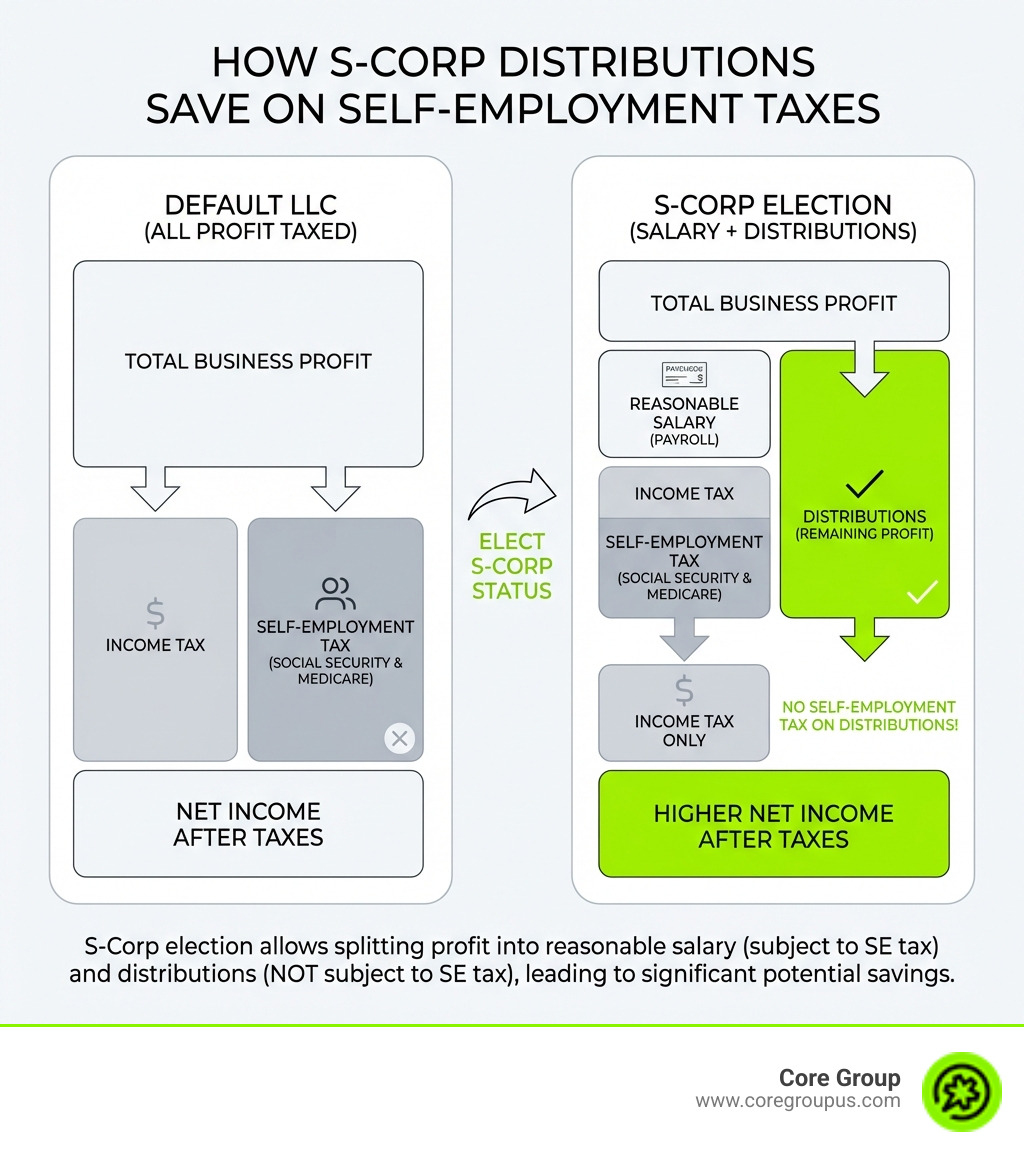
The main appeal of an S-corp is saving on self-employment taxes. As a shareholder-employee, you must pay yourself a "reasonable salary" via payroll, which is subject to Social Security and Medicare taxes. However, remaining profits taken as distributions are not subject to these taxes. This offers significant savings compared to a default LLC or sole proprietorship, where all profits are subject to self-employment tax.
S-Corp vs. LLC vs. C-Corp
Understanding the differences between these business structures is key to making an informed decision for your creative business.
FeatureLLC (Default Tax)S-Corp (LLC or Corp Election)C-CorpLegal EntityState-formed legal entityTax election applied to an LLC or CorporationState-formed legal entityLiability ProtectionStrong protection from personal liabilityStrong protection from personal liability (inherits from LLC/Corp)Strongest protection from personal liabilityTaxationPass-through (owner pays self-employment tax on ALL profits)Pass-through (owner pays self-employment tax on salary only; distributions are SE-tax-free)"Double Taxation" (corporate tax + shareholder dividend tax)Administrative ComplexityLowModerate (payroll, compliance)High (formal meetings, bylaws, minutes, double taxation)Owner CompensationDraws/distributions (all subject to SE tax)Reasonable salary (subject to SE tax) + distributions (SE-tax-free)Salary (subject to payroll tax) + dividends (double-taxed)Shareholders/OwnersMembers (no limit)Shareholders (max 100, specific types)Shareholders (no limit, any type)
A C-corp is a separate legal entity with strong liability protection. Its profits face "double taxation"—once at the corporate level and again as shareholder dividends—making it less ideal for most small businesses.
An LLC (Limited Liability Company) offers liability protection and operational flexibility. It's a pass-through entity by default, but all profits are typically subject to self-employment tax.
The S-corp election combines the liability protection of an LLC or C-corp with pass-through taxation and self-employment tax savings, making it popular with creative entrepreneurs. For a deeper dive, see our insights on Should Creative Entrepreneurs Become an S-Corp?.
Who is an Ideal Candidate for an S-Corp?
Who benefits most from the S-corp setup process? The election generally makes sense when your net profit exceeds $40,000-$50,000 after paying a reasonable salary. Below this, administrative costs like payroll may outweigh the tax savings.
Service-based businesses and creative entrepreneurs are ideal candidates, including:
- Content Creators
- Photographers
- Influencers
- Videographers
- Marketing Agencies
- Graphic Designers
Their service income is subject to the 15.3% self-employment tax under a sole proprietorship or default LLC. An S-corp reduces this burden. If your business is consistently profitable, an S-corp is a smart move for tax optimization.
S-Corp Eligibility Requirements
Before starting the S-corp setup process, ensure your business meets the IRS's strict eligibility requirements. Failure to do so can lead to a rejected election and unexpected tax liabilities.
Here are the key criteria:
- Domestic Corporation: Your business must be a domestic corporation or an eligible domestic entity (like an LLC that has elected to be taxed as a corporation).
- Allowable Shareholders: Shareholders must generally be individuals, certain trusts, or estates.
- Ineligible Shareholders: Partnerships, corporations, and non-resident aliens cannot be shareholders. This is a common pitfall for businesses with diverse ownership structures.
- Shareholder Limit: The IRS requires S-corps to have no more than 100 shareholders.
- One Class of Stock Rule: Your S-corp can only have one class of stock. While there can be differences in voting rights among shares, all shares must have identical rights to distribution and liquidation proceeds.
It's always a good idea to check the official IRS eligibility requirements for the most up-to-date information.
The Complete S-Corp Setup Process: A Step-by-Step Guide
The S-corp setup process is a sequence of steps. There are two main paths, both starting with forming a legal entity.
Path 1: Form a traditional corporation (C-corp) and then elect S-corp status.Path 2: Form an LLC and then elect S-corp status.
For most small businesses and creative entrepreneurs, forming an LLC and then electing S-corp status is the preferred path. LLCs are easier to maintain, with fewer formalities than corporations. This balance of legal simplicity and tax advantage makes the "LLC taxed as an S-corp" a popular choice.
Regardless of the path you choose, the goal is the same: to gain the tax benefits of an S-corp. You can find more detailed guidance in our article on How to Form an S-Corp.
Step 1: Form a Legal Entity (LLC or Corporation)
Your first step in the S-corp setup process is forming a legal entity with your state.
- Choose Your State: For most small businesses, forming your entity in your home state is the most straightforward option. Our services cover all 50 states.
- Business Name Search: Before you commit, you'll need a unique business name. Search your chosen state's business entity database to ensure availability. Additionally, it's wise to search the USPTO trademark database to avoid potential trademark conflicts.
- File Articles of Organization (LLC) or Incorporation (C-Corp): This is the formal document that legally creates your business entity with the state. It typically includes your business name, address, and registered agent information. Filing fees for this step can range from $50-$500, depending on your state.
- Appoint a Registered Agent: Every legal entity needs a registered agent in its state of formation. This individual or company is responsible for receiving legal and tax documents on behalf of your business. This allows you to keep your personal address private and ensures important correspondence is always received.
Step 2: Create Governing Documents
After forming your entity, creating governing documents is a critical step. They outline ownership, operational rules, and responsibilities.
- LLC Operating Agreement: For an LLC, this document details how the business will be run, how profits and losses will be allocated, and the rights and responsibilities of each member. It's crucial for maintaining liability protection and preventing future disputes.
- Corporate Bylaws: For a corporation, bylaws establish the rules for how the corporation will be governed, including details about shareholder meetings, board of directors, and officer duties.
- Shareholder Agreements: These agreements are particularly important for corporations and LLCs with multiple owners, defining rights, responsibilities, and procedures for selling or transferring ownership shares.
While not always required by the state, these internal rulebooks are a best practice and vital for protecting your personal liability.
Step 3: Obtain an Employer Identification Number (EIN)
An Employer Identification Number (EIN) is a unique nine-digit number from the IRS, like a Social Security number for your business, used for tax identification.
- What is an EIN and Why It's Necessary: You need an EIN to file business taxes, open a business bank account, and hire employees. It's a fundamental identifier for any business taxed as an S-corp or with employees.
- How to Apply for Free: The best part? You can apply directly with the IRS for your EIN, and it's completely free. The online application is typically instant, providing you with your EIN immediately. You'll complete Form SS-4, Application for Employer Identification Number, as part of this process.
Step 4: File Form 2553 for S-Corp Election
This is the pivotal step where you officially elect S-corp tax status with the IRS.
- What is Form 2553: Form 2553, "Election by a Small Business Corporation," is the IRS document you file to request S-corp tax treatment for your entity, instead of its default tax status (LLC/C-corp).
- Shareholder Consent: All shareholders must consent to the S-corp election by signing Form 2553. This ensures everyone involved agrees to the tax implications.
- Where to File: Mail or fax the completed Form 2553 to the correct IRS Service Center for your state. Refer to the Form 2553 instructions for current filing information.
- Confirmation Letter (CP261): The IRS typically sends a CP261 acceptance letter within 60-90 days confirming your S-corp election. Keep this letter for your records and follow up with the IRS if you don't receive it.
Critical Deadlines, Costs, and Common Mistakes
Navigating the S-corp setup process requires attention to deadlines and costs. Missing a deadline can delay tax savings or incur penalties, while understanding the costs ensures you're making a profitable decision.
S-Corp Election Deadlines and Late Relief
Strict deadlines apply to filing Form 2553, and they vary depending on whether your business is new or already established.
- New Business Deadline: If you're a new business wanting S-corp status from your first tax year, you must file Form 2553 within 2 months and 15 days of your business's formation date.
- Existing Business Deadline: For an existing business (e.g., an LLC currently taxed as a sole proprietorship) wishing to elect S-corp status for the current tax year, the deadline is March 15th of that year. Alternatively, you can file at any time during the prior tax year for the next year's election.
- What Happens if You Miss the Deadline: Missing these deadlines can mean you won't qualify for S-corp status for the intended tax year, forcing you to wait until the next year to realize the tax benefits.
- Late Election Relief (Rev. Proc. 2013-30): If you miss the deadline, don't despair. The IRS offers "late election relief" under Revenue Procedure 2013-30, allowing you to request acceptance of a late filing.
- Reasonable Cause: To qualify for late relief, you must show "reasonable cause" for the delay and that you acted diligently to fix it. Examples include natural disasters or relying on incorrect professional advice. You must also prove your business operated as an S-corp from the intended date, including filing appropriate tax returns and running payroll. The request must generally be filed within 3 years and 75 days of the intended effective date.
Estimated S-Corp Costs
While the tax savings can be substantial, the S-corp setup process and ongoing maintenance come with costs you need to factor in.
- Startup Costs: These one-time expenses can range from $50-$1,300.
- State Filing Fees: For forming your LLC or corporation, these typically range from $50-$500 depending on your state.
- Registered Agent Fees: While you can be your own registered agent, many businesses opt for a professional service, costing around $0-$300 for the first year.
- Operating Agreement/Bylaws Drafting: If you hire an attorney, this can add to the cost, though templates are often available.
- Ongoing Annual Costs: These recurring expenses typically run from $1,300-$5,100 per year.
- State Annual Fees/Franchise Taxes: Many states require annual reports or impose franchise taxes. For example, California has an $800 annual minimum franchise tax for LLCs and corporations.
- Registered Agent Renewal: Annual fees if you use a service.
- Payroll Service Costs: Since you must run payroll for yourself, you'll need a payroll service. These services typically have a monthly base fee plus a per-employee charge.
- Tax Preparation Fees: S-corp tax returns (Form 1120-S) are more complex than Schedule C for sole proprietors, so professional tax preparation costs will be higher.
- Bookkeeping Fees: Accurate bookkeeping is paramount for S-corps. We offer comprehensive Accounting services custom for creative entrepreneurs.
It's vital to ensure your projected tax savings will comfortably exceed these ongoing costs to make the S-corp election financially worthwhile.
Common Mistakes in the S-corp Setup Process
Avoiding these common mistakes during your S-corp setup process can save you significant headaches and money.
- Missing Form 2553 Deadline: This is the most common mistake. It can delay tax benefits for a year or force you to seek complex late election relief. File early!
- Not Paying a Reasonable Salary: The IRS requires S-corp owners to pay themselves a "reasonable salary." Paying too little can trigger an audit, reclassification of distributions, and result in back taxes and penalties.
- Commingling Funds: Never mix personal and business finances. Keeping them separate in a dedicated business bank account is essential for liability protection and simplified accounting.
- Skipping the Operating Agreement: This vital document for LLCs defines roles and decision-making. Without it, your personal liability protection is at risk.
- Incorrect Payroll Setup: Payroll for S-corp owners is a requirement. Ensure it's set up correctly for tax withholding and timely payments.
Life After Formation: S-Corp Compliance and Best Practices
Congratulations on completing the S-corp setup process! Now, maintaining your S-corp status requires ongoing diligence to keep your business in good standing and preserve its tax benefits.
- Maintaining Good Standing: This involves filing state annual reports, paying franchise taxes (like California's $800 minimum), and keeping your registered agent information current.
- State-Specific Considerations: The S-corp election is federal, but states have unique rules. For example, states like New York and New Jersey may require separate state-level S-corp elections or have different tax treatments. Always check your state's regulations.
- Annual Reports & Franchise Taxes: Most states require an annual report or information statement to be filed, often with a fee. Be mindful of these deadlines to avoid penalties.
Setting Up Payroll and Determining a Reasonable Salary
One of the most significant ongoing requirements for an S-corp is setting up and maintaining payroll for yourself as a shareholder-employee.
- IRS Requirement for Shareholder-Employees: The IRS requires S-corp owners who work in the business to be paid a reasonable salary. This salary is subject to income tax withholding, Social Security, and Medicare taxes, like any employee's wages.
- Factors for Reasonable Salary: Determining a "reasonable salary" is crucial. The IRS considers factors like:
- Your experience and qualifications
- Your duties and responsibilities
- Time and effort devoted to the business
- Salaries at comparable businesses for similar services
- Your gross receipts and net incomeWe can help you steer this complex calculation to ensure compliance.
- Salary vs. Distributions: After paying a reasonable salary, remaining profits can be taken as distributions, which are not subject to self-employment taxes. This is the key to S-corp tax savings. For support, explore our HR and Payroll for Small Business services.
Essential Post-Formation Steps
Beyond payroll, a few other critical steps will ensure your S-corp is set up for success:
- Open a Business Bank Account: Separating personal and business finances is non-negotiable. Open a dedicated business bank account with your EIN.
- Set Up Bookkeeping System: Implement a robust bookkeeping system from day one for tax compliance, financial analysis, and proving your S-corp's legitimacy.
- Obtain Business Licenses and Permits: Depending on your industry and location, you may need various federal, state, or local business licenses and permits. Research these requirements for your specific business.
- Hold Initial Meetings: Corporations must hold an initial board meeting and document minutes. For LLCs, an initial member meeting to ratify the operating agreement is a good practice.
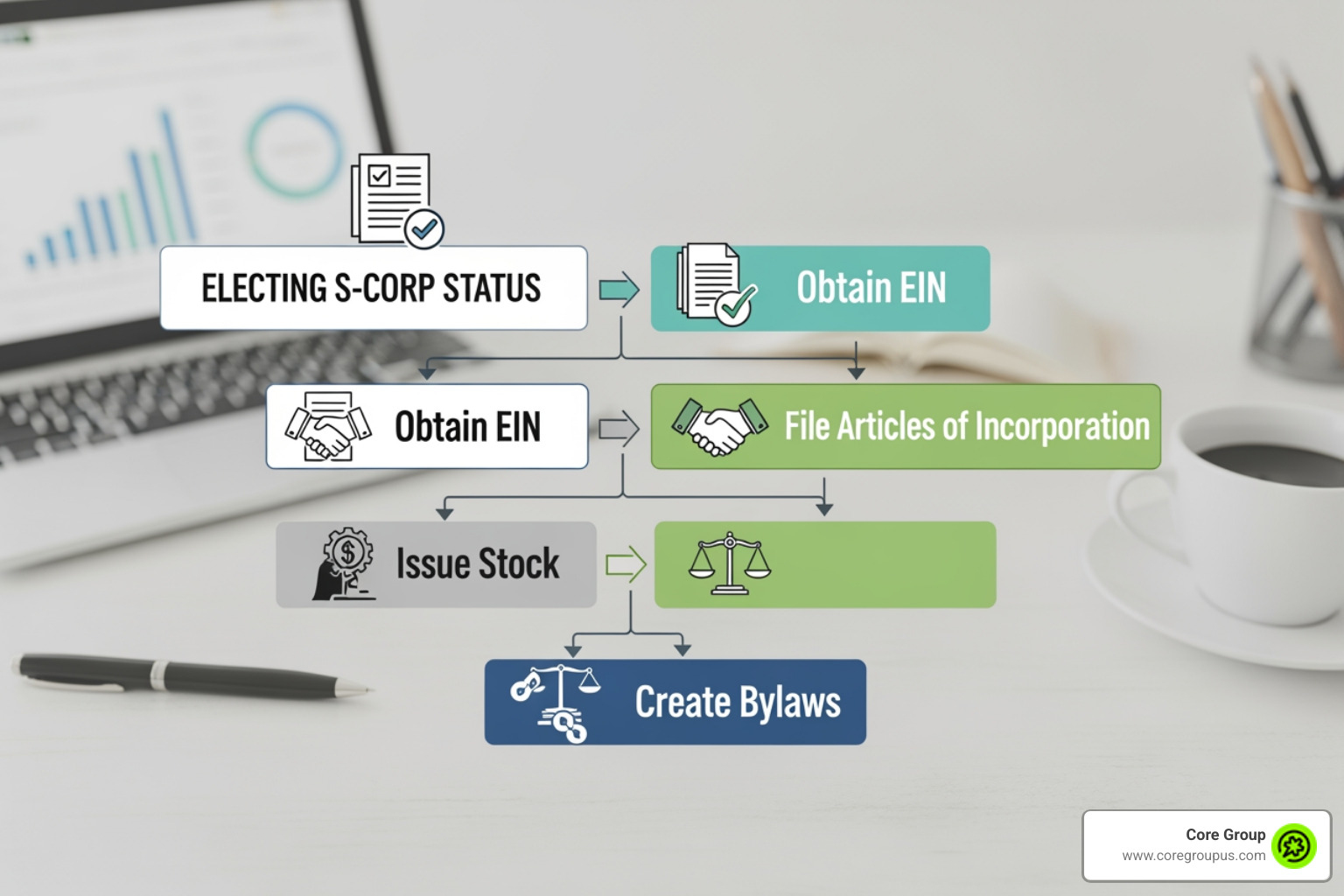
- Issue Stock Certificates (for Corporations): If you've formed a traditional corporation, issuing stock certificates to shareholders formally documents ownership.
Frequently Asked Questions about the S-Corp Setup Process
Here are common questions we hear from creative entrepreneurs about the S-corp setup process.
Can I form an S-Corp by myself?
Yes, you can handle the S-corp setup process yourself, as all forms are publicly available. However, the DIY approach requires meticulous attention to detail and complex tax rules. A small mistake, like missing the Form 2553 deadline or setting an incorrect reasonable salary, can lead to significant penalties and negate tax savings.
Many creatives prefer hiring a professional for peace of mind and to ensure a correct setup. We specialize in helping solo business owners file accurately with the state and the IRS.
How long does the S-corp setup process take?
The timeline for the S-corp setup process varies depending on several factors:
- State Formation Time: Forming your LLC or corporation with the state can take anywhere from a few days to a few weeks, depending on the state's processing times and whether you opt for expedited services.
- EIN Application: Obtaining your EIN from the IRS online is typically instant.
- Form 2553 Processing Time: After you file Form 2553, the IRS generally takes 60-90 days to process it and send you an acceptance letter (CP261).
- Total Timeline Estimate: The core setup can take 2-4 months, assuming no delays. It's best to start well before your desired effective date due to strict filing deadlines.
Can I convert my existing sole proprietorship to an S-Corp?
Yes, you can convert a sole proprietorship or partnership to an S-corp. Since it's a tax election, not an entity, the process involves:
- Forming a Legal Entity: First, you'll need to formally establish an LLC or a traditional corporation with your state. This creates the legal structure that can then elect S-corp status.
- Obtaining an EIN: If your sole proprietorship already has an EIN (for example, if you had employees), you may need a new one for your newly formed LLC or corporation.
- Filing Form 2553: Once your LLC or corporation is established and has its EIN, you'll file Form 2553 with the IRS to elect S-corp tax status, adhering to the deadlines for existing businesses (typically March 15th for the current tax year).
This conversion has tax implications, especially when transferring assets. Consulting a tax professional is highly recommended to ensure a smooth transition and understand any tax consequences.
Conclusion: Is an S-Corp Right for Your Creative Business?
The S-corp setup process is a game-changer for creative entrepreneurs, offering substantial savings on self-employment tax. It combines an LLC's liability protection with tax-efficient pass-through income, leaving more profit in your pocket.
However, this structure brings more administrative work, including strict deadlines, payroll, and compliance. Weigh this against your profitability. The S-corp election is usually beneficial when net profits exceed $40,000-$50,000 after paying a reasonable salary.
Our "no-fluff, profit-first playbook" is designed to help creative entrepreneurs like you steer these decisions with confidence. We believe in empowering you with the knowledge to make informed choices, ensuring peace of mind so you can focus on what you do best—your creative work.
For a comprehensive dive into this topic, listen to The Essential Guide to S-Corporations. For expert guidance on structuring your creative business for maximum profitability, explore our Tax Planning resources.