The Ultimate Guide to S Corporations and IRS Rules
What S Corporations Are and Why They Matter for Your Business
S corporations are one of the most popular business structures in the United States, and for good reason. They let business owners avoid the double taxation that hits regular corporations, while still getting the liability protection that comes with being incorporated.
Here is a quick overview of what you need to know
- What they are - Corporations that elect pass-through tax status under Subchapter S of the Internal Revenue Code
- Who they are for - Small business owners with 100 or fewer shareholders who want tax savings and liability protection
- How they are taxed - Income passes through to shareholders' personal tax returns, not taxed at the corporate level
- Key requirement - Must file Form 2553 with the IRS to make the election
- Biggest benefit - Owners can split income between salary and distributions, which can reduce self-employment taxes significantly
For creative entrepreneurs, especially those in film and media, this structure can be a game-changer. Instead of losing a big chunk of revenue to taxes, you keep more of what you earn and stay focused on your craft.
S corporations have grown from around 750,000 in 1985 to over four million by 2011, making them the most common corporate entity type in the country. That growth tells you something, a lot of small business owners have found real value in this structure.
This guide walks you through everything, from eligibility rules and IRS requirements to state-level taxes and how to actually set one up.
S corporations word roundup
What is an S Corporation and How It Works

An S corporation is not a distinct type of business entity in the eyes of state law. Instead, it is a special tax status that a domestic corporation or a limited liability company elects with the Internal Revenue Service. This status is named after Subchapter S of Chapter 1 of the Internal Revenue Code.
When you set up an s-corp business structure, your company operates under standard corporate rules but enjoys a unique relationship with the federal government. You still have a board of directors, corporate officers, and share certificates. However, the IRS treats your business as a pass-through entity for federal income tax purposes.
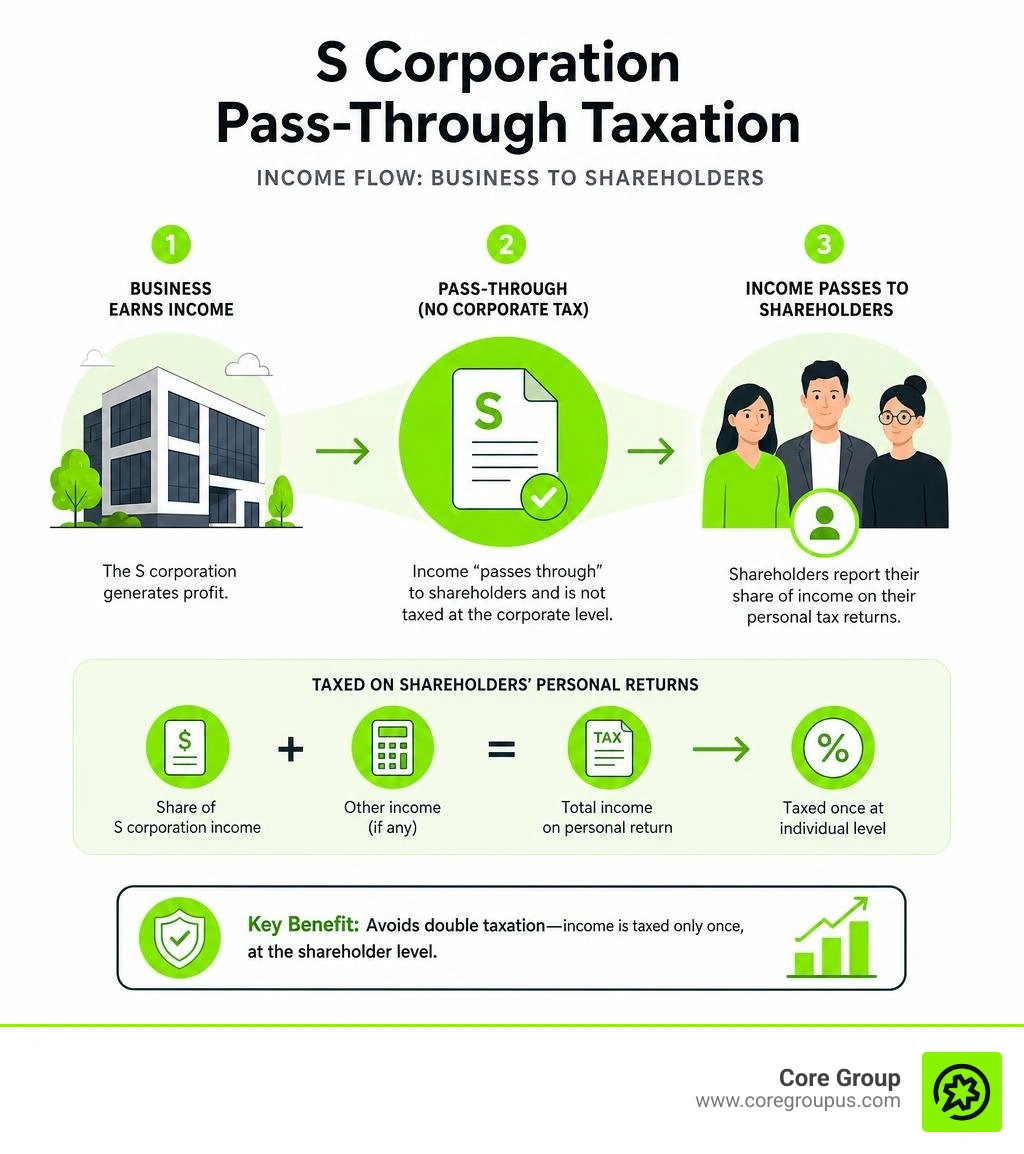
According to the S corporations | Internal Revenue Service guidelines, this election allows the business to pass its corporate income, losses, deductions, and credits directly through to its shareholders. The operational flow is simple. The corporation reports its annual financial activity on an informational tax return, but it does not pay any federal income tax itself. Instead, the profits and losses flow directly onto the personal tax returns of the owners, who pay taxes at their individual tax rates.
S Corporations Versus C Corporations
When you first incorporate your business at the state level, the IRS automatically treats you as a C corporation. Understanding the differences between these two tax classifications is essential for making the right choice for your business.
The primary difference lies in how profits are taxed. C corporations face what is commonly known as double taxation. The corporation pays a flat federal corporate tax rate of 21% on its taxable income. Then, when the remaining profits are distributed to shareholders as dividend distributions, the shareholders must report those dividends and pay personal income taxes on them again.
S corporations avoid this double taxation entirely. Here is a comparison to help you understand the core differences.
| Feature | S Corporation | C Corporation |
|---|---|---|
| Federal Income Tax | Passed through to shareholders | Paid at the corporate level |
| Double Taxation | Avoided entirely | Applies to distributed dividends |
| Shareholder Limits | Maximum of 100 shareholders | Unlimited shareholders |
| Ownership Restrictions | US citizens and residents only | Anyone can hold shares |
| Classes of Stock | Only one class allowed | Multiple classes permitted |
| Tax Filing Form | Form 1120-S | Form 1120 |
For small businesses that plan to distribute most of their income to the owners rather than reinvesting millions into heavy infrastructure, the S election is often the clear winner.
S Corporations Versus LLCs
Many business owners confuse S corporations with Limited Liability Companies. While both offer excellent personal liability protection, they differ significantly in their management flexibility, tax options, and compliance requirements.
An LLC is incredibly flexible. It can be managed by its members or by appointed managers, and it requires very little corporate paperwork. However, LLC owners are considered self-employed. This means they must pay self-employment taxes, which cover Social Security and Medicare, on the entire net income of the business.
An S corporation has more rigid requirements, including holding annual meetings and maintaining detailed corporate minutes. However, it offers a major advantage when it comes to self-employment taxes. As an S corporation owner, you can be treated as an employee of your own company. You pay self-employment taxes only on your reasonable salary, while the remaining business profits can be distributed as tax-free distributions.
When deciding which path to take, we recommend looking at your current revenue. If you want to know if this model fits your creative business, you should read our guide on Should Creative Entrepreneurs Become an S-Corp to see how the savings stack up.
Understanding the Tax Benefits of S corporations

The main reason business owners choose to elect S corporation status is to secure significant tax advantages. By moving away from standard corporate tax rules, you open the door to strategic tax planning that can save you thousands of dollars every year. You can also take advantage of valuable business write-offs, which we explain in detail in our resource on s-corp business deductions.
Pass Through Taxation and Avoiding Double Taxation
As we established, pass-through taxation means the business itself does not pay federal income tax. Instead, the financial activity of the business is reported to the IRS on Form 1120-S. This is an informational return that shows the total revenue, expenses, deductions, and net income of the corporation.
Each shareholder receives a Schedule K-1, which outlines their specific share of the profits, losses, and deductions based on their ownership percentage. The shareholders then copy this information onto Schedule E of their personal Form 1040 tax returns.
One important concept to keep in mind is phantom income. Because the profits pass through to your personal tax return, you must pay income taxes on your share of the profits even if the corporation does not actually distribute the cash to you. For this reason, many S corporations use shareholder agreements that require the business to distribute enough cash to cover each owner's personal tax liabilities.
Reasonable Compensation and Payroll Rules
The strategy of splitting your business income between a salary and shareholder distributions is highly effective, but you must follow strict IRS guidelines.
You cannot simply pay yourself a salary of one dollar and take the rest of your profits as tax-free distributions. The IRS requires every shareholder-employee who provides substantial services to the business to receive reasonable compensation. This salary must be paid through a standard payroll system and is subject to FICA taxes, which include Social Security and Medicare.
Once you pay yourself a reasonable salary, any remaining profit can be paid out as distributions. These distributions are completely exempt from FICA taxes.
Determining what qualifies as a reasonable salary depends on your industry, your geographic location, and your level of expertise. If you pay yourself too little, the IRS can audit your business and reclassify your distributions as wages, hitting you with back taxes, interest, and penalties. To avoid these issues, make sure you understand the s-corp payroll rules before setting up your compensation plan.
Strict IRS Rules and Eligibility Requirements
Because the tax benefits of an S corporation are so generous, the IRS maintains strict rules about which businesses can qualify. To make and maintain a valid S election, your business must meet several specific eligibility requirements.
Under the federal guidelines outlined in the statutory definition of an S Corporation Defined page, your business must be a domestic entity. This means it must be organized under the laws of the United States or an individual state.
Additionally, certain types of businesses are completely ineligible for S corporation status. These ineligible corporations include financial institutions that use the reserve method of accounting for bad debts, insurance companies, and Domestic International Sales Corporations. If your business falls into any of these categories, you cannot make the S election. For a complete breakdown of these limitations, you can review our guide on s-corp eligibility requirements.
Shareholder Restrictions for S corporations
The IRS places strict limits on who can own shares in an S corporation. If you violate any of these rules, your S corporation status will be immediately terminated.
First, an S corporation can have no more than 100 shareholders. Second, all shareholders must be individuals, estates, or certain types of allowable trusts. Partnerships, C corporations, and non-resident aliens are completely prohibited from owning shares in an S corporation. Every single shareholder must be a US citizen or a resident alien.
One Class of Stock and Other Limitations
An S corporation is allowed to have only one class of stock. This means that every share of stock must convey identical rights to distribution and liquidation proceeds.
You are allowed to have voting and non-voting shares of common stock, and this difference in voting rights does not violate the one class of stock rule. However, you cannot issue preferred stock that gives certain investors priority when it comes to dividends or business liquidation.
To help businesses raise capital without violating this rule, the IRS provides a straight debt safe harbor. Under this rule, certain written debts will not be treated as a second class of stock if they represent an unconditional promise to pay a sum certain on demand or on a specified date, the interest rate is not tied to profits, and the debt is not convertible into stock.
The Step by Step Formation Process
Forming an S corporation requires careful planning and precise execution. Because you are setting up a formal corporate structure, you must follow all standard corporate formalities required by your state. To make sure you do not miss any critical steps, we suggest reviewing our detailed s-corp setup process guide.
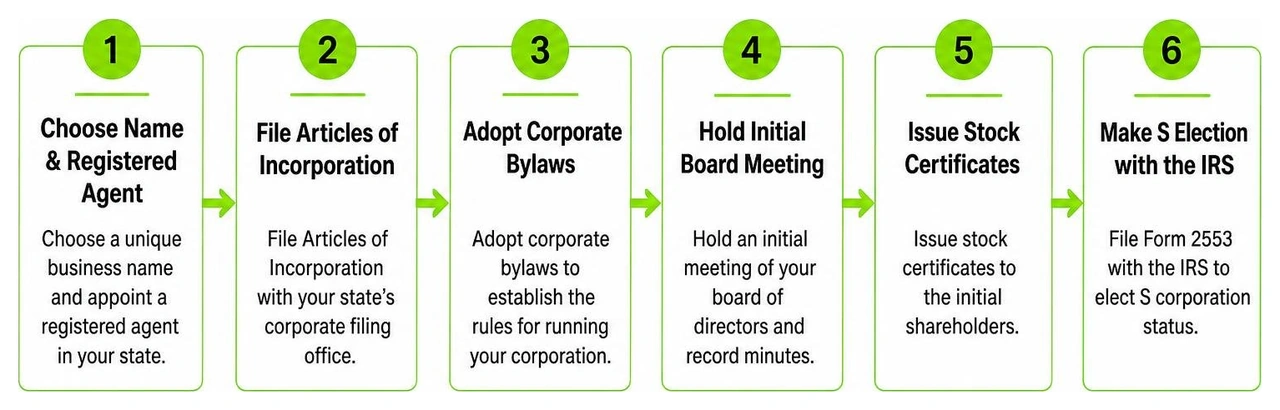
The process begins by choosing a unique business name and appointing a registered agent in your state. Next, you must file Articles of Incorporation with your state's corporate filing office. Once the state approves your filing, you must adopt corporate bylaws, hold an initial meeting of your board of directors, and formally issue stock certificates to your shareholders.
How to Form and Elect Status for S corporations
Once your corporation is officially formed at the state level, you must take the extra step of making the S election with the IRS.
To do this, you must file Form 2553, Election by a Small Business Corporation. This form must be signed by an authorized corporate officer and by every single shareholder of the corporation.
Timing is critical when filing Form 2553. To be effective for the current tax year, you must file the form no later than two months and fifteen days after the beginning of the tax year. If you file the form after this deadline, the S election will not take effect until the following tax year.
If you miss the deadline due to reasonable cause, you can request late election relief from the IRS. However, it is always best to file on time to avoid unnecessary delays and complicated paperwork.
State Level Tax Considerations and Compliance
While the federal government recognizes S corporations as pass-through entities, individual states have their own rules. You must understand how your state taxes S corporations to avoid unexpected tax bills.
For example, California imposes a 1.5% franchise tax on the net income of S corporations, with an annual $800 minimum franchise tax that applies to almost every corporation doing business in the state. You can read more about these rules on the S corporations Business type - Franchise Tax Board - CA.gov page.
In South Carolina, the corporate income tax rate for S corporations is 5%. Additionally, South Carolina requires S corporations to withhold 5% of the taxable income of any nonresident shareholders. This nonresident withholding must be paid using form SC1120S-WH, which is filed separately from the annual corporate return. For more details on these state-specific rules, visit the S Corporation | South Carolina Department of Revenue page.
If your business operates in multiple states, you must comply with the apportionment and withholding rules of every state where you do business. This can make tax compliance highly complex, which is why having an experienced financial team on your side is so important.
Frequently Asked Questions
Navigating the rules of S corporations can raise a lot of questions. We have compiled answers to some of the most common inquiries we receive from business owners.
What happens if an S corporation loses its status
If an S corporation violates any of the eligibility requirements, its S status is immediately terminated. This can happen if the business exceeds 100 shareholders, issues a second class of stock, or transfers shares to an ineligible owner like a partnership or a non-resident alien.
Termination can also happen voluntarily if a majority of the shareholders agree to revoke the S election. If the termination was inadvertent, you can apply to the IRS for relief to restore your S status. However, if your status is officially terminated, you must wait five years before you can apply to elect S corporation status again.
How does the 100 shareholder limit work for families
To help family-owned businesses maintain their S status, the IRS offers generous family aggregation rules.
Under these rules, all members of a family can be treated as a single shareholder for the purposes of the 100 shareholder limit. This family group can span up to six generations, and it includes spouses, former spouses, and direct lineal descendants. This makes it much easier for large families to pass a business down through generations without worrying about losing their S corporation tax status.
Are S corporations required to e-file their tax returns
Yes, many S corporations are required to electronically file their tax returns.
Under IRS rules that took effect for returns required to be filed on or after January 1, 2024, S corporations that file ten or more returns of any type in a calendar year must e-file their Form 1120-S. This ten-return threshold includes W-2 forms, 1099 forms, and employment tax returns. Because almost every operating S corporation easily clears this threshold, electronic filing is now the standard requirement for almost all S corporations.
Conclusion
Choosing the right business structure is one of the most important decisions you will make for your business. An S corporation offers an incredible blend of liability protection and tax savings, but keeping up with the strict IRS rules and state-level compliance requirements can be overwhelming.
At Core Group, we offer expert financial management, bookkeeping, and tax services specifically designed for creative entrepreneurs. We understand the unique challenges of your industry, and we take the stress of financial compliance off your plate.
Our unique profit-first playbook is designed to guarantee your peace of mind and save you valuable time, allowing you to focus entirely on your creative work. We are so confident in our services that we back our work with our signature MacBook Pro guarantee.
If you are ready to take the next step and set up your business for long-term success, we invite you to read our step-by-step guide on How to Form S-Corp and reach out to our team today.