S Corp Payroll Rules That Won't Break the Bank
Why S Corp Payroll Rules Matter More Than You Think
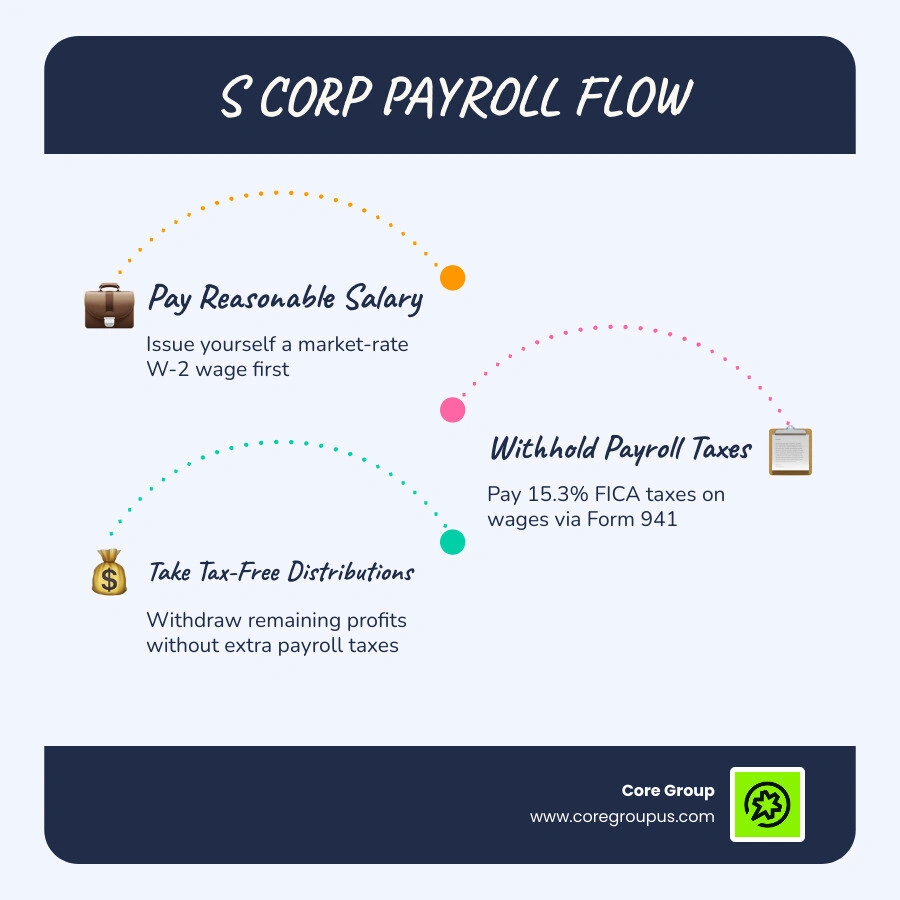
S corp payroll rules require every shareholder-employee who performs more than minor services for the business to receive a reasonable W-2 salary before taking any profit distributions. Here is a quick summary of what that means in practice:
- Reasonable salary first - pay yourself a market-rate wage for the work you do
- Payroll taxes apply to wages - FICA taxes (15.3%) are withheld and paid on your salary
- Distributions come after - remaining profits can be taken as distributions, which are not subject to payroll taxes
- IRS forms required - file Form 941 quarterly, issue a W-2 annually, and report everything on Form 1120-S
- No skipping payroll - you cannot replace your salary with distributions to avoid employment taxes; courts have ruled against this consistently
You started your creative business to make great work, not to become a payroll expert. But once you elect S corp status, the IRS expects you to run a real payroll for yourself, and ignoring that obligation can cost far more than the taxes you were trying to save.
The good news is that S corps are genuinely powerful. An owner paying themselves a $60,000 salary and taking $40,000 in distributions can save over $6,000 per year compared to paying self-employment tax on the full amount as a sole proprietor.
But those savings only hold up if you follow the rules.
The IRS has won case after case against S corp owners who tried to skip wages entirely or paid themselves far below market rates. Getting this right is not complicated, but it does require a clear process.
This guide walks you through exactly what you need to know, without the jargon.
Related content about S corp payroll rules:
Understanding IRS S corp payroll rules for shareholder employees

When you run an S corporation, the line between being the owner and being an employee gets a little blurry. According to the IRS, corporate officers who perform services for the firm and receive or are entitled to payments are considered employees. This means that if you are the one making the magic happen in your business, you cannot just take a "draw" like you might have done as a sole proprietor.
The IRS guidance on shareholder employees is very clear. If you provide more than minor services, you are an employee. There is a tiny "minor services exception" for officers who do almost nothing and aren't entitled to pay, but for most creative entrepreneurs, this does not apply. If you are signing the contracts, making the art, or managing the clients, you are an employee.
To stay compliant with S-Corp Eligibility Requirements, you must acknowledge your dual role. You are both a shareholder who owns the stock and an employee who does the work.
History is full of people who tried to outsmart these rules, and the courts have not been kind to them. In the Veterinary Surgical Consultants case, the court ruled that a sole shareholder had to treat his compensation as wages despite labeling them as distributions. In the David E. Watson case, an accountant paid himself a tiny $24,000 salary while taking hundreds of thousands in distributions. The IRS successfully argued that his salary was not reasonable, leading to massive back taxes.
Understanding How S Corporation Payroll Works starts with accepting that the IRS views your labor as a taxable event. You cannot simply bypass employment taxes by changing the name of the payment on your accounting software.
Determining a reasonable salary for your business

So, how do you decide what to pay yourself? The IRS does not give a specific dollar amount. Instead, they use the term "reasonable compensation." This is defined as the amount that similar businesses would pay for the same or similar services.
When setting your salary, we recommend looking at several factors:
- Training and experience
- Duties and responsibilities
- Time and effort devoted to the business
- Dividend history
- Payments to non-shareholder employees
- What comparable businesses pay for similar services
You can find excellent data through the Bureau of Labor Statistics (BLS) or industry-specific salary surveys. For example, if you are a creative director in Arizona, you should look at what other creative directors in that region earn. This helps you justify your pay if the IRS ever asks.
Using an S Corp Payroll Guide can help you navigate these waters, especially when considering the QBI Deduction Explained. Your W-2 salary actually impacts how much Qualified Business Income deduction you can take, so finding the "sweet spot" is part of a smart tax strategy.
If you are an Arizona S Corp for Solopreneurs or operating in any of our other 50 states, documentation is your best friend. Keep a simple memo in your files explaining how you reached your salary figure based on market data.
Why the 60 40 rule might not satisfy S corp payroll rules
You might have heard of the 60 40 rule. This is a common rule of thumb where you pay yourself 60 percent of profits as salary and 40 percent as distributions. While it sounds simple, it is not an official IRS rule.
Relying on an arbitrary split can be risky. If your business makes $500,000 and you pay yourself $300,000 (the 60 percent), you are likely safe because that is a high salary. But if your business makes $40,000 and you pay yourself $24,000, that might be below the market rate for your professional skills. The IRS cares more about the market value of your work than the percentage of your profit.
When deciding Should Creative Entrepreneurs Become an S-Corp, your salary should reflect the "replacement cost" of your labor. If you had to hire someone to do your job, what would you have to pay them? That is your starting point.
Risks of noncompliance with S corp payroll rules
The consequences of getting S corp payroll rules wrong are not just a slap on the wrist. If the IRS decides your salary is too low, they can reclassify your distributions as wages. This triggers:
- Back taxes for the employer and employee portions of FICA
- Interest on those unpaid taxes
- Failure-to-pay and failure-to-file penalties
- Negligence penalties, which can be quite steep
In some states, like Alabama, there are specific fiduciary responsibilities to consider. Looking into S-Corporations and Fiduciaries in Alabama shows that state departments of revenue often follow federal leads on these audits. Once the IRS finds an issue, the state is usually right behind them.
Comparing wages and profit distributions to maximize savings
The whole reason we love the S corp structure is the tax savings. To understand how to maximize these, we have to look at the difference between wages and distributions.
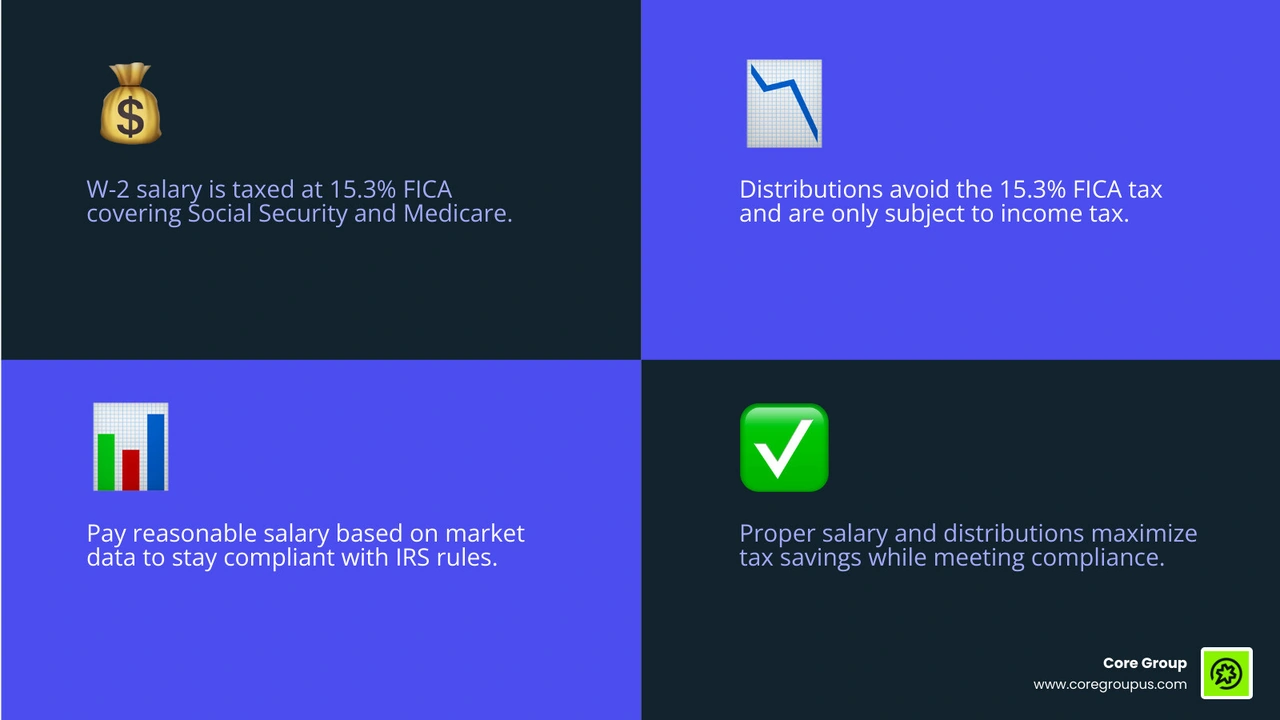
When you receive a W-2 salary, you pay a total of 15.3 percent in FICA taxes. This covers Social Security and Medicare. Half is paid by the business and half is withheld from your check. You also pay federal and state income tax on this money.
Distributions are different. These are payments made to you as a shareholder from the remaining profits. These are not subject to the 15.3 percent FICA tax. They are only subject to personal income tax. This is where the "magic" happens. By paying yourself a reasonable salary and taking the rest as distributions, you save 15.3 percent on every dollar in that distribution category.
For those moving from a Federal Income Tax LLC or managing Single Member LLC Taxes, this is a major shift. In an LLC, you usually pay that 15.3 percent on every single dollar you earn. The S corp breaks that cycle.
Just remember that distributions are only tax-free if you have "basis" in the company. This basically means you cannot take out more money than you have put in or earned through profits. If you take out too much, those distributions could become taxable capital gains.
Essential steps to stay compliant with federal and state laws
Running payroll is a process that requires a few specific steps to get off the ground. You cannot just write yourself a check and call it a day.
First, you need an Employer Identification Number (EIN). Even if you have no other employees, the S corp needs its own EIN for payroll purposes. Next, you must register with your state labor and revenue departments. This allows you to pay State Unemployment Tax (SUTA) and state income tax withholding.
The S-Corp Setup Process also involves setting up Federal Unemployment Tax (FUTA) accounts. FUTA is generally 6 percent on the first $7,000 of wages, though credits often reduce this significantly.
According to How to Run Payroll in an S Corp, you also need to think about workers' compensation insurance. Many states require this even for officer-only corporations. In places like Alaska, checking the Business Structure FAQs will confirm that state-specific licensing and insurance requirements are non-negotiable parts of the setup.
Filing requirements and deadlines for S corp payroll rules
Once your payroll is running, you have a recurring date with the IRS. Here are the forms you need to know:
- Form 941: Filed quarterly to report the income taxes, Social Security tax, and Medicare tax withheld from your pay, along with the employer's share.
- Form 940: Filed annually for FUTA (unemployment) taxes.
- Form W-2: Issued to you by January 31 of the following year. This reports your total annual wages.
- Form 1120-S: The annual tax return for the S corp itself.
- Schedule K-1: This form comes with the 1120-S and tells the IRS how much you received in distributions.
Missing these deadlines is a quick way to get an expensive letter from the government. If you are still in the early stages, reviewing How to Form an S-Corp or listening to The Essential Guide to S-Corporations can help you build a calendar that keeps you on track.
Frequently Asked Questions about S corp payroll
Can I pay myself with a 1099 instead of a W-2
No. This is one of the most common mistakes S corp owners make. The IRS is very firm that an officer of a corporation who performs services is an employee. Employees get W-2s, not 1099s. Trying to 1099 yourself is a major red flag for an audit because it looks like you are trying to avoid paying the employer portion of payroll taxes.
What happens if my S corp has no profit
If your business does not make any money, you are not required to pay yourself a salary. The "reasonable compensation" rule applies when there are funds available to pay the shareholder. You cannot be forced to pay a salary out of thin air. However, you should not take distributions if you aren't paying a salary. If there is no money for a paycheck, there is usually no money for a distribution.
Do I need to pay my spouse if they work for the business
If your spouse is performing significant work for the S corp, they should also be treated as an employee and paid a reasonable salary. The benefit here is that it allows them to contribute to retirement plans like a Solo 401(k) and can sometimes provide additional tax-deductible benefits for the household. Just like your own salary, theirs must be based on the actual work they do.
Conclusion
Navigating S corp payroll rules does not have to be a nightmare. By paying yourself a reasonable salary, staying on top of your quarterly filings, and keeping your distributions separate from your wages, you can enjoy the significant tax benefits of the S corp structure without the fear of an IRS audit.
At Core Group, we believe you should spend your time creating, not crunching numbers. Our "no-fluff, profit-first playbook" is designed specifically for creative entrepreneurs who want to maximize their income while staying perfectly compliant. We handle the financial management, bookkeeping, and tax services so you can focus on your craft. Plus, we back our work with a MacBook Pro guarantee for your peace of mind.
Ready to stop worrying about the IRS and start growing your business? Master your tax planning with us today and let us handle the heavy lifting.