What is a Semi Monthly Pay Period and How Does It Affect Your Wallet?
What a Semi Monthly Pay Period Actually Means for Your Money
A semi monthly pay period is a payroll schedule where employees receive exactly two paychecks every month, always on fixed calendar dates, resulting in 24 paychecks per year.
Quick answer
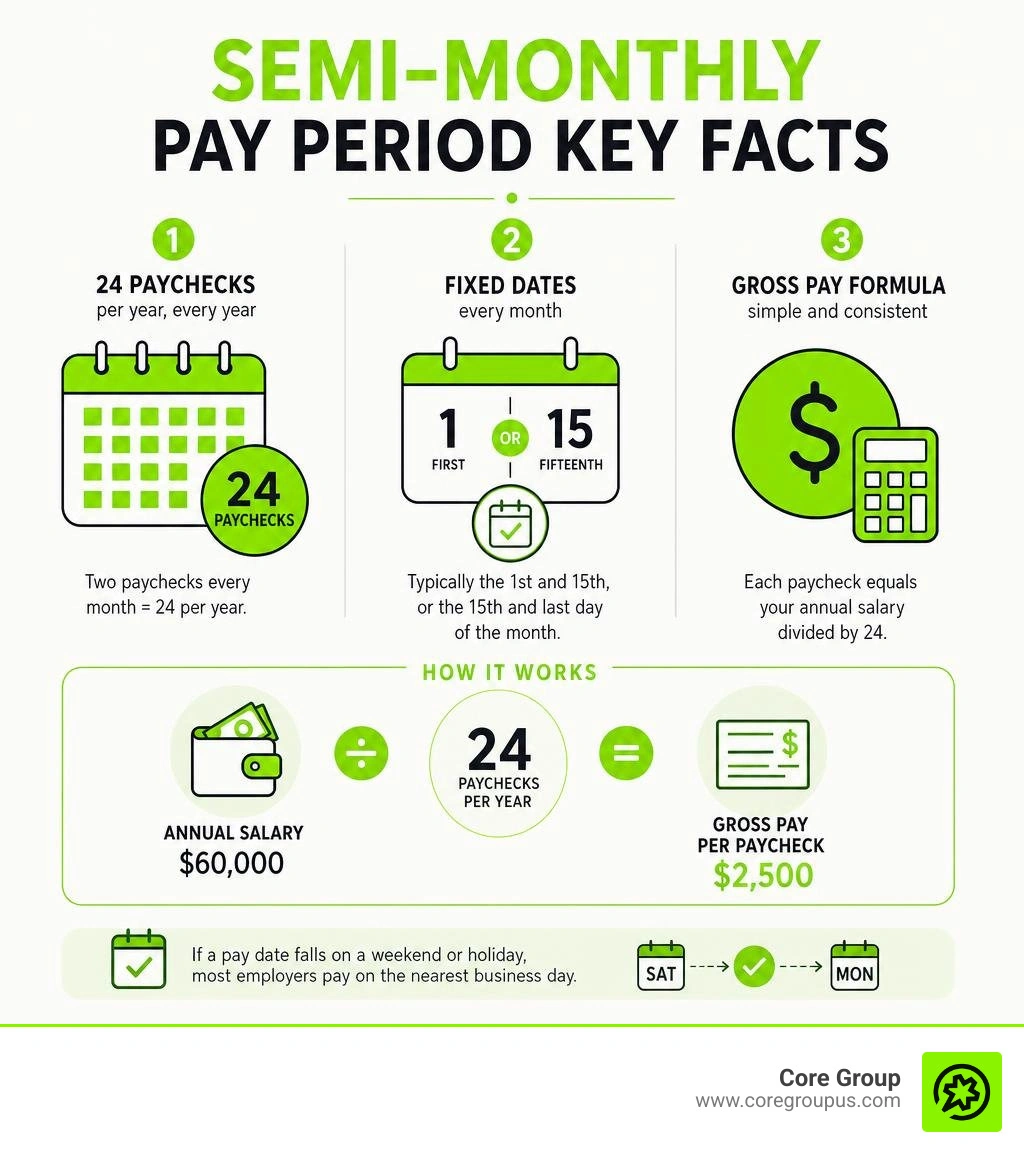
- Pay dates are fixed, typically the 1st and 15th, or the 15th and last day of the month
- You get exactly 24 paychecks per year, every year, with no variation
- Each paycheck equals your annual salary divided by 24
- A $60,000 salary produces $2,500 gross per paycheck
- If a pay date falls on a weekend or holiday, most employers pay on the nearest business day
For creative entrepreneurs and self-employed professionals, understanding your pay schedule is not just a payroll detail. It directly shapes your cash flow, your ability to pay vendors, and how you plan for taxes and expenses.
Semi-monthly pay is one of the most common schedules for salaried workers, used by roughly 20% of private U.S. employers. It is especially popular in corporate, government, and professional services roles.
The predictability is its biggest strength. You always know exactly when money is coming in, and you always know how much. That consistency can be a quiet superpower when you are managing a creative business with variable income and irregular project cycles.
But it is also easy to confuse semi-monthly pay with biweekly pay, and that mix-up can throw off your budgeting in ways that sneak up on you.
Understanding the Semi Monthly Pay Period and How It Works
To understand how a semi monthly pay period operates, we have to look at the calendar. Unlike weekly or biweekly schedules that rely on specific days of the week, a semi-monthly schedule is entirely date-driven.
When we look at What is Semi-Monthly Payroll? we see that this system splits each of the twelve calendar months into two distinct halves. Because there are twelve months in a year and each month has exactly two pay periods, employees receive exactly 24 paychecks per year. This number never changes, regardless of whether it is a leap year or how the weekends fall.
For business owners, setting up this schedule requires a solid understanding of payroll administration. If you are currently setting up your business systems, checking out our Payroll Guide for Small Business Owners 2026 can help you establish structured processes that keep your team happy and your books clean.
Typical Pay Dates for a Semi Monthly Pay Period
The most common dates for a semi-monthly payroll schedule are the 1st and the 15th of the month, or the 15th and the final day of the month.
If we look at a typical calendar, the first pay period might run from the 1st through the 15th, with a paycheck issued on the 15th. The second pay period would run from the 16th through the end of the month, with the paycheck issued on the last day of the month.
Some businesses choose a slightly different variation, such as paying on the 5th and the 20th of each month. No matter which specific dates are chosen, the core rule remains the same. The pay dates are fixed calendar dates rather than rotating days of the week. You can see how these dates align across the year by reviewing the Semi-Monthly Pay Schedule 2026 1st and 15th Pay Dates NextPayday to visualize the exact structure.
How Holidays and Weekends Affect Your Paycheck
Because semi-monthly pay dates are tied to fixed calendar numbers, they will inevitably land on Saturdays, Sundays, and federal holidays. Banks do not process direct deposits on weekends or bank holidays, which means employers must adjust the actual deposit dates.
Most companies follow a standard rule. If a pay date falls on a Saturday or Sunday, the deposit is made on the preceding Friday. For example, if the 15th of the month is a Sunday, you will typically see the money land in your account on Friday the 13th. If the pay date falls on a major holiday, the payroll processing is shifted to the nearest preceding business day.
To keep operations running smoothly, organizations publish strict timelines for timesheets and processing. For instance, the 2026 Semi-Monthly Payroll Deadlines University of Delaware schedule highlights how administrative teams must submit and approve hours early to account for these weekend and holiday shifts, ensuring that employees are always paid on time.
Key Differences Between Semi Monthly and Biweekly Pay Schedules
It is incredibly common for people to use the terms biweekly and semi-monthly interchangeably. However, in accounting and personal finance, they are entirely different animals.
A biweekly schedule pays employees every two weeks, usually on a specific day like Friday. Because there are 52 weeks in a year, a biweekly schedule results in 26 paychecks per year. A semi-monthly schedule, as we have established, always results in exactly 24 paychecks.
To help visualize how these two systems stack up, let us look at a direct comparison.
| Feature | Semi-Monthly Pay Schedule | Biweekly Pay Schedule |
|---|---|---|
| Paychecks Per Year | Exactly 24 | Typically 26, sometimes 27 |
| Pay Dates | Fixed calendar dates, like the 1st and 15th | Fixed days of the week, like every other Friday |
| Days Per Pay Period | Varies from 13 to 16 days depending on the month | Always exactly 14 days |
| Average Hours Per Check | 86.67 hours for standard full-time work | Always exactly 80 hours for standard full-time work |
| Budget Alignment | Aligns perfectly with monthly bills and rent | Requires adjusting for three-paycheck months |
For a deeper dive into how these structures influence your business operations, you can read the comprehensive breakdown in Biweekly vs Semimonthly Pay Key Differences and How to Choose Lattice to see which fits your team best.
The 2026 Biweekly Paycheck Anomaly
One of the most fascinating quirks of payroll scheduling is the occasional leap-year style shift that happens with biweekly pay. Because a standard calendar year is not perfectly divisible by 14-day increments, every eleven years or so, a biweekly schedule produces 27 paychecks instead of the usual 26.
Our current year of 2026 is one of those exact anomaly years for many biweekly employers. This extra pay period can cause significant headaches for business owners because it represents an entire extra payroll cycle of expenses. It also forces employers to choose between dividing salaries by 27, which reduces the size of each individual paycheck, or keeping the paycheck sizes the same, which increases total payroll costs for the year.
With a semi monthly pay period, this anomaly simply does not exist. You can read more about this calendar phenomenon in Biweekly vs Semi-Monthly vs Weekly Pay 2026 Pay44 to understand how it impacts both business cash flow and employee earnings.
Impact on Employee Budgeting and Cash Flow
For the average household, a semi-monthly schedule is often much easier to budget around. Most major recurring expenses, such as rent, mortgages, car payments, and utility bills, are billed on a monthly cycle. Receiving exactly two paychecks per month makes it incredibly simple to allocate the first check to rent and the second check to other living expenses.
With a biweekly schedule, paydays constantly shift. One month you might get paid on the 2nd and 16th, and the next month you get paid on the 13th and 27th. This shifting cycle can make it difficult to ensure that funds are available in your account when automatic monthly bills are deducted.
On the flip side, biweekly employees enjoy two months out of the year where they receive three paychecks instead of two. Many people treat these magic three-paycheck months as bonus money to fund savings or pay down debt. With semi-monthly pay, you do not get those three-paycheck months, but your regular checks are slightly larger to make up for it.
How to Calculate Your Take Home Pay on This Schedule
Calculating your take-home pay on a semi-monthly schedule is a straightforward process, but it requires understanding the difference between your starting earnings and what actually lands in your bank account.

Before you can figure out your net take-home pay, you must first determine your gross pay. If you want a refresher on how this starting figure is defined, our guide on Gross Pay Meaning breaks down the baseline mechanics.
Once you have your gross pay, you can use tools like the Semi-Monthly Pay Calculator to estimate tax withholdings, social security contributions, and voluntary deductions like health insurance or retirement savings.
Calculating Salaried Wages in a Semi Monthly Pay Period
For salaried employees, calculating gross pay per paycheck is incredibly simple. You take the total annual salary and divide it by 24.
Let us look at a quick mathematical example. If an employee earns an annual salary of $60,000, the calculation is as follows.
$60,000 annual salary divided by 24 pay periods equals $2,500 gross pay per paycheck.
If that same employee were on a biweekly schedule, the calculation would be $60,000 divided by 26, which equals $2,307.69 gross per paycheck. As you can see, the semi-monthly paycheck is larger because the money is distributed over fewer checks.
For business owners operating under specific corporate structures, these calculations are vital for tax compliance. If you run an S-Corporation, you must follow strict guidelines regarding reasonable compensation and payroll distribution. Reading up on S-Corp Payroll Rules will help ensure you stay fully compliant with federal guidelines.
Managing Overtime and Hourly Wages
While salaried calculations are simple, managing hourly employees on a semi-monthly schedule is where things can get a bit complicated.
A standard full-time work schedule is based on a 40-hour workweek. In a semi-monthly payroll system, the number of days in a pay period constantly changes. A pay period in February might only have 10 actual working days, while a pay period in July might have 12 or 13 working days. Because of this, a full-time hourly employee does not work a fixed number of hours each pay period. On average, a full-time employee works 86.67 hours per semi-monthly period, but the actual hours worked will fluctuate.
This fluctuation makes calculating overtime under the Fair Labor Standards Act quite tricky. The FLSA mandates that overtime must be calculated based on a fixed, recurring 7-day workweek, not based on the pay period itself.
When a pay period ends in the middle of a workweek, it creates a split workweek. For example, if your workweek runs from Monday to Sunday, but the pay period ends on a Wednesday, you have to track the hours worked from Monday through Wednesday in the current pay period, and Thursday through Sunday in the next.
If an employee works overtime during that split week, you cannot accurately calculate the overtime until the entire 7-day workweek is complete. This often means that overtime earned at the end of a pay period must be calculated and paid on the subsequent paycheck. For a detailed look at how to handle these situations legally, you can review How to Calculate Overtime on a Semi-Monthly Payroll in Colorado to see a practical state-level example of compliance.
Frequently Asked Questions About Twice Monthly Pay
How many paychecks do you get a year with semi-monthly pay?
You receive exactly 24 paychecks per year. Because there are twelve months in a year and you are paid twice per month, the math is always twelve multiplied by two. This number is completely fixed and never changes from year to year.
Is semi-monthly pay better for taxes and benefits?
Your total tax obligation is determined by your total annual income, not by how frequently you are paid. Therefore, getting paid semi-monthly will not change the total amount of income tax you owe at the end of the year.
However, a semi-monthly schedule does make benefit deductions much simpler to manage. Many insurance companies bill premiums on a monthly basis. With 24 pay periods, your employer can simply split your health insurance, dental insurance, and other monthly premium deductions exactly in half and deduct them from your two checks.
On a biweekly schedule, employers must either calculate deductions based on 26 periods or hold back deductions during the two months of the year that have three paychecks, which adds administrative complexity.
Can hourly employees be on a semi-monthly schedule?
Yes, hourly employees can legally be paid on a semi-monthly schedule, but it requires diligent tracking and robust payroll software to manage the varying hours and split-workweek overtime calculations.
Additionally, you must ensure that your pay frequency complies with local labor laws. Some states have strict regulations regarding how often certain types of employees must be paid. For example, manual laborers or hourly workers in certain jurisdictions may be legally required to receive weekly or biweekly pay to ensure they are compensated quickly.
If you have workers in California, you must adhere to specific state guidelines regarding payday intervals. You can find detailed information on these requirements by reviewing the guidelines on Paydays, pay periods, and the final wages to ensure your business remains fully compliant with California labor laws.
Conclusion

Choosing the right payroll schedule is a foundational decision that impacts your business operations, your administrative workload, and the financial well-being of your team. While a semi monthly pay period offers incredible predictability and aligns beautifully with monthly accounting cycles, it also requires careful attention to detail, especially when managing hourly workers and complex overtime rules.
At Core Group, we understand that creative entrepreneurs did not start their businesses to spend hours wrestling with payroll calendars, split-workweek overtime calculations, and tax withholding formulas. You started your business to create, build, and grow.
That is why we offer comprehensive financial management, bookkeeping, and tax services designed specifically for creative entrepreneurs. We operate in the financial services industry, bringing you our signature no-fluff, profit-first playbook. Our goal is to guarantee you absolute peace of mind and save you valuable time, allowing you to focus entirely on your creative vision. We are so committed to your success and seamless integration that we back our services with our unique MacBook Pro guarantee.
If you are ready to take the headache out of payroll and financial management, explore our Payroll Services for Small Business Guide 2026 to see how we can help you streamline your systems, stay compliant, and keep your business moving forward. Let us handle the numbers so you can handle the creative magic.