A Practical Guide to Simple Bookkeeping for eBay
Why Simple Bookkeeping for eBay Is Worth Getting Right
Simple bookkeeping for eBay sellers comes down to six core steps you can start today
- Open a separate business bank account for all eBay income and expenses
- Track gross sales using eBay's built-in Payments reports
- Record your Cost of Goods Sold (COGS) for every item you sell
- Log eBay fees including final value fees, insertion fees, and promoted listing fees
- Capture operating expenses like shipping supplies, packaging, and software
- Reconcile your records monthly to confirm your books match your bank deposits
That's the foundation. Everything else builds on these six habits.
If you're selling on eBay, the financial side can feel overwhelming fast. Sales come in, fees get deducted, lump-sum payouts land in your bank account, and suddenly you're staring at numbers that don't quite add up.
Here is the reality. eBay takes an average of 16.5% of your sale price in fees before anything hits your account. If you're only looking at your bank deposits, you're already working with an incomplete picture of your business.
Good bookkeeping fixes that. It shows you what you actually earned, what you spent, and what's left over after everything is accounted for. It also keeps tax season from becoming a crisis.
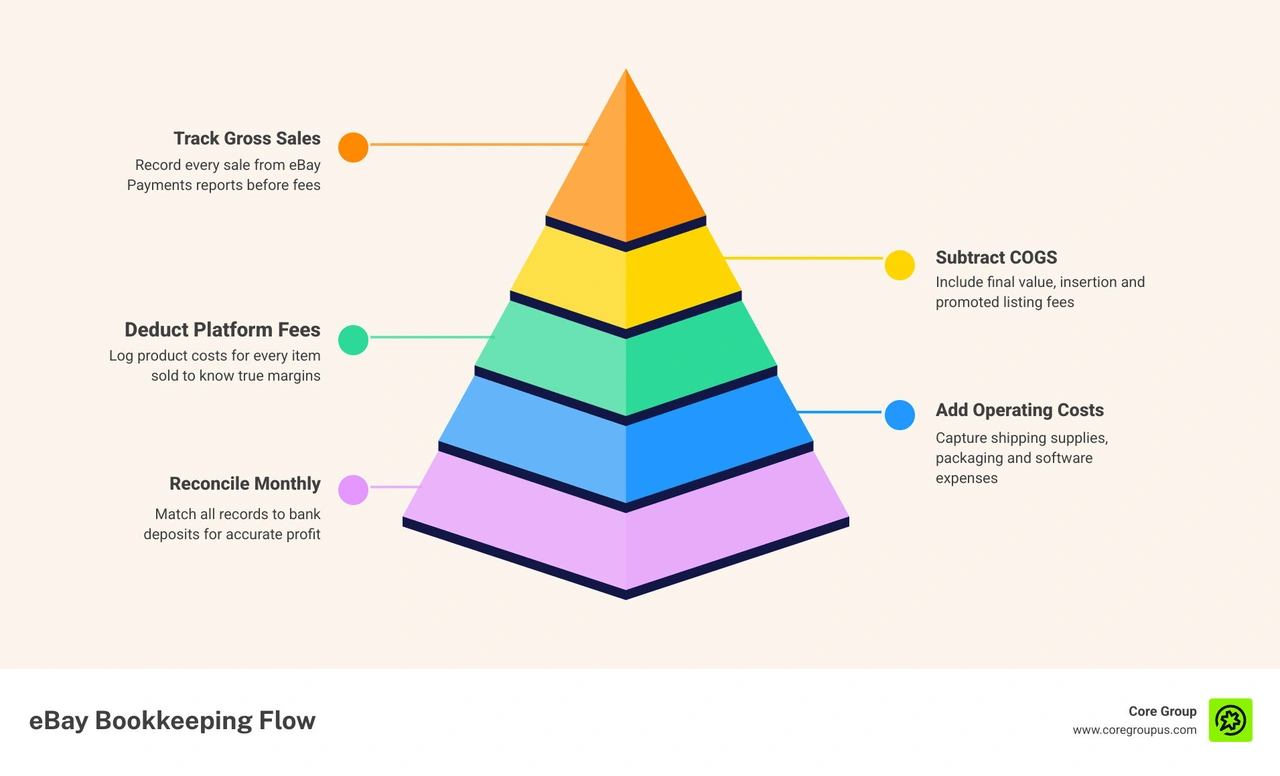
Key terms for simple bookkeeping for ebay include
Understanding the Basics of Simple Bookkeeping for eBay
When we talk about bookkeeping, we are referring to the daily process of recording every single financial transaction that happens in your business. Think of it as your financial dashboard. Without it, you are flying blind. We often see sellers confuse bookkeeping with accounting, but they serve different roles. Bookkeeping is the data entry and organization part, while accounting is the higher level analysis and tax preparation that happens later.
The most important step you can take to achieve simple bookkeeping for ebay is to separate your personal and business finances. Over 60% of eBay sellers report that this single move is the most critical step for accuracy. When you mix your grocery shopping with your bubble wrap purchases, you create a nightmare for yourself come tax time.
Opening a dedicated business bank account and a business credit card ensures that every transaction on those statements is related to your shop. This makes bookkeeping for small business much easier because you don't have to hunt through hundreds of personal transactions to find one deductible expense.
Furthermore, the IRS uses a profit motive test to decide if your eBay activity is a business or just a hobby. If you show a profit in three out of five consecutive years, you are generally viewed as a business. Proper records help prove this and protect you during an audit. For those just starting out, check out this eBay bookkeeping beginner guide for more on the fundamentals. Whether you are a full time pro or just learning bookkeeping for solopreneurs, clean lines between "me" and "my business" are essential.
Key Financial Metrics and Tracking Methods
To understand if you are actually making money, you need to track more than just the "cha-ching" notification on your phone. We recommend focusing on these essential metrics.
Gross Sales
This is the total amount your customers paid. It is important to remember that eBay reports usually exclude sales tax from gross sales since eBay collects and remits it in most states under marketplace facilitator rules.
Cost of Goods Sold (COGS)
This is what you paid for the items you actually sold. If you bought ten vintage cameras for $100 but only sold one, your COGS is $10, not $100. Sellers who track COGS at the item level report 25% better insight into their most profitable products.
eBay Fees
These are deducted before you get your payout. You need to track insertion fees, final value fees, and any costs for promoted listings or store subscriptions.
Operating Expenses
These are the costs of running the show. Think of shipping tape, boxes, home office space, and even a portion of your internet bill.
Net Profit
This is the "real" money you keep. It is calculated by taking your gross sales and subtracting COGS, fees, shipping, and all other expenses.
| Component | What it Includes | Impact on Profit |
|---|---|---|
| Gross Sales | Total buyer payments | Increases |
| COGS | Purchase price of sold items | Decreases |
| eBay Fees | Final value, listing, and ad fees | Decreases |
| Shipping | Labels and packaging materials | Decreases |
| Net Profit | What you actually keep | The Bottom Line |
If you are looking for the options for eBay bookkeeping, you can choose between manual methods or automated tools.
Best Tools for Simple Bookkeeping for eBay
Choosing the right tool depends on your volume. If you are selling fewer than 20 items a month, a well organized spreadsheet might be all you need. However, as you scale, manual entry becomes a recipe for errors.
Cloud based software like QuickBooks or Xero can sync directly with your bank and eBay accounts. Automation is a game changer. eBay sellers who use dedicated software save an average of 10 to 15 hours per month. That is time you could spend sourcing more inventory or finally taking a weekend off.
Some software even handles inventory management, which is a huge plus. For a deeper look at what these tools can do, our bookkeeping services complete guide breaks down the benefits of professional level tracking.
Implementing Simple Bookkeeping for eBay with Regular Updates
The biggest mistake we see is "procrastination bookkeeping." If you wait until April to look at your January receipts, you have already lost the battle. We suggest a weekly routine. Spend 30 minutes every Sunday reviewing your transactions and categorizing them while the details are fresh in your mind.
Use a receipt scanning app to digitize every physical slip of paper. If you buy inventory at a garage sale with cash, snap a photo of your handwritten receipt immediately. This creates a digital ledger that is easy to search. This habit is similar to bookkeeping for amazon sellers where high transaction volume makes regular updates a requirement for survival.
Navigating eBay Payouts and Tax Compliance
eBay's payout system can be tricky. They issue lump sum payouts that don't always align with your sales dates. For example, a payout on May 2nd might include sales from the last three days of April. If you just record the deposit as "income" in May, your monthly profit reports will be wrong.
You also need to be aware of the 1099K forms. For the 2025 tax year, the IRS requires 1099K forms for businesses generating over $20,000 in sales and 200 transactions, though some states have much lower thresholds. Even if you don't receive a form, you are still responsible for reporting every dollar of profit.
The good news is that almost everything you spend to run your shop is a deductible expense. This includes items such as
- eBay fees and store subscriptions
- Shipping labels and postage
- Packaging materials like bubble mailers and tape
- Mileage for driving to thrift stores or the post office
- Software and home office costs
If you are also an influencer or freelancer, you might find our guides on taxes for influencers and as a freelancer how do I plan for taxes helpful for managing multiple income streams.
Frequently Asked Questions About eBay Accounting
We hear a lot of the same questions from sellers trying to navigate e-commerce finance. Here are the answers to the most common concerns.
What is the difference between bookkeeping and accounting for sellers
Bookkeeping is the "doing" and accounting is the "thinking." Bookkeeping involves the daily recording of sales, expenses, and receipts. It is the foundation of your data. Accounting takes that data to create financial statements like Profit and Loss reports and Balance Sheets. An accountant uses the work of a bookkeeper to help with tax planning and long term financial strategy.
How do I handle returns and refunds in my records
Returns should be recorded as negative revenue. When you issue a refund, you aren't just losing the sale amount. You are often getting a credit for the eBay final value fee, but you might still be out the original shipping cost. You must also adjust your inventory records to show that the item is back in stock. Tracking these carefully ensures you don't pay taxes on money you eventually gave back to a customer.
When should I hire a professional for my eBay business
You should consider hiring help when your sales volume makes it impossible to keep up with weekly updates, or when your tax situation gets complex. If you are selling across multiple platforms or internationally, the risk of a mistake grows. Hiring a professional can actually save you money by finding deductions you missed and preventing expensive tax penalties.
Conclusion
Mastering simple bookkeeping for ebay is the difference between having a hobby and running a real business. When you have clear records, you can make smart decisions about what to buy, how to price your items, and when to grow.
At Core Group, we believe in a profit first playbook that removes the fluff and gives you peace of mind. Our team specializes in financial management for creative entrepreneurs, ensuring your books are always ready for tax season. We are so confident in our ability to save you time and stress that we even offer a MacBook Pro guarantee.
If you are ready to stop stressing over spreadsheets and start focusing on your next big sale, we are here to help. You can find more info about accounting services on our website to see how we can support your eBay journey. Let us handle the numbers so you can handle the business.