How to Avoid Surprises When the IRS Withholds Your Winnings
What Happens When the IRS Takes a Cut of Your Winnings
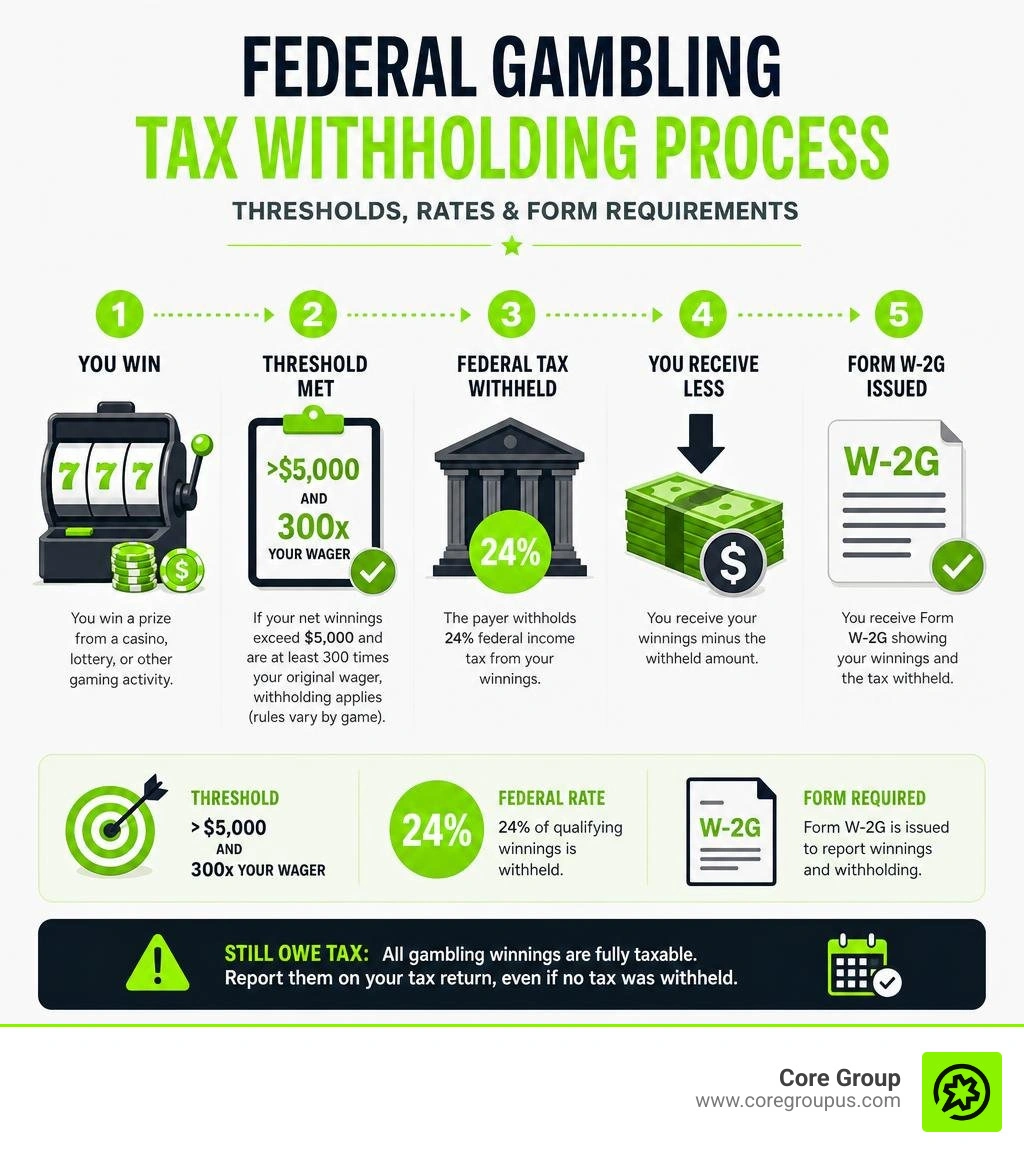
Withholding gambling winnings is the process where a payer automatically deducts federal (and sometimes state) income tax from your prize before handing you a check. If you've ever walked away from a casino, lottery, or poker tournament with less than you expected, this is likely why.
Here's a quick breakdown of how it works
- Who withholds - Casinos, lottery commissions, and other gaming operators are required by law to withhold tax on certain winnings
- Federal rate - 24% is withheld on qualifying winnings that exceed the threshold
- When it applies - Generally when your net winnings exceed $5,000 and are at least 300 times your original wager (rules vary by game type)
- What you receive - A Form W-2G documenting the winnings and any tax already withheld
- Still owe tax - Even if nothing was withheld, all gambling winnings are fully taxable and must be reported
The tricky part is that the rules aren't the same for every type of gambling. Slot machines, bingo, and keno follow different rules than poker tournaments or lotteries. And if you're a creative entrepreneur who wins something big, like a car or a trip, the tax math gets even more complicated.
This guide breaks it all down so you know exactly what to expect before, during, and after tax season.
Withholding gambling winnings terms you need
Federal Rules for Withholding Gambling Winnings
When we look at federal withholding, the rules are very specific about when a gaming operator must grab a portion of your payout. The standard federal tax rate for withholding gambling winnings is 24 percent. This rate applies directly to your net winnings once you cross certain thresholds.
The rules differ based on the type of game you are playing. If you win a wager placed in a state-conducted lottery, the winnings are subject to withholding only if the proceeds exceed $5,000. This same $5,000 threshold applies to sweepstakes, wagering pools, and other lotteries that are not run by a state.
For other wagering transactions, the rules require withholding only if the proceeds exceed $5,000 and the payout is at least 300 times as large as the amount of your original wager. These guidelines are established under federal tax regulations, specifically 26 CFR § 31.3402(q)-1, Extension of withholding to certain gambling winnings, Electronic Code of Federal Regulations (e-CFR), US Law, LII / Legal Information Institute -1.
If you want to read more about the historical background of these rules, you can view the Internal Revenue Service, Treasury § 31.3402(q)–1 document or check out the 26 C.F.R. § 31.3402(q)-1 Extension of Withholding to Certain Gambling Winnings (26 C.F.R. § 31.3402(q)-1) - vLex United States legal text.
When Payers Apply Backup Withholding Gambling Winnings Rules
Regular withholding is not the only way the IRS secures its share. If you do not provide a correct Taxpayer Identification Number or Social Security Number when you win, the payer must apply backup withholding.
Backup withholding is also applied at a flat rate of 24 percent. This process is triggered if you fail to provide proper identity verification, such as a government-issued photo ID and a signed Form W-9.
For games like bingo, slot machines, and keno, regular withholding does not automatically apply. However, backup withholding rules will kick in for these games if you win a reportable amount and refuse to provide your Taxpayer Identification Number.
How Identical Wagers Impact Withholding Gambling Winnings Calculations
Calculating your total proceeds gets interesting when you place identical wagers. Under federal tax rules, wagers are considered identical if they are placed on the same outcome or in the same parimutuel pool.
For example, if you place two separate bets on the exact same horse to win a race, those are treated as identical wagers. The payer must aggregate these identical wagers when calculating whether your winnings meet the withholding thresholds.
If you make multiple bets on different outcomes, those are not aggregated. If you bet on two different horses in the same race, those are separate wagers, and their amounts are calculated individually. Understanding this distinction can help you understand why a casino might withhold taxes on some payouts but not on others.
When Payers Must Issue Form W-2G

Even if a casino does not withhold taxes from your payout, they may still be required to report your winnings to the IRS. They do this by issuing Form W-2G, which lists your total winnings and any taxes withheld.
The thresholds for issuing a Form W-2G vary by the type of game you play. A payer must issue this form if you win the following amounts.
- $1,200 or more from slot machines or bingo games
- $1,500 or more from keno jackpots
- More than $5,000 from a poker tournament
- $600 or more from other wagering transactions, provided the payout is at least 300 times your original wager
For calendar years after 2025, which includes our current year of July 2026, the minimum threshold for reporting certain payments on Form W-2G is adjusted yearly for inflation. The 2026 threshold is set at $2,000 for specific transactions.
Payers must follow strict deadlines. They must provide you with your copy of Form W-2G by January 31 of the year following your win. They must also file these forms with the IRS by February 28 if filing on paper, or by March 31 if filing electronically. You can find detailed instructions on these requirements in the Instructions for Forms W-2G and 5754 (Rev. January 2026) document.
Valuing and Withholding on Non Cash Prizes
Sometimes your big win is not a stack of cash. If you win a car, a vacation, or a new boat, you are still responsible for paying taxes on that prize. The IRS requires you to pay taxes based on the fair market value of the item.
If the prize is subject to withholding, you must pay the withholding tax to the payer before you can receive the prize. Alternatively, the payer can choose to pay the tax for you. If the payer pays the tax on your behalf, they must calculate the tax using a higher rate of 31.58 percent because the tax paid for you is also considered taxable income.
How States Differ on Gambling Tax Withholding
State tax rules can vary significantly from federal rules. Some states do not tax gambling winnings at all, while others have strict withholding requirements that apply to both residents and nonresidents.
Let us look at how some states handle withholding.
- Maryland taxes gambling winnings for both residents and nonresidents. The state automatically withholds taxes at a rate of 9.5 percent for residents and 8.75 percent for nonresidents on lottery winnings over $5,000.
- Colorado requires gaming operators to withhold state income tax at a flat rate of 4 percent on any gambling winnings that are already subject to federal withholding. You can read more about these rules in the Gambling Winnings - Withholding Tax Topics publication.
- West Virginia requires a 4.58 percent backup withholding rate on gambling winnings whenever federal backup withholding is required.
- New Jersey withholds state income tax at a rate of 3 percent on general gambling winnings. However, New Jersey lottery payouts face different tiers, with a 5 percent withholding rate on prizes between $10,001 and $500,000, and an 8 percent rate on prizes over $500,000. You can find more details on the State of NJ - Department of the Treasury - Division of Taxation - Lottery and Gambling Winnings page.
The table below summarizes these different state withholding rates and thresholds.
| State | Regular Withholding Rate | Backup Withholding Rate | Special Thresholds |
|---|---|---|---|
| Maryland | 9.5 percent for residents and 8.75 percent for nonresidents | Same as regular | Applies to lottery winnings over $5,000 |
| Colorado | 4 percent | Same as regular | Applies to winnings subject to federal withholding |
| West Virginia | Varies by transaction | 4.58 percent | Backup withholding applies when federal backup is triggered |
| New Jersey | 3 percent | 8 percent if no Taxpayer Identification Number is provided | Lottery winnings over $10,000 are taxed at 5 percent or 8 percent |
Reporting Your Wins and Deducting Your Losses
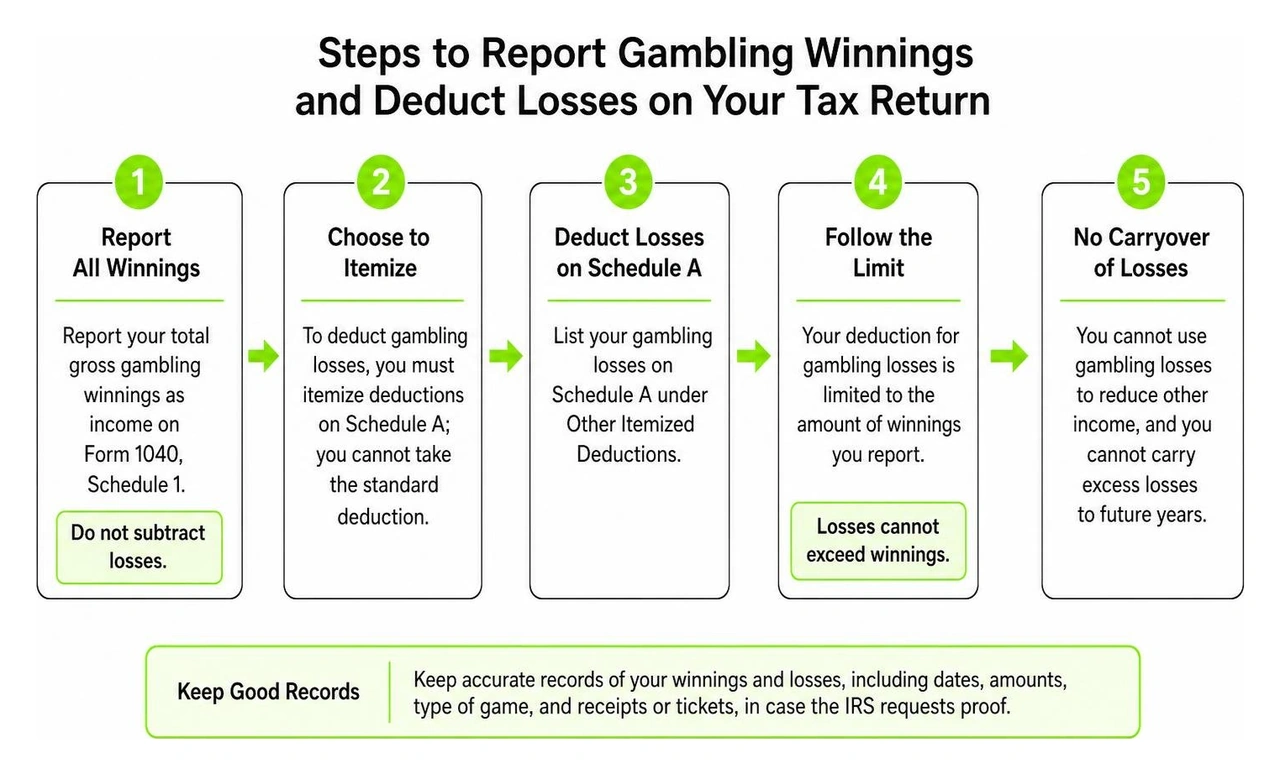
When we prepare our federal tax returns, we must report all gambling winnings as income. You cannot simply subtract your losses from your winnings and report the difference.
Instead, you must report your total, gross winnings on Form 1040, Schedule 1. If you want to deduct your gambling losses, you must itemize your deductions on Schedule A.
Your deduction for gambling losses is strictly limited to the amount of winnings you report on your return. You cannot use gambling losses to reduce your other taxable income, and you cannot carry excess losses over to future tax years. For more information on how these rules work, check out our articles on Can You Claim Gambling Losses On Your Taxes and Are Gambling Losses Itemized Deductions.
Recordkeeping Requirements for Deducting Losses

To safely deduct your losses on Schedule A, you must keep excellent records. The IRS can disallow your deductions if you cannot provide proof of both your wins and your losses.
We recommend keeping a detailed gambling log or diary. Your log should include the following information.
- The date and type of your specific wager or gambling activity
- The name and address of the casino or gaming establishment
- The names of other people present with you at the time
- The exact amounts you won or lost
In addition to your log, you should save physical evidence. Keep your losing tickets, betting slips, canceled checks, bank statements, and any payment slips provided by the gaming facility. Read our guide on Taxes On Gambling Losses to learn more about keeping audit proof records.
Tax Rules for Nonresident Aliens
If you are a nonresident alien playing in the United States, your tax rules are different. Nonresident aliens must report U.S. sourced gambling winnings on Form 1040-NR, Schedule NEC.
The standard withholding rate for nonresident aliens is 30 percent. This tax is usually withheld at the source. Unlike U.S. citizens and residents, nonresident aliens generally cannot deduct gambling losses on their tax returns, unless they are residents of Canada and can claim a deduction under the U.S. Canada tax treaty.
Frequently Asked Questions About Gambling Taxes
Tax laws can feel overwhelming, so we have answered some of the most common questions we hear about gambling winnings and losses.
Do I have to report winnings if I did not receive a Form W-2G
Yes, you must report all gambling winnings on your tax return. The IRS requires you to report all income, regardless of whether a casino issues a Form W-2G. Even if you win twenty dollars on a scratch-off ticket, that amount is technically taxable income.
Can I offset my winnings directly with my losses
No, you cannot net your winnings and losses. You must report your total winnings as gross income on Schedule 1, and then deduct your losses separately as an itemized deduction on Schedule A. If you take the standard deduction, you cannot deduct your losses at all. You can read more about this rule in our post Gambling Losses Should Just Offset My Gambling Winnings Right.
What happens if I win a non cash prize like a car
If you win a car, you must report its fair market value as taxable income. You will likely have to pay the estimated tax on the car to the sponsor before you can drive it away, or pay it directly to the IRS when you file your annual tax return.
Conclusion
Navigating the rules for withholding gambling winnings does not have to be a headache. Whether you are a casual player or a creative entrepreneur with a lucky streak, understanding these tax thresholds helps you avoid stressful surprises at the end of the year.
At Core Group, we offer financial management, bookkeeping, and tax services specifically tailored for creative entrepreneurs. Our no-fluff, profit-first playbook is designed to give you complete peace of mind and save you valuable time, allowing you to focus on growing your business. We even back our services with our MacBook Pro guarantee.
If you want to make sure your gambling records and tax filings are completely accurate, let us help you stay on track. For a deeper dive into the specific deductions you can claim, read our guide on IRS Gambling Deductions.