Ultimate Checklist for 1099 Self Employment Deductions
Claim More 1099 Self Employment Deductions With Better Records
1099 self employment deductions can lower the profit reported on Schedule C, which may reduce both income tax and self-employment tax. Start by tracking every ordinary and necessary cost of doing business, then separate business spending from personal spending.
Common write-offs include
- Home office costs, phone, internet, software, supplies, and professional fees
- Business mileage or actual vehicle expenses
- Qualifying travel and 50 percent of eligible client meals
- Health insurance premiums, retirement contributions, and half of self-employment tax
- Equipment purchases, depreciation, and certain start-up costs
The key is not to chase deductions you cannot support. Save receipts, record the business purpose of purchases, and keep a mileage log as you drive. For creative professionals, that can mean tracking editing subscriptions, camera gear, studio costs, client travel, and the business share of a home workspace.
I am Christian Brim, and this checklist will help you identify legitimate write-offs while building a cleaner system for your business finances.
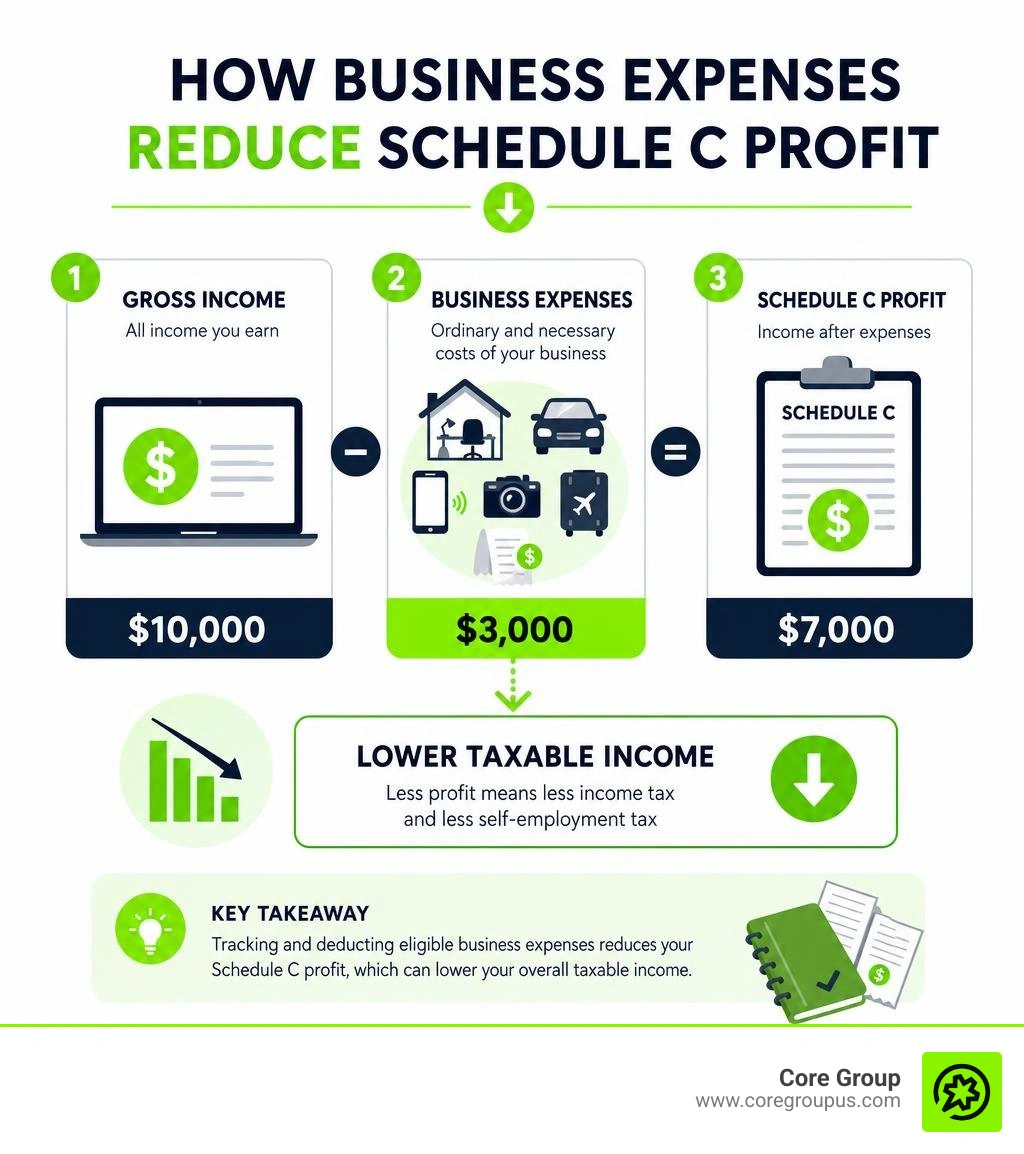
Simple guide to 1099 self employment deductions terms
Understanding How Write Offs Lower Your Self Employment Taxes
When you work as an independent contractor, you step into the shoes of both the worker and the employer. This dual role means you are responsible for paying the self-employment tax, which covers Social Security and Medicare. The baseline self-employment tax rate is 15.3 percent, made up of 12.4 percent for Social Security and 2.9 percent for Medicare. If your earnings surpass statutory thresholds ($200,000 for single filers or $250,000 for married couples filing jointly), an additional 0.9 percent Medicare surtax applies.
To calculate this liability on Schedule SE, the IRS applies a 92.35 percent factor to your net business profit. This adjustment mirrors the tax deduction corporate employers receive for paying payroll taxes. Every legitimate business expense you claim reduces your net profit dollar for dollar.
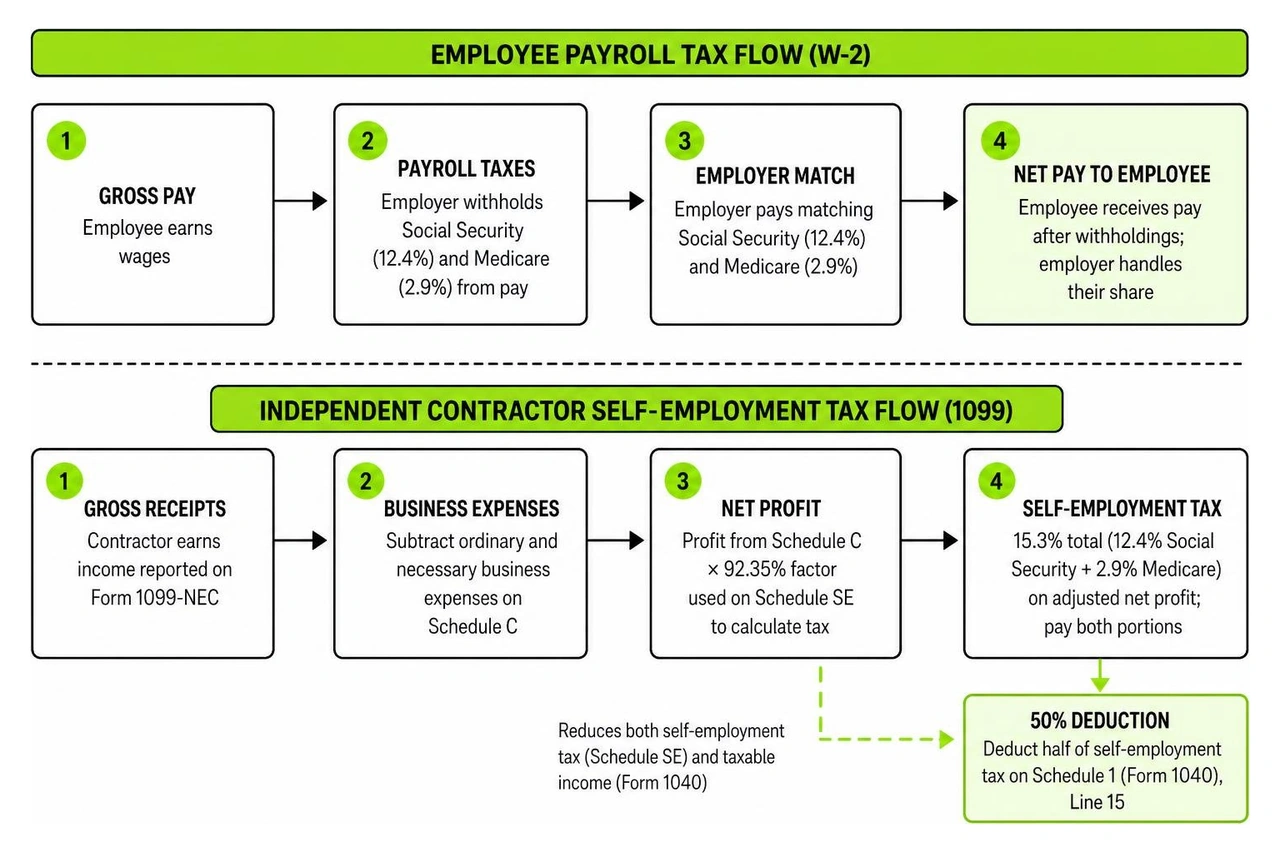
This creates dual tax savings for contractors. A standard business deduction lowers the net profit subject to the 15.3 percent self-employment tax and simultaneously reduces your taxable income subject to federal and state income tax brackets. Understanding proper worker classification guidelines helps clarify how your nonemployee earnings differ from traditional W-2 pay. When clients issue compensation recorded on a Form 1099-NEC compensation statement, your net earnings start high until you apply valid business deductions.
The 50 Percent Self Employment Tax Write Off
Paying both halves of FICA taxes can feel steep, but the tax code offers relief through the 50 percent self-employment tax write off. You can deduct half of your total calculated self-employment tax directly on Schedule 1 of Form 1040, specifically on Line 15.
This is an above the line deduction. It reduces your adjusted gross income without requiring you to itemize deductions on Schedule A. By lowering your adjusted gross income, this write-off can also protect your eligibility for other income-dependent tax credits and savings.
Qualified Business Income and Section 199A Savings
The Qualified Business Income (QBI) deduction under Section 199A offers another major tax break for sole proprietors, LLCs, and pass-through entities. Eligible contractors can deduct up to 20 percent of their qualified business income before income tax rates apply.
Starting in the 2026 tax year, a minimum qualified business income deduction of $400 is available for qualifying taxpayers who earn at least $1,000 in qualified business income across their operations. For high earners, the deduction phases out depending on taxable income thresholds and whether your enterprise is a Specified Service Trade or Business (SSTB), such as law, health, consulting, or performing arts. For 2026, the full deduction applies when income is below $203,000 for single filers and $406,000 for married couples filing jointly. You claim this deduction using Form 8995 or Form 8995-A.
Essential 1099 Self Employment Deductions for Every Contractor

Operating a business involves a wide range of everyday expenses. Every dollar spent on ordinary and necessary tools to serve clients belongs on your return. Proper Schedule C tax reporting ensures you capture these items accurately to establish your true bottom line.
Home Office Write Offs and Utility Allocations
If you run your business from home, you can write off a portion of your housing expenses. To qualify, your workspace must pass two strict tests.
- Regular and Exclusive Use. The space must be used solely for business activities. A dedicated spare bedroom qualifies, but a kitchen table used for family dinners does not.
- Principal Place of Business. The space must serve as the primary hub where you conduct administrative tasks, manage clients, or deliver services.
You can calculate this deduction using two distinct approaches.
- The Simplified Method. Multiply the square footage of your dedicated office by $5 per square foot. The IRS caps this calculation at 300 square feet, giving you a maximum deduction of $1,500 with zero receipts required for household utilities.
- The Actual Expense Method. Total your actual housing costs, including rent or mortgage interest, property taxes, homeowners insurance, electricity, heating, and internet. Calculate the percentage of your home dedicated to business on Form 8829 and deduct that proportional share.
Mixed-use services like mobile phones and residential internet require reasonable allocation. You can claim deductible business phone expenses based on the exact percentage of time the device is used for business calls, client messaging, and field operations.
Vehicle Expenses and Mileage Tracking
When driving to client locations, project sites, or supply vendors, your vehicle costs are deductible. Commuting from your residence to a regular office does not count, but travel between job sites or to meet clients qualifies.
You have two choices for vehicle deductions.
- Standard Mileage Rate. For the 2026 tax year, the IRS business mileage rate is 72.5 cents per mile for the first half of the year and 76 cents per mile for the second half. You can also deduct business-related parking fees and toll charges.
- Actual Expense Method. Track all vehicle operating costs during the year, including gas, oil changes, repairs, insurance, registration, and lease payments or depreciation. Multiply total expenses by the percentage of miles driven for business.
To protect this deduction, keep a detailed log that records the date, mileage, destination, and business purpose of every trip. Consistent 1099 contractor expense tracking ensures your mileage stands up to IRS review.
Business Travel and Client Meals
Traveling out of town for conferences, shoots, or client pitches creates several tax write-offs. When business travel takes you away from your general tax home overnight, you can deduct the following expenses.
- Airfare, train tickets, bus fares, and rental cars
- Hotel and lodging expenses
- Baggage fees, Wi-Fi access fees, and tips
- Dry cleaning and laundry during extended business travel
Meals with clients, prospects, or business partners are subject to the standard 50 percent meal deduction limit. The meal must have a clear business purpose, and the spending cannot be lavish or extravagant. Personal entertainment, such as sporting event tickets or concert passes, is non-deductible. Reviewing an official state tax deductions guide can help you navigate regional rules alongside federal regulations.
Equipment Depreciation and Operational Business Expenses

Investing in tools, hardware, and digital assets allows your enterprise to produce high-value client work while creating write-offs.
Operational 1099 Self Employment Deductions from Startup to Supplies
Launching a new venture requires upfront capital. The tax code lets you deduct up to $5,000 of business start-up costs in your first active year. This $5,000 limit is reduced dollar for dollar if your total start-up costs exceed $50,000. Any remaining initial expenses must be amortized over a 180-month period.
Once operational, daily supplies and recurring overhead are fully deductible.
- Office supplies, printing paper, and packaging materials
- Cloud storage, design software, and digital subscriptions
- Payment processing fees from Stripe, PayPal, and merchant gateways
- Business liability insurance and errors and omissions coverage
- Professional legal, accounting, and consulting fees
- Continuing education courses that maintain or improve skills in your current industry
Applying reliable LLC tax write off strategies keeps these everyday operating costs structured throughout the year.
Section 179 Expensing and Bonus Depreciation
Purchasing expensive physical assets like computers, cameras, audio gear, and editing stations does not always require multi-year depreciation. Section 179 expensing allows you to write off the entire purchase price of qualifying equipment in the year you buy and place it into service.
For the 2026 tax year, the maximum Section 179 deduction is generally $2.56 million, with a phase-out threshold beginning when qualifying property purchases exceed $4.09 million. For assets not written off under Section 179, bonus depreciation is available at a 20 percent rate for the 2026 tax year. You document these asset write-offs on Form 4562. Using well-planned creative deduction strategies allows you to time large equipment purchases to balance your income peaks.
Health Insurance Premiums and Retirement Contribution Strategies
Healthcare and retirement planning provide two of the most effective above the line tax reductions for independent workers.
Self Employed Health Insurance Deduction
Self-employed contractors can deduct 100 percent of the health, dental, and qualified long-term care insurance premiums paid for themselves, their spouses, and their dependents. You claim this adjustment on Schedule 1 of Form 1040 using Form 7206.
This deduction comes with two main rules.
- No Employer Plan Eligibility. You cannot take this deduction if you or your spouse were eligible to participate in a subsidized health plan offered by an employer during that month.
- Net Profit Cap. The deduction cannot exceed your net self-employment earnings from the business that established the policy.
Long-term care insurance premiums qualify for deduction up to age-based statutory caps. For 2026, these limits range from $500 for individuals age 40 or younger up to $6,200 for individuals age 71 or older.
High Contribution Retirement Plans for 1099 Workers
Establishing a dedicated self-employed retirement plan lets you build wealth while lowering your current-year tax burden.
- Solo 401(k). Designed for sole proprietors with no full-time employees other than a spouse. For 2026, you can contribute up to $23,500 as an employee elective deferral ($31,000 if age 50 or older), plus up to 25 percent of net adjusted self-employment income as an employer contribution, up to an overall cap of $70,000 ($77,500 for age 50+).
- SEP-IRA. A straightforward account allowing you to contribute up to 25 percent of your net adjusted self-employment profits, capped at $70,000 for the 2026 tax year.
- SIMPLE IRA. Ideal for small operations with modest revenue, allowing employee salary reductions up to $16,500 ($20,000 if age 50 or older) plus matching contributions.
Coordinating your retirement funding with LLC contractor expense planning helps protect more of your gross revenue from federal income tax brackets.
Compliance Protocols and Audit Proof Record Keeping
Claiming aggressive tax deductions without adequate documentation can create serious issues during an IRS review. Following basic record-keeping routines protects your deductions and keeps your business compliant.
| Expense Category | Standard Mileage Method | Actual Vehicle Expense Method |
|---|---|---|
| Calculation Formula | Total business miles multiplied by IRS rate (72.5¢ or 76¢) | Total auto costs multiplied by business use percentage |
| Qualifying Costs | Standard mileage rate plus parking fees and highway tolls | Gas, oil changes, repairs, insurance, registration, and lease costs |
| Documentation Needed | Contemporaneous mileage log with dates, miles, and purpose | Itemized receipts for all operating expenses plus total mileage log |
| Depreciation Treatment | Built into the standard per-mile rate | Calculated separately using Form 4562 |
| Best Suited For | High-mileage drivers with fuel-efficient vehicles | Low-mileage drivers with high maintenance, lease, or repair costs |
Record Keeping Rules to Protect 1099 Self Employment Deductions
To defend your write-offs during an audit, build these core habits.
- Keep Itemized Receipts. A credit card statement only proves a payment occurred. An itemized invoice proves what was bought and confirms it was ordinary and necessary.
- Segregate Your Accounts. Maintain separate checking accounts and credit cards strictly for business transactions. Co-mingling funds creates confusion and weakens your records.
- Record Business Purpose. Note the client name or project goal on meal receipts, travel vouchers, and hardware purchases.
- Follow Document Retention Rules. Keep all tax returns and supporting records for at least three years from the filing date, or longer if claiming asset depreciation and bad debts.
Quarterly Estimated Tax Payment Management
Because clients do not withhold taxes from 1099 payouts, you must make quarterly estimated tax payments using Form 1040-ES or IRS Direct Pay if you expect to owe $1,000 or more.
Quarterly payments follow this schedule.
- First Quarter due April 15
- Second Quarter due June 15
- Third Quarter due September 15
- Fourth Quarter due January 15 of the following year
To avoid underpayment penalties, follow IRS safe harbor rules by paying at least 90 percent of your current-year tax liability or 100 percent of your prior-year tax liability (110 percent if your adjusted gross income exceeded $150,000). Setting aside 25 percent to 35 percent of all gross receipts into a dedicated tax account ensures you have the cash ready each quarter.
Frequently Asked Questions About Self Employed Tax Write Offs
Can 1099 contractors claim vehicle mileage and actual auto expenses together?
No. You must choose either the standard mileage rate or the actual expense method for each vehicle in a given tax year. If you choose the standard mileage rate in the first year a vehicle is placed in service, you can switch to actual expenses in later years. However, if you start with actual expenses using accelerated depreciation, you must continue using actual expenses for that vehicle.
Does claiming the home office deduction increase audit risk?
Claiming a legitimate home office deduction does not automatically trigger an audit, especially when calculated using the simplified square footage method. As long as your workspace meets the exclusive and regular use standards and you maintain clear records, you can claim this write-off with confidence.
How do business expenses reduce self employment taxes directly?
Business expenses lower your gross revenue down to your net profit on Schedule C. Because your 15.3 percent self-employment tax is calculated directly on this net figure, every dollar of ordinary expense reduces your self-employment tax base while also lowering your federal and state income tax liability.
Conclusion
Maximizing your deductions is about keeping more of your hard-earned revenue while building a resilient business foundation. At Core Group, we deliver financial management, bookkeeping, and tax services designed specifically for creative entrepreneurs. Our no-fluff, profit-first playbook gives you total peace of mind and saves you valuable time, all backed by our MacBook Pro guarantee so you can stay focused on client work.
Review our complete guide on single member LLC tax reporting to refine your business structure, streamline your accounting workflow, and keep your business thriving year-round.